Blackburn, Greider & Szostak: Telomeres, Telomerase, and the Truth About Biological Age
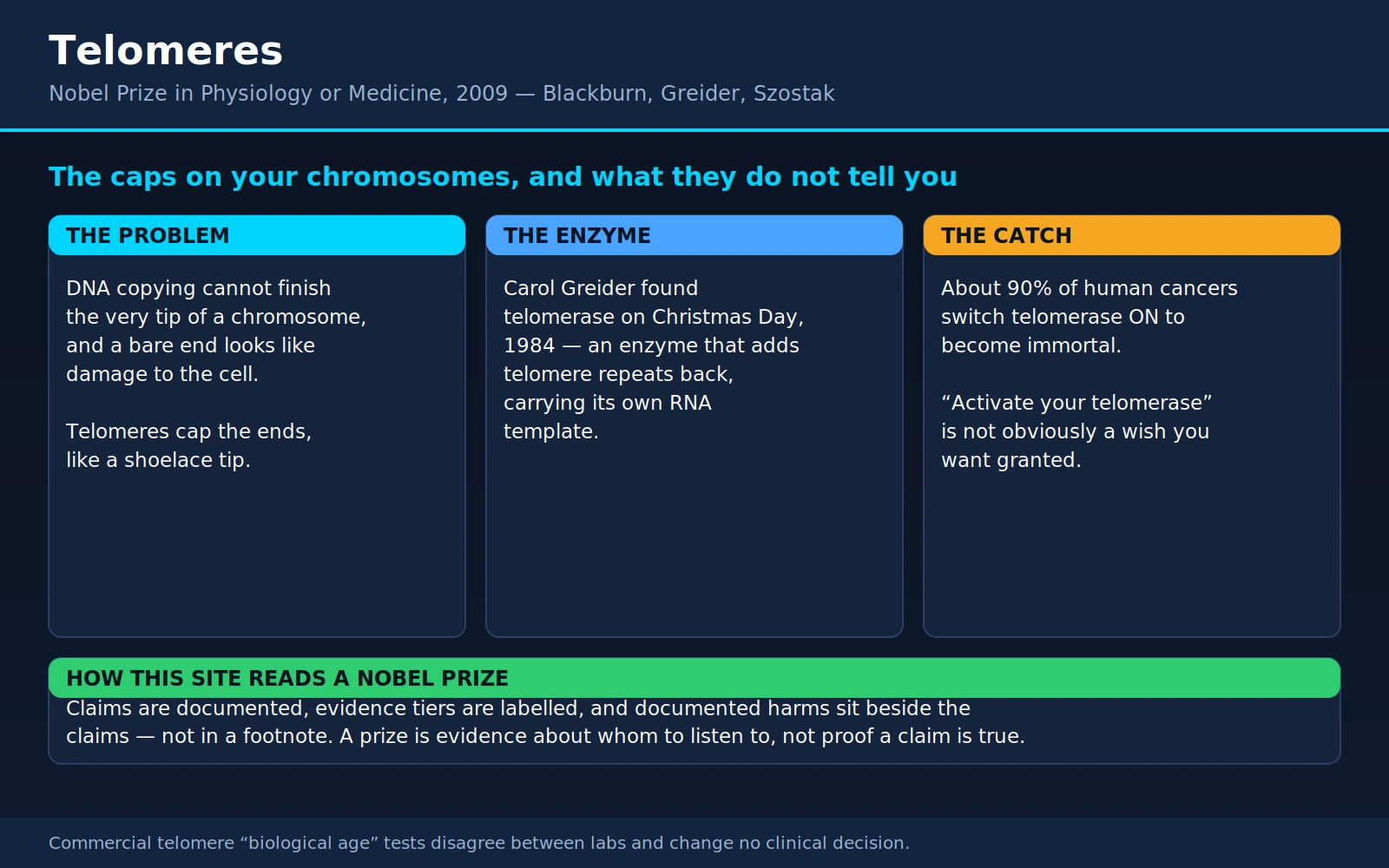
Table of Contents
- The Prize and the Three Scientists
- The End Problem
- Pond Scum First
- Christmas Day, 1984
- Telomeres and Aging: The Honest Chain
- The Commercial Telomere Test, Audited
- The Lengthening Industry
- What Actually Associates with Healthier Telomeres
- Beyond Aging: Cancer Drugs and Second Acts
- Where Mainstream Medicine Agrees / Where Claims Outrun Evidence
- Key Research Papers
- Connections
- Featured Videos
1. The Prize and the Three Scientists
In October 2009 the Nobel Assembly at the Karolinska Institute awarded the Nobel Prize in Physiology or Medicine in equal thirds to Elizabeth Blackburn, Carol Greider, and Jack Szostak, "for the discovery of how chromosomes are protected by telomeres and the enzyme telomerase." The official summary is worth a look: nobelprize.org — 2009 Prize in Physiology or Medicine. It was also a landmark: the first time in the history of the science Nobels that two women shared a single prize.
Elizabeth Blackburn (born 1948 in Hobart, Tasmania) is a biochemist from a family of Australian physicians. She trained in Melbourne, earned her PhD in Cambridge in Fred Sanger's DNA-sequencing orbit, and did her postdoctoral work at Yale with the cell biologist Joseph Gall, where this story begins. She went on to lead laboratories at Berkeley and the University of California, San Francisco, later served as president of the Salk Institute, and is the first Australian-born woman to win a Nobel Prize.
Carol Greider (born 1961 in San Diego) is the heart of this story's most repeated lesson. She is dyslexic. As a child she was pulled into remedial classes and concluded she must be stupid; she compensated by memorizing what she could not reliably sound out. Her standardized test scores were poor enough that nearly every graduate school she applied to turned her down; exactly two offered interviews. She chose Berkeley because a professor there — Elizabeth Blackburn — was working on a strange question about chromosome ends. Greider was 23 years old, a first-year graduate student, when she ran the experiment that found telomerase. Twenty-five years later, mentor and student shared the Nobel stage — an advisor-advisee laureate pair, which remains rare, and rarer still as two women.
Jack Szostak (born 1952 in London, raised in Canada) was the outsider the discovery needed: a yeast geneticist at Harvard and Massachusetts General Hospital with a stubborn problem — linear pieces of DNA he put into yeast cells kept getting chewed up. His collaboration with Blackburn lasted essentially one experiment, and it was decisive. Szostak then walked away from the field at its peak and rebuilt his laboratory around a completely different question — how life began — where he has worked ever since; by the time the Nobel call came, he was describing the telomere work as coming from a previous scientific life.
This page tells the story in two movements: the discovery itself — curiosity-driven research on an unglamorous organism paying off decades later in human medicine — and what the marketplace did with it: "biological age" telomere tests and telomere-lengthening supplements, an industry built on the laureates' science that the laureates themselves largely do not endorse. We audit both honestly, because the gap between what telomeres mean for populations and what a telomere number means for you is exactly where the marketing lives.
2. The End Problem
Every chromosome is a long double strand of DNA, and long molecules have ends. By the 1930s, two of the great early geneticists — Hermann Muller working with fruit flies, Barbara McClintock with maize — had noticed that ends are strange. A chromosome snapped in the middle by radiation behaves like an open wound: the broken ends fuse to other broken ends, creating mangled, unstable chromosomes that tear themselves apart at the next division. But the natural ends of chromosomes never do this. Something caps them. Muller named the mysterious cap the telomere, from the Greek telos (end) and meros (part), without knowing what it was made of.
The everyday metaphor is the plastic tip of a shoelace — the aglet. Without it the lace frays and unravels; with it, the same lace threads and holds. A telomere is the aglet of a chromosome: it carries no instructions for building anything, it just keeps the instruction-bearing part from fraying and from being mistaken for damage. That second job matters as much as the first: cells maintain a repair crew that hunts for broken DNA, and a raw double-stranded end looks exactly like a break. An uncapped end gets "repaired" — welded to another chromosome — with catastrophic results. The cap's message to the repair crew: this end is supposed to be here.
In the early 1970s a second, deeper problem came into focus, articulated independently by James Watson and by the Russian theorist Alexey Olovnikov: the end-replication problem. The machinery that copies DNA before each cell division cannot copy the very tip of the molecule — the copying enzyme needs a primer to get started and works in only one direction, so on one strand the last stretch is left unfinished, every time. Olovnikov, the story goes, saw the analogy while waiting on a Moscow metro platform: a train laying track behind itself can never lay the piece of track it is standing on. The consequence: each cell division shortens the chromosome by a small sliver — tens to a couple of hundred DNA letters.
Olovnikov connected that arithmetic to a famous observation from 1961: Leonard Hayflick's discovery that normal human cells in a dish divide a limited number of times — roughly fifty — then stop permanently, in a state now called senescence. Perhaps, he proposed, the shrinking ends were the counter: a disposable buffer whose exhaustion tells the cell its dividing days are over. This was pure theory, elegant and untestable. Testing it required knowing what a telomere actually was, letter by letter — and that knowledge came from one of the least prestigious organisms in biology.
3. Pond Scum First
Tetrahymena thermophila is a single-celled, hair-covered creature that lives in freshwater ponds — the laureates themselves cheerfully call it pond scum. Joseph Gall's lab at Yale prized it for a quirk: alongside its regular chromosomes, a Tetrahymena cell carries thousands upon thousands of tiny linear "minichromosomes." Where a human cell offers 92 chromosome ends to study, Tetrahymena offers tens of thousands. In the 1970s, before gene cloning made rare things abundant, this absurd little organism was the only practical source of chromosome-end material.
Blackburn arrived in Gall's lab in 1975 having learned DNA sequencing in Sanger's Cambridge before almost anyone else on Earth could do it. Applied to Tetrahymena's minichromosome ends, sequencing returned an answer nobody had predicted: the ends were the same six letters — TTGGGG — repeated dozens of times in a row, and the number of repeats varied from molecule to molecule, as if the ends were not fixed structures but something dynamic, growing and shrinking. The 1978 paper (Blackburn and Gall, Journal of Molecular Biology) is the founding document of telomere biology. At the time, nobody knew what the repeats did — they might have been a private eccentricity of pond scum.
The experiment that settled it began at a Gordon Research Conference in 1980: Blackburn presented the repeats, and Jack Szostak saw in them a possible answer to his own frustration — the linear DNA molecules he put into yeast, a step toward artificial chromosomes, were destroyed every time, degraded at the ends or welded into circles. The two designed a long-shot graft: stitch Tetrahymena's sequenced telomere repeats onto the ends of Szostak's linear DNA, then put the hybrid into yeast — a species separated from pond scum by well over a billion years of evolution.
It worked. The capped linear molecules survived in yeast, stayed linear, and replicated stably — the first functioning artificial linear chromosomes, ancestors of the yeast artificial chromosomes that later carried the Human Genome Project. The 1982 paper (Szostak and Blackburn, Cell) proved two things at once. First, the repeats are the cap — the physical thing Muller and McClintock had inferred forty years earlier. Second, and more profound: the protective mechanism is universal. Yeast recognized and honored pond-scum telomeres, meaning life has conserved this machinery across the deepest branches of the family tree — so it would be in us, too. (It is: human telomeres, sequenced a few years later, are the same idea with one letter changed — TTAGGG.)
Hidden in the yeast experiment was a clue pointing at the next discovery. When the team examined their Tetrahymena-capped chromosomes after time in yeast, the ends had grown — and the added material was yeast-style telomere sequence, tacked onto the pond-scum cap. No known copying mechanism could explain new sequence appearing at an end. Something in the cell was adding telomere repeats, fresh, without a template to copy from. An enzyme nobody had ever seen.
4. Christmas Day, 1984
Finding that enzyme became the project Blackburn handed her new Berkeley graduate student in April 1984 — a risky assignment for a first-year student, since the enzyme was purely hypothetical. Greider's approach was patient and unglamorous: grind up Tetrahymena cells at the stage of life when they rebuild thousands of minichromosome ends, mix the extract with short synthetic telomere DNA as bait, supply radioactive DNA letters, and look — on X-ray film exposed by electrophoresis gels — for any sign the bait had been extended.
On December 25, 1984 — nine months of failed and ambiguous experiments in — Greider came into the empty lab to develop a film. What she saw has become one of molecular biology's iconic images: a ladder of DNA bands climbing the gel in perfect six-letter steps. Something in the extract was grabbing the telomere bait and adding TTGGGG, one full repeat at a time — sixty, seventy, eighty rungs. A ladder with six-base spacing is exactly the fingerprint an end-building enzyme would leave, and nothing else known could leave it. She went home and danced to Bruce Springsteen — and then spent months trying to prove her own result wrong, ruling out every known enzyme and every artifact. The result survived everything. The 1985 paper in Cell announced a new enzyme, cautiously named "telomere terminal transferase" — soon shortened to telomerase.
The follow-up discovery was, if anything, more beautiful. An enzyme that adds a specific sequence has to know the sequence — where was the information coming from? Greider and Blackburn found that telomerase is a hybrid machine, part protein, part RNA, and in 1989 (in Nature) they identified the answer written inside it: the enzyme's RNA contains the sequence CAACCCCAA — a perfect mold for TTGGGG. Telomerase is an enzyme that carries its own blueprint: a built-in template it reads over and over, stamping fresh repeats onto chromosome ends the way a wheel with raised lettering prints the same word down a page.
Step back and the architecture is complete, and genuinely elegant. The end-replication problem guarantees erosion at every division; telomeres are a sacrificial buffer of meaningless repeats, so the erosion consumes nothing that matters; and telomerase rebuilds the buffer, in the cells that need it, from an internal template. Muller's cap, Olovnikov's counter, and the machine that resets it — found in pond scum, proven universal in yeast, and true in every dividing cell of the person reading this sentence.
One more finding closed the loop on human relevance: in 1990, Greider — by then running her own lab at Cold Spring Harbor — showed with Calvin Harley and Bruce Futcher that in ordinary human cells, which keep telomerase switched off, telomeres really do shorten with every round of division, and the erosion tracks the Hayflick limit. The buffer-and-counter theory was no longer theory. Which is where biology's clean story met the aging industry — and this page changes tone.
5. Telomeres and Aging: The Honest Chain
Here is the chain of evidence connecting telomeres to human aging, link by link, each link labeled for strength. It starts strong and weakens exactly where the sales pitches begin.
Link one — solid: telomeres shorten as we age. In tissues that renew throughout life, especially blood, average telomere length declines from birth onward — on the order of a few dozen DNA letters per year in white blood cells. This is one of the most replicated observations in the field. Groups of older people have shorter average telomeres than groups of younger people, and in many (not all) large studies, people with the shortest telomeres for their age go on to somewhat higher rates of cardiovascular disease and death. Real, modest, population-scale associations.
Link two — solid: severe telomere failure causes disease. This is the proof of the deficiency direction. Rare families inherit broken telomere-maintenance genes — the very machinery this page describes — and their diseases, the telomere biology disorders, are exactly what theory predicts. Dyskeratosis congenita, the classic form, hits the fastest-dividing tissues: fingernails ridge and waste, the mouth develops white patches, skin pigment goes lacy — and then the bone marrow, the most division-hungry tissue of all, fails. Other families present in midlife with pulmonary fibrosis — inherited short telomeres explain a meaningful fraction of familial cases of this lung-scarring disease — or with liver disease and certain cancers. These syndromes even show "anticipation": each generation inherits shorter telomeres and gets sick younger. Telomeres that are genuinely, pathologically short cause organ failure — the strongest human evidence in the field. But note what it is evidence about: catastrophic deficiency, not the gradual middle of the normal range.
Link three — real but frequently oversold: life circumstances associate with telomere length. The study that launched a thousand wellness headlines is Elissa Epel and Elizabeth Blackburn's 2004 paper in PNAS: among 58 mothers, those enduring the most prolonged, highest-perceived stress — many caring for chronically ill children — had shorter telomeres and lower telomerase activity than low-stress mothers, a difference the authors translated as roughly a decade of additional cellular aging. It is a genuinely important study, and an honest reader keeps its shape in view: 58 women, measured once, showing an association. It cannot say stress shortened the telomeres, or that de-stressing lengthens them, and its "decade" framing describes a group average, not a diagnosis available to any individual. Larger studies since have generally supported a modest stress–telomere association — modest being the operative word.
Link four — where the chain snaps: "your telomere length is your true biological age." This is the claim the consumer industry needs, and the evidence does not support it. Heredity sets much of telomere length at birth, and the spread within any single birth-year dwarfs the average drift between decades — a perfectly healthy 65-year-old can carry longer telomeres than a perfectly healthy 25-year-old. For forecasting an individual's health, telomere length adds little beyond blood pressure, smoking status, and a lipid panel. Group science does not convert into a personal oracle. The next two sections audit the two products built on pretending it does.
6. The Commercial Telomere Test, Audited
Through direct-to-consumer labs and "longevity" clinics, you can mail off a cheek swab or blood sample and buy your "cellular age" as a number. One such company was co-founded briefly by Blackburn herself before she stepped away, and her public position is the one this page takes: the science is real and population measurements are meaningful, but a single personal telomere number is very hard to interpret responsibly. Here is the audit, point by point.
The measurement methods disagree with each other. Telomeres can be measured by Southern blot (the old workhorse), by qPCR (cheap and fast — what consumer tests mostly use), by Flow-FISH (the clinical-grade method), and by newer single-molecule approaches — and the answers are not interchangeable. The methods reviews cited below (Aubert and Lansdorp; Lai, Wright, and Shay) document that the same samples measured by different techniques, or by different laboratories running the same technique, can rank people differently. The qPCR assay is the most error-prone of the family — sensitive to sample handling, DNA extraction method, even the day's batch.
The number wobbles within one person. Send the same person's blood twice and the result can differ by more than a typical year's worth of telomere attrition — sometimes by many years' worth. True attrition runs well under one percent of telomere length per year, while run-to-run noise in consumer-grade assays is commonly several percent. That arithmetic is fatal to the product's premise: a test whose noise exceeds several years of real signal cannot tell you whether this year's lifestyle changes "made you younger." Apparent improvement on a retest is, more often than not, the noise smiling at you.
The ranges overlap too much to age anyone. Even measured perfectly, telomere length distributions for 30-year-olds and 60-year-olds overlap heavily. Reporting "your cellular age is 47" projects a noisy point onto a heavily overlapping curve and states the result with two significant figures. It is numerology wearing a lab coat.
No guideline-backed action follows from the number. This is the decisive failure. A useful medical test changes what you do: a high LDL has a treatment pathway; a positive strep test has a prescription. No professional-society guideline in cardiology, oncology, geriatrics, or preventive medicine recommends measuring telomere length in healthy adults, and no approved therapy depends on the result. The field's own scientists say so — the NIH-funded Telomere Research Network, created in part to sort out these measurement problems, has been explicit that telomere length is a research biomarker not ready for individual clinical use. Whatever a report advises you to do about your number — exercise, sleep, manage stress — was already good advice before the swab, free of charge.
The honest verdict: telomere length is an interesting research biomarker and a poor consumer product. The one legitimate clinical telomere test is the specialist Flow-FISH assay used when a physician actually suspects a telomere biology disorder — unexplained bone marrow failure, early pulmonary fibrosis with a family history — interpreted against age-matched curves, with real consequences for transplant-donor screening and drug choices. That test answers a specific question. The consumer version answers none. (The newer "epigenetic age" clocks track calendar age more tightly than telomeres do — and then fail the same final exam: no validated action follows from the number.)
7. The Lengthening Industry
If the test sells you the worry, the supplement sells you the cure. The flagship product is TA-65, a purified extract of astragalus root whose active molecule, cycloastragenol, modestly activates telomerase in laboratory cells. Astragalus itself is a venerable herb with genuinely interesting immune research behind it — our Astragalus page covers it fully and fairly. The telomere-specific product is a different proposition: sold at hundreds of dollars a month on the promise, stated or winked, of lengthening your telomeres and thereby your life. Per this site's standing policy, we document the claims, label the evidence tier, and place the documented concerns beside them.
The claim: cycloastragenol activates telomerase; telomerase rebuilds telomeres; rebuilt telomeres slow or reverse aging. The evidence tier: weak — small, short, largely industry-connected human studies of lab markers, with no health-outcome data. The most-cited human study (2011, Rejuvenation Research, authors connected to the product's commercialization) followed supplement-takers in a paid health program and reported a decline in the percentage of very short telomeres — while finding no significant change in average telomere length. Read that again: the flagship study of the flagship telomere supplement did not show telomere lengthening in the ordinary sense. A later, smaller manufacturer-linked randomized study reported modest changes in one dose group; none of this work measured what a buyer actually cares about — disease, function, or lifespan — and none has been independently reproduced at convincing scale. Fifteen-plus years on the market is long enough to have produced an outcomes trial. There isn't one.
Now the harm column, stated plainly, because it is the central fact of telomerase biology. Ask why evolution left telomerase switched off in most adult cells. The answer arrived in 1994, when a landmark survey found telomerase activity in roughly 90 percent of human cancers across every tumor type examined — while the surrounding normal tissues were negative. A tumor is a population of cells trying to divide forever; the Hayflick counter is one of the body's built-in barricades against exactly that; and switching telomerase back on is how nearly every successful cancer breaks the barricade and becomes immortal. Among the most common mutations in all of human cancer are tiny changes that do nothing but jam the telomerase gene's switch to "on." So the pitch — this pill activates telomerase, body-wide, in whatever cells take it up — is not obviously a wish you want granted. To be fair and precise: no human trial has shown TA-65 causes cancer; the studies are far too small and short to detect it either way, which is a statement about the studies, not reassurance. And people with diagnosed telomere biology disorders genuinely need telomere-directed medicine, under specialist oversight — which is not what a longevity-clinic subscription is.
The verdict, kindly but without wobble: if you love astragalus as an herb, drink the tea and read our page — that use stands on its own tradition and evidence tier. But nobody should pay hundreds of dollars a month to faintly, indiscriminately activate the enzyme that nine of ten cancers use to become immortal, on the strength of industry studies that did not show average telomeres lengthening and did not measure health. The scientists who discovered telomerase do not take telomerase activators. When the discoverers decline their own discovery's merchandise, that is information.
8. What Actually Associates with Healthier Telomeres
So is there anything a person can do that the telomere evidence smiles upon? Yes — and the punchline is that you already know the list. Tiered honestly:
Not smoking — the most consistent association in the field. Across dozens of cohorts, smokers carry shorter telomeres than non-smokers, with a dose-response pattern (more pack-years, shorter telomeres). Association, not a randomized trial — nobody randomizes people to smoke — but it points the same direction as everything else known about smoking.
Exercise — consistent, modest. More physically active people tend to have longer telomeres than sedentary people of the same age; twin comparisons sharpen the picture, and the differences reported amount to meaningful fractions of a decade's normal attrition. Our Exercise page covers the far stronger direct evidence — you do not need a telomere to justify a walk.
Diet pattern — cohort-level support, Mediterranean-flavored. In large cohorts such as the Nurses' Health Study, women with the strongest adherence to a Mediterranean-style diet — vegetables, fruit, olive oil, fish, whole foods — had modestly longer telomeres. No single food drives it; the whole-diet pattern does.
Sleep and stress reduction — suggestive, smallest evidence. Short and poor-quality sleep associate with shorter telomeres in several cohorts. Beyond Epel's caregiver finding, small trials of meditation and stress-reduction programs have reported higher telomerase activity in treated groups — intriguing, small, short, and not yet the kind of evidence you build a claim on.
And the most quoted study of all deserves its honest label. Dean Ornish's 2013 pilot in Lancet Oncology followed men with low-risk prostate cancer who adopted a comprehensive program — whole-food plant-forward diet, exercise, stress management, group support — for five years, and reported their telomeres measured about ten percent longer on average while a comparison group's shortened. Headlines said lifestyle "reverses aging." The study's own fine print: ten men in the lifestyle group, no randomization (they volunteered), twenty-five comparison patients, and a surrogate lab outcome. A genuinely interesting pilot that has awaited a definitive successor for over a decade — citable as a hint, sold as proof.
The pattern is almost comically consistent: everything generically good for you associates with slower telomere attrition, and nothing exotic beats the generic list. Telomere biology has not discovered a single new health behavior; it offers a molecular echo of advice medicine already gives away free — move, don't smoke, eat real food, sleep, tend your stress. If picturing your aglets helps you take the walk, picture away. Telomeres add motivation, not new advice — and anyone charging you monthly for the motivation is selling you the wrapping paper.
9. Beyond Aging: Cancer Drugs and Second Acts
The most instructive postscript is where the first approved telomerase drug actually landed, because it completes the paradox. Geron — the biotech founded in 1990 expressly around telomeres and aging — ultimately brought one molecule across the FDA finish line: imetelstat, approved in June 2024 (brand name Rytelo) for certain patients with myelodysplastic syndromes, a bone-marrow cancer family, whose anemia no longer responds to standard agents. Imetelstat is not a telomerase activator. It is a telomerase inhibitor: a synthetic strand that clamps onto the enzyme's built-in RNA template — the very blueprint Greider and Blackburn identified in 1989 — and jams it. Malignant marrow clones lean on telomerase to keep dividing; blocking it preferentially suppresses them, and in the phase 3 IMerge trial (cited below), roughly forty percent of imetelstat patients escaped transfusion dependence for at least eight weeks, versus fifteen percent on placebo. The anti-aging company's drug became a cancer drug by blocking the "anti-aging" enzyme. There is no cleaner one-sentence rebuttal to the supplement aisle: medicine's first successful telomerase therapy works by turning telomerase off.
The laureates' second acts each carry a lesson. Jack Szostak executed one of the great mid-career pivots in modern science: having helped found telomere biology (and co-invented the in-vitro evolution methods behind aptamer drugs), he left the field entirely to ask how chemistry became life — building protocells, fatty-acid vesicles that grow and divide, and RNA systems that copy themselves, in pursuit of the origin of life, where he remains a central figure. The lesson graduate students take from him: the Nobel-winning move was leaving a hot field for an unfashionable question — twice.
Elizabeth Blackburn's detour through politics deserves its brief, fair telling. In 2001 she was appointed to the President's Council on Bioethics under George W. Bush; in February 2004 she was dismissed. The White House described routine membership rotation. Blackburn — who had dissented from the council's framing of embryonic stem-cell research and said its reports downplayed scientific evidence — published her account in the New England Journal of Medicine, and well over a hundred scientists signed protests viewing the removal as the sidelining of an inconvenient scientific voice. Readers can weigh both statements. She went on to lead the Salk Institute and co-write a bestselling telomere book whose practical advice, to its credit, is essentially the free list in section 8.
Carol Greider — who learned she had won the Nobel while folding laundry at dawn, and brought her two children to Stockholm as a single mother — has spent her later career running a chromosome-biology lab (Johns Hopkins, now UC Santa Cruz) and advocating for curiosity-driven basic research, and for room in science for people whose test scores said they didn't belong. The dyslexic student told she would never make it academically has a Nobel Prize. On a site full of famous doctors, that may be the most transferable finding on this page.
10. Where Mainstream Medicine Agrees / Where Claims Outrun Evidence
Where mainstream medicine fully agrees:
- Telomeres and telomerase are real, Nobel-recognized, foundational biology. Chromosome ends are protective caps of repeated DNA; telomerase rebuilds them from an internal RNA template; the machinery is conserved from pond scum to people.
- The end-replication problem is real: ordinary dividing cells shorten their telomeres with each division, and telomere exhaustion drives cells into senescence — the Hayflick limit has a molecular counter.
- Severe telomere deficiency causes disease. Inherited telomere biology disorders — dyskeratosis congenita, familial pulmonary fibrosis, related marrow-failure syndromes — prove the causal direction, and specialist Flow-FISH telomere testing is legitimate medicine when one is suspected.
- Telomerase is a validated cancer target — in the inhibitory direction. Most cancers reactivate telomerase to become immortal, and the first approved telomerase drug, imetelstat, treats a marrow cancer by blocking the enzyme.
- Population-level associations are real and modest: smoking, inactivity, poor sleep, and chronic stress associate with shorter telomeres; healthy patterns associate with longer ones.
Where claims outrun the evidence:
- "A telomere test reveals your true biological age." Methods disagree between labs, results wobble within one person by more than years of true signal, same-age ranges overlap enormously, and no medical guideline acts on the number. A research biomarker, not an oracle.
- "This supplement lengthens your telomeres." The flagship product's centerpiece human study — small and industry-connected — found no significant change in average telomere length, and no telomere supplement has any health-outcome evidence.
- "Activating telomerase is anti-aging." Roughly 90 percent of human cancers activate telomerase to become immortal; indiscriminate body-wide activation is a theoretical harm that belongs printed beside the claim.
- "Longer telomeres are always better." People born with unusually long telomeres from inherited variants show higher rates of certain blood conditions and cancers — the buffer's length is a trade-off tuned by evolution, not a score to maximize.
- "The Ornish study proved lifestyle reverses cellular aging." Ten men, self-selected, no randomization, surrogate outcome — a valuable pilot, quotable as a hint, oversold as proof. The lifestyle list stands on far stronger evidence of its own and costs nothing.
11. Key Research Papers
- Blackburn EH, Gall JG. A tandemly repeated sequence at the termini of the extrachromosomal ribosomal RNA genes in Tetrahymena. J Mol Biol 1978;120(1):33-53
- Szostak JW, Blackburn EH. Cloning yeast telomeres on linear plasmid vectors. Cell 1982;29(1):245-55
- Greider CW, Blackburn EH. Identification of a specific telomere terminal transferase activity in Tetrahymena extracts. Cell 1985;43(2 Pt 1):405-13
- Greider CW, Blackburn EH. A telomeric sequence in the RNA of Tetrahymena telomerase required for telomere repeat synthesis. Nature 1989;337(6205):331-7
- Epel ES, Blackburn EH, Lin J, et al. Accelerated telomere shortening in response to life stress. Proc Natl Acad Sci U S A 2004;101(49):17312-5
- Ornish D, Lin J, Chan JM, et al. Effect of comprehensive lifestyle changes on telomerase activity and telomere length in men with biopsy-proven low-risk prostate cancer: 5-year follow-up of a descriptive pilot study. Lancet Oncol 2013;14(11):1112-1120
- Aubert G, Hills M, Lansdorp PM. Telomere length measurement — caveats and a critical assessment of the available technologies and tools. Mutat Res 2012;730(1-2):59-67
- Lai TP, Wright WE, Shay JW. Comparison of telomere length measurement methods. Philos Trans R Soc Lond B Biol Sci 2018;373(1741)
- Harley CB, Liu W, Blasco M, et al. A natural product telomerase activator as part of a health maintenance program. Rejuvenation Res 2011;14(1):45-56
- Platzbecker U, Santini V, Fenaux P, et al. Imetelstat in patients with lower-risk myelodysplastic syndromes who have relapsed or are refractory to erythropoiesis-stimulating agents (IMerge): a multinational, randomised, double-blind, placebo-controlled, phase 3 trial. Lancet 2024;403(10423):249-260
- Niewisch MR, Savage SA. An update on the biology and management of dyskeratosis congenita and related telomere biology disorders. Expert Rev Hematol 2019;12(12):1037-1052
Live PubMed Searches
- Telomerase discovery history
- Telomere length and aging: association studies
- TA-65 and cycloastragenol telomerase studies
- Telomere length measurement reproducibility
- Imetelstat telomerase inhibitor
Connections
- All Notable Doctors
- Nobel Prize in Medicine — the full wing: every laureate story on this site
- Yoshinori Ohsumi — autophagy: the other cell-biology Nobel the longevity industry adopted
- Hall, Rosbash & Young — circadian clocks: another timing mechanism inside your cells
- Otto Warburg — cancer metabolism: an earlier Nobel insight the supplement world also oversold
- Shinya Yamanaka — cellular reprogramming: the other route cells take back toward youth
- Longevity Protocols — our honest review of the anti-aging field this science anchors
- Brain Aging — what actually protects an aging brain
- Meditation — the stress-reduction practice in the telomerase pilot studies
- Exercise — the strongest entry on the healthy-telomere lifestyle list
- Mediterranean Diet — the diet pattern cohort studies tie to longer telomeres
- Astragalus — the herb behind TA-65 and cycloastragenol, reviewed on its own merits
- Genetics — inherited disease, including the telomere biology disorders
- Oncology — cancer: where telomerase went from anti-aging hope to drug target