Otto Loewi & Henry Dale: Acetylcholine and the Chemistry of Nerve Signals
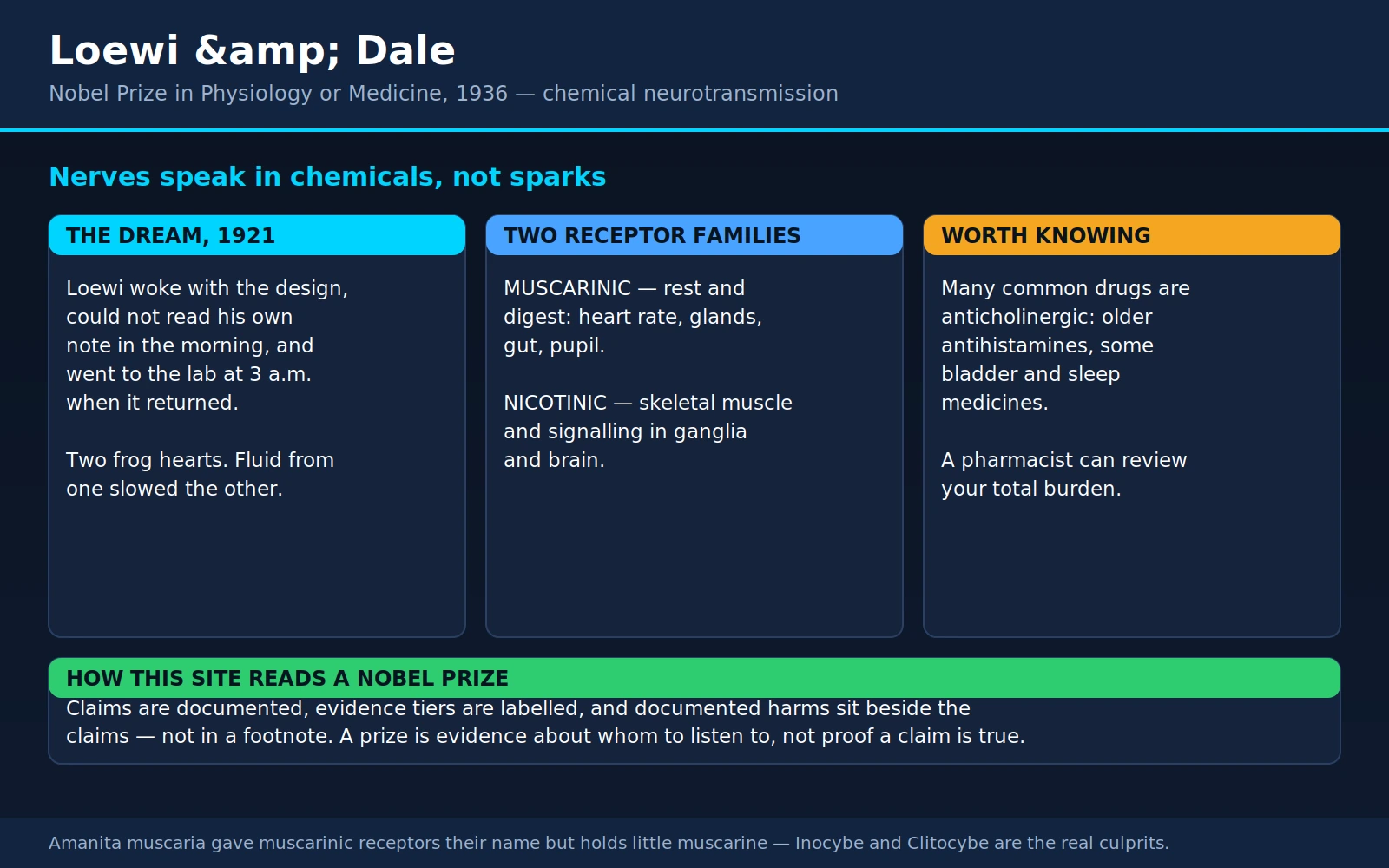
Table of Contents
- The Prize and the Two Men
- The Great Argument: Sparks Versus Soup
- The Dream Experiment, Easter 1921
- Dale Names It: From Vagusstoff to Acetylcholine
- The Two Receptor Families
- Your Medicine Cabinet, and the Anticholinergic Burden
- Myasthenia Gravis: The Disease That Proves the Junction
- Alzheimer's and the Cholinergic Story
- Loewi's Escape, and Dale's Public Life
- Where Mainstream Medicine Agrees / Where Claims Outrun Evidence
- Key Research Papers
- Connections
- Featured Videos
1. The Prize and the Two Men
In 1936 the Nobel Prize in Physiology or Medicine went jointly to Otto Loewi and Sir Henry Hallett Dale — in the citation's words, "for their discoveries relating to chemical transmission of nerve impulses." That sentence is easy to skim past. What it means is that before these two men, nobody could say for certain how one nerve cell tells another nerve cell — or a heart, or a muscle, or a gland — what to do. After them, the answer was known, and it was a molecule.
The molecule is acetylcholine. It is the reason your heart slows when you exhale, the reason your eyes water and your mouth waters, the reason your gut moves food along, and the reason your hand closes when you decide to close it. It is also the reason a nerve-agent attack kills, the reason an antihistamine makes you fuzzy, and the reason the standard drugs for Alzheimer's disease work the modest way they do. Almost everything on this page traces back to one night in a laboratory in Austria in 1921.
Otto Loewi (1873–1961) was born in Frankfurt am Main into a German Jewish wine-merchant family. He wanted to study art history; his family steered him to medicine. He took his degree at Strasbourg in 1896, trained in pharmacology under Hans Horst Meyer, and in 1909 took the chair of pharmacology at the University of Graz in Austria, where he stayed nearly thirty years. Colleagues described him as talkative, impulsive, generous and intuitive — a man who followed hunches, which is a relevant detail given what happened in 1921.
Henry Dale (1875–1968) was almost his opposite: a Londoner, Cambridge-trained, meticulous, institutionally minded, famously careful about what a piece of evidence would and would not support. He directed the Wellcome Physiological Research Laboratories from 1906, then in 1914 moved to what became the National Institute for Medical Research, which he directed from 1928 to 1942. He was knighted in 1932, served as President of the Royal Society through the war years, and chaired the Wellcome Trust for more than two decades. If Loewi had the flash of insight, Dale had the machinery — chemical, pharmacological and institutional — to turn a flash into a science.
They met around 1902–1903, when Loewi spent time in Ernest Starling's laboratory at University College London and encountered a young Dale working there. They stayed friends for more than sixty years, through two wars, an ocean, and the collapse of Loewi's world in 1938.
2. The Great Argument: Sparks Versus Soup
To understand why 1936 was a Nobel-worthy year, you have to understand what physiologists were arguing about, and it is easier than it sounds.
By 1900 it was well established that a nerve fibre carries an electrical signal down its own length — a travelling change in voltage across the nerve's membrane. That was never in dispute. The dispute was about what happens at the gap, the tiny space where one nerve ends and the next cell begins. Charles Sherrington had named that junction the synapse in 1897, but naming a gap does not explain how a message gets across it. There were two camps, and physiologists later nicknamed the fight "sparks versus soup."
The sparks camp held that the electrical signal simply jumps across the junction — that the whole nervous system is one continuous electrical machine. This was the majority view, and it was not stupid: nerve conduction is electrical, transmission is astonishingly fast, and the gap is vanishingly small. Why invoke chemistry when electricity was already doing the work?
The soup camp held that the arriving impulse causes the nerve ending to squirt out a chemical, and that the chemical — not the electricity — is what the next cell detects. In 1920 this was a minority position held by a scattering of pharmacologists, supported mainly by the fact that certain plant and fungal poisons mimicked nerve stimulation with uncanny precision. Thomas Elliott had suggested in 1904 that sympathetic nerves might release something adrenaline-like; Walter Dixon floated a similar idea for the vagus in 1907. Both were shrugged off for want of a decisive experiment.
Here is why the argument mattered, in plain terms. If nerves talk to each other with electricity, there is essentially nothing for a drug to grab hold of. You cannot design a pill that politely interrupts a spark. But if nerves talk with molecules, then the entire nervous system suddenly becomes druggable: you can block the molecule, mimic it, prevent its breakdown, flood the junction with it, or starve the junction of it. Every drug that acts on the brain, every anaesthetic, every treatment for Parkinson's disease or depression or myasthenia gravis, every nerve-agent antidote — all of it rests on the soup camp having been right. Loewi's frog hearts are, in a real sense, the founding experiment of modern pharmacology.
3. The Dream Experiment, Easter 1921
This is the most famous anecdote in the history of physiology, and it is worth telling accurately, because the accurate version is better than the polished one.
Loewi had been carrying the chemical-transmission idea around since 1903, when it occurred to him in conversation and then, by his own account, sank out of sight for seventeen years because he could not think of a way to test it. Then, on the night before Easter Sunday 1921, he woke with the design fully formed in his head. He scribbled it on a scrap of paper and went back to sleep. In the morning he had the note and could not read his own handwriting — and, worse, could not reconstruct what it had said. He described the following day as the most desperate of his scientific life. The next night, at three in the morning, the idea came back. This time he did not trust paper: he dressed, went straight to the laboratory, and did the experiment.
The design is beautifully simple. He took two frog hearts, still beating, bathed in a salt solution that keeps isolated tissue alive. The first he left with its vagus nerve attached — the great parasympathetic nerve that runs from the brainstem to the chest and abdomen and which, when stimulated, slows the heart. The second heart had no nerve supply at all.
He stimulated the first heart's vagus. As expected, that heart slowed. Then he did the thing that settled a twenty-year argument: he took the fluid bathing the first heart — not the nerve, not the tissue, just the liquid — and transferred it to the second heart.
The second heart slowed too.
Nothing electrical had passed between them. No nerve connected them. The only thing that crossed from one heart to the other was a few drops of salt solution. Therefore the vagus nerve, when stimulated, had released a chemical into that solution, and that chemical carried the instruction "slow down." Loewi called the unknown substance Vagusstoff — "vagus substance" — and published the result that same year in Pflügers Archiv. He soon showed the mirror image as well: stimulating the sympathetic accelerator nerve released a different substance, which he called Acceleransstoff, that sped a second heart up. Chemical signalling was not a quirk of one nerve; it was how the system worked.
Now the honest footnote, which the storybook version leaves out. The experiment was not as clean as the anecdote implies, and Loewi was the first to say so. He repeated it many times, and its success depended on conditions he did not fully control at first: the species and seasonal state of the frog, the temperature, the volume of fluid, the timing of the transfer. Other laboratories initially struggled to reproduce it, and for several years the result was genuinely contested. The reason emerged later — acetylcholine is destroyed within seconds by an enzyme, and the amounts involved are tiny, so the effect is fragile unless you work fast or block the enzyme. Once physostigmine (eserine), which blocks that enzyme, was added to the bath, the experiment became robust in anyone's hands.
Loewi put it with disarming candour in his later autobiographical writing: careful consideration in the daylight would almost certainly have led him to reject the very experiment he performed. That admission is the most valuable thing in the whole anecdote. The dream did not deliver a proof; it delivered a testable idea at a moment when its author was too sleepy to talk himself out of trying it. Everything after that was ordinary, grinding verification — much of it done by Henry Dale.
4. Dale Names It: From Vagusstoff to Acetylcholine
Loewi had proved that a chemical did the job. He had not proved which chemical. That is where Dale's decade of prior work turned out to be perfectly positioned.
Back in 1914, working at the Wellcome laboratories on the pharmacology of ergot — a fungus that contaminates rye and had been a medical curiosity for centuries — Dale and his chemist colleague Arthur Ewins isolated acetylcholine from an ergot extract. The compound itself was not new; it had been synthesised in the nineteenth century, and Reid Hunt had noted in 1906 that it was extraordinarily potent at lowering blood pressure. What was new was finding it in a natural biological source and characterising exactly what it did.
Dale did that with a thoroughness that became the template for receptor pharmacology. He observed that acetylcholine produced two distinguishable sets of effects, separable by using other poisons as tools: one set resembled the effects of muscarine, the toxin of certain poisonous mushrooms, and was abolished by atropine; the other resembled nicotine and was not. In a single 1914 paper he had therefore described, without knowing it yet, the two great receptor families of the cholinergic system.
When Loewi's Vagusstoff appeared in 1921, Dale recognised its behaviour immediately: it acted exactly like acetylcholine, and was destroyed by tissue exactly as acetylcholine was. The decisive piece came in 1929, when Dale and Harold Dudley extracted acetylcholine from the spleens of oxen and horses — the first demonstration that acetylcholine is a normal constituent of animal tissue, not a laboratory artefact or a fungal oddity. A substance found in an abattoir spleen could plausibly be the body's own messenger. A substance found only in ergot could not.
Then Dale's group, with Wilhelm Feldberg and Marthe Vogt, extended the discovery beyond the involuntary nervous system entirely. In 1936 — the Nobel year — they demonstrated that acetylcholine is released at voluntary motor nerve endings: the junction where a nerve from your spinal cord meets a skeletal muscle fibre. That single result moved chemical transmission out of the specialised world of the vagus and into the mechanism of every deliberate movement a human being makes. It is also, directly, the reason we can treat myasthenia gravis and the reason surgical anaesthesia can safely paralyse a patient and then reverse it.
Dale contributed one more idea worth knowing, usually called Dale's Principle: that a given neuron releases the same chemical messenger at all of its endings — the transmitter being a property of the cell, not of the particular branch. It was an enormously useful simplifying assumption for forty years, and has since been refined rather than discarded, since neurons are now known to co-release more than one signalling molecule.
The pairing is what earned the prize. Loewi supplied the experiment that could not be argued with. Dale supplied the chemistry, the natural source, the receptor classification, the extension to voluntary muscle, and the standards of proof. An anecdote became a field.
5. The Two Receptor Families
Every pharmacology student still learns Dale's 1914 division, because it remains the most useful map of the cholinergic system. Acetylcholine is one molecule, but it acts on two entirely different kinds of receptor, and the difference explains why one drug can dry your mouth while another paralyses your diaphragm.
Both families are named after the poison used to identify them, which is a nice reminder that pharmacology grew up out of toxicology.
Muscarinic receptors — the "rest and digest" side
Named after muscarine, a toxin first characterised from the fly agaric mushroom, Amanita muscaria. (A small accuracy note, since this site covers mushrooms: A. muscaria actually contains very little muscarine, and its own poisoning syndrome is driven mainly by ibotenic acid and muscimol, which act on a different system entirely. Genuine muscarinic mushroom poisoning comes mostly from certain Inocybe and Clitocybe species. The receptor kept the name anyway.)
Muscarinic receptors are slow, subtle, and modulatory — they work through internal signalling cascades rather than by opening a channel directly. There are five subtypes, M1 through M5. They sit at the receiving end of the parasympathetic nervous system, the branch that runs your body when nothing is chasing you. Their effects are the physiology of calm and digestion:
- Heart — slower rate (this is Loewi's frog heart, in you).
- Eye — pupil constriction and focusing for near vision; tear production.
- Glands — saliva, sweat, bronchial and gut secretions.
- Airways — bronchial narrowing.
- Gut — increased motility and tone; the bowel moving things along.
- Bladder — contraction of the detrusor muscle, i.e. emptying.
- Brain — attention, arousal, and memory formation, especially through M1 receptors.
Nicotinic receptors — the fast switches
Named after nicotine, from tobacco, which activates them. Nicotinic receptors are ion channels: acetylcholine binds, the channel opens, ions rush through, and the target cell responds in milliseconds. Where muscarinic signalling is a dimmer switch, nicotinic signalling is a light switch. They come in two broad groups:
- Muscle-type, at the neuromuscular junction — the receptor that makes skeletal muscle contract. This is the one attacked in myasthenia gravis and the one blocked by the paralysing agents used in surgery.
- Neuronal-type, in the autonomic ganglia (the relay stations of both the sympathetic and parasympathetic systems) and throughout the brain. Brain subtypes such as α4β2 and α7 are involved in attention, reward, and — because α4β2 is where inhaled nicotine lands — in addiction.
This site's section on Bryan Ardis includes a page on nicotinic acetylcholine receptor pharmacology and a page documenting his nicotine hypothesis. What is described here is the standard textbook account of the receptor biology, established by Dale and a century of work since. It is the baseline against which any specific claim about nicotinic receptors — his or anyone else's — has to be read.
The off switch
One more piece completes the system, and it is the piece that most of the drugs and poisons in the next three sections act on. Acetylcholine has to be cleared from the junction almost the instant it arrives, or the signal would smear into a continuous roar. The clearing is done by an enzyme, acetylcholinesterase, which chops acetylcholine in half within milliseconds — one of the fastest enzymes known.
That gives medicine three levers, and all three are in clinical use: block the receptor (atropine, scopolamine, surgical muscle relaxants), block the enzyme so acetylcholine lingers and the signal is amplified (pyridostigmine, donepezil — and, catastrophically, nerve agents), or stimulate the receptor directly (nicotine, pilocarpine for dry mouth, bethanechol for a sluggish bladder). The next three sections are those levers in action.
6. Your Medicine Cabinet, and the Anticholinergic Burden
This is the section with the most practical value on the page, so it is worth reading slowly.
Atropine and scopolamine
Atropine comes from deadly nightshade, Atropa belladonna — the plant whose Italian name, "beautiful lady," records the Renaissance cosmetic habit of dilating the pupils with its juice. Atropine blocks muscarinic receptors. Because muscarinic signalling slows the heart and wets everything, blocking it speeds the heart and dries everything. That is exactly why it is used: intravenously for dangerously slow heart rates (bradycardia), as a surgical premedication to dry secretions, as eye drops to dilate the pupil for examination, and — critically — as the first-line antidote in organophosphate poisoning.
Scopolamine (hyoscine), from the same plant family, crosses into the brain more readily. The transdermal patch worn behind the ear for motion sickness is scopolamine; it works because the balance signals that produce nausea run through a cholinergic pathway. The side effects are the same family of effects, which is why patch users get a dry mouth and, not uncommonly, a dilated pupil on the side where they touched the patch and then rubbed an eye.
Medical students memorise the anticholinergic toxidrome with a rhyme that is crude but accurate: dry as a bone, red as a beet, blind as a bat, mad as a hatter, hot as a hare — dry mouth, flushed skin, blurred near vision, confusion, and an inability to sweat off heat. Hold that list in mind, because dozens of ordinary drugs produce a mild, chronic version of it without anyone calling them anticholinergics.
The anticholinergic burden
Many common medicines block muscarinic receptors as a side effect, and the effects add up across every drug a person takes. Clinicians call the total the anticholinergic burden. Drugs that carry meaningful burden include:
- Older antihistamines — diphenhydramine (the antihistamine in most over-the-counter "PM" and "night-time" formulations), chlorpheniramine, hydroxyzine, promethazine, doxylamine, meclizine.
- Overactive-bladder drugs — oxybutynin, tolterodine, solifenacin.
- Tricyclic antidepressants — amitriptyline, nortriptyline, doxepin; and among the newer drugs, paroxetine.
- Antispasmodics for the gut — dicyclomine, hyoscyamine.
- Muscle relaxants — cyclobenzaprine.
- Some antipsychotics and anti-Parkinson drugs — chlorpromazine, olanzapine, trihexyphenidyl, benztropine.
Short-term, the burden shows up as dry mouth, constipation, blurred vision, difficulty starting urination, and grogginess. In older adults it also causes falls and acute confusion, and it is a standard thing to look for when a previously sharp eighty-year-old becomes muddled after a medication change.
The long-term question is dementia, and here is what the evidence honestly shows. Two large, careful observational studies dominate the discussion. A prospective cohort of older adults published in 2015 found that higher cumulative use of strong anticholinergics over several years was associated with a substantially increased risk of later dementia — roughly a 50 percent relative increase at the highest exposure level. A much larger nested case-control study published in 2019, drawing on tens of thousands of British dementia cases matched to hundreds of thousands of controls, found a very similar association, concentrated in antidepressant, bladder, antipsychotic and anti-Parkinson anticholinergics, with exposure counted up to twenty years before diagnosis.
Both studies are observational, and the caveats are real rather than decorative. Confounding by indication is the big one: depression, insomnia, and bladder problems can all be early symptoms of a dementia that has not yet been diagnosed, so some of the association may run backwards — the brewing disease causing the prescription, not the prescription causing the disease. The 2019 study specifically tried to address this by pushing the exposure window back many years, which strengthens but does not settle the case. No one has run, or will run, a randomised trial of giving people anticholinergics for a decade.
What to actually do with this. The reasonable position — and it is now mainstream geriatric practice, not a fringe one — is that anticholinergic burden in older adults should be minimised where there is an equally good alternative, and that this is worth doing for the falls, confusion and constipation alone, with the dementia signal as an additional reason. Practically:
- Put every medicine, prescription and over-the-counter, into one bag and ask a pharmacist for a burden review. Pharmacists do this routinely and are often better at it than a rushed office visit.
- For allergies, the non-sedating antihistamines — loratadine, cetirizine, fexofenadine — carry far less burden than diphenhydramine.
- For sleep, "PM" formulations are simply a painkiller plus diphenhydramine. They are among the easiest anticholinergics to drop, and cognitive behavioural therapy for insomnia outperforms them anyway.
- For overactive bladder, ask whether mirabegron (a different mechanism entirely) or pelvic floor therapy could substitute.
- Do not stop a prescribed drug on your own. Several of these — antidepressants especially — need tapering, and an untreated condition is its own harm.
Running the machine in reverse: organophosphates and nerve agents
If blocking the receptor dries you out, blocking the enzyme does the opposite, and at high doses it kills. Organophosphate insecticides — malathion, chlorpyrifos, parathion and their relatives — and the chemical-weapon nerve agents such as sarin and VX all work the same way: they bind acetylcholinesterase and disable it, more or less permanently. Acetylcholine then piles up at every cholinergic junction in the body at once.
The result is a horrifying tour of section 5. The muscarinic effects come first: streaming eyes and nose, drenching sweat, drooling, vomiting, diarrhoea, pinpoint pupils, a slow heart, and lungs filling with secretions — the immediate cause of death is often drowning in one's own bronchial fluid. The nicotinic effects follow at the muscles: twitching, fasciculation, then weakness and paralysis, including the diaphragm. In the brain, seizures.
Treatment is a direct application of Dale's map: atropine in large repeated doses to block the muscarinic flood and dry the airway, pralidoxime to prise the poison off the enzyme before the bond "ages" into permanence, benzodiazepines for seizures, and mechanical ventilation. Organophosphate self-poisoning has been one of the largest single causes of suicide deaths worldwide, concentrated in rural agricultural Asia, and restricting access to the most toxic compounds has done more to reduce those deaths than any hospital treatment. Our Pesticides page covers the agricultural exposure side, and the wider Toxins section places it among other environmental exposures.
7. Myasthenia Gravis: The Disease That Proves the Junction
If you wanted to design a disease to demonstrate that Dale and Feldberg were right about the neuromuscular junction, you would design myasthenia gravis.
In myasthenia gravis, the immune system makes antibodies against the body's own nicotinic acetylcholine receptors at the neuromuscular junction — in roughly 85 percent of patients. The antibodies block the receptors, cross-link and internalise them, and recruit complement to damage the delicate folded membrane where they sit. Acetylcholine is released normally; there is simply less and less to receive it. A smaller group of patients have antibodies against MuSK or LRP4, proteins that organise the receptors into place, which produces the same failure by a different route.
The symptoms follow from the mechanism with unusual directness. The junction has a safety margin — normally far more receptors than a single impulse needs — so early disease shows up only where that margin is thinnest: the small muscles that move the eyes and hold up the eyelids. Drooping eyelids (ptosis) and double vision are the classic first signs, and about half of patients start there. The second signature is fatigability: strength close to normal in the morning that drains away with use, so speech slurs late in a conversation, chewing fails partway through a meal, and arms give out while brushing hair. Rest restores it. That pattern — weakness that comes and goes with use rather than staying constant — is close to diagnostic and is what should send someone to a neurologist. In severe disease the swallowing and breathing muscles are affected, and a myasthenic crisis is a respiratory emergency.
Diagnosis rests on the antibody blood tests, on electrical studies (repetitive nerve stimulation and single-fibre EMG, which measure the failing junction directly), and on chest imaging, because myasthenia is strongly associated with abnormalities of the thymus gland. One old bedside test survives because it is elegant: applying an ice pack to a drooping eyelid for two minutes often lifts it, because cold slows the enzyme that destroys acetylcholine.
That same principle is the front-line treatment. Pyridostigmine is an acetylcholinesterase inhibitor: it does nothing to the antibodies and nothing to the immune system, it simply lets each released packet of acetylcholine linger longer in the junction so the reduced number of surviving receptors gets more chances to be hit. It is a purely mechanical fix for a shortage of receivers, and it makes sense only because of Loewi and Dale. Before 1936 the drug would have been unimaginable; there was no theory in which it could work.
Pyridostigmine treats symptoms, not cause, so modern management adds immune treatment: corticosteroids, steroid-sparing drugs such as azathioprine or mycophenolate, thymectomy in selected patients, and, in crisis, plasma exchange or intravenous immunoglobulin. The newest agents are the most mechanistically satisfying — complement inhibitors that stop the antibodies destroying the junction, and FcRn blockers that strip the offending antibodies out of the circulation.
Two practical points patients should know. First, several common drugs make myasthenia worse — aminoglycoside and fluoroquinolone antibiotics, intravenous magnesium, some beta-blockers, and certain anaesthetic agents. Anyone with myasthenia should say so before any procedure and before accepting a new antibiotic. Second, a related but distinct condition, Lambert-Eaton myasthenic syndrome, attacks the sending side of the same junction rather than the receiving side, and behaves differently: strength briefly improves with sustained effort. It is a useful contrast, and it is frequently linked to an underlying lung cancer, which makes getting the distinction right consequential.
8. Alzheimer's and the Cholinergic Story
In the mid-1970s, researchers examining the brains of people who had died with Alzheimer's disease found something specific and striking: a severe loss of choline acetyltransferase, the enzyme that makes acetylcholine, in the cortex and hippocampus. Work that followed traced the loss to the degeneration of a small cluster of neurons deep in the forebrain — the nucleus basalis of Meynert — which supplies acetylcholine to most of the cortex. Since acetylcholine was already known to be central to attention and memory encoding, this produced the cholinergic hypothesis: that the memory failure of Alzheimer's is, at least in part, a cholinergic deficit.
That hypothesis gave the field its first drugs, and they are still in use.
Donepezil, rivastigmine, galantamine
All three are acetylcholinesterase inhibitors — the same lever as pyridostigmine, aimed at the brain instead of the muscle. They do not replace the dying neurons; they make the surviving ones' output last longer.
The honest tier is: real, but modest, and symptomatic only. A Cochrane systematic review of donepezil found consistent small benefits at six months across cognition, activities of daily living, and clinician-rated global impression — on the standard cognitive scale, an average improvement of roughly two to three points on a seventy-point scale at the usual dose. That is a genuine effect, reproducible across many trials, and for some families it is the difference between managing at home and not. It is also nowhere near a cure, it does not slow the underlying disease, and a substantial number of patients notice nothing.
The side effects are predictable from the mechanism — more acetylcholine everywhere: nausea, diarrhoea, loss of appetite and weight, muscle cramps, vivid dreams and insomnia, and a slowed heart rate that occasionally causes fainting and, in older patients, has been linked to falls and hip fractures. Rivastigmine is available as a patch, which reduces the gut effects. A sensible approach is a defined trial of three to six months with someone specific tasked to judge whether anything actually improved, and a willingness to stop if it did not.
One quiet irony deserves stating. Section 6 described the drugs that block muscarinic receptors, and their association with cognitive decline. It is not unusual for an older adult to be prescribed donepezil to raise acetylcholine while simultaneously taking an anticholinergic bladder drug or a night-time antihistamine that blocks its effect. Those two prescriptions are working against each other, and checking for that combination is one of the highest-value things a pharmacist review can catch.
The supplements next door, tiered fairly
Because the cholinergic story is genuinely true, an entire supplement category has grown up beside it. Some of it has real pharmacology behind it. Very little of it has adequate trial evidence. Here is the honest sorting.
Huperzine A — an alkaloid from Chinese club moss (Huperzia serrata, qian ceng ta), long used in traditional Chinese medicine. Its pharmacology is not in doubt: it is a genuine, potent, reversible acetylcholinesterase inhibitor that crosses into the brain. In other words it is a drug, and it belongs on the same list as donepezil rather than in the vitamin aisle. The trial evidence is the problem. A systematic review and meta-analysis of twenty randomised trials reported apparent benefits on cognitive scores and daily function — but the reviewers judged the methodological quality of nearly all the included trials to be poor, with small samples, weak randomisation and blinding, and almost all conducted in a single country. A US-based randomised trial found no benefit at the lower dose it tested. Tier: real mechanism, thin and low-quality efficacy evidence. Because it is a genuine cholinesterase inhibitor it carries genuine cholinergic side effects, it is sold without dose standardisation, and it should not be stacked on top of a prescribed cholinesterase inhibitor. Anyone taking it should tell their doctor they are taking a drug.
Alpha-GPC and citicoline (CDP-choline) — choline donors, marketed as raw material for acetylcholine synthesis. The compounds do raise choline availability. The human outcome evidence is mixed and mostly comes from small trials, several decades old, in mild cognitive impairment or post-stroke cognitive decline rather than in healthy people wanting sharper thinking; larger and better-designed trials have generally been less impressive than the early small ones. One caution is worth flagging honestly: a large claims-database analysis has reported an association between alpha-GPC use and later stroke risk. That is observational and hypothesis-generating, not proof of harm — but it is a reason not to assume that pushing more choline into the system is automatically free of consequence. Tier: plausible mechanism, mixed and mostly weak human evidence, one unresolved safety signal. Both are covered on this site's Alpha-GPC and Citicoline pages.
Dietary choline — this is the part that is solid, and it is solid for reasons that have nothing to do with Alzheimer's. Choline is an essential nutrient: your body cannot make enough, and it is required not only to build acetylcholine but to build cell membranes (as phosphatidylcholine), transport fat out of the liver, and supply methyl groups. Frank deficiency causes liver fat accumulation and muscle damage. Requirements are set at roughly 550 mg a day for men and 425 mg for women, higher in pregnancy and lactation, and survey data consistently show most people fall short. The richest ordinary sources are eggs — almost all of it in the yolk, around 150 mg per large egg — and liver, which is in a class of its own; meat, fish and cruciferous vegetables contribute meaningfully. The Choline section covers requirements, sources and deficiency in full.
And now the idea that ties this whole section together: a nutrient being a precursor does not mean that supplementing it treats a disease. Acetylcholine is made from choline, so it is intuitive that more choline should mean more acetylcholine and therefore better memory. But the brain of someone with Alzheimer's disease is not short of raw material — the neurons that would use it have died. Pouring in more flour does not help when the bakery has burned down. The same error runs through the supplement world: tryptophan is a precursor of serotonin, tyrosine of dopamine, and in neither case does eating more of the precursor reliably do what the corresponding drug does. Eat enough choline because it is an essential nutrient and most people do not get enough — not because you expect it to treat dementia.
9. Loewi's Escape, and Dale's Public Life
Loewi was still professor of pharmacology at Graz in March 1938 when German troops entered Austria and the Anschluss was declared. He was sixty-four, a Nobel laureate, and Jewish.
He was arrested during the night, along with two of his sons, and held for about two months. He later wrote that he expected to be shot and that his first thought in the cell was that his 1921 results, some of which were still unpublished, would be lost — so he wrote the essentials on a scrap of paper and had it sent to a journal. He was eventually released on a condition: he had to arrange the transfer of his Nobel Prize money, held in a Stockholm bank, to a bank controlled by the Nazi authorities. He paid, was stripped of his position, and was permitted to leave.
He went first to Britain, where colleagues — Dale among those who worked on behalf of displaced scientists — helped arrange temporary positions, and in 1940 he emigrated to the United States. He became research professor of pharmacology at the New York University College of Medicine and an American citizen in 1946. His wife was not allowed to follow until 1941, and only after a further payment. He worked and taught in New York, spending summers at the Marine Biological Laboratory at Woods Hole, until his death on 25 December 1961, at eighty-eight.
Henry Dale's war looked entirely different, and the contrast is the point. He was elected President of the Royal Society in 1940 and served through the war, chaired the government's Scientific Advisory Committee, and directed the National Institute for Medical Research until 1942. He also used that standing publicly: he spoke and wrote against the Nazi corruption of science, protested the regime's treatment of Jewish and dissenting scientists — including its forcing of Gerhard Domagk to decline the Nobel Prize — and supported the organised British effort to find posts for refugee researchers. From 1938 he chaired the Wellcome Trust, which he ran for over twenty years.
Two men who had been arguing productively about frog hearts since before the First World War: one of them ended up a refugee at sixty-five, the other a knight of the realm running British science. They remained friends. Loewi's Nobel money, so far as the record shows, was never recovered.
10. Where Mainstream Medicine Agrees / Where Claims Outrun Evidence
Acetylcholine is one of those subjects where genuinely settled science sits directly beside enthusiastic marketing, and the two are easy to confuse because they use the same vocabulary. Here is the sorting.
Where mainstream medicine agrees — and this is a long list
Chemical neurotransmission itself is contested by nobody; Loewi and Dale won that argument completely, and the muscarinic/nicotinic map is textbook. Built on it, and all uncontroversial: pyridostigmine as first-line therapy for myasthenia gravis; atropine and pralidoxime for organophosphate poisoning; cholinesterase inhibitors for Alzheimer's disease, approved and guideline-recommended, with the honest caveat that the benefit is modest and symptomatic; reducing anticholinergic burden in older adults, now conventional geriatric practice and written into the prescribing-safety criteria used in ordinary clinics; choline as an essential nutrient with a defined requirement and a real deficiency state; and implanted vagus nerve stimulation for its approved indications, below.
Vagus nerve stimulation, tiered
Loewi's experiment made the vagus nerve famous, and a century later "the vagus nerve" has become a wellness brand. The underlying anatomy is entirely real: the vagus is the body's longest cranial nerve, it carries parasympathetic signals to the heart, lungs and gut, and roughly 80 percent of its fibres run the other way, carrying information from the organs up to the brain. That two-way traffic is why stimulating it can influence mood and seizures at all. What varies enormously is the evidence behind each specific application.
Tier 1 — established. Implanted vagus nerve stimulation, a surgically placed device wrapped around the left vagus in the neck, has been approved since 1997 as an add-on treatment for drug-resistant focal epilepsy and since 2005 for treatment-resistant depression; a paired-stimulation system was later approved for upper-limb rehabilitation after stroke. In epilepsy, a substantial minority of patients — on the order of a third to a half — achieve at least a halving of seizure frequency, with benefit typically increasing over the first year or two. It is not a cure, it requires surgery, and hoarseness, cough and voice change during stimulation are common — but it is a real, approved therapy for people who have run out of other options.
Tier 2 — plausible, under-evidenced. Transcutaneous vagus nerve stimulation (taVNS) — the ear-clip and ear-bud devices sold direct to consumers — targets the auricular branch of the vagus, which really does supply part of the outer ear. The anatomy is legitimate; that is not the weak point. The human evidence is. A critical review of the field found what most reviews of taVNS find: stimulation parameters differing wildly between studies with no agreed standard, small samples, sham conditions that are hard to blind convincingly, and inconsistent results. There is enough signal to justify continued research and nowhere near enough to justify the claims on the packaging. Generally low-risk — skin irritation, occasional dizziness or headache — with caution for anyone with a cardiac conduction problem or an implanted cardiac device.
Tier 3 — "vagus hacking." The free, DIY end: cold water on the face, slow breathing, humming, gargling, singing. Sorted honestly:
- Slow breathing with a long exhale has the best evidence of the group. The physiology is well established — heart rate genuinely rises on inhalation and falls on exhalation through vagal control, an effect called respiratory sinus arrhythmia — and paced breathing reliably shifts short-term heart rate variability and produces measurable acute reductions in stress markers. It is free, harmless, and the one item here worth actually doing.
- Cold-water face immersion triggers the mammalian diving reflex, which is real, vagally mediated, and immediate — it is used clinically to break certain fast heart rhythms. Whether repeated cold exposure produces durable mood or health benefits is a much weaker literature, mostly small and short. It also carries genuine risk: the cold-shock response can provoke gasping and arrhythmia, and it is not a casual practice for anyone with cardiac disease.
- Humming, gargling, singing, gag-reflex stimulation. Proposed on the grounds that the vagus supplies the throat muscles. Essentially unstudied for any health outcome, and completely harmless. The honest label is "unproven and free," which is a perfectly respectable category — it is only a problem when sold as treatment.
- Heart rate variability as a "vagal tone" score. HRV is a real measurement genuinely influenced by vagal activity, but it varies with age, fitness, posture, sleep, alcohol, illness and time of day. A single number from a wearable does not grade the health of your nervous system.
Where claims outrun evidence
- "Acetylcholine boosters" for healthy cognition. Alpha-GPC, citicoline and huperzine A are sold as memory enhancers for people with no disease. That population is the least studied of all, and the precursor logic in section 8 applies directly.
- Ear-clip taVNS marketed for anxiety, inflammation, long COVID, autoimmune disease or "resetting the nervous system." The device may be harmless; the specific therapeutic claims are ahead of the data by a wide margin.
- The "cholinergic anti-inflammatory pathway" as a consumer product. The underlying science is legitimate and interesting — vagal signalling through α7 nicotinic receptors on immune cells can damp inflammatory cytokine release, and early-phase human trials of implanted stimulation in rheumatoid arthritis and Crohn's disease have been conducted. That is a research programme, not an approved therapy, and it is routinely cited in marketing as though it were settled.
- Any claim that a supplement, breathing pattern or ear clip treats myasthenia gravis, Alzheimer's disease or epilepsy. These are conditions with real treatments and real consequences for delay.
One last connection worth making. Loewi's vagus is also Ivan Pavlov's vagus. Pavlov's sham-feeding experiments — showing that the mere sight and smell of food makes the stomach secrete, and that cutting the vagus abolishes the response — were vagal physiology two decades before anyone knew what the nerve was releasing. Pavlov won the 1904 Nobel Prize for that work on digestion. Loewi, in 1921, supplied the chemistry underneath it. The cephalic phase of digestion, "gut feelings," and the modern interest in the gut-brain axis all run down the same nerve.
11. Key Research Papers
- Loewi O. Über humorale Übertragbarkeit der Herznervenwirkung (On the humoral transmissibility of the cardiac nerve action). Pflügers Archiv 1921;189:239-42 — the original Vagusstoff report, published before PubMed indexing. Search PubMed for related citations
- Dale HH. The action of certain esters and ethers of choline, and their relation to muscarine. J Pharmacol Exp Ther 1914;6:147-90 — the paper that separated muscarinic from nicotinic actions, also predating PubMed indexing. Search PubMed for related citations
- Borges R, García AG. One hundred years from Otto Loewi experiment, a dream that revolutionized our view of neurotransmission. Pflugers Arch 2021;473(6):977-981
- Tansey EM. Henry Dale and the discovery of acetylcholine. C R Biol 2006;329(5-6):419-25
- Dale HH, Dudley HW. The presence of histamine and acetylcholine in the spleen of the ox and the horse. J Physiol 1929;68(2):97-123
- Dale HH, Feldberg W, Vogt M. Release of acetylcholine at voluntary motor nerve endings. J Physiol 1936;86(4):353-80
- Gilhus NE. Myasthenia Gravis. N Engl J Med 2016;375(26):2570-2581
- Coupland CAC, Hill T, Dening T, et al. Anticholinergic Drug Exposure and the Risk of Dementia: A Nested Case-Control Study. JAMA Intern Med 2019;179(8):1084-1093
- Gray SL, Anderson ML, Dublin S, et al. Cumulative use of strong anticholinergics and incident dementia: a prospective cohort study. JAMA Intern Med 2015;175(3):401-7
- Birks JS, Harvey RJ. Donepezil for dementia due to Alzheimer's disease. Cochrane Database Syst Rev 2018;6(6):CD001190
- Yang G, Wang Y, Tian J, et al. Huperzine A for Alzheimer's disease: a systematic review and meta-analysis of randomized clinical trials. PLoS One 2013;8(9):e74916
- Zeisel SH, da Costa KA. Choline: an essential nutrient for public health. Nutr Rev 2009;67(11):615-23
- Yap JYY, Keatch C, Lambert E, et al. Critical Review of Transcutaneous Vagus Nerve Stimulation: Challenges for Translation to Clinical Practice. Front Neurosci 2020;14:284
- Eddleston M, Buckley NA, Eyer P, et al. Management of acute organophosphorus pesticide poisoning. Lancet 2008;371(9612):597-607
Live PubMed Searches
- Acetylcholine discovery history
- Anticholinergic burden and cognitive decline
- Huperzine A and Alzheimer's disease
- Myasthenia gravis acetylcholine receptor antibody
- Transcutaneous vagus nerve stimulation
12. Connections
- All Notable Doctors
- Nobel Prize in Physiology or Medicine — the full roll of laureates, including the 1936 award to Loewi and Dale
- Ivan Pavlov — the sham-feeding and cephalic-phase work that was vagal physiology before the chemistry was known
- Myasthenia Gravis — antibodies against the nicotinic receptor, and why pyridostigmine works
- Alzheimer's Disease — the cholinergic hypothesis and what cholinesterase inhibitors actually deliver
- Neurology — the full section on nerve and brain conditions
- Choline — requirements, food sources, deficiency, and why precursor is not the same as treatment
- Alpha-GPC — the choline donor supplement, and the evidence for and against it
- Eggs — the most practical everyday source of dietary choline, almost all of it in the yolk
- Beef Liver — the densest common food source of choline
- Pesticides — organophosphates, the acetylcholinesterase poisons that run this whole system in reverse
- Cryotherapy & Cold Exposure — the diving reflex is genuinely vagal; the durable-benefit claims are a separate question
- Nicotinic Acetylcholine Receptors — the receptor-pharmacology page in this site's Bryan Ardis section
- The Nicotine Hypothesis — the page documenting Ardis's claims about nicotinic receptor binding