Charles Richet: Anaphylaxis, and What to Do When the Immune System Overreacts
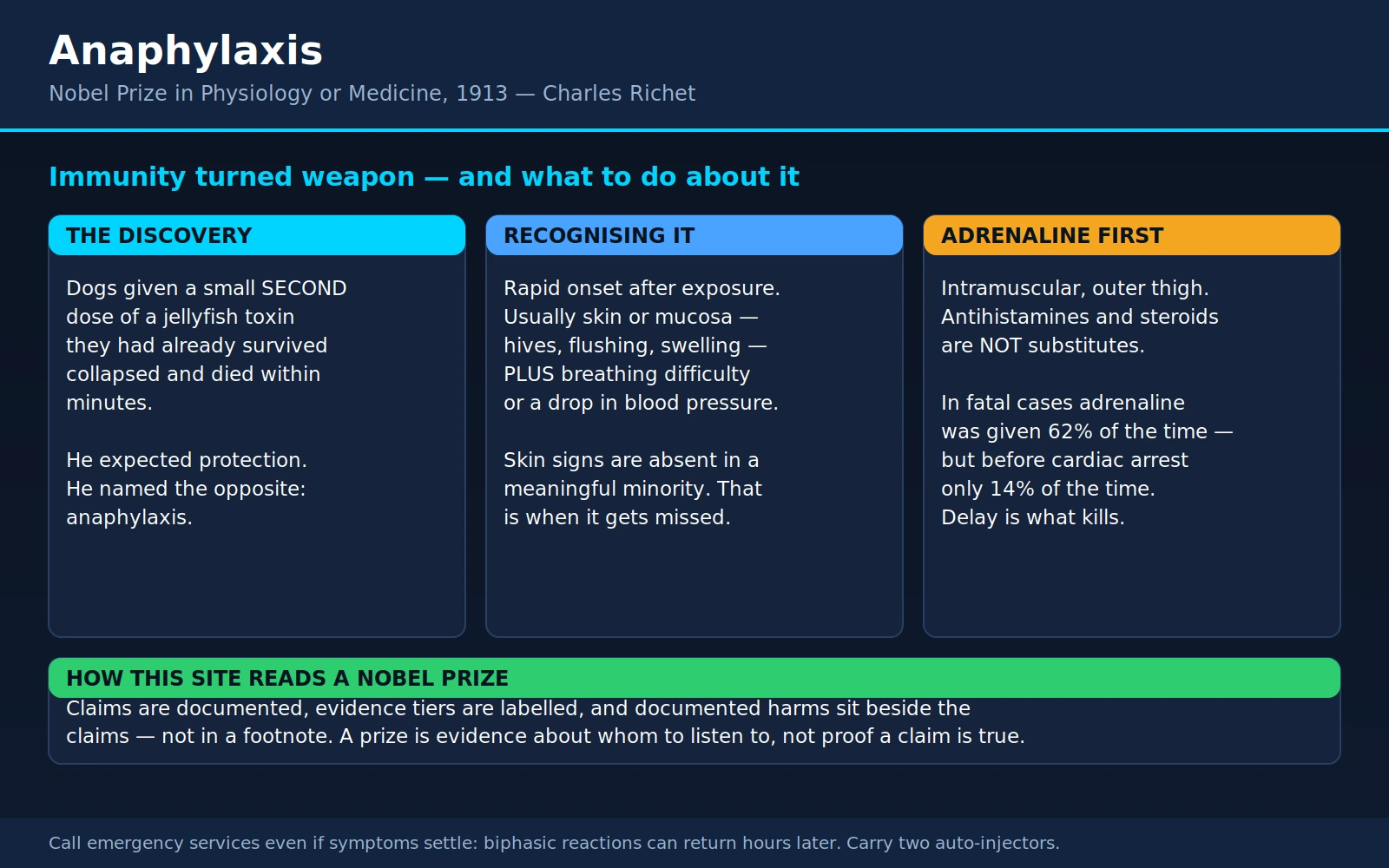
In February 1902, in a laboratory in Paris, a dog named Neptune was given a tiny injection of a jellyfish-relative toxin he had already survived once before. He should have been protected. Within minutes he was dead. The physiologist standing over him, Charles Richet, had just discovered that the immune system — the thing that keeps you alive — can also kill you in under five minutes, and that it needs to have met the trigger before in order to do it.
He called it anaphylaxis. It won him the Nobel Prize in Physiology or Medicine in 1913. This page tells that story, and then does the more important job: it explains what anaphylaxis actually is, how to recognise it when the textbook signs are missing, and exactly what to do. If you are looking for the emergency information, go straight to section 7.
Table of Contents
- The Prize and the Man
- The Voyage That Started It
- The Unexpected Result
- Serum Sickness and the Clinical Context
- What Is Actually Happening
- Recognising Anaphylaxis
- Adrenaline, and Why It Is First
- Alpha-Gal Syndrome: The Rule-Breaker
- Testing and Diagnosis
- What Has Genuinely Changed
- Where Mainstream Medicine Agrees — and What Remains Debated
- Richet's Legacy and Its Shadow
- Key Research Papers
- Connections
- Featured Videos
1. The Prize and the Man
Charles Robert Richet (1850–1935) was a French physiologist, born in Paris to a family already inside medicine — his father, Alfred Richet, was a professor of surgery. Charles took the chair of physiology at the Faculty of Medicine in Paris in 1887 and held it for more than three decades. He was elected to the Academy of Medicine in 1898 and the Academy of Sciences in 1914. He worked on body-heat regulation, gastric secretion, muscle physiology, serum therapy against infection, and the physiology of respiration; he helped fund and design one of the earliest attempts at a heavier-than-air flying machine; he wrote plays and poetry under a pen name; and he was a lifelong, active pacifist who campaigned for international arbitration long before it was fashionable.
In 1913 he received the Nobel Prize in Physiology or Medicine "in recognition of his work on anaphylaxis." That work is genuinely first-rate. It is one of a small number of discoveries that did not just add a fact to medicine but reversed one of its assumptions, and the entire discipline of allergy grows out of it. Everything on this page from section 5 onward exists because of what Richet and his collaborator noticed in 1902.
The uncomfortable part, stated up front
This site does not launder records, so two things go here rather than in a footnote at the bottom.
Richet was a committed eugenicist. He was not a man of his time who made an offhand remark; he wrote a book arguing the case. La Sélection humaine (written in 1912, published in 1919) advocated preventing people he classified as defective from reproducing, and it contains explicitly racist ranking of human populations. He served as president of the French Eugenics Society. His views were wrong as science — the genetics he leaned on was crude even by the standards of his own lifetime — and the programme he advocated was, where it was implemented anywhere in the world, harmful to real people. Nothing about the quality of his physiology changes that, and nothing about his eugenics makes the physiology wrong either. Both are true at once, and a reader is entitled to know both.
Richet also devoted a large share of his later life to what he called "metapsychics" — the investigation of mediums, séances, telepathy and materialised spirits. He coined the word ectoplasm for the substance mediums supposedly exuded, coined cryptesthesia for a supposed sixth sense, served as president of the Society for Psychical Research in London in 1905, and published a book-length Traité de Métapsychique in 1922 treating the whole subject as an emerging science. He pursued it with exactly the seriousness he brought to physiology, and he did not abandon it when his star cases collapsed — most famously the 1905 Villa Carmen séances in Algiers, where the "materialised" spirit was reported by others to have been a local coachman draped in a sheet.
The lesson worth carrying forward is not that Richet was a fraud — he was not, and the anaphylaxis experiments replicate. It is that a Nobel Prize is awarded for a specific piece of work and confers no general authority on anything else its holder believes. That principle recurs across this section of the site; see Prizes That Aged Badly.
2. The Voyage That Started It
In the summer of 1901, Richet was a guest aboard the Princesse Alice II, the oceanographic research yacht of Prince Albert I of Monaco — a serious working oceanographer who had turned his fortune into a research programme and would later found the Oceanographic Museum in Monaco. Richet was joined by Paul Portier (1866–1962), a younger French physiologist.
The prince made a suggestion that turned out to be one of the most productive pieces of scientific small talk on record. Bathers in the Mediterranean were being stung by the Portuguese man-of-war (Physalia physalis), and the prince wanted to know what the toxin actually was. Why not, he asked, study it?
Portier and Richet began on board, extracting material from Physalia tentacles and injecting it into laboratory animals. Back in Paris, Physalia was not available, so they switched to a local stand-in: the sea anemone (Actinia), whose stinging cells belong to the same phylum. They obtained a glycerine extract, found it lethal to dogs at sufficient dose, and named the active principle hypnotoxin for the drowsiness it produced.
Their stated goal was entirely conventional and, at the time, entirely reasonable: they wanted to find the dose that would immunise. Give an animal a small, survivable amount of a poison, let it mount a response, and it should tolerate a larger amount later. That was how antitoxin worked. That was how vaccination worked. It was the organising idea of the whole young field.
3. The Unexpected Result
Some of the dogs given a sublethal dose survived. Weeks later, those same dogs were given another dose — deliberately a small one, well below the amount they had already tolerated. The expectation was that nothing much would happen, or that the animals would prove more resistant than before.
Instead they collapsed. Vomiting, bloody diarrhoea, laboured breathing, loss of consciousness, and death — often within minutes. The dog Neptune, who had been perfectly healthy that morning and had survived a far larger dose three weeks earlier, died in under half an hour after a dose calculated to be harmless.
Richet's first response was the correct scientific one: he suspected he had made a mistake. He had not. The result held. And when he understood it, he understood that it was the exact inverse of what the experiment had been designed to demonstrate. The first exposure had not protected the animal. The first exposure was the thing that made the second one lethal.
Because phylaxis meant protection, he named the phenomenon aphylaxis — without protection — and then, reportedly for how it sounded, changed it to anaphylaxie. Portier and Richet presented the finding to the Société de Biologie in Paris on 15 February 1902, in a short French paper titled De l'action anaphylactique de certains venins.
Why this was a genuine shock
It is hard to feel the force of this now, because we grew up knowing that allergies exist. In 1902 nobody did. Immunity was understood as protective by definition. The word carried its meaning inside it: to be immune was to be exempt from harm. Twenty years of triumphant work — von Behring's diphtheria antitoxin, Ehrlich's side-chain theory of antibodies, Metchnikoff's phagocytes — had all pointed the same way. An immune response that had been raised against a substance was a good thing you wanted more of.
Richet showed that the machinery of immune memory could be the machinery of injury. The specificity was the damning part: an anaphylactic dog reacted to that toxin and not to others, and a naive dog given the same small dose was fine. It was not poisoning. It was recognition. The body had learned the substance and had learned it wrongly, and the learning was what killed.
Every autoimmune disease, every drug allergy, every peanut reaction, and every transplant rejection is downstream of the conceptual door Richet opened: immune specificity is a mechanism, not a moral position, and it can be pointed at the wrong thing.
Paul Portier, who did not get the prize
The 1913 Nobel went to Richet alone. Portier was a full partner in the discovery — he was on the yacht, he did the bench work alongside Richet, and his name is first on the 1902 paper. He was not included, and he never publicly complained about it; he went on to a distinguished career in marine and comparative physiology and lived until 1962. Richet himself credited Portier consistently, including in his Nobel lecture. The omission is one of the clearer single-name errors in the history of the prize, and this page names Portier as co-discoverer because that is what he was.
4. Serum Sickness and the Clinical Context
Richet's dogs did not land in an empty field. By 1902 doctors already had a problem they could not explain, and it came from medicine's greatest recent success.
Emil von Behring's diphtheria antitoxin — the work that won the very first Nobel Prize in Physiology or Medicine, in 1901 — was made by immunising horses and harvesting their serum. It saved an enormous number of children. But it meant injecting large volumes of horse protein into humans, sometimes repeatedly, and clinicians were seeing something odd: a first course usually went smoothly, while a later course in the same patient could produce fever, rash, joint pain, swollen glands and, occasionally, sudden collapse.
In Vienna, the paediatricians Clemens von Pirquet and Béla Schick studied this systematically and published Die Serumkrankheit (Serum Sickness) in 1905. They saw what Richet had seen: the reaction depended on prior exposure, its timing shortened dramatically on re-exposure, and it was the patient's own response — not a contaminant in the serum — that caused it.
In 1906 von Pirquet coined the word that stuck. He needed a neutral term for "altered reactivity" that did not prejudge whether the alteration was protective or harmful, and from the Greek allos (other) and ergon (work) he built allergy. It was meant to cover immunity and hypersensitivity together. Usage narrowed it to the harmful half within a generation, which is why the word means what it means today.
So the field has a fairly precise birthday. Richet and Portier supplied the mechanism in 1902; von Pirquet and Schick supplied the clinical description in 1905 and the vocabulary in 1906. Serum sickness itself became much rarer once antitoxins moved to purified and then human or recombinant products — but it never vanished, and it turns up today after antivenoms, anti-thymocyte globulin, rabies immunoglobulin of equine origin, and certain monoclonal antibodies.
5. What Is Actually Happening
Here is the modern account in plain language. It is worth understanding, because it explains almost every practical rule in the sections that follow.
Step one: sensitisation (nothing visible happens)
The first meaningful encounter with the substance — a peanut protein, a bee venom component, a drug — is silent. Immune cells take a fragment of it, show it to helper T cells, and in susceptible people the response goes down a particular route (a "type 2" response) that instructs B cells to make an antibody class called IgE.
IgE is unusual. Most antibodies float in blood and lymph doing their work in solution. IgE hardly stays in circulation at all — it goes and parks on cells, binding tightly to high-affinity receptors on the surface of mast cells (which sit in skin, gut lining, airway walls and around blood vessels) and basophils (which circulate). Once bound, it can sit there for months.
The person now has loaded cells and no symptoms whatsoever. This is why a first exposure to a food is so often uneventful and the third or the thirtieth is not, and it is why "but she's eaten it before" is never a reason to doubt an allergic reaction. Prior uneventful exposure is a requirement, not a defence.
Step two: the trigger (everything happens at once)
On a later exposure, the allergen molecule bridges two adjacent IgE antibodies on the same mast cell. That physical cross-linking is the switch. The receptors cluster, a signalling cascade fires, and the cell empties its granules into the surrounding tissue in seconds.
Out come pre-formed mediators — histamine, tryptase, heparin, chymase — followed within minutes by newly manufactured ones: prostaglandin D2, the leukotrienes, and platelet-activating factor. Millions of cells across the whole body can do this simultaneously, which is what separates anaphylaxis from a local reaction such as a single hive.
Step three: what those mediators do to a body
- Blood vessels widen and start leaking. Fluid moves out of the circulation and into tissue. This is simultaneously why you flush, why lips and eyelids swell, and why blood pressure falls — there is less volume left inside the pipes. In severe reactions a very large fraction of circulating plasma can shift into the tissues within about ten minutes.
- Airways narrow. Smooth muscle in the bronchi contracts and mucus production jumps — wheeze, chest tightness, cough. Separately, swelling of the tongue, throat and larynx can obstruct the airway higher up, which produces a hoarse voice, a sensation of throat closing, and stridor.
- The gut cramps. Smooth muscle contraction and fluid secretion give abdominal pain, vomiting and diarrhoea.
- The heart is hit two ways. It is trying to pump a suddenly reduced volume, and mast cells sitting in the heart's own tissue release mediators locally that can affect rhythm and coronary blood flow.
- Nerve endings fire. Itch, and often a distinctive sense of dread — patients frequently describe an overwhelming feeling that something is badly wrong, sometimes before any objective sign. Take that symptom seriously.
Honest caveat: not every anaphylaxis is IgE-mediated
The IgE story above is the commonest route and the one worth learning first. It is not the only one, and pretending otherwise causes real reactions to be dismissed because "the allergy test was negative."
- Direct mast-cell activation. Some drugs switch mast cells on without any antibody involved, through a receptor called MRGPRX2 — certain antibiotics (vancomycin, fluoroquinolones), some opioids, and neuromuscular blocking agents used in anaesthesia. No prior sensitisation is needed, so it can happen on first exposure.
- Complement activation. Iodinated contrast media and some liposomal or nanoparticle drug formulations can generate complement fragments that trigger mast cells.
- Interference with an enzyme. Aspirin and other NSAIDs can precipitate severe reactions by shifting arachidonic-acid metabolism toward leukotriene production, which is a pharmacological effect rather than an allergy in the classical sense.
- Idiopathic anaphylaxis. In a minority of people, no trigger is ever found despite thorough evaluation. That is a recognised diagnosis, not a failure of belief.
This is why the modern definition of anaphylaxis is clinical, not mechanistic. The old habit of calling non-IgE events "anaphylactoid" has been abandoned in current guidance, because it implied a lesser condition treated differently. It is not and it is not. If the clinical picture is anaphylaxis, it is anaphylaxis, and the treatment is the same regardless of the pathway that produced it.
6. Recognising Anaphylaxis
This is where anaphylaxis is won or lost, because the treatment is simple and the recognition is not. The single most useful thing on this page may be the sentence in the box below.
The pattern to hold in your head
Anaphylaxis is sudden (usually minutes to two hours after exposure), it is multi-system, and it is getting worse rather than better. Current international guidance recognises it in two situations:
- Skin or mucosal signs — widespread hives, flushing, itch, or swelling of lips, tongue or uvula — plus at least one of: difficulty breathing (wheeze, cough, stridor, throat tightness, hoarseness, blue lips), a drop in blood pressure or its consequences (faintness, collapse, confusion, incontinence), or severe gastrointestinal symptoms such as repeated vomiting and severe crampy abdominal pain.
- No skin signs at all, but sudden low blood pressure, bronchospasm or throat involvement after exposure to something that person is known or strongly suspected to react to. This second route exists precisely so that a reaction without a rash still counts.
The trap: skin signs are absent in a meaningful minority
Most people — including many non-specialist clinicians — carry a mental image of anaphylaxis that is essentially "covered in hives and struggling to breathe." Hives are present in the large majority of cases, but in roughly one in ten to one in five they are absent, and their absence is associated with delayed recognition and delayed adrenaline.
Reactions that present as sudden collapse with no rash, or as severe abdominal pain and vomiting with no rash, are exactly the ones that get labelled a faint, a panic attack, food poisoning, or a vasovagal episode. If the timing fits an exposure and more than one body system is involved, treat it as anaphylaxis. You are not required to see hives.
Gastrointestinal symptoms are a legitimate presenting feature
Repetitive vomiting and severe cramping abdominal pain after an exposure count as an organ system in their own right — this was made explicit in the 2020 guidance rather than being treated as an incidental detail. In children with food-triggered reactions, vomiting is often the first objective sign. In insect-sting and drug reactions, severe gut symptoms may be the only warning before cardiovascular collapse.
Biphasic reactions: it can come back hours later
In a minority of people the reaction settles, the person feels genuinely better — and then it returns hours later without any further exposure. A meta-analysis pooling twelve studies of nearly 2,900 adults found biphasic reactions in about one in twenty, and calculated that six hours of observation after the initial reaction resolves rules out recurrence in more than 97% of cases; extending observation to 8–12 hours adds a little more.
Two practical consequences: go to hospital even if the adrenaline worked, and if you were treated and sent home, do not spend the next several hours alone. Second-phase reactions can be as severe as the first.
The common triggers
- Foods — peanut, tree nuts (walnut, cashew, hazelnut, pistachio, almond), shellfish and crustaceans, finned fish, cow's milk, egg, wheat, soy and sesame. Sesame was added as a formally declarable major allergen in the United States under the FASTER Act, with labelling required from 2023. Peanut, tree nut and shellfish reactions dominate the severe adult cases; milk and egg dominate in young children and are frequently outgrown.
- Drugs — beta-lactam antibiotics are the classic; NSAIDs including aspirin and ibuprofen are a major and under-appreciated cause; then perioperative agents (neuromuscular blockers, chlorhexidine antiseptic, latex), iodinated contrast, platinum and taxane chemotherapy, and monoclonal antibodies. Drug reactions have the shortest time to collapse of any category.
- Insect stings — honeybee, wasp, yellow jacket, hornet, and imported fire ant. Venom immunotherapy is highly effective here and is one of the genuine success stories of the field.
- Latex — less common than it was, thanks to a deliberate move to non-latex gloves in healthcare, but still relevant for people with spina bifida and for healthcare workers, and it cross-reacts with banana, avocado, kiwi and chestnut.
- Alpha-gal — delayed reactions to mammalian meat after a tick bite; see section 8.
- Exercise- and cofactor-dependent food anaphylaxis — badly under-recognised. Here the food alone is tolerated perfectly well, and the reaction only occurs when eating is combined with a cofactor: exercise within a few hours of the meal, alcohol, NSAIDs, an infection, menstruation, sleep deprivation, or extreme heat or cold. Wheat is the best-characterised trigger (the responsible protein is omega-5 gliadin), but shellfish, celery and others are described. This is the answer for the person who says "I've eaten that a hundred times and only reacted twice" — and it explains why an allergy test on the food alone can look unimpressive while the reactions are severe.
Some people carry an amplified baseline that makes any trigger worse: mastocytosis, hereditary alpha tryptasemia, and poorly controlled asthma. Asthma in particular is the strongest single predictor of a fatal food reaction, and getting asthma properly controlled is one of the most useful things a food-allergic person can do about their allergy.
7. Adrenaline, and Why It Is First
Read this section before you need it. It is written to be acted on.
The rule
Intramuscular adrenaline (epinephrine) into the outer thigh is the first-line treatment for anaphylaxis. Give it immediately. Nothing else comes first, and nothing else substitutes for it.
Adrenaline is the only treatment that acts on every part of the problem at once. It tightens leaking blood vessels and raises blood pressure, it relaxes the airway muscle, it reduces swelling in the throat, it supports the heart, and it dampens further mediator release from mast cells. It works within minutes. In a person having anaphylaxis, given intramuscularly at the correct dose, it is a safe drug — the risk of withholding it is far greater than the risk of giving it.
How to give it
- Site: the outer thigh, halfway between hip and knee, into the big muscle on the outside of the leg. Not the arm, not the buttock. Absorption from the thigh muscle is faster and reaches a higher peak level than from the arm or from under the skin.
- Through clothing is fine. Do not waste time undressing anyone. Avoid a seam or anything in a pocket.
- Hold the device in place for the time its instructions specify (modern devices are typically about three seconds; some older instructions said ten), then remove and rub the site briefly.
- Typical auto-injector doses: 0.3 mg for adults and children roughly 30 kg (66 lb) and over; 0.15 mg for smaller children, usually about 15–30 kg. Some countries also have a 0.5 mg device. Your prescriber sets the dose for the individual — know yours before the day you need it.
- If there is no improvement in 5–15 minutes, give a second dose. A meaningful minority of reactions need more than one. This is the reason for the next rule.
Carry two
Two auto-injectors, together, wherever you go. Not one at home and one at school. Not one in the car. The reasons are unglamorous and all real: a device can misfire, a dose can be given into the wrong place, a first dose can be inadequate for the severity of the reaction, and the ambulance can be more than fifteen minutes away. A device in a drawer at home has never helped anyone.
Check the expiry date and set a reminder before it lapses. Look through the viewing window: the liquid should be clear and colourless. If it is brown, cloudy, or has solid material in it, replace it — it has degraded. Do not leave devices in a hot car or a cold one; heat in particular destroys adrenaline. And learn your own device by handling a trainer, because they are not all operated the same way — the familiar "blue to the sky, orange to the thigh" mnemonic belongs to one brand and does not describe the others.
Antihistamines and steroids are not substitutes
This needs to be unambiguous, because the mistake is common and it is lethal.
- Antihistamines (cetirizine, loratadine, diphenhydramine, chlorphenamine) block histamine at one receptor family. They help itch, hives and flushing. They do nothing for airway swelling, bronchospasm, or falling blood pressure, and even the fastest oral antihistamine takes far longer to act than the reaction takes to progress. Giving an antihistamine and waiting to see is the most frequently reported error in fatal cases.
- Corticosteroids (prednisolone, hydrocortisone, dexamethasone) take hours to have any effect at all. They were given for decades on the theory that they prevent biphasic reactions; the evidence does not support that, and the 2020 practice parameter specifically recommends against relying on them for that purpose.
- An asthma inhaler may help wheeze, but does not treat throat swelling or low blood pressure and is not a substitute either. If someone with asthma and a food allergy is struggling to breathe after an exposure, give adrenaline — do not assume it is "just asthma."
Both classes have a place after adrenaline, as add-ons for symptom relief. Neither has a place instead of it.
Delay is the factor most consistently associated with death
The clearest evidence comes from a UK register of fatal anaphylaxis. In that series, the median time from onset to respiratory or cardiac arrest was 5 minutes for drug-triggered reactions, 15 minutes for insect venom, and 30 minutes for food. Adrenaline was used at some point in 62% of the fatal cases — but it was given before arrest in only 14%. In other words, in most deaths adrenaline was eventually administered; it was administered too late to matter.
That same study carries an honest counterweight worth stating: at least three deaths in the series were attributed to adrenaline overdose. Those were intravenous administrations in a clinical setting, not intramuscular auto-injector doses. It is a reason for hospitals to be careful with the IV route in a patient who is not in arrest. It is not a reason for anyone to hesitate over an auto-injector in the thigh.
What else to do, in order
- Give adrenaline. First. Before anything below this line.
- Call emergency services (911, 999, 112, or your local number). Say the word "anaphylaxis." Call even if the person improves — because of biphasic reactions, and because the effect of a single dose can wear off before the reaction has finished.
- Position them. Lie the person flat with their legs raised. If breathing is easier sitting up, let them sit — but keep the legs out straight and do not let them stand. If they are vomiting or unconscious, put them on their side in the recovery position. Pregnant patients should lie on the left side.
- Do not let them stand up or walk. This matters more than it sounds. Sudden upright posture in someone whose circulating volume has collapsed can stop the heart from filling; deaths have occurred at the moment a patient stood up or was walked to a car. Keep them down and let the ambulance come to them.
- Second dose at 5–15 minutes if there is no improvement, or if symptoms return.
- Stay with them. Anaphylaxis can deteriorate quickly and the person may not be able to tell you.
- Go to hospital and be observed. Guidance generally supports at least six hours of observation after symptoms resolve, longer for severe reactions, for people on beta-blockers, for those with asthma, and for anyone who needed more than one dose.
Afterwards
Get a replacement prescription before you leave, get a written anaphylaxis action plan, and get a referral to an allergist — identifying the trigger is what prevents the next episode. Consider medical ID jewellery. Teach the people around you, including at school or work, how and when to use the device; the person having the reaction is often too unwell to do it themselves.
One recent development is worth knowing about: a needle-free nasal adrenaline spray was approved in the United States in 2024 for adults and children of about 30 kg and over, with a lower-dose version subsequently approved for smaller children. It is an option for people who cannot or will not carry a needle device, and it does not change any of the rules above about acting fast and calling for help.
8. Alpha-Gal Syndrome: The Rule-Breaker
Everything in section 6 teaches you that allergic reactions are fast. Alpha-gal syndrome breaks that rule, which is why it goes undiagnosed for years, and why it deserves its own section here. This site has detailed coverage — see Alpha-Gal Syndrome and its deep-dive articles — and what follows is the short version.
What it is
Galactose-alpha-1,3-galactose ("alpha-gal") is a sugar molecule found on the cells of essentially all non-primate mammals. Humans, apes and Old World monkeys lost the enzyme that makes it, which is why we can safely treat it as foreign. Ordinarily we ignore it in food. In alpha-gal syndrome, a person develops IgE antibodies against that sugar and then reacts to mammalian meat — beef, pork, lamb, venison, rabbit — and sometimes to dairy, gelatin, and mammal-derived medical products.
The tick
The sensitising event is a tick bite. In the United States it is chiefly the lone star tick (Amblyomma americanum), whose range has expanded well beyond the historic southeast; other species are implicated in Australia, Europe, Asia, Africa and South America. Something in tick saliva presents alpha-gal to the immune system in a way that drives an IgE response, and people often report intense, prolonged itching at the bite site. Repeated bites raise antibody levels; avoiding further bites lets them fall.
The delay, and why it hides the diagnosis
Reactions typically begin three to six hours after eating, not within minutes. The leading explanation is that alpha-gal arrives attached to fats and must be digested, packaged into lipid particles and delivered to the circulation before it can reach the sensitised mast cells — and that takes hours.
The consequence is that nobody connects the dots. Someone eats a steak at seven, wakes at midnight covered in hives or vomiting, and blames the last thing they ate or drank, or the bedroom, or stress. Reactions are frequently nocturnal. Many patients are carried for years with a label of chronic idiopathic urticaria, irritable bowel syndrome, or idiopathic anaphylaxis. Gastrointestinal-predominant presentations — abdominal pain, diarrhoea, nausea — with no skin involvement at all are common, and those are the hardest to catch.
How it was found
The discovery is a good example of medicine noticing a geographic anomaly. Around 2007, oncologists observed that severe first-dose reactions to the cancer antibody cetuximab were far more common in parts of the southeastern United States than elsewhere. Investigators showed in 2008 that affected patients had pre-existing IgE against alpha-gal, which is present on the cetuximab molecule because of how it is manufactured. Within a year the same research group had connected that antibody to the puzzle of delayed red-meat reactions in the same region, and the syndrome had a name.
Practical points
- Diagnosis is a blood test — specific IgE to alpha-gal, usually with beef, pork and lamb. Skin-prick testing with commercial meat extracts is often falsely negative, so a negative skin test does not exclude it.
- Awareness is still the bottleneck. A 2023 US survey of health-care providers found that a large share — close to half — had never heard of the condition, and only a minority felt confident diagnosing or managing it. If you fit the picture, you may need to raise it yourself.
- Hidden sources matter. Gelatin (sweets, capsules, marshmallows, some vaccines), beef or pork stock, lard and tallow, dairy for a subset of patients, and mammal-derived medical products including some heparins, bovine or porcine heart valves, and certain drug excipients.
- It can improve. Antibody levels fall over time if further tick bites are avoided, and a substantial proportion of people regain tolerance over months to years. Tick-bite prevention is therefore treatment, not just precaution.
- Sensitisation is not the same as syndrome. In heavily tick-exposed populations many people carry alpha-gal IgE and eat steak without incident. The antibody plus a matching reaction history is what makes the diagnosis.
The site's deep-dive coverage includes an anaphylaxis emergency plan and a dedicated testing and diagnosis article.
9. Testing and Diagnosis
Allergy testing is enormously useful when it is used to answer a question raised by a history, and actively harmful when it is used as a fishing expedition. The distinction is the single most important thing in this section.
Sensitisation is not allergy
A skin-prick test puts a drop of allergen extract on the skin and pricks through it; a wheal means IgE against that allergen is present on skin mast cells. A specific IgE blood test measures the same antibody in serum. Both answer one question: is there IgE against this substance? Neither answers the question you care about: will this person react if they eat it?
Plenty of people have detectable IgE to foods they eat happily every week. A positive test in someone with no history of reacting to that food often means nothing at all. Acting on it — removing the food "just in case" — is not a neutral choice: unnecessary avoidance is uncomfortable, nutritionally costly in children, and, as section 10 explains, can actually cause the allergy it was meant to prevent.
What these tests are good at is ruling things out. A negative test in someone with a doubtful history is reassuring. And higher values do shift the probability of a real reaction upward — but the number does not predict how severe a reaction would be. A modest result can precede a severe reaction and a very high one can accompany mild symptoms.
Tests that are sharper
- Component testing measures IgE against individual proteins rather than a whole-food soup. Testing IgE to Ara h 2 discriminates genuine peanut allergy from peanut cross-reactivity far better than whole-peanut IgE; omega-5 gliadin identifies wheat-dependent exercise-induced anaphylaxis; alpha-gal is itself a component test.
- Supervised oral food challenge remains the gold standard. The food is given in graded doses in a setting equipped to treat a reaction. It is the only way to prove a food is safe, and it liberates a great many people from diets they never needed.
Tryptase during an episode
Tryptase is a mast-cell enzyme released during degranulation, and measuring it can confirm after the fact that mast cells fired. Two rules make it useful:
- Timing. Draw the sample from roughly 15 minutes to 3 hours after symptoms start — it peaks early and falls back.
- Comparison. A single value means little. It must be compared with the same person's baseline, drawn at least 24 hours later once fully recovered. A rise above the baseline by a defined margin supports mast-cell activation.
Crucially, a normal tryptase does not exclude anaphylaxis. It is frequently normal in food-triggered reactions, and it is most often elevated in drug- and venom-triggered ones. Anaphylaxis remains a clinical diagnosis. Separately, a persistently raised baseline tryptase is a clue to mastocytosis or hereditary alpha tryptasemia, both of which raise the risk of severe reactions.
See an allergist
A proper assessment is a detailed history first, then targeted testing to confirm or refute what the history suggested, then a challenge if there is doubt. That sequence produces answers. The reverse sequence — a broad panel followed by an attempt to explain the results — produces long avoidance lists and no answers. An allergist also handles the things that genuinely change outcomes: venom immunotherapy, drug allergy de-labelling (most people labelled "penicillin allergic" are not, and the label leads to worse antibiotics), action plans, and the immunotherapy options in the next section.
A plain warning about commercial "food intolerance" and IgG panels
Direct-to-consumer tests that measure IgG or IgG4 antibodies against dozens or hundreds of foods are heavily marketed, often through clinics, gyms, wellness practitioners and online kits, and are typically sold as identifying "food sensitivities" or "food intolerances." They do not diagnose allergy, and they do not diagnose intolerance either.
The reason is not subtle. Food-specific IgG and IgG4 are a normal physiological response to eating food. Their presence indicates exposure and, if anything, tolerance — rising IgG4 is one of the markers that accompanies successful immunotherapy. The European Academy of Allergy and Clinical Immunology issued a formal Task Force statement in 2008 recommending against the use of IgG4 food testing as a diagnostic tool, and major allergy societies internationally have since reiterated the point.
What these panels reliably produce is a long list of foods the person eats often, followed by an elimination diet built on nothing. That costs money, restricts nutrition, generates anxiety around eating, and — the most serious harm — can delay the diagnosis of a real condition, whether that is a genuine IgE-mediated allergy, coeliac disease, inflammatory bowel disease, or alpha-gal syndrome. The same applies to hair analysis, applied kinesiology, cytotoxic testing, electrodermal or "bioresonance" devices, and pulse testing: none has demonstrated validity for diagnosing food allergy. See also Food Intolerance, which covers the real, non-allergic mechanisms that these tests are usually being bought to explain.
10. What Has Genuinely Changed
For most of the century after Richet, allergy management consisted of one instruction: avoid the food, and carry adrenaline in case you fail. That is no longer the whole of it. Three changes since 2015 are real, and one of them is an outright reversal of previous advice.
Early introduction: the advice used to be wrong
For years, parents of infants at high risk of food allergy were told to delay introducing peanut — US paediatric guidance in 2000 suggested waiting until age three. The reasoning was intuitive and completely untested. During the same period, peanut allergy rates rose sharply.
The LEAP trial (Learning Early About Peanut Allergy), published in the New England Journal of Medicine in 2015, tested it properly. It randomised 640 infants aged 4 to 11 months who already had severe eczema, egg allergy or both — that is, the highest-risk group, the ones the old advice was aimed at — to either consume peanut regularly or avoid it entirely until age five.
Among the children who started with a negative peanut skin test, peanut allergy at age five was 13.7% in the avoidance group and 1.9% in the consumption group. Among those who already had a small positive skin test, it was 35.3% versus 10.6%. Regular early eating did not cause peanut allergy. It prevented most of it. A follow-up study showed the protection persisted after a further twelve months of avoidance, so it was not merely temporary desensitisation.
Guidelines were rewritten. Current advice in the US, UK, Australia and elsewhere is to introduce peanut and egg-containing foods in infancy, around four to six months alongside other solids, with a specialist assessment first for infants with severe eczema or existing food allergy. Say it plainly: the old guidance to avoid early was wrong, it was based on plausibility rather than evidence, and it was reversed. It is one of the clearest self-corrections in modern paediatrics, and it is a fair reminder that "be cautious" is itself an intervention with consequences.
Oral immunotherapy: real, and honestly limited
Oral immunotherapy (OIT) means eating tiny, precisely measured, gradually increasing amounts of the allergen under medical supervision, then continuing a maintenance dose indefinitely. For peanut, the PALISADE trial published in 2018 tested a standardised peanut protein product in nearly 500 participants. Among the 4-to-17-year-olds who completed treatment, 67.2% could tolerate at least 600 mg of peanut protein at the exit challenge, versus 4.0% on placebo. The product was approved in the United States in 2020 for children and adolescents, and later extended to younger children.
The caveats are as important as the result, and a good clinician will lead with them:
- It raises the threshold; it is not a cure. The goal is protection against an accidental bite — a stray fragment in a shared kitchen — not a life where peanuts are safe. Participants still carried adrenaline and still avoided peanut as food.
- It requires ongoing daily dosing. Stop, and protection fades. This is a long-term commitment, not a course of treatment.
- It causes reactions during treatment. That is inherent: you are deliberately feeding an allergen to an allergic person. In PALISADE a substantially higher proportion of treated participants than placebo participants received adrenaline during the study, and around one in seven withdrew because of adverse events. A small number develop eosinophilic oesophagitis.
- Adults did not show significant benefit in that trial's adult cohort. Age matters: the Immune Tolerance Network's IMPACT trial, published in the Lancet in 2022, found that starting OIT in children aged one to three produced both higher desensitisation rates and a meaningful chance of sustained remission after stopping — the best results yet reported, and a strong argument for treating early.
Omalizumab: protection without eating the allergen
Omalizumab is an injected antibody that mops up circulating IgE and, indirectly, strips IgE receptors from mast cells. It has been used in asthma and chronic hives for years. The OUtMATCH trial, published in the New England Journal of Medicine in 2024, tested it in people — mostly children — allergic to peanut plus at least two other foods. After 16–20 weeks of injections, 67% of those on omalizumab could consume at least 600 mg of peanut protein without dose-limiting symptoms, compared with 7% on placebo, with similar results for the other foods tested.
It was approved in the United States in 2024 as an adjunct to food avoidance, to reduce reactions from accidental exposure in people aged one and over with IgE-mediated food allergy. The wording is deliberate and matters: it is not permission to eat the food. Avoidance continues, adrenaline continues to be carried, the injections continue every two to four weeks, and about a third of participants did not reach the protective threshold. It is expensive. But for someone with multiple severe food allergies, where OIT to each food separately is impractical, it is the first genuinely new option in a very long time.
A smaller change worth knowing
The addition of sesame to the US list of major allergens requiring declaration produced an unintended consequence: rather than segregate production lines, some manufacturers added sesame flour to products that had not contained it and declared it on the label, which is legal and which reduced the number of safe products for sesame-allergic people. It is a good illustration that labelling law shapes behaviour in ways nobody drafted, and a reason to keep reading labels on products you have bought safely for years.
11. Where Mainstream Medicine Agrees — and What Remains Debated
Broad agreement
- Intramuscular adrenaline in the outer thigh is first-line for anaphylaxis, given immediately, with no exceptions worth arguing about.
- Antihistamines and corticosteroids do not treat anaphylaxis and must never delay adrenaline.
- Anaphylaxis is a clinical diagnosis. No test is required to make it, and normal tryptase does not exclude it.
- Skin signs can be absent, and their absence must not prevent treatment.
- Sensitisation is not allergy. Testing follows a history; it does not replace one.
- IgG and IgG4 food panels are not valid for diagnosing food allergy or intolerance.
- Early introduction of peanut and egg in infancy reduces allergy, and delayed introduction was a mistake.
- Venom immunotherapy works for insect-sting anaphylaxis and is strongly recommended for those with systemic reactions.
- Alpha-gal syndrome is real, tick-driven, and under-diagnosed.
- Good asthma control reduces the risk of a fatal food reaction.
Genuinely unsettled
- How long to observe after a reaction. Estimates of biphasic reaction rates range widely depending on how studies define them, and recommendations for observation range from one hour to twelve. Most guidance lands on about six hours as a pragmatic compromise, longer if the reaction was severe.
- Whether corticosteroids have any role at all. Increasingly, the answer looks like "not much," but they remain in wide use out of habit.
- Who needs two auto-injectors. Universal two-device prescribing is standard advice in many places and questioned in others on cost and adherence grounds, with some arguing for risk stratification instead.
- The best immunotherapy protocol. Oral versus sublingual versus epicutaneous (a patch), optimal duration, whether true long-term remission is achievable outside very young children, and whether combining omalizumab with OIT beats either alone.
- Why food allergy became more common. The dual-allergen-exposure hypothesis — that sensitisation happens through inflamed skin while tolerance is built through the gut — is the leading explanation and fits LEAP well, but the contributions of the microbiome, vitamin D status, processing methods and diagnostic fashion are all still argued. Trials of routine infant emollients to prevent eczema and allergy have been disappointing.
- Where the tryptase thresholds should sit for diagnosing mast-cell disorders, and how much hereditary alpha tryptasemia explains.
- How far alpha-gal avoidance should extend — who needs to avoid dairy and gelatin as well as meat, and how to identify them.
12. Richet's Legacy and Its Shadow
Richet gave medicine something it could not have reasoned its way to. The idea that the immune system can be the agent of injury was not a refinement of existing theory; it contradicted it. From that single reversal come the modern understanding of allergy, of autoimmunity, of transplant rejection, and of drug hypersensitivity. Every auto-injector in every school bag traces back through a straight line to a dog in a Paris laboratory in February 1902 — and to Paul Portier, who should have shared the prize.
And Richet spent decades of his working life on ideas that were wrong, and one set of them was harmful.
The eugenics is the serious one. La Sélection humaine is not a stray paragraph; it is a sustained argument for state control of who may reproduce, with a racial hierarchy built into it, written by a man whose scientific authority gave the argument weight it had not earned. He led the French Eugenics Society. Whatever he intended, the movement he lent his name to supplied intellectual cover for forced sterilisation programmes across several countries and, in its most extreme form, for far worse. The fact that he was simultaneously a pacifist who campaigned against war does not resolve the contradiction; it is simply part of the record, and it should make anyone cautious about assuming that decency in one domain travels to another.
The metapsychics is different in kind — a distinguished scientist spending his later decades chasing ectoplasm and materialised spirits is a story about credulity, not cruelty. But it makes the same point in a gentler way. Richet applied real methodological seriousness to séances and still could not see through them, because he wanted the phenomena to be real and because a laboratory reflex is not proof against a conjuror. Expertise does not transfer. Rigour in one field does not immunise you in another.
This is, in the end, the reason to keep both halves of the man on one page. Richet's anaphylaxis work is not credible because Richet said it — it is credible because Portier and Richet reported an experiment that others repeated and extended, and because the mechanism they stumbled into turned out to explain a mountain of clinical observation they never made. Strip his name off it entirely and the science stands. Attach his name to his eugenics and it still falls, because the evidence was never there. That is how it is supposed to work, and it is the most useful thing this page can leave you with besides section 7.
13. Key Research Papers
- Portier P, Richet C. De l'action anaphylactique de certains venins. C R Soc Biol (Paris) 1902;54:170-172. The original report; French, pre-dating the modern indexes and not carried in PubMed. Search PubMed for coverage of this paper
- Cohen SG, Zelaya-Quesada M. Portier, Richet, and the discovery of anaphylaxis: a centennial. J Allergy Clin Immunol 2002;110(2):331-6
- Sampson HA, Muñoz-Furlong A, Campbell RL, et al. Second symposium on the definition and management of anaphylaxis: summary report. J Allergy Clin Immunol 2006;117(2):391-7
- Shaker MS, Wallace DV, Golden DBK, et al. Anaphylaxis — a 2020 practice parameter update, systematic review, and GRADE analysis. J Allergy Clin Immunol 2020;145(4):1082-1123
- Cardona V, Ansotegui IJ, Ebisawa M, et al. World Allergy Organization anaphylaxis guidance 2020. World Allergy Organ J 2020;13(10):100472
- Pumphrey RS. Lessons for management of anaphylaxis from a study of fatal reactions. Clin Exp Allergy 2000;30(8):1144-50
- Kim TH, Yoon SH, Hong H, Kang HR, Cho SH, Lee SY. Duration of observation for detecting a biphasic reaction in anaphylaxis: a meta-analysis. Int Arch Allergy Immunol 2019;179(1):31-36
- Chung CH, Mirakhur B, Chan E, et al. Cetuximab-induced anaphylaxis and IgE specific for galactose-alpha-1,3-galactose. N Engl J Med 2008;358(11):1109-17
- Commins SP, Satinover SM, Hosen J, et al. Delayed anaphylaxis, angioedema, or urticaria after consumption of red meat in patients with IgE antibodies specific for galactose-alpha-1,3-galactose. J Allergy Clin Immunol 2009;123(2):426-33
- Platts-Mills TAE, Li RC, Keshavarz B, Smith AR, Wilson JM. Diagnosis and management of patients with the alpha-gal syndrome. J Allergy Clin Immunol Pract 2020;8(1):15-23.e1
- Du Toit G, Roberts G, Sayre PH, et al. Randomized trial of peanut consumption in infants at risk for peanut allergy (LEAP). N Engl J Med 2015;372(9):803-13
- Vickery BP, Vereda A, Casale TB, et al; PALISADE Group of Clinical Investigators. AR101 oral immunotherapy for peanut allergy. N Engl J Med 2018;379(21):1991-2001
- Wood RA, Togias A, Sicherer SH, et al. Omalizumab for the treatment of multiple food allergies. N Engl J Med 2024;390(10):889-899
- Stapel SO, Asero R, Ballmer-Weber BK, et al. Testing for IgG4 against foods is not recommended as a diagnostic tool: EAACI Task Force Report. Allergy 2008;63(7):793-6
Live PubMed Searches
- Anaphylaxis epinephrine management
- Alpha-gal syndrome red meat allergy
- Peanut oral immunotherapy trial
- Early peanut introduction (LEAP)
- Biphasic anaphylaxis incidence
Connections
- All Notable Doctors
- Anaphylaxis — the full clinical page: recognition, emergency treatment, and long-term management
- Alpha-Gal Syndrome — tick-induced delayed meat allergy, with a full deep-dive series including an emergency action plan
- Food Allergy — the major allergens, thresholds, labelling, and living with avoidance
- Drug Allergy — the fastest-collapsing category of anaphylaxis, and why penicillin labels should be tested
- Food Intolerance — the real non-allergic mechanisms that unvalidated IgG panels are usually sold to explain
- Chronic Urticaria — long-running hives, a frequent misdiagnosis for alpha-gal syndrome
- Mastocytosis — too many mast cells, and a major amplifier of anaphylaxis risk
- Mast Cell Activation Syndrome — the same cells Richet's toxin was setting off, firing without an obvious trigger
- Asthma — the strongest single predictor of a fatal food reaction; controlling it is allergy treatment
- Eczema — inflamed skin as the route to sensitisation, and the reason LEAP targeted the infants it did
- Hives & Flushing — the skin signs of mast-cell degranulation, and when they mean more than skin
- Histamine and Allergy — where histamine comes from and what it does in the body
- Allergy & Pain Conditions — the full category index
- Immunology — immune deficiency, dysregulation, and the rest of the immune-disease index
- Emil von Behring — the serum therapy whose repeat injections created the clinical problem Richet explained
- Paul Ehrlich — antibodies and the side-chain theory; the "horror autotoxicus" he thought forbade self-harm by immunity
- Élie Metchnikoff — phagocytes and the cellular half of early immunology
- Brunkow, Ramsdell & Sakaguchi — regulatory T cells and peripheral immune tolerance: the modern answer to why most of us don't react
- Prizes That Aged Badly — on Nobel laureates whose records are complicated, which is where Richet belongs
- Nobel Prize in Medicine — the complete roll of laureates, 1901 to the present