Burnet & Medawar: Why Your Immune System Spares You
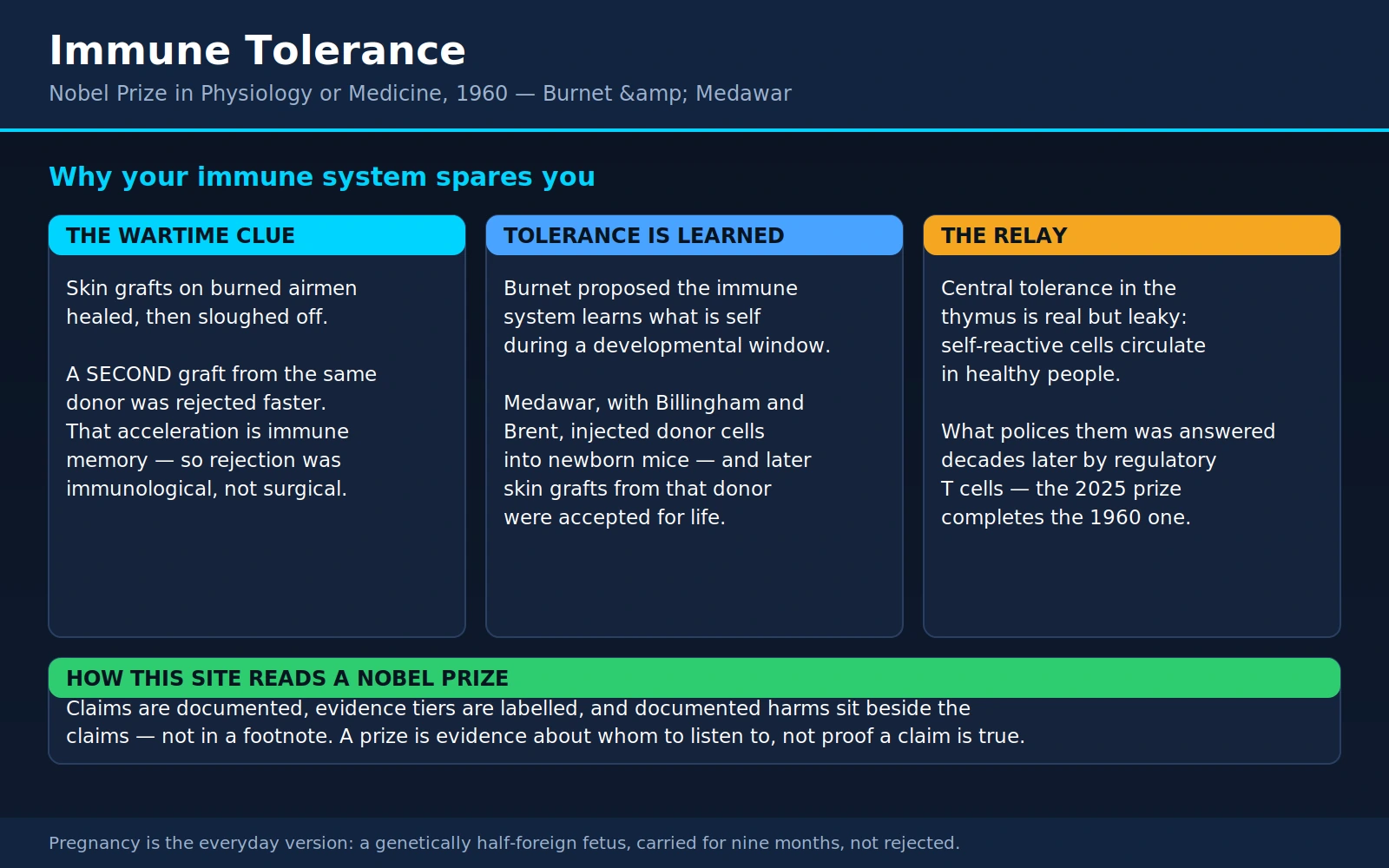
Your immune system spends every hour of your life deciding what to destroy. It kills bacteria, it kills virus-infected cells, it kills things it has never encountered before. And it is surrounded, constantly and on every side, by roughly thirty trillion of your own cells — which it does not touch.
That restraint is not an absence of action. It is not that your immune system simply fails to notice you. It is an active, learned, maintained discipline, and it is arguably the single most remarkable thing your body does. Two men worked out how it happens, from opposite ends of the problem, and shared the 1960 Nobel Prize in Physiology or Medicine for it.
Table of Contents
- The Prize and the Two Men
- The Wartime Problem That Started It
- Burnet's Question: Why Doesn't It Attack You?
- The 1953 Experiment: Tolerance Made to Order
- Clonal Selection: One Idea That Explained Everything
- Where the 1950s Picture Was Incomplete
- What Tolerance Explains in Ordinary Life
- When Tolerance Fails: Autoimmune Disease
- When Tolerance Is Too Good: Cancer and Chronic Infection
- Therapeutic Tolerance: The Field's Holy Grail
- Burnet's Honest Complications
- Where Mainstream Medicine Agrees — and What Remains Hard
- Key Research Papers
- Connections
- Featured Videos
1. The Prize and the Two Men
The 1960 Nobel Prize in Physiology or Medicine was awarded jointly to Sir Frank Macfarlane Burnet and Peter Brian Medawar "for the discovery of acquired immunological tolerance." It is one of the cleanest divisions of labour in the history of the prize: one man supplied the theory, the other proved it in the laboratory, and they worked twelve thousand miles apart.
Frank Macfarlane Burnet (1899–1985)
Burnet was born in Traralgon, a country town in the Australian state of Victoria, the son of a bank manager. He trained in medicine at the University of Melbourne, then spent essentially his whole career at the Walter and Eliza Hall Institute in Melbourne, directing it from 1944 to 1965. He was, by trade, a virologist — and a formidable one. He worked out how to grow influenza virus in fertilised hen's eggs, a technique that made large-scale influenza vaccine manufacture possible and is still in use. He did foundational work on bacteriophage. He identified the organism behind Q fever so decisively that it carries his name to this day: Coxiella burnetii.
What made him unusual was that he was also a genuine theorist — a naturalist-turned-immunologist who thought in terms of populations, selection and ecology at a time when most immunologists thought in terms of chemistry. He was the sort of scientist who read Darwin and asked what Darwin implied about antibodies. That habit of mind is why the two ideas he is remembered for — acquired tolerance and clonal selection — are ideas rather than experiments.
He was knighted in 1951, received the Order of Merit in 1958, and was named Australian of the Year in 1960, the year of the prize. He is, to this day, one of the most decorated scientists Australia has produced. He was also a man who held views that this page will not skip past — see section 11.
Peter Brian Medawar (1915–1987)
Medawar was born in Petrópolis, Brazil, to a Lebanese father and an English mother, and was sent to England for school. He read zoology at Magdalen College, Oxford, and by temperament he was an experimentalist and a superb writer — two things that rarely arrive in the same person. He held chairs at Birmingham and then University College London, and from 1962 to 1971 directed the National Institute for Medical Research at Mill Hill.
In 1969, at the age of 54 and at the peak of his powers, Medawar suffered a severe stroke — a subarachnoid haemorrhage — while reading a lesson at Exeter Cathedral during a meeting of the British Association for the Advancement of Science. It left him with permanent paralysis on his left side and impaired vision. He resigned the directorship of Mill Hill two years later.
And then he kept working for nearly two more decades. He moved to a smaller laboratory at the Clinical Research Centre in Northwick Park, continued to publish, and wrote the books he is now best known for outside immunology. The Art of the Soluble, Advice to a Young Scientist, Pluto's Republic, The Limits of Science, and the memoir Memoir of a Thinking Radish are still read, still assigned to students, and still quoted — his line that science is "the art of the soluble," and his insistence that the scientific paper as a literary form is a systematic misrepresentation of how research actually happens, have outlived most of the technical literature of his era. He suffered further strokes and died in 1987. He was appointed to the Order of Merit in 1981.
It is worth pausing on that. A great deal of the writing that shaped how the general public understands what scientists actually do was produced by a half-paralysed man in his sixties and seventies, working with one hand, after the career that won him a Nobel Prize had effectively ended.
2. The Wartime Problem That Started It
None of this began as a question about the philosophy of the self. It began with burned airmen.
In the early years of the Second World War, Britain had a specific and terrible surgical problem. Aircrew in burning bombers and fighters were surviving crashes with burns over enormous areas of skin. A patient who has lost most of their skin cannot heal it back; they die of fluid loss and infection. The obvious answer was to graft skin from somebody else — a donor, a relative, anyone. Surgeons had tried it. It did not work, and nobody could say why.
Medawar, then a young zoologist in Oxford with no medical training, was pulled into the problem — by the widely repeated account, after an RAF aircraft crashed near his home and a surgeon asked whether a biologist could help. The Medical Research Council's War Wounds Committee funded him to find out what was happening.
He went to the Burns Unit at the Glasgow Royal Infirmary and worked with the plastic surgeon Thomas Gibson on a patient with severe burns. They grafted small pieces of skin donated by the patient's brother onto her, and watched. The grafts took. They knitted in, grew a blood supply, looked for a fortnight like they were going to work — and then, at around two weeks, they died. The tissue was invaded by lymphocytes, broke down, and sloughed away.
Then Gibson and Medawar did the thing that turned a surgical disappointment into a discovery. They applied a second set of grafts from the same donor. If graft failure were a matter of technique, or nutrition, or the graft simply being too fragile to survive on a burn bed, the second batch would behave like the first: take, hold for a fortnight, then fail.
It did not. The second set was destroyed much faster — and in some cases never took at all. They published this in 1943 as "The fate of skin homografts in man."
That accelerated destruction is the entire clue, and it is worth being explicit about why. Speeding up on the second exposure is the signature of immunity. It is the same phenomenon as the second dose of a vaccine, the same phenomenon as never getting measles twice. The body had remembered the donor. A surgical failure does not remember anything; a tissue that is simply too weak to survive does not get weaker the second time you try. Only an immune response behaves this way.
Medawar followed it up with systematic rabbit experiments — hundreds of grafts, first sets and second sets, autografts (skin moved on the same animal, which always survived) against homografts (skin from another rabbit, which always eventually died). The two Journal of Anatomy papers he wrote for the War Wounds Committee in 1944 and 1945 established the pattern beyond argument, and named what became known as the second-set response.
The conclusion was blunt and it changed a field: graft rejection is an immune reaction, not a surgical one. No amount of better suturing was going to fix it. If you wanted transplanted tissue to survive, you had to do something about the immune system — which is the entire premise on which organ transplantation would later be built (see Murray and Thomas, who did the building).
3. Burnet's Question: Why Doesn't It Attack You?
While Medawar was establishing that the immune system attacks foreign tissue, Burnet in Melbourne was chewing on the mirror-image problem, which is much stranger the longer you look at it.
The immune system, on the evidence, can recognise and attack essentially anything foreign — including molecules that have never existed in nature, synthesised in a laboratory for the first time that morning. Its repertoire is effectively unlimited. So how does an unlimited weapon avoid its owner?
This was not a new worry. Paul Ehrlich had named it around 1901 with the phrase horror autotoxicus — literally, the horror of self-poisoning. Ehrlich's intuition was that the organism must possess some contrivance that prevents it from making antibodies against its own tissues, because the alternative was obviously lethal. He was right that a contrivance existed. He had no way of knowing what it was, and for half a century neither did anyone else.
The lazy answer — and it was the standing answer — was that self-molecules must be chemically special somehow, marked in some way that the immune system could read as "do not attack." Burnet's version of this in the 1940s was the "self-marker" hypothesis. It had a fatal problem, which he came to see himself: your body contains such a huge chemical variety of molecules that there is no plausible common mark they could all carry. Insulin and keratin and the inside of a mitochondrion have nothing chemically in common.
The clue from cattle
The unlock came from an unexpected direction: cows.
In 1945, an American geneticist named Ray D. Owen, working at the University of Wisconsin, published a short paper in Science about non-identical (fraternal) cattle twins. Cattle twins very often share a placental blood supply in the womb, the two circulations fusing through vascular connections. Owen found something that should have been impossible: these twins, who were genetically as different as any two siblings, carried each other's red blood cells — not briefly, but permanently, for the whole of their adult lives. Each animal was a stable mixture of two genetically distinct cell populations, a chimera.
And — the crucial part — neither animal made any attempt to destroy the other's cells. An adult cow given a transfusion from an unrelated cow would react against it. These cows did not react against cells that were, by any genetic measure, just as foreign. The difference was when the cells had arrived: before birth.
Burnet's proposal
Burnet, with his colleague Frank Fenner, set this out in the second edition of their monograph The Production of Antibodies in 1949. (The book is not indexed in PubMed — it is a Macmillan monograph published in Melbourne, and predates the era of comprehensive journal indexing. It can be tracked through library catalogues and through the later literature that cites it.) Their proposal reframed the whole question:
The immune system does not know what "self" is by chemistry. It learns it, by experience, during a critical window early in development.
The logic is beautifully economical. Suppose that during fetal and newborn life, any immune cell that reacts against something present in the body is deleted rather than activated. What is present in the body during that window? Your own tissues — all of them, in all their chemical variety. So every self-reactive cell gets removed, no marker required. What is left afterwards is a repertoire that by construction attacks anything except you.
It also makes a falsifiable prediction, which is what elevates it from a nice idea to science: if you introduce foreign material during that early window, the animal should treat it as self for life. Owen's cattle were the natural experiment. Burnet and Fenner predicted the deliberate one.
Burnet attempted the deliberate experiment himself in Melbourne, injecting antigens into chick and mouse embryos. It did not work. The technique was wrong, the antigens were wrong, and the results were ambiguous. He had published the prediction and could not deliver the proof — a frustration he was still writing about years later.
4. The 1953 Experiment: Tolerance Made to Order
The proof came from London, and it came from a team of three.
Medawar had read Burnet and Fenner. He also had a mundane practical reason to be interested: British cattle farmers wanted a reliable way to tell identical from fraternal twin calves, and Medawar had been asked whether skin grafting could do it — identical twins should accept each other's skin, fraternal twins should reject it. When his group tried it, fraternal twin calves accepted each other's grafts too. That made no sense until somebody remembered Owen's paper: these calves had shared a placental circulation. They were chimeras. They had been made tolerant of each other before birth, without anyone intending it.
That was the moment the two lines of work fused. Medawar had a theory worth testing, a technique for reading out the answer (skin grafting, which he had spent a decade perfecting), and two exceptional collaborators.
The experiment
Working with Rupert Everett Billingham and Leslie Brent, Medawar set up an experiment in inbred mouse strains — which matters, because within an inbred strain every animal is genetically identical, so a graft between two members of a strain is effectively a graft onto yourself, while a graft between strains is reliably rejected.
- Take a mouse fetus in utero (or a newborn) of strain A.
- Inject it with living cells — spleen, kidney, testis — from an adult mouse of strain CBA.
- Let it grow up. Do nothing else. Give it no drugs, no further treatment.
- Weeks later, when it is a fully immunocompetent adult mouse, graft a piece of CBA skin onto it.
Every prior expectation said the graft would be rejected within a fortnight, exactly as CBA skin was rejected by every other strain-A mouse on Earth.
It was accepted. It healed in, grew hair, and stayed. Permanently. The mice were not immunosuppressed — they rejected skin from a third strain perfectly normally. Their immune systems were fully functional. They had simply been taught, before birth, that CBA was part of the family.
They published it in Nature on 3 October 1953 under a title that says exactly what it is: "Actively acquired tolerance of foreign cells." The word actively is doing real work — this was not a passive failure to respond. It was a state that had been deliberately induced, and it lasted a lifetime.
This is what earned the Nobel. Owen had observed tolerance happening by accident in cattle. Burnet had predicted that it should be inducible. Billingham, Brent and Medawar made it — on demand, in a chosen species, against a chosen donor, in a laboratory. Tolerance stopped being a curiosity of bovine obstetrics and became a manipulable biological state. Everything in this article after this point follows from the fact that it can be manipulated.
Billingham and Brent
The prize went to Burnet and Medawar. It did not go to Billingham or Brent, and it is worth saying their names properly.
Rupert Everett Billingham (1921–2002) was a British biologist who had come to Medawar's lab after wartime service and who did much of the hands-on transplantation work; he later moved to the United States, to the Wistar Institute and then to the University of Texas Southwestern, and did foundational work on graft-versus-host disease and on the immunology of pregnancy.
Leslie Brent (1925–2019) was, at the time of the experiment, Medawar's PhD student. He had been born Lothar Baruch in Köslin, Germany. In December 1938, aged 13, he was put on a Kindertransport train to Britain by his parents. He never saw them again: his father Arthur, his mother Charlotte and his sister Eva were deported and murdered in the Holocaust. He took the name Leslie Brent while serving in the British Army, went to Birmingham to study zoology under Medawar, followed him to University College London, and was in his twenties when he helped perform one of the defining experiments of twentieth-century biology. He went on to a professorship at St Mary's Hospital Medical School in London and wrote A History of Transplantation Immunology, still the standard account of the field, and a memoir, Sunday's Child?
The Nobel Prize's three-laureate limit is a real constraint, and 1960 had only two names to fill it — so the limit was not what excluded them. Historians of the field have written directly about the oddities of that award; Arthur Silverstein's 2016 paper on the prize is a good, sceptical treatment of who was recognised for what. Medawar himself never obscured his colleagues' role: in his Nobel lecture, in his books and in his memoir, he credits them plainly. That does not make the omission right. It is simply how the record stands, and this site's practice is to state the record rather than tidy it.
5. Clonal Selection: One Idea That Explained Everything
Tolerance was Burnet's smaller idea. His larger one arrived in 1957, and it is the framework the entire modern discipline of immunology still sits on.
The problem it solved was this. Your immune system can make an antibody against essentially any molecular shape — including shapes that no organism has ever encountered. How? The dominant answer for decades was the instructive or template theory, championed by chemists of the stature of Linus Pauling: the foreign molecule acts as a mould, and the antibody-producing cell folds a generic protein around it to make a complementary shape. It is an intuitive idea and it is completely wrong.
The selective alternative had been floated by Niels Jerne in 1955, in a paper proposing that the body already contains a vast pre-existing library of antibodies and the antigen merely selects the ones that happen to fit. Jerne's version had a mechanical problem — it operated on free-floating antibody molecules, and it was not clear how selecting a molecule in the bloodstream could lead to more of that molecule being made.
Burnet's modification — and he named it as a modification, in the title of the paper, crediting Jerne explicitly — was to move the selection from the molecule to the cell. The American immunologist David Talmage arrived at a closely related idea independently and at almost the same moment, and Burnet credited him too.
The theory in four steps
- One cell, one specificity. Each lymphocyte carries receptors of a single specificity on its surface, generated before it has ever met an antigen. Your body makes millions of different lymphocytes, each committed to one shape, at random. The library is built blind, in advance.
- The antigen selects. When something foreign enters, it binds to whichever of those millions of cells happens to fit it. It does not instruct anything; it simply finds its match.
- The selected cell proliferates. Binding activates that cell, which divides repeatedly to produce a clone — thousands of daughter cells, all making the one antibody that fits. This is why an infection takes days to control: the matching clone has to be found and then grown.
- Self-reactive clones are deleted. Any clone whose receptor happens to fit one of your own molecules is destroyed during development, before it can do harm. This is the tolerance mechanism — now expressed in cellular terms rather than as a hypothesis about markers.
Burnet published the short paper in the Australian Journal of Science in 1957 and expanded it into a book, The Clonal Selection Theory of Acquired Immunity, in 1959.
Why it matters so much
Clonal selection is Darwinian natural selection running inside your body over a matter of days. Variation is generated at random and in advance; the environment (the antigen) selects; the successful variant reproduces. Burnet the naturalist saw it because he was in the habit of thinking that way.
And it explains, with one mechanism, a list of things that had previously needed separate explanations:
- Specificity — why an antibody against tetanus does nothing against diphtheria.
- Immune memory — a first exposure leaves the matching clone permanently enlarged, so the second response is faster and larger. This is Medawar's second-set graft rejection, and it is also every booster shot you have ever had.
- Vaccination — you are pre-expanding the right clone with something harmless, so the real pathogen meets an army instead of a scout.
- The lag before a response — the delay is the time taken to grow a clone from a handful of cells.
- Self-tolerance — the self-reactive clones were deleted.
- Autoimmunity — a self-reactive clone that escaped deletion, or was created later, and then got activated.
The last two are the same mechanism read forwards and backwards, which is why Burnet's two big ideas are really one idea. Direct experimental proof of the deletion step took another thirty years: in 1987, John Kappler, Nancy Roehm and Philippa Marrack showed in mice that T cells bearing a receptor capable of recognising self were physically eliminated in the thymus — clonal deletion, observed directly, exactly where Burnet had put it. The confirmation of Burnet's "one cell, one antibody" premise had come earlier still, in 1958, when Gustav Nossal — Burnet's own student, and later his successor at the Hall Institute — and Joshua Lederberg showed that a single antibody-producing cell makes antibody of a single specificity.
6. Where the 1950s Picture Was Incomplete
Here is where an honest account has to slow down, because the 1960 story is usually told as though it settled the matter. It did not. It opened a question that took another fifty years to answer, and this site's view is that the relay is more interesting than the myth of the single insight.
Burnet's mechanism is what immunologists now call central tolerance: self-reactive cells are deleted centrally, in the organs where they are made — T cells in the thymus, B cells in the bone marrow. This is real. It happens. The thymus is, functionally, a rather brutal finishing school: developing T cells are shown self-molecules, and those that bind too strongly are instructed to die. The great majority of T cells that enter the thymus never leave it.
There is even a beautiful piece of machinery for making the lesson comprehensive. A gene called AIRE (autoimmune regulator), working in specialised cells in the thymus, forces the local expression of proteins that properly belong to organs elsewhere in the body — insulin, thyroid proteins, retinal proteins. The thymus effectively stages a display of the whole body so that developing T cells can be tested against tissues they will not physically meet for years. Children born with defective AIRE develop a severe multi-organ autoimmune syndrome, which is about as direct a demonstration as biology offers that this mechanism is load-bearing. Anderson and Su's 2016 review in Nature Reviews Immunology is the accessible modern account (PMID 26972725).
The problem: it leaks
Central deletion is not complete, and this is not a small caveat. If you take blood from a perfectly healthy person with no autoimmune disease of any kind and look for T cells capable of recognising their own myelin, their own insulin, their own thyroid tissue — you find them. Routinely. In everybody.
That is a genuine problem for the 1950s picture. If the thymus deleted every self-reactive cell, those cells would not be there. They are there, in you, right now, and you are not sick. So something else must be holding them in check out in the body, continuously, for your whole life.
Burnet's framework had no room for that something. In his scheme, tolerance was a one-off editorial decision made during development: cut the dangerous cells, ship the rest. There was no ongoing police force.
What filled the gap
The answer turned out to be peripheral tolerance — an entire second system operating outside the thymus, throughout life. Part of it is cell-intrinsic: a self-reactive T cell that meets its target without the alarm signals that accompany a real infection is switched into a state of unresponsiveness called anergy, or is deleted then. But the largest part of the answer is a dedicated population of cells whose whole job is suppression.
Regulatory T cells — Tregs — are a specialised T-cell subset, defined by a transcription factor called FOXP3, whose function is to actively restrain other immune cells. They are not a passive absence of attack. They are a standing brake, applied continuously. Remove them from an animal and it develops devastating multi-organ autoimmune disease within weeks. Humans born with a broken FOXP3 gene develop IPEX syndrome, which is fatal in infancy without a bone-marrow transplant.
This is exactly the mechanism that Mary Brunkow, Fred Ramsdell and Shimon Sakaguchi were awarded the 2025 Nobel Prize in Physiology or Medicine for — the discovery of peripheral immune tolerance and the regulatory T cells that maintain it. The 2025 prize is the direct completion of the 1960 prize. Sixty-five years apart, the two awards are two halves of the same question: Burnet and Medawar established that tolerance is learned and can be induced; Sakaguchi and colleagues established what maintains it afterwards, every day, in the tissues.
That is the honest shape of this story, and it is a better story than the tidy version. Burnet was right about something enormous and incomplete about something equally enormous. Science is a relay, not a lightning strike. If you want the second leg of the race in detail, the 2025 laureates' page covers it.
7. What Tolerance Explains in Ordinary Life
It is easy to file all this as laboratory abstraction. It is not. Tolerance is doing visible, daily work in your body and in the bodies of people you know, and three examples make the point better than any amount of theory.
Pregnancy — the everyday miracle
A fetus carries a full set of the father's genes. Half of its proteins are, to the mother's immune system, foreign tissue — as foreign as a transplanted kidney from an unrelated donor, which the same immune system would destroy in days without powerful drugs.
The mother does not reject it. She carries it for nine months, in intimate contact with her own blood supply, and delivers it alive. Then, very often, she does it again with a different father's genes and it works just as well.
Medawar was the first to state clearly that this is a paradox demanding explanation — he set it out in 1953, the same year as the tolerance experiment, and the problem is still called the fetal allograft paradox in his honour. It is not solved by any single trick. The placenta is an unusual immunological barrier that withholds the classical molecules T cells use to identify foreign tissue; the uterine lining is actively reprogrammed so that inflammatory T cells are not recruited into it; and — strikingly — regulatory T cells specific for the father's molecules expand during pregnancy and are a substantial part of what keeps the peace. Erlebacher's review in Annual Review of Immunology is the standard modern synthesis.
When this system fails or is inadequate, the consequences are clinical rather than theoretical: disorders of pregnancy including pre-eclampsia and some cases of recurrent miscarriage have immune components, though the mechanisms are incompletely mapped and this is an active, unsettled research area rather than a solved one.
Your gut — the largest tolerance problem in your body
Your intestine faces a demand that is genuinely absurd when you state it plainly. On one side of a single layer of cells sit:
- Every food protein you have ever eaten — all of it structurally foreign, all of it a legitimate immune target on paper.
- Roughly forty trillion bacteria, thousands of species, of which the great majority are harmless or actively useful.
- And, occasionally, something that is genuinely trying to kill you.
The gut immune system — and there is more immune tissue around your intestine than anywhere else in your body — must ignore the first two categories completely while retaining a lethal response to the third, and it must make that discrimination thousands of times a day for decades.
It does this largely through oral tolerance: antigen encountered through the gut in the ordinary way, in the absence of danger signals, actively induces regulatory rather than aggressive responses. Specialised gut dendritic cells sample food and bacterial proteins and present them in a way that generates Tregs specific to them. Weiner and colleagues' review in Immunological Reviews is the standard reference.
Notice what this implies: tolerating your food is an active immunological achievement, not the default. When it fails, you get food allergy. When it fails against a specific food protein in a genetically susceptible person, you get coeliac disease. When it fails against your own gut, you get Crohn's disease or ulcerative colitis.
Peanuts — where the theory changed the advice
This is the most consequential recent example, and it is worth telling because it shows a seventy-year-old principle overturning standard paediatric guidance within living memory.
For years, parents of infants at risk of allergy were told to avoid peanuts — delay introduction, keep them away, on the intuitive logic that you cannot become allergic to something you never meet. Peanut allergy rates rose anyway, sharply.
The tolerance framework predicts the opposite of the guidance. Early exposure through the gut, in the ordinary way, should induce tolerance. Meanwhile exposure through inflamed skin — a baby with eczema, in a household where peanut protein is in the dust — is exposure through a route that signals danger, and should induce allergy. On that reading, avoidance advice was arranging for infants to meet peanut protein through the sensitising route and never through the tolerising one.
The LEAP trial (Learning Early About Peanut Allergy) tested this directly. Infants at high risk were randomised to eat peanut regularly from infancy, or to avoid it. Published in the New England Journal of Medicine in 2015, the result was decisive in favour of early introduction, with a large relative reduction in peanut allergy at age five in the consumption group.
Guidelines changed. The current advice for infants at risk is early, deliberate introduction — the reverse of what was recommended a decade earlier. The same principle underlies oral immunotherapy, in which people who are already allergic are given carefully escalating doses under medical supervision to raise their reaction threshold. That is a real, licensed treatment, and it is also genuinely risky if attempted without supervision — it is a deliberate, controlled provocation of an allergic person, and it belongs in a clinic. The story of anaphylaxis itself — the discovery that immunity has a destructive mode — belongs to Charles Richet.
8. When Tolerance Fails: Autoimmune Disease
If tolerance is what stops your immune system attacking you, then autoimmune disease is what happens when that stopping fails. Roughly one in ten people develops an autoimmune condition at some point; they are disproportionately common in women; and collectively they are among the largest causes of chronic illness in the world.
This section is written for people who have one of these diagnoses, so it will be plain about what is known and equally plain about what is not.
What the failure looks like
In each case, a clone of immune cells that should have been deleted or restrained is instead attacking a specific tissue:
- Type 1 diabetes — T cells destroy the insulin-producing beta cells of the pancreas. The target is precise, the destruction is essentially complete, and it is irreversible with current treatment.
- Hashimoto's thyroiditis — the thyroid is attacked and gradually destroyed, producing hypothyroidism. The most common autoimmune disease there is.
- Rheumatoid arthritis — the synovial lining of joints is attacked, causing inflammation, pain and, untreated, erosion of the joint itself.
- Coeliac disease — unusually, the trigger is known: gluten, in people carrying particular HLA types. The immune response damages the lining of the small intestine.
- Lupus (SLE) — antibodies form against the body's own DNA and nuclear proteins, so the attack is not confined to one organ but can involve skin, joints, kidneys, blood and brain.
- Multiple sclerosis — the myelin insulation around nerve fibres in the brain and spinal cord is attacked, disrupting signal conduction.
- Sjögren's syndrome — tear and salivary glands are attacked, causing profound dryness alongside systemic effects.
- Myasthenia gravis — antibodies block the receptor that nerves use to signal muscles, causing fatiguable weakness.
Coeliac disease is the exception that proves how hard the rest are. There, the environmental trigger is identified, the genetic susceptibility is defined, and removing the trigger stops the disease. That combination has not been achieved for any of the others.
Why does tolerance fail? The honest answer
For most autoimmune diseases, no single cause is established. That sentence is not a hedge and it is not this page being cautious — it is the actual state of the field, and you should be sceptical of anyone who tells you otherwise, in either direction. What exists is a set of contributing factors, each real, none sufficient:
- Genetic susceptibility — real, but not destiny. Particular HLA types (the molecules that display protein fragments to T cells) carry substantially increased risk, and variants in genes governing immune regulation contribute. But identical twins — who share every gene — are frequently discordant: one develops the disease, the other does not. For most autoimmune conditions, twin concordance is well below 50%. Genes load the gun; they do not fire it. This is also why a family history matters but does not decide anything.
- Molecular mimicry. A microbial protein resembles one of your own closely enough that an immune response raised against the infection cross-reacts with your tissue. This mechanism is proven for rheumatic fever, where streptococcal antigens cross-react with heart tissue, and there is strong evidence linking Epstein–Barr virus infection to multiple sclerosis risk. For most other conditions it remains a well-supported hypothesis rather than a demonstrated cause of any individual case.
- Loss of regulation. Regulatory T cells that are reduced in number, or present but functionally impaired, or outcompeted by aggressive cells. This is documented in several autoimmune diseases — and it is precisely the peripheral-tolerance mechanism that Burnet's 1950s framework had no room for.
- Environment. Infections, smoking (a well-established risk factor for rheumatoid arthritis in particular), some drugs, and probably others not yet identified. The drug-induced lupus that resolves when a medication is stopped is the clearest demonstration that an external trigger can produce an autoimmune syndrome.
- Sex. Women are affected far more often than men across most of these conditions — roughly nine to one for lupus and Sjögren's, and strongly skewed for thyroid autoimmunity. Contributing explanations include X-chromosome gene dosage and hormonal effects on immune function, and this remains actively researched rather than settled.
Rosenblum, Remedios and Abbas's 2015 review in the Journal of Clinical Investigation is a clear and honest synthesis if you want the technical version.
What this means if you have one
A few things follow that are worth saying directly to someone living with one of these diagnoses.
It is not your fault, and it is not a weak immune system. Autoimmune disease is an immune system that is working hard and aiming at the wrong target. The phrase "weakened immunity" is the opposite of what is happening, and treatments that "boost the immune system" are, on the mechanism, pointed the wrong way.
The mechanism being incompletely understood does not mean treatment is guesswork. This is the distinction that matters most in practice. We do not know why most people develop rheumatoid arthritis, and modern treatment still changes its natural history dramatically — disease-modifying drugs and biologics have made severe joint destruction far less common than it was a generation ago. Thyroid hormone replacement in Hashimoto's works regardless of why the thyroid was attacked. Not knowing the first cause and not being able to treat the disease are different problems.
Be careful with claims that a single dietary or lifestyle change reverses autoimmunity. Coeliac disease is genuinely trigger-removable, and that fact gets generalised far beyond the evidence. Diet, sleep, stress and smoking cessation are worth attention and can materially affect how you feel and, for smoking in rheumatoid arthritis, affect risk and severity. But "reversal" claims for conditions with no identified trigger are running ahead of what anyone can support, and the cost of believing them is usually a delay in treatment that does work.
9. When Tolerance Is Too Good: Cancer and Chronic Infection
Tolerance has a second failure mode, and it is the mirror image of the first: sometimes the immune system tolerates something it should be destroying.
Cancer
A tumour is your own cells, mutated. That is the crux of the problem. Those mutations generate abnormal proteins that the immune system can, in principle, recognise as foreign — and it often does; immune cells infiltrating tumours are a common finding, and in some cancers the extent of that infiltration predicts survival.
But a tumour is also, from the immune system's point of view, mostly self — and every mechanism evolved to prevent attack on self is available for the tumour to exploit. Successful tumours do exactly that. They recruit regulatory T cells into their microenvironment. They produce suppressive signals. And they display checkpoint molecules — the same molecules that normally shut down a T cell once an infection is cleared, so that the response does not run on indefinitely and damage healthy tissue.
A tumour expressing PD-L1 is, in effect, showing an approaching T cell a legitimate credential that says stand down, everything here is fine. The T cell recognises the tumour, engages it, and then switches itself off, because that is what it is built to do when it receives that signal.
Which is why checkpoint inhibitors work by deliberately breaking tolerance. Drugs that block CTLA-4 or PD-1/PD-L1 remove the brake and let the T cell finish what it started, producing durable remissions in cancers that were rapidly fatal a generation ago. It is a straight line from Burnet's framework: if tolerance is an active, mechanistic state rather than an absence, then it has machinery, and machinery can be interfered with. The work belongs to James Allison and Tasuku Honjo, who received the 2018 Nobel Prize for it.
And the confirmation that this is genuinely tolerance being broken, rather than something else, is written in the side effects. Checkpoint inhibitors cause immune-related adverse events — colitis, thyroiditis, hepatitis, dermatitis, hypophysitis, occasionally type 1 diabetes. In other words, releasing the brake on anti-tumour immunity releases the brake on self-reactivity too, and patients develop iatrogenic autoimmune disease. Sections 8 and 9 of this page are the same mechanism, dialled in opposite directions.
Burnet also proposed, in the late 1950s, the idea of immune surveillance — that the immune system routinely detects and eliminates arising cancer cells. The idea was contentious for decades and was for a time largely dismissed. In its modern, qualified form it is accepted: immunodeficient people do have elevated rates of certain cancers, and the clinical success of immunotherapy is a practical demonstration that the immune system can control tumours. Burnet was, once again, directionally right and ahead of the evidence.
Chronic infection
Some pathogens survive by inducing tolerance to themselves. Chronic viral infections drive responding T cells into a dysfunctional state called exhaustion — the same checkpoint machinery, chronically engaged, until the T cells persist but no longer function. Certain parasites actively promote regulatory responses in the host that damp down the attack on them. In each case the pathogen is not hiding from the immune system so much as persuading it to stand down, using signals the host cannot afford to ignore in general.
10. Therapeutic Tolerance: The Field's Holy Grail
If tolerance can be induced — and Billingham, Brent and Medawar proved in 1953 that it can — then in principle you could induce it on purpose, against a chosen target, in a patient. That prospect has driven immunology for seventy years. It would be transformative in three areas.
1. Transplantation without lifelong immunosuppression
This is the largest prize. Every organ transplant recipient takes immunosuppressive drugs for as long as the organ functions. Those drugs work — but they suppress immunity generally, not selectively, so recipients carry raised lifelong risks of infection and of certain cancers, plus drug-specific toxicity including kidney damage from the calcineurin inhibitors that are the mainstay. Stopping the drugs usually means losing the organ.
A tolerant recipient would accept the graft indefinitely on no drugs, with a fully intact immune system otherwise — exactly the state of Medawar's 1953 mice.
There are real footholds here, and they should be stated accurately. The most striking is the combined kidney and bone-marrow transplant approach: a recipient is given bone marrow from the same donor as the kidney, deliberately creating a chimeric state reminiscent of Owen's cattle. Kawai and colleagues reported in the New England Journal of Medicine in 2008 that a small number of patients receiving HLA-mismatched kidneys under such a protocol were able to discontinue all maintenance immunosuppression and retain functioning grafts. Later studies from several centres have extended this. Separately, a minority of liver transplant recipients — the liver being an unusually tolerogenic organ — can be weaned off immunosuppression entirely under careful protocolised monitoring, and trials of regulatory T cell infusion in transplantation have been conducted and shown acceptable safety.
These are genuine results in real patients. They are also small, highly selected, protocol-intensive, not without risk, and not standard care. The overwhelming majority of transplant recipients in 2026 take immunosuppressive drugs for life. Anyone who tells you tolerance induction is a solved clinical problem is overstating it substantially.
2. Antigen-specific therapy for autoimmune disease
Current autoimmune treatment mostly works by turning immunity down broadly — steroids, methotrexate, biologics targeting particular cytokines or cell populations. Effective, often dramatically so, but non-selective, with infection risk as the price.
The goal is to restore tolerance to one target — teach the immune system to leave myelin alone while retaining every other response intact. Approaches under investigation include tolerogenic dendritic cell therapies, peptide immunotherapy, nanoparticle-delivered self-antigen, and expanded or engineered regulatory T cells directed at a specific tissue.
The honest status: largely experimental. Animal models are frequently and impressively successful; human trials have been much harder, and the field has a long history of results that did not translate. There is one important partial exception — in type 1 diabetes, an anti-CD3 antibody has been shown in trials to delay the onset of clinical disease in high-risk relatives with early autoimmunity, and has been approved for that use in the United States. That is a real, licensed intervention that alters the course of an autoimmune process. It is also a delay rather than a cure, and it applies to a narrow, screened population.
3. Allergy
This is where tolerance induction has come closest to routine practice. Allergen immunotherapy — escalating doses of allergen given under the tongue or by injection over years — is established treatment for allergic rhinitis and for venom allergy, where it is highly effective. Oral immunotherapy for food allergy is licensed for peanut in some countries and raises reaction thresholds substantially, though it usually requires continued dosing to maintain the effect and carries a real risk of reactions during treatment.
The scorecard
Seventy years after Medawar's mice, the fair summary is this: tolerance induction is real, it is proven in humans, and it remains mostly aspirational as a general clinical strategy. The gap between "we can do this in an inbred mouse before birth" and "we can do this in an adult human with an established immune repertoire and an existing disease" turned out to be enormous. The inducing window Burnet identified is a developmental one, and adults are not in it. Everything since has been an attempt to reproduce, by pharmacology and cell therapy, a state that biology only hands out for free in the womb.
11. Burnet's Honest Complications
This site does not launder scientific reputations. Burnet's contribution to immunology is enormous and is described accurately above. His record also contains material that a full account has to state.
Eugenics. Burnet held and published eugenic views for much of his career, including well after the Second World War had made such positions disreputable in most of the scientific world. He wrote about the genetic "quality" of populations, expressed concern about the reproduction of people with inherited disease, and in his later books — notably Endurance of Life (1978) — set out positions on genetic screening, reproduction and the management of ageing and death that drew substantial criticism at the time and read worse now. These were not private remarks; they were published under his name in books intended for a general readership.
Biological weapons advice. Australian government documents declassified decades later, and reported in the Australian press in 2002, show that Burnet advised the Australian government on biological warfare. In a memorandum prepared in the late 1940s and in subsequent committee work in the early 1950s, he assessed the military potential of biological agents for Australia and discussed their use against the populations and food crops of densely populated countries to Australia's north, in Southeast Asia. He argued that such weapons would be of particular strategic value to a country in Australia's position — small in population, facing far larger neighbours — and that agents targeting crops and livestock, as well as human disease agents, warranted investigation. Australia did not develop a biological weapons programme, and Burnet's advice did not lead to one. That does not alter what the advice was.
How to hold this. The temptation is to resolve the discomfort in one of two ways: decide the science is tainted, or decide the politics are irrelevant. Neither is right.
The science is not tainted. Clonal selection is true, tolerance is real, and their truth does not depend on the character of the man who proposed them. Nature does not consult the biography of the person asking. If Burnet's ideas had to be discarded, the entire discipline of immunology would have to be rebuilt from scratch, and it would arrive at the same place.
But the politics are not irrelevant either, and there is something specific worth noticing. The same cast of mind that made Burnet a superb theorist — thinking about organisms as populations, about selection acting on variation, about biology at the scale of the species — is visibly the cast of mind that produced the eugenics and the strategic-biology memoranda. He applied population-level reasoning to human beings and reached conclusions that treat people as a population to be managed. The historians Warwick Anderson and Ian Mackay have written directly about how Burnet's conception of biological individuality connected to his broader social thought.
The lesson is not that theorists are dangerous. It is that scientific brilliance confers no authority whatsoever outside its domain, and that a Nobel Prize is a statement about one piece of work and about nothing else — not about wisdom, not about judgement, and certainly not about politics. That is worth remembering every time an eminent scientist's name is invoked as a warrant for a claim in a field they never worked in. This site keeps a page on prizes that aged badly for related reasons.
12. Where Mainstream Medicine Agrees — and What Remains Hard
Settled, and not seriously disputed by anyone
- Self-tolerance is learned and actively maintained, not a chemical property of self-molecules. Burnet's central insight is correct.
- Clonal selection is how adaptive immunity works. Random pre-generated repertoire, antigen-driven selection, clonal expansion. The instructive/template theory is dead.
- Central tolerance happens in the thymus and bone marrow, self-reactive clones are deleted there, and this was demonstrated directly in 1987.
- Tolerance can be induced experimentally by introducing antigen during the developmental window — the 1953 result, reproduced innumerable times.
- Graft rejection is immunological, and transplantation medicine exists because of that finding.
- Central tolerance is incomplete, self-reactive lymphocytes circulate in healthy people, and peripheral mechanisms — regulatory T cells foremost — restrain them for life.
- Autoimmune diseases are failures of tolerance, and tumours exploit tolerance mechanisms.
Genuinely hard, and openly unresolved
- Why does tolerance fail in a particular person? Susceptibility factors are known. The trigger in an individual case is almost never identifiable. This is the honest answer to the most common question patients ask, and the field does not have a better one yet.
- Why the sex bias? The magnitude of the female predominance is not fully explained by any single mechanism.
- Can tolerance be induced in an adult, against a chosen antigen, safely? Occasionally and in narrow settings, yes. As a general strategy, not yet.
- Can transplant tolerance be made routine? Small-cohort successes exist; standard practice remains lifelong immunosuppression.
- How much do the microbiome and early-life environment shape tolerance? The associations are strong and the mechanisms are partly worked out in animals; causal human evidence is much thinner than the popular discussion implies.
- Can autoimmunity be reversed rather than suppressed? Delaying onset in high-risk individuals has been achieved in type 1 diabetes. Reversing established disease has not.
The through-line of this page is that a 1953 experiment in mice remains, seventy years later, ahead of clinical medicine. Medawar's mice were tolerant of foreign tissue, drug-free, for life. No routine treatment can yet reproduce that in a person. The theory is settled; the engineering is not.
13. Key Research Papers
Every citation below was verified against the PubMed record — journal, year, volume, and pages all confirmed — before being listed. Where a paper is a later reprint of an earlier original, that is stated explicitly.
- Gibson T, Medawar PB. The fate of skin homografts in man. Journal of Anatomy, 1943 Jul;77(Pt 4):299–310. The wartime observation that started everything: donor skin grafts are destroyed, and a second set from the same donor is destroyed faster. Accelerated rejection on second exposure is immune memory.
- Medawar PB. The behaviour and fate of skin autografts and skin homografts in rabbits: a report to the War Wounds Committee of the Medical Research Council. Journal of Anatomy, 1944 Oct;78(Pt 5):176–199. The systematic animal work establishing that self grafts always survive and non-self grafts always fail.
- Medawar PB. A second study of the behaviour and fate of skin homografts in rabbits: a report to the War Wounds Committee of the Medical Research Council. Journal of Anatomy, 1945 Oct;79(Pt 4):157–176. The second-set response characterised in detail, establishing rejection as an immunological phenomenon with memory.
- Owen RD. Immunogenetic consequences of vascular anastomoses between bovine twins. Science, 1945 Oct 19;102(2651):400–401. Two pages on cattle that supplied the decisive clue: fraternal twins sharing a placental circulation carry each other's blood cells permanently and never react against them. (PMID 17755278)
- Billingham RE, Brent L, Medawar PB. Actively acquired tolerance of foreign cells. Nature, 1953 Oct 3;172(4379):603–606. The Nobel experiment. Cells injected into fetal or newborn mice produce lifelong acceptance of skin grafts from the donor strain, in otherwise fully immunocompetent adults. Tolerance made, not merely observed. (PMID 13099277)
- Jerne NK. The natural-selection theory of antibody formation. Proceedings of the National Academy of Sciences USA, 1955 Nov 15;41(11):849–857. The selective theory Burnet credited and modified: antigen selects from a pre-existing repertoire rather than instructing a template. (PMID 16589759)
- Burnet FM. A modification of Jerne's theory of antibody production using the concept of clonal selection. CA: A Cancer Journal for Clinicians, 1976 Mar–Apr;26(2):119–121. This is a 1976 reprint, not the original. The paper first appeared in the Australian Journal of Science in 1957 (volume 20, pages 67–69), which is not indexed in PubMed; the CA reprint is the accessible indexed version and is labelled as such here to avoid misdating the idea by nineteen years. (PMID 816431)
- Kappler JW, Roehm N, Marrack P. T cell tolerance by clonal elimination in the thymus. Cell, 1987 Apr 24;49(2):273–280. Direct demonstration, thirty years after Burnet proposed it, that self-reactive T cells are physically deleted in the thymus. (PMID 3494522)
- Anderson MS, Su MA. AIRE expands: new roles in immune tolerance and beyond. Nature Reviews Immunology, 2016 Apr;16(4):247–258. How the thymus displays proteins belonging to distant organs so that developing T cells can be tested against tissues they will not meet for years. (PMID 26972725)
- Josefowicz SZ, Lu LF, Rudensky AY. Regulatory T cells: mechanisms of differentiation and function. Annual Review of Immunology, 2012;30:531–564. The standard reference on the peripheral-tolerance mechanism that Burnet's framework had no room for — and the subject of the 2025 Nobel Prize. (PMID 22224781)
- Erlebacher A. Immunology of the maternal–fetal interface. Annual Review of Immunology, 2013;31:387–411. Why a genetically half-foreign fetus is not rejected — the paradox Medawar named, and the several overlapping mechanisms that resolve it. (PMID 23298207)
- Weiner HL, da Cunha AP, Quintana F, Wu H. Oral tolerance. Immunological Reviews, 2011 May;241(1):241–259. How antigen encountered through the gut induces regulation rather than attack — the principle underlying food tolerance and, ultimately, early allergen introduction. (PMID 21488901)
- Du Toit G, Roberts G, Sayre PH, et al. Randomized trial of peanut consumption in infants at risk for peanut allergy. New England Journal of Medicine, 2015 Feb 26;372(9):803–813. The LEAP trial. Early, deliberate peanut introduction substantially reduced peanut allergy compared with avoidance, reversing standard infant-feeding guidance. (PMID 25705822)
- Rosenblum MD, Remedios KA, Abbas AK. Mechanisms of human autoimmunity. Journal of Clinical Investigation, 2015 Jun;125(6):2228–2233. A clear and appropriately humble account of what is and is not known about why tolerance fails in individual people. (PMID 25893595)
- Kawai T, Cosimi AB, Spitzer TR, et al. HLA-mismatched renal transplantation without maintenance immunosuppression. New England Journal of Medicine, 2008 Jan 24;358(4):353–361. Combined kidney and bone-marrow transplantation producing chimerism — deliberately recreating Owen's cattle in humans — allowing a small number of recipients to stop immunosuppression entirely. (PMID 18216355)
- Silverstein AM. The curious case of the 1960 Nobel Prize to Burnet and Medawar. Immunology, 2016 Mar;147(3):269–274. A historian of immunology examines what the 1960 prize actually recognised, and who was left out of it. (PMID 26790994)
- Anderson W, Mackay IR. Fashioning the immunological self: the biological individuality of F. Macfarlane Burnet. Journal of the History of Biology, 2014 Spring;47(1):147–175. Historical scholarship connecting Burnet's scientific conception of biological selfhood to his wider social and political thought — relevant background to section 11. (PMID 23341117)
Two sources referenced above are not indexed in PubMed and are deliberately not given false citations. Burnet FM and Fenner F, The Production of Antibodies, 2nd edition (Macmillan, Melbourne, 1949), is the monograph in which the developmental-learning hypothesis of self-tolerance was set out; it is a book, predating comprehensive journal indexing, and is traceable through library catalogues. Medawar's 1953 statement of the fetal allograft paradox appeared in Symposia of the Society for Experimental Biology, volume 7, and is likewise not indexed. Both are widely cited in the secondary literature listed above.
Live PubMed Searches
These links run a live search on PubMed rather than pointing at a fixed paper, so they stay current as new work is published.
- Acquired immunological tolerance — history
- Clonal selection theory
- Maternal–fetal immune tolerance
- Transplantation tolerance and withdrawal of immunosuppression
- Oral tolerance and food allergy
14. Connections
- All Notable Doctors
- Nobel Prize in Physiology or Medicine — the complete roll of laureates, 1901 to the present
- Brunkow, Ramsdell & Sakaguchi — the 2025 prize for peripheral tolerance and regulatory T cells, which completes the story this page begins
- Joseph Murray & E. Donnall Thomas — the surgeons who built organ and marrow transplantation on Medawar's finding that rejection is immunological
- James Allison & Tasuku Honjo — checkpoint inhibitors, which work by deliberately breaking the tolerance described here
- Paul Ehrlich — whose horror autotoxicus, coined around 1901, is the century-old intuition that the body must have some contrivance preventing it from attacking itself; Burnet supplied the contrivance
- Charles Richet — anaphylaxis: the discovery that immunity has a destructive mode, and the other face of the tolerance problem
- Élie Metchnikoff — phagocytes and cellular immunity, the other half of the founding argument about how immunity works
- Karl Landsteiner — blood groups: the first demonstration that human tissue comes in immunologically distinct types, without which transfusion and transplantation are impossible
- Prizes That Aged Badly — why a Nobel Prize is a statement about one piece of work and nothing else
- Immunology — immune system disorders, including the immunodeficiencies that show what happens when the machinery fails in the other direction
- Rheumatoid Arthritis — tolerance failure against the joint lining, and one of the best-treated autoimmune diseases despite an unknown first cause
- Type 1 Diabetes — the precise autoimmune destruction of insulin-producing cells, and the one condition where onset can now be delayed
- Hashimoto's Thyroiditis — the most common autoimmune disease, and one where treatment works regardless of unknown cause
- Coeliac Disease — the exception: an autoimmune disease with an identified trigger that stops when the trigger is removed
- Lupus — tolerance failure against the cell nucleus itself, which is why the attack is not confined to one organ
- Multiple Sclerosis — myelin as the target, and the strongest current evidence for molecular mimicry in human autoimmunity
- Sjögren's Syndrome — tear and salivary glands attacked, and one of the most strongly female-predominant autoimmune conditions