Karl Landsteiner: Blood Groups, the Rh Factor, and Why Transfusions Stopped Killing
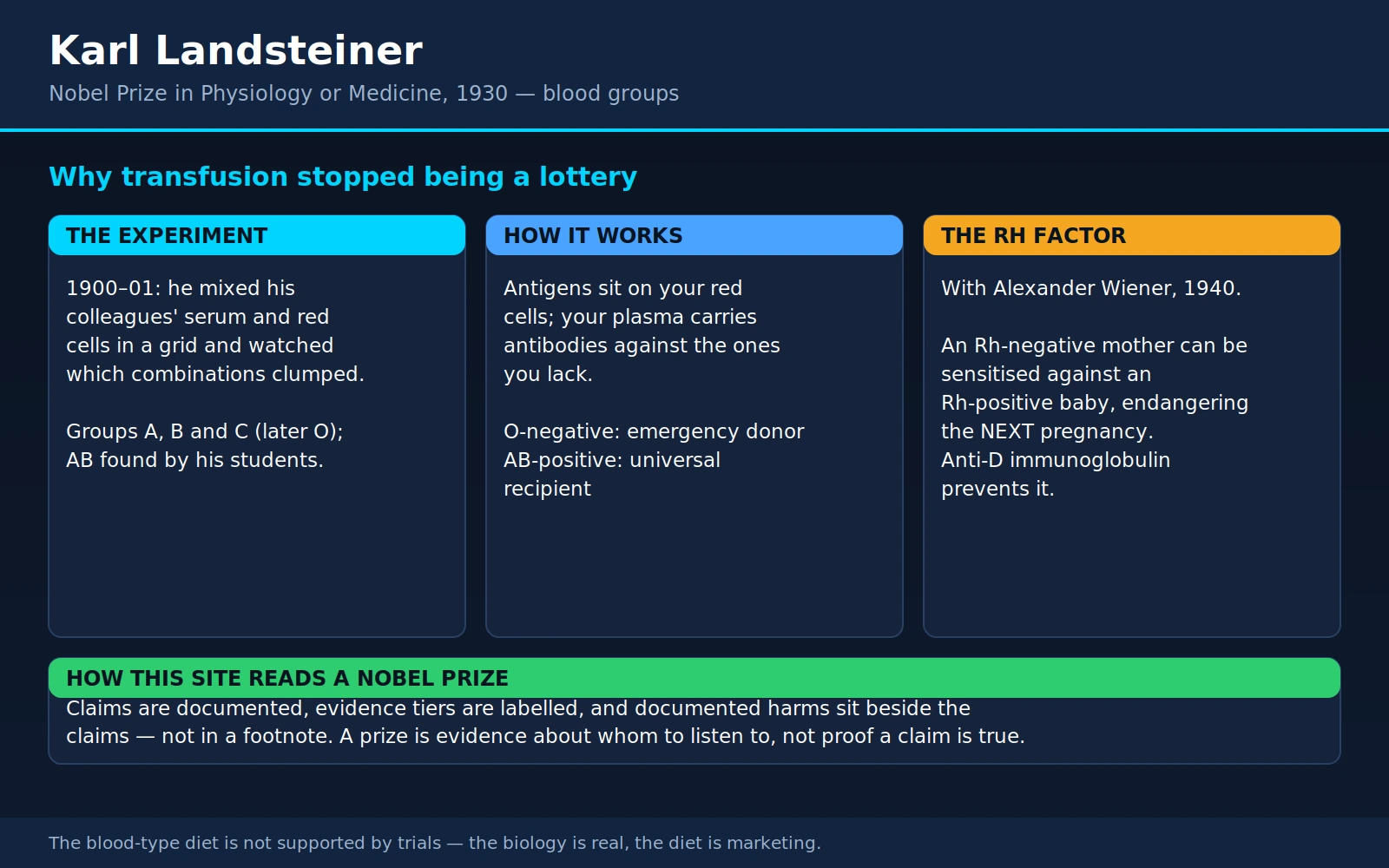
Table of Contents
- Who He Was
- Why Blood Transfusion Used to Kill
- The 1900–1901 Experiment
- What Your Blood Type Actually Is
- From Footnote to Operating Room
- Polio, 1909: The Forgotten Triumph
- Haptens and the Chemistry of Specificity
- The Rh Factor, 1940
- The Blood-Type Diet, Honestly
- Where Mainstream Medicine Agrees
- Key Research Papers
- Connections
- Featured Videos
1. Who He Was
Karl Landsteiner (1868–1943) is the reason a blood transfusion is one of the safest routine procedures in medicine instead of a coin flip with your life. Born in Vienna on June 14, 1868, he discovered the ABO blood groups in 1900–1901, proved in 1909 that polio is caused by a virus, invented the science of immunochemistry, and — at age 72, in his supposed retirement — co-discovered the Rh factor, the finding that would eventually save hundreds of thousands of newborns. He received the Nobel Prize in Physiology or Medicine in 1930, "for his discovery of human blood groups," twenty-nine years after the discovery itself. Any one of these achievements would anchor a career. He treated most of them as unfinished business.
His father, a prominent Viennese newspaper editor, died when Karl was six; he was raised by his mother, Fanny, to whom he stayed devoted his whole life — after her death he kept her death mask on his wall until his own. He took his medical degree at the University of Vienna in 1891, then did something unusual for a young physician of his day: he spent the next five years training as a chemist, including a stint in the Würzburg laboratory of Emil Fischer, the greatest organic chemist of the age and the man who worked out the structures of sugars. That combination — a physician who thought like a chemist — is the key to everything Landsteiner later did. Where other doctors saw mysterious "vital properties" in blood and immunity, he saw molecules that had to obey chemical rules.
Back in Vienna he took a post in pathological anatomy and spent a decade doing autopsies — more than 3,600 of them — while running serology experiments on the side. Colleagues described him as austere, shy, relentlessly self-critical, and prone to melancholy; he dreaded publicity, doubted the worth of his own work, and was happiest standing at a laboratory bench. After World War I left Vienna impoverished, he moved his family to the Netherlands in 1919 and took a modest hospital pathologist's job to survive. In 1923 the Rockefeller Institute in New York invited him over; he became a U.S. citizen in 1929 and worked at the Institute for the rest of his life. On June 24, 1943, he suffered a heart attack in his laboratory — pipette in hand, by the accounts of those who found him — and died two days later, at 75. It is hard to imagine an ending he would have preferred.
2. Why Blood Transfusion Used to Kill
To understand what Landsteiner solved, you have to understand the lottery that transfusion was before him. Physicians had been trying to transfuse blood since the 1600s — at first from animals, with predictably grim results, and after about 1818 from human to human, when the London obstetrician James Blundell began transfusing husbands' blood into wives dying of hemorrhage after childbirth. And here is the maddening part: sometimes it worked like a miracle. A woman bleeding to death would receive a pint of her husband's blood and sit up, pink and talking. And sometimes — with the same technique, the same care, the same kind of donor — the patient would be seized within minutes by shaking chills, crushing back and chest pain, a racing pulse, and then pass urine the color of dark cola or worse: black urine, the stain of ruptured red blood cells pouring their hemoglobin through the kidneys. Collapse and death often followed within hours.
Nobody could predict which transfusion would rescue and which would kill, because nobody suspected the truth: that human blood is not one substance. The assumption of the era was that blood was blood — one fluid, universal to the species. When mixing experiments in the late 1800s showed that serum from one animal species clumped the red cells of another, that was written off as a quirk of crossing species. When human serum occasionally clumped another human's red cells, doctors assumed it was a sign of disease in one of them. By the 1890s, the fatal roulette had discredited the whole procedure; most surgeons had abandoned transfusion in favor of injecting salt water, which did far less good but at least did not kill anyone in minutes. Transfusion was, in effect, a dead technology waiting for an explanation.
3. The 1900–1901 Experiment: Six Colleagues and a Grid
The explanation arrived as a footnote. In 1900, in a paper about other properties of serum, Landsteiner added a brief note: the serum of healthy human beings clumps the red blood cells of other healthy human beings. That single observation quietly demolished the disease theory — whatever this clumping was, it was normal physiology, not sickness. A colleague later called it possibly the most consequential footnote in medical history.
In 1901 he did the experiment that made it undeniable, and its beauty is that a high-school student could repeat it. Landsteiner drew blood from himself and five colleagues in his Vienna laboratory. He separated each person's blood into its two working parts: the serum (the yellowish liquid) and the red cells. Then he mixed every serum with every other person's red cells — a simple grid, six people down the side, six across the top — and watched what happened in each little drop.
Some combinations stayed smooth. Others curdled visibly, the red cells gathering into grainy clumps like sand in water. This clumping is called agglutination: antibodies in the serum grab onto markers on the foreign red cells and stick them together into clusters. In the body, the consequences go further — the clumped cells block small vessels and are then torn apart, a process called hemolysis, which is what floods the kidneys with hemoglobin and turns the urine black. The grid's pattern was not random. The six people sorted cleanly into groups whose serum tolerated their own group's cells and attacked the others'. Landsteiner named the groups A, B, and C — the third soon renamed O, the group whose cells nothing attacked. The following year, two of his students, Alfred von Decastello and Adriano Sturli, testing a larger series of people, found a fourth, rarer group whose cells were attacked by everyone else's serum: AB.
Landsteiner ended the 1901 paper — a few pages in a Viennese weekly — with one dry, prophetic sentence: the observations, he suggested, might explain the varying consequences of therapeutic blood transfusions. That sentence is the birth certificate of transfusion medicine. The fatal lottery had never been a lottery at all; it was chemistry, and now the chemistry had a map.
4. What Your Blood Type Actually Is
Here is the modern picture, which is still exactly Landsteiner's picture with the molecules filled in. The surface of each of your red blood cells is studded with inherited markers called antigens — for the ABO system, they are small sugar structures. Type A blood carries the A antigen, type B carries the B antigen, type AB carries both, and type O carries neither (the "O" is often read as the German ohne, "without").
The dangerous half of the system lives in your plasma: you carry ready-made antibodies against whichever ABO antigens your own cells lack. A type A person has anti-B antibodies patrolling their bloodstream from infancy, apparently primed by harmless gut bacteria that wear similar sugars. A type B person carries anti-A. Type O people carry both anti-A and anti-B; type AB people carry neither. This is why a mismatched transfusion fails instantly and violently — the recipient's antibodies are already there, waiting, and they attack the incoming cells within minutes. No sensitization, no delay, no second chance.
Work out the combinations and you get the rules every hospital lives by. O-negative red cells carry no A, no B, and no Rh D antigen (more on Rh in Section 8), so there is nothing on them for anyone's antibodies to grab — which is why O-negative is the emergency donor blood kept ready for trauma patients whose type nobody knows yet. AB-positive people carry every major antigen and therefore no anti-A or anti-B antibodies at all, making them the universal recipient for red cells. (Plasma runs in the mirror direction — AB plasma, containing no ABO antibodies, is the universal plasma donation.) These "universal" labels have fine print — there are dozens of minor blood group systems beyond ABO and Rh, which is why hospitals still crossmatch when there is time — but in an emergency, O-negative red cells are as close to universally safe as biology allows.
5. From Footnote to Operating Room
Discoveries do not become medicine by themselves, and for a few years the blood groups sat in the literature, largely ignored — Landsteiner himself moved on to other problems. The bridge to the bedside was built by others, and the names deserve their one line each. In New York, Reuben Ottenberg read the Vienna work and, starting in 1907 at Mount Sinai Hospital, began testing donor against recipient before transfusing — the first crossmatching — and went on to show that with matched blood, the catastrophic reactions simply did not happen. The second obstacle was that blood clots within minutes of leaving the body, which had forced surgeons to sew donor artery to recipient vein in real time. Around 1914–1915, Albert Hustin in Brussels, Luis Agote in Buenos Aires, and Richard Lewisohn in New York worked out that a small, safe dose of sodium citrate keeps drawn blood liquid — which meant blood could be collected into a bottle, stored cold, and carried to wherever it was needed.
Typing plus citrate plus refrigeration turned blood into a supply. In World War I, physicians — notably the American Oswald Robertson, working with the British in 1917 — built the first blood depots near the front, stocking citrated type O blood ahead of battles. Wounded soldiers who would have bled to death in every previous war in history survived. From there the line runs straight and unbroken to the present: blood banks in the 1930s, the donation system of today, and the "type and screen" on your own pre-operative paperwork — the routine test in which the lab determines your ABO and Rh type and screens your plasma for unexpected antibodies before any planned surgery. When you see that line item, you are looking at Section 3 of this page: a six-person grid from 1901, industrialized. Blood typing even escaped medicine entirely — because blood groups are inherited, they became the first biological evidence usable in paternity and forensic cases, decades before DNA.
6. Polio, 1909: The Forgotten Triumph
If Landsteiner had never touched blood, he would still belong in medical history for what he did in the winter of 1908–1909. Vienna was suffering a polio epidemic, and polio was then a terrifying mystery — a disease that struck children, paralyzed limbs within days, and killed when it reached the muscles of breathing. Bacteriology was king; Koch and his school had found the microbes of tuberculosis, cholera, and diphtheria. But no one could find a bacterium in polio, and no one could pass the disease to laboratory animals.
Landsteiner, working with his young assistant Erwin Popper, obtained the spinal cord of a nine-year-old boy who had died of the disease. No bacteria could be seen or cultured from it. Ordinary lab animals — rabbits, guinea pigs, mice — could not be infected. So Landsteiner did the expensive, unheard-of thing: he injected a suspension of the boy's spinal cord tissue into monkeys. The monkeys developed the paralysis of human polio, and under the microscope their spinal cords showed the same destruction of motor nerve cells seen in the dead child. Crucially, the infectious material passed through filters fine enough to trap all known bacteria, and it could then be passed from monkey to monkey. The agent was a "filterable virus" — the term of the day for an infectious particle smaller than any bacterium. Polio was a viral disease. Landsteiner and Popper published in 1909, and with Constantin Levaditi at the Pasteur Institute, Landsteiner went on to help show that survivors' serum could neutralize the virus — the first hint that immunity, and therefore a vaccine, was possible.
Everything that later beat polio stands on that foundation. John Enders and colleagues grew the virus in non-nervous tissue culture in 1949, which made vaccine production practical (and won its own Nobel). Jonas Salk's killed-virus vaccine arrived in 1955. Albert Sabin's oral live vaccine followed and carried eradication across the world. Salk and Sabin became household names; the man who proved there was a virus to vaccinate against rarely comes up. Landsteiner, constitutionally allergic to credit, would not have minded — but you should know it.
7. Haptens and the Chemistry of Specificity
At the Rockefeller Institute, Landsteiner spent the 1920s and 1930s on the question underneath all his other work: how does an antibody know what to bind? In his era, antibody specificity bordered on the mystical — the immune system simply "recognized" things, the way a dog recognizes its owner. Landsteiner replaced the mysticism with organic chemistry, using a tool he invented and named: the hapten.
A hapten is a small, simple molecule — too small to provoke an immune response on its own — that becomes a target when chemically bolted onto a carrier protein. Because Landsteiner the chemist could synthesize haptens to order, he could ask the immune system exquisitely precise questions. Move a chemical group from one position on a benzene ring to the position next door, and does the antibody still bind? (Often not.) Swap a right-handed form of a molecule for its mirror image? (The antibody can tell them apart.) Antibody specificity, he showed, is stereochemistry — the physical fit between molecular shapes — not vital magic. His 1936 book The Specificity of Serological Reactions distilled the program and effectively founded the field of immunochemistry; it shaped how Linus Pauling and everyone after thought about molecular recognition, and it is the intellectual ancestor of every monoclonal antibody drug in your pharmacy today.
Along the way, almost casually, he kept finding new blood groups. In 1927, with Philip Levine, he described the M, N, and P systems — additional inherited red-cell markers, mostly irrelevant to transfusion but immediately useful in paternity testing. The message of the M and N work turned out to matter enormously: ABO was not the end of blood's individuality. There were more markers to find. One of them would define his last act.
8. The Rh Factor, 1940: The Discovery That Saves Babies
In 1940, officially retired but still at his bench, Landsteiner and his colleague Alexander Wiener immunized rabbits with the red cells of rhesus monkeys and found that the resulting serum clumped the red cells of about 85 percent of the New Yorkers they tested. A new inherited marker — named the Rh factor, for rhesus — split humanity into Rh-positive (you carry the antigen, now called D) and Rh-negative (you do not). That is the "positive" or "negative" after your blood type, and unlike ABO, most Rh-negative people carry no pre-made anti-Rh antibody. They only make one if Rh-positive blood gets into their circulation. Which is precisely what pregnancy can do.
Here is the story as it plays out in a family, because this is the section worth reading slowly if you have ever seen "Rh-negative" on a prenatal panel. An Rh-negative mother conceives a child with an Rh-positive father, and the baby inherits Rh-positive blood. During the pregnancy — and especially during delivery, when small amounts of the baby's blood inevitably enter the mother's circulation — her immune system meets the D antigen for the first time and quietly learns to attack it. This is called sensitization. Her first Rh-positive baby is usually born healthy; the antibodies come too late to harm it. The danger is to the next Rh-positive baby. In a later pregnancy, her now-established anti-D antibodies cross the placenta and destroy the fetus's red cells — hemolytic disease of the fetus and newborn. In its mild form, a jaundiced, anemic infant; in its severe forms, brain damage from jaundice (kernicterus) or a baby so profoundly anemic it dies swollen with fluid before birth. For most of history this was an unexplained curse on certain families: a healthy firstborn, then stillbirth after stillbirth. Landsteiner's colleagues Philip Levine and Rufus Stetson traced exactly this mechanism from a 1939 case of a mother whose stillbirth was followed by a violent reaction to her own husband's blood — and the Rh work gave the curse a name and a test.
Then medicine did something rare: it did not just explain the tragedy, it abolished it. If you fill a mother's bloodstream with ready-made anti-D antibody at the moments fetal cells might leak in, the borrowed antibody sweeps those cells away before her immune system ever notices them — no sensitization, no antibodies of her own, no disease in the next baby. That is Rh immunoglobulin (the familiar brand name is RhoGAM, licensed in 1968): an injection around 28 weeks of pregnancy and another within 72 hours of delivering an Rh-positive baby, repeated in each pregnancy, plus extra doses after miscarriage, amniocentesis, or abdominal trauma. In the classic figures from the prophylaxis literature, an at-risk mother's chance of becoming sensitized fell from roughly one in six without treatment to a fraction of one percent with the full two-dose program. A disease that once filled entire hospital wards became, in countries with routine prenatal care, a rarity — one of the cleanest wins preventive medicine has ever recorded. So if your prenatal panel says Rh-negative, it is not a defect and not a danger to you; it simply means you will be offered those two unglamorous injections, which exist because a 72-year-old man in his "retirement" was still running agglutination grids like it was 1901.
9. The Blood-Type Diet, Honestly
Because this site documents popular health claims alongside the science, the blood-type diet gets its section — and Landsteiner's page is the right place for it, since the diet borrows his discovery for its branding. The claim: in the 1996 bestseller Eat Right 4 Your Type, naturopath Peter D'Adamo proposed that your ABO group encodes your evolutionary dietary destiny — type O as the "hunter" who thrives on meat, type A as the "agrarian" suited to vegetarian eating, type B the dairy-tolerant "nomad," AB the blend — with dietary lectins supposedly reacting with your blood-group antigens when you eat "wrong" for your type. Tens of millions of copies later, it may be the most widely followed piece of blood-group folklore on Earth.
The evidence tier: not supported. This has actually been checked, carefully, twice. A 2013 systematic review in the American Journal of Clinical Nutrition searched the entire literature for controlled trials of blood-type-based eating and found that no study supporting the diet's central claim exists — not weak evidence; no evidence. Then a 2014 study in PLoS One did the elegant test on 1,455 real people: those who happened to follow, say, the "type A" diet did show better cardiometabolic numbers — but the benefit was completely independent of whether they were actually type A. Eating more vegetables and less processed food helps everyone; your ABO group has nothing to do with it. A 2018 follow-up in a separate cohort reached the same conclusion. And the proposed mechanism does not rescue it — ABO antigens are real, dietary lectins are real, but the claimed type-specific interactions have never been demonstrated in a living human.
To be fair to the kernel of truth: blood type does have genuine, modest medical correlates — type O runs a slightly lower risk of venous blood clots, for example, and blood-group science is serious science. But none of it tells you what to eat. Landsteiner's discovery is real biology with a Nobel Prize behind it; the blood-type diet is marketing wearing its clothes. If following it has nudged you toward whole foods and vegetables, keep the whole foods and vegetables — they were doing the work all along, whatever letter is on your donor card.
10. Where Mainstream Medicine Agrees — and What the Record Complicates
Where everyone agrees: Landsteiner's standing in mainstream medicine is about as unclouded as a scientific reputation gets. ABO and Rh typing is universal, uncontroversial standard of care in every hospital on Earth; transfusion medicine, organ-transplant compatibility, and forensic serology all descend from the 1901 grid; the anti-D program of Section 8 is cited among the most successful preventive interventions in medical history; and the 1909 monkey experiments are the accepted foundation of polio virology. He is routinely called the father of transfusion medicine, and no serious historian disputes the paternity.
What the record complicates is mostly about who gets credit around him — and one irony of naming. The Rh story has a genuine priority dispute: Levine and Stetson described the human antibody behind hemolytic disease in 1939 but declined to name it; Landsteiner and Wiener's rhesus-immunization work was published in 1940 and supplied the name. Wiener and Levine then feuded for decades over who discovered Rh, a quarrel that outlived them both. Nature added the punchline: later work showed the antibody made by immunizing animals with rhesus-monkey cells actually targets a different molecule than the human anti-D antibody — that related antigen is now named LW, for Landsteiner–Wiener, while the "Rh" label stuck to a system that, strictly speaking, was misnamed from birth. There are smaller credit notes too: the Czech psychiatrist Jan Janský had independently described four blood groups by 1907, and his numeral system competed with Landsteiner's letters for decades before ABO was standardized in the 1930s. Landsteiner himself, characteristically, stayed out of the shouting; the man who fought hardest against publicity even objected, near the end of his life, to biographical attention of any kind. None of this diminishes him. It mostly shows how unusual he was: in a field of loud men, the quiet one built the floor they all stood on.
11. Key Research Papers
- Landsteiner K. Ueber Agglutinationserscheinungen normalen menschlichen Blutes (On agglutination phenomena of normal human blood) — the original 1901 blood-groups paper, Wien Klin Wochenschr 1901;14:1132-4; predates PubMed indexing. Related literature on PubMed
- Schwarz HP, Dorner F. Karl Landsteiner and his major contributions to haematology. Br J Haematol 2003;121(4):556-65
- Goldman AS, Schmalstieg FC. Karl Otto Landsteiner (1868-1943). Physician-biochemist-immunologist. J Med Biogr 2019;27(2):67-75
- Giangrande PL. The history of blood transfusion. Br J Haematol 2000;110(4):758-67
- Eggers HJ. Milestones in early poliomyelitis research (1840 to 1949). J Virol 1999;73(6):4533-5
- Urbaniak SJ, Greiss MA. RhD haemolytic disease of the fetus and the newborn. Blood Rev 2000;14(1):44-61
- Bowman J. Thirty-five years of Rh prophylaxis. Transfusion 2003;43(12):1661-6
- Storry JR, Olsson ML. The ABO blood group system revisited: a review and update. Immunohematology 2009;25(2):48-59; not indexed in PubMed. Related literature on PubMed
- Cusack L, De Buck E, Compernolle V, Vandekerckhove P. Blood type diets lack supporting evidence: a systematic review. Am J Clin Nutr 2013;98(1):99-104
- Wang J, García-Bailo B, Nielsen DE, El-Sohemy A. ABO genotype, 'blood-type' diet and cardiometabolic risk factors. PLoS One 2014;9(1):e84749
Live PubMed Searches
- Landsteiner blood groups history
- ABO blood group antigens
- Hemolytic disease of the newborn and anti-D
- Blood type diet evidence
- Transfusion crossmatch history
Connections
- All Notable Doctors
- Paul Ehrlich — the other founding immunologist: side-chain theory, magic bullets, and the chemistry Landsteiner refined
- Emil von Behring — serum therapy and the first Nobel in Medicine: the antibodies Landsteiner later explained
- Élie Metchnikoff — cellular immunity, the other half of the immune system's story
- Robert Koch — the bacteriology Landsteiner's virus work reached beyond
- The Nobel Prize in Medicine — the prize's story, and where 1930 fits in it
- Blood Type Test — the modern lab test descended directly from the 1901 grid
- Complete Blood Count (CBC) — the everyday census of the cells Landsteiner sorted
- Peripheral Blood Smear — where hemolysis and agglutination are seen under the microscope
- Reticulocyte Count — the marker that rises when red cells are being destroyed, as in hemolytic disease
- Blood Culture — hunting infections in the bloodstream
- Hematology — the blood diseases, from anemia to clotting disorders
- Anemia — including the hemolytic anemias, the destructive process behind transfusion reactions and Rh disease
- Infectious Disease — the viral diseases, the category Landsteiner's polio proof helped define