Linus Pauling: Vitamin C and Orthomolecular Medicine
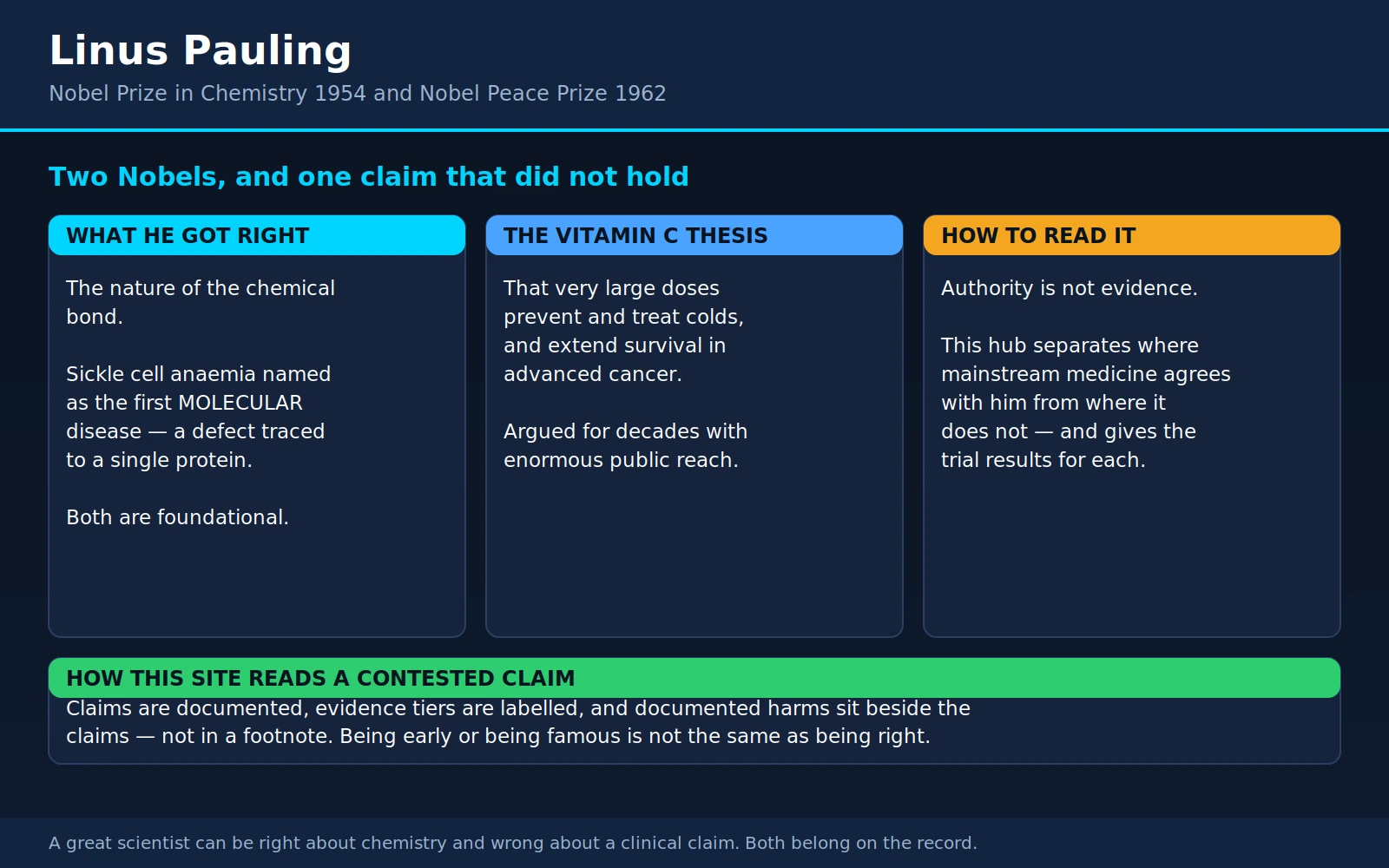
Linus Pauling (1901–1994) is the only person ever awarded two unshared Nobel Prizes — Chemistry in 1954 for his work on the nature of the chemical bond, and Peace in 1962 for his campaign against atmospheric nuclear-weapons testing. He founded molecular biology's central idea when he showed in 1949 that sickle cell anemia is a molecular disease, caused by a defective protein. Then, in the last third of his life, the most decorated chemist of the twentieth century became the world's most famous advocate of high-dose vitamin C — for colds, for cancer, for heart disease, for aging itself — and gave the movement he named orthomolecular medicine a scientific prestige no alternative-health idea has had before or since.
That double identity is exactly why Pauling is worth reading carefully. His vitamin claims cannot be dismissed as the ravings of a crank — he understood molecular biology better than nearly anyone alive — and yet the controlled-trial record did not confirm most of them. This hub documents both Paulings honestly: the claims as he made them, the evidence tier each claim actually sits on, and the places where his instincts — like his focus on lipoprotein(a) — look better today than they did at his death. The reader is the audience; this hub does not endorse a protocol.
Deep-Dive Articles
1. Vitamin C and the Common Cold
The 1970 bestseller that put megadose vitamin C in every medicine cabinet, Pauling's 1971 scientific defenses, and what half a century of randomized trials actually shows: no prevention in the general population, a real but modest effect on duration — and one athlete-and-soldier exception Pauling essentially got right.
2. Vitamin C and Cancer: The Cameron Collaboration
Ewan Cameron's 10 g/day ascorbate practice at Vale of Leven, the 1976 and 1978 PNAS survival papers and why their matched-historical-control design inflates benefit, the Mayo Clinic randomized answer, and how the oral question closed while the IV question later reopened.
3. Orthomolecular Medicine: The Theory
The 1968 Science paper that coined the word: the “right molecules” argument, localized cerebral deficiency, genetic individuality in nutrient needs, the debt to Hoffer and Osmond's niacin work, the mainstream rebuttals — and the pieces of the theory conventional medicine quietly kept.
4. The Pauling Therapy: Vitamin C, Lysine & Heart Disease
The Rath–Pauling hypothesis that cardiovascular disease is low-grade scurvy and lipoprotein(a) is the body's patch material; the vitamin C + lysine protocol still sold today on the strength of two 1990 papers and no adequate human trial; and the twist — mainstream cardiology now treats Lp(a) as a serious causal risk factor.
5. Scientific Legacy: The Chemical Bond to Molecular Disease
The mainstream giant: The Nature of the Chemical Bond, electronegativity, the alpha helix, the 1949 sickle-cell paper that founded molecular medicine, the near-miss on DNA, two Nobel Prizes, and the Linus Pauling Institute that carries his name into evidence-based micronutrient research today.
Who Was Linus Pauling?
Pauling was born in Portland, Oregon in 1901, worked his way through Oregon Agricultural College (today's Oregon State University), and took his PhD at Caltech, where he spent most of his career. In the 1930s he used the new quantum mechanics to explain how atoms bond, work summarized in The Nature of the Chemical Bond (1939) — still among the most-cited scientific books ever written. In 1949 he and Harvey Itano showed that sickle cell anemia is caused by a physically altered hemoglobin molecule — the first time any disease was traced to a specific molecule — and in 1951 he described the alpha helix, the basic coil of protein structure. The 1954 Nobel Prize in Chemistry followed.
His second act was political: alarmed by atmospheric bomb testing, Pauling organized a petition signed by more than eleven thousand scientists calling for a test ban, was branded disloyal and had his passport restricted during the McCarthy years, and was vindicated with the 1962 Nobel Peace Prize as the Partial Test Ban Treaty was signed. His third act began in the mid-1960s after biochemist Irwin Stone introduced him to gram-dose vitamin C. Pauling adopted it personally, escalated his own daily intake over the years, and spent his remaining decades — through the Linus Pauling Institute he co-founded in 1973 — arguing that optimal nutrient concentrations could prevent and treat much of human disease. He died of prostate cancer at his Big Sur ranch in 1994, at 93, still taking his ascorbate.
The Pauling Thesis on One Page
- Disease lives at the level of molecules. Sickle cell proved a single altered protein can produce a whole disease; Pauling generalized the idea into “molecular medicine.”
- Humans carry a repaired-by-diet genetic defect for vitamin C. Most animals synthesize ascorbate internally; humans lost the GULO enzyme and must eat it. Pauling argued the RDA-scale intake merely prevents scurvy, while gram-scale intake restores what our physiology “expects.”
- “Orthomolecular” means the right molecules in the right amounts. Treat disease by adjusting concentrations of substances normally present in the body — vitamins first — rather than only with foreign pharmaceuticals.
- Vitamin C became the flagship. Colds first (1970), then cancer with Ewan Cameron (1976), then cardiovascular disease with Matthias Rath (1990) — each claim bigger than the last, each resting on weaker evidence than the last.
- Adjunct, not always — but usually. Like Hoffer, Pauling generally framed nutritional therapy as accompanying conventional care; his cancer patients were treated patients. The framing matters medically and this site preserves it.
How to Read This Hub
If you know Pauling only as “the vitamin C guy,” start with Scientific Legacy to understand the stature he brought to the debate. For the practical question most readers arrive with, go to Vitamin C and the Common Cold — it has the cleanest evidence record and the most usable answer. The cancer collaboration is the famous controversy, best read alongside our IV High-Dose Vitamin C & Cancer page. The heart-disease protocol is where his ideas most directly intersect a modern cardiology topic — lipoprotein(a) — and where the gap between hypothesis and tested therapy is widest. The theory behind it all is in Orthomolecular Medicine, which pairs naturally with our Dr. Abram Hoffer hub.
Where Mainstream Medicine Agrees
- The molecular foundations are his. The chemical bond, protein secondary structure, and the molecular-disease concept are load-bearing walls of modern medicine, not contested claims.
- Vitamin C modestly shortens colds. The Cochrane evidence supports a real duration effect from regular supplementation (about 8% in adults, 14% in children), and a genuine prevention effect in people under acute physical stress.
- Vitamin C is required for collagen synthesis, and severe deficiency produces vascular fragility — the true core of the heart-disease hypothesis.
- Lipoprotein(a) is a causal cardiovascular risk factor. Pauling and Rath put their theory on a molecule mainstream cardiology now measures and targets with drugs in late-stage trials.
- Nutrient status genuinely matters in illness — from deficiency psychoses to the modern trials of vitamin C in critical care (see Vitamin C and ICU Recovery).
Where Mainstream Medicine Disagrees
- Megadose C does not prevent colds in the general population — the central claim of the 1970 book did not survive randomized testing.
- Oral high-dose C did not extend cancer survival in the randomized Mayo trials; the Cameron–Pauling survival differences are attributed to their non-randomized design. The separate IV-ascorbate question remains researched and unproven.
- The Pauling therapy for heart disease was never adequately tested — two 1990 papers and an animal model are its entire foundation, and vitamin C RCTs on cardiovascular outcomes have been negative.
- Orthomolecular megavitamin psychiatry failed replication and never entered guidelines.
- The final-years breadth — vitamin C framed as relevant to nearly every disease of aging — is regarded as the cautionary half of his biography: brilliance does not exempt a claim from controlled trials.
Connections
- All Notable Doctors
- Vitamin C and the Common Cold
- Vitamin C and Cancer: The Cameron Collaboration
- Orthomolecular Medicine: The Theory
- The Pauling Therapy: Vitamin C, Lysine, and Heart Disease
- Scientific Legacy
- Dr. Abram Hoffer — the clinical program Pauling's theory was built on
- Dr. Bryan Ardis
- Morley Robbins
- Vitamin C — the nutrient itself, evidence first
- IV High-Dose Vitamin C & Cancer
- Vitamin C and ICU Recovery
- Vitamin C and Collagen
- Vitamin B3 (Niacin)
- Lysine
- Cardiology
- Schizophrenia