Brunkow, Ramsdell & Sakaguchi: Regulatory T Cells and the Immune System's Brakes
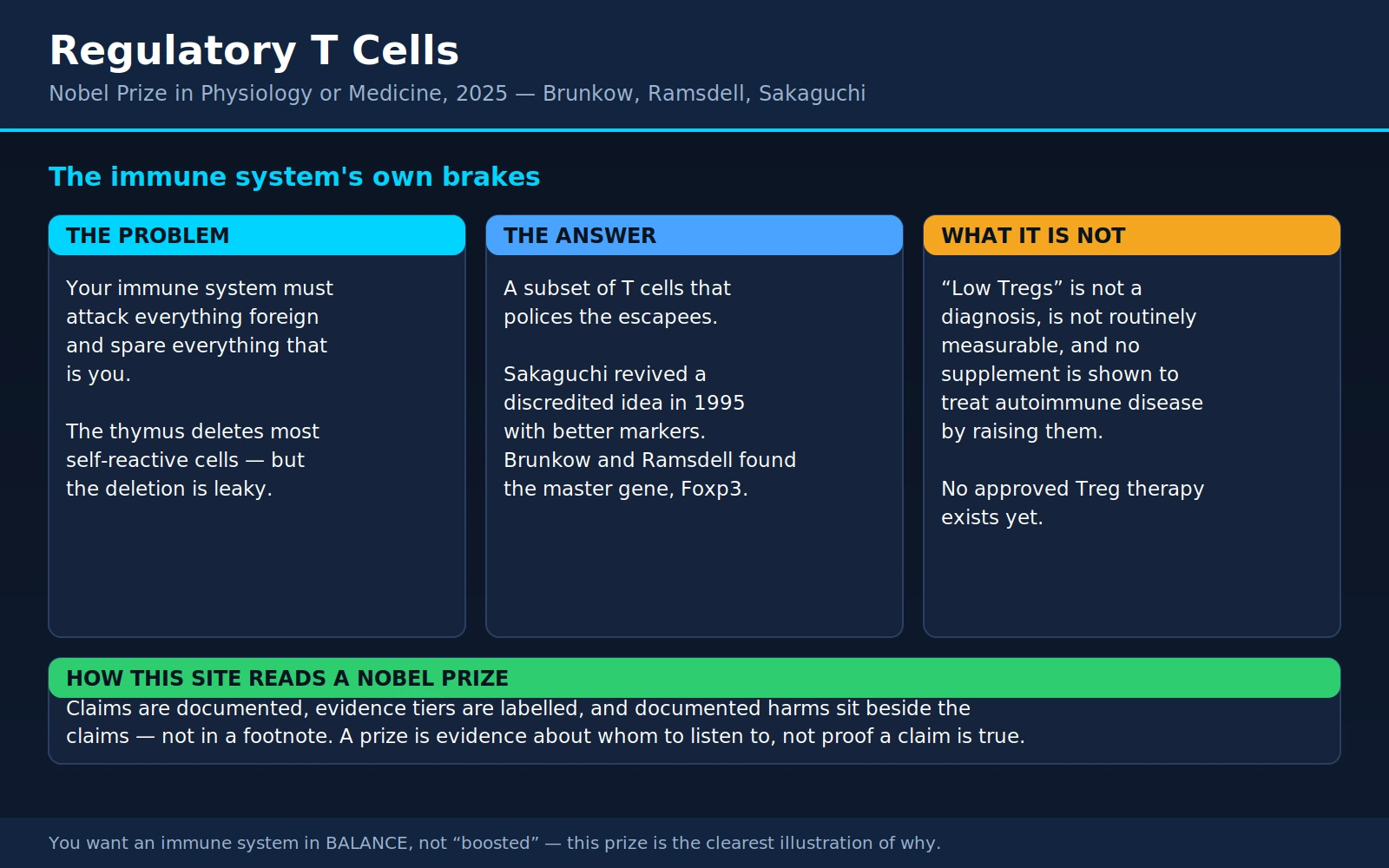
Table of Contents
- The 2025 Prize and the Three Scientists
- The Problem Tolerance Solves
- Sakaguchi's Unfashionable Idea, 1995
- Scurfy and IPEX: One Gene, Total Collapse
- Foxp3 Is the Master Switch, 2003
- What Regulatory T Cells Do All Day — and the Trade-Off
- What This Explains About Autoimmune Disease — and What It Doesn't
- Therapies: Real, Early, and Hyped
- Diet, the Microbiome, and Tregs
- Where Mainstream Medicine Agrees / Where Claims Outrun Evidence
- Key Research Papers
- Connections
- Featured Videos
1. The 2025 Prize and the Three Scientists
On 6 October 2025, the Nobel Assembly at the Karolinska Institutet awarded the Nobel Prize in Physiology or Medicine jointly to Mary E. Brunkow, Fred Ramsdell, and Shimon Sakaguchi — "for their discoveries concerning peripheral immune tolerance." The announcement is at nobelprize.org — 2025 Prize in Physiology or Medicine.
The prize honors the answer to a question that sounds childish and turns out to be one of the deepest in biology: why doesn't your immune system kill you? It is armed to destroy anything foreign, generates its weapons partly at random, and lives inside a body made of the tissues it could attack. Something holds it back; the three laureates found what.
Shimon Sakaguchi (born 1951 in Japan; now at Osaka University's Immunology Frontier Research Center) is the immunologist who, in 1995, demonstrated that a distinct population of T cells exists whose job is to suppress other immune cells — at a moment when the field considered the idea discredited.
Mary E. Brunkow (now at the Institute for Systems Biology in Seattle) and Fred Ramsdell (now associated with Sonoma Biotherapeutics, which develops regulatory T cell therapies) came at the same biology from the opposite direction — not from immunological theory but from genetics. At the biotechnology company Celltech Chiroscience in Washington State, they hunted down the single mutated gene behind a mouse strain that dies in infancy of runaway autoimmunity. In 2001 they found it and named it Foxp3; that same year, Ramsdell was part of the team showing the human version causes a devastating infant syndrome called IPEX. Two years later Foxp3 turned out to be the master gene that makes Sakaguchi's suppressor cells what they are. Those cells now have a name every immunologist uses daily — regulatory T cells, or Tregs.
One footnote. This is the most recent Nobel in medicine: the discoveries honored are decades old and thoroughly established, but the therapeutic chapter is still being written, and this page keeps those two categories apart throughout.
2. The Problem Tolerance Solves
Your adaptive immune system generates an enormous library of receptors — tens of millions of distinct T cell receptor specificities in one person — by cutting and randomly rejoining gene segments. Randomness is the trick: it lets your body recognize a virus that did not exist when you were born. It is also the problem, because a random library will inevitably contain receptors that fit you: your thyroid, your islet cells, your joint lining, your myelin, your gut. Paul Ehrlich saw the danger a century before anyone could explain it and named it horror autotoxicus, the body's "horror of self-poisoning." He assumed a safeguard must exist; he had no way to find it.
The first safeguard is central tolerance. T cells mature in the thymus and are tested there against self; those binding self-antigens too strongly are ordered to die. The thymus even cheats to make the test comprehensive, switching on genes it has no business expressing — insulin, thyroid proteins — so a developing T cell sees a sample of the body before release.
Here is the crux. Central tolerance is leaky. The thymus cannot display every self-antigen — some proteins appear only at puberty, only in pregnancy, only in a wound — and the deletion threshold cannot be set so strictly that it destroys the useful repertoire with the dangerous one. Self-reactive T cells demonstrably escape into circulation. They are present in healthy people. You are carrying them right now.
So something must police them out in the body, for a lifetime, everywhere. That is peripheral tolerance, and it is what the 2025 prize is for: not passive neglect of self-reactive cells, but a state actively enforced by a dedicated cell type whose entire job is suppression. The thymus is a hiring screen that rejects most bad candidates; Tregs are the supervisors who spend every day on the floor stopping the ones who slipped through.
3. Sakaguchi's Unfashionable Idea, 1995
In the early 1970s, immunologists proposed a class of "suppressor T cells" that damped down immune responses. For roughly a decade this was a hot field; then it collapsed. The defining markers did not hold up, a gene locus thought to encode a suppressor factor turned out on sequencing not to contain the gene at all, and results failed to reproduce between labs. By the late 1980s "suppressor T cell" was a phrase that could damage a grant application. The concept was not gently retired — it was discredited.
Sakaguchi had reasons not to let go. In the early 1980s he had shown that removing the thymus from newborn mice caused autoimmune disease of the ovaries, thyroid and stomach, and that transferring normal T cells prevented it — not what you expect if tolerance is purely deletional, since deleting self-reactive cells cannot be undone by adding cells. Something in the normal T cell pool was doing something protective. The missing piece was a reliable marker. In 1995, in the Journal of Immunology, Sakaguchi and colleagues supplied one: CD25, the alpha chain of the interleukin-2 receptor. The experiment runs both directions. Take them away: deplete CD4+CD25+ cells — roughly a tenth of CD4 T cells — transfer the rest into mice with no immune system of their own, and those mice develop spontaneous autoimmune disease across multiple organs: thyroiditis, gastritis, insulitis, oophoritis, adrenalitis. Put them back: co-transfer the CD4+CD25+ cells with the rest, and it does not happen. Necessity and sufficiency in one paper.
Note the method of rehabilitation: Sakaguchi did not defend the old literature, he rebuilt the claim on a molecule anyone could stain for, in an assay anyone could repeat. That is how a discredited idea comes back. Acceptance was still slow — CD25 also appears on ordinary T cells when activated — and it took a gene to settle it.
4. Scurfy and IPEX: One Gene, Total Collapse
The gene arrived from an entirely different direction. In 1949, at Oak Ridge National Laboratory, a spontaneous mutation appeared in a mouse colony; the affected animals — only males, marking it as X-linked — developed scaly, flaking skin, which gave the strain its name: scurfy. Scurfy males fail to grow, develop massively enlarged spleens and lymph nodes packed with activated T cells, suffer inflammation of liver, skin, lungs and gut, become anemic, and die at about three to four weeks of age. This is not immune deficiency but the opposite — immune catastrophe, a T cell system with no restraint attacking every organ at once. Remove the T cells and the disease does not occur, which localizes the fault precisely.
Finding the gene took the better part of five decades, because in the pre-genomic era that meant narrowing a chromosomal interval by breeding and marker analysis until a candidate fell out of it. Brunkow, Ramsdell and colleagues did exactly that, publishing the answer in Nature Genetics in January 2001. The scurfy mutation lay in a previously undescribed gene encoding a forkhead/winged-helix transcription factor they named scurfin — the gene is Foxp3. A small insertion truncates the protein, destroying the DNA-binding domain it needs to switch other genes on and off. That the whole collapse of immune self-restraint traced to one broken transcription factor was a strong hint that this gene sits near the top of a hierarchy.
Then came the part that turned a mouse curiosity into human medicine. In the same journal, in the same month, a second paper — with Ramsdell among the authors — reported that mutations in the human gene FOXP3 cause a rare inherited disease called IPEX: immune dysregulation, polyendocrinopathy, enteropathy, X-linked. Another group reported it independently and almost simultaneously; the finding was confirmed rather than debated.
IPEX shows what peripheral tolerance is worth. Affected boys typically present in the first months of life with severe enteropathy — intractable watery diarrhea and failure to thrive from autoimmune destruction of the intestinal lining — plus early-onset type 1 diabetes, sometimes in the newborn period, severe eczematous dermatitis, autoimmune thyroid disease, and autoimmune destruction of blood cells. Untreated, IPEX is generally fatal in infancy or early childhood. The only established curative treatment is hematopoietic stem cell transplantation, which gives the child a donor's supply of functioning regulatory T cells. Immunosuppressive drugs buy time; they do not fix the underlying absence.
Set the mouse and the child side by side and the argument is complete. One gene. Break it, and self-tolerance does not partially degrade — it fails. Foxp3 is not a fine-tuner; it is load-bearing.
5. Foxp3 Is the Master Switch, 2003
Two facts now sat on the table and obviously belonged together: Sakaguchi had a cell that suppresses autoimmunity, and Brunkow and Ramsdell had a gene whose loss produces exactly the autoimmunity you would expect if it were missing. In 2003, independent groups closed the circuit — Sakaguchi's, in Science, with Shohei Hori and Takashi Nomura; Alexander Rudensky's, in Nature Immunology, with Jason Fontenot; and a third from Ramsdell's collaborators. (Rudensky is the name most often raised as a fourth laureate the prize's three-person limit could not accommodate.) The findings converged:
- Foxp3 is expressed specifically in CD4+CD25+ regulatory T cells and not in ordinary T cells — a far cleaner definition than CD25 had provided.
- Without Foxp3, regulatory T cells do not develop. Scurfy and Foxp3-knockout mice do not have defective Tregs; they largely lack them.
- Forcing Foxp3 into ordinary T cells converts them into suppressors. One transcription factor is sufficient to install the entire program.
That third point is why "master switch" is the right phrase rather than "marker": Foxp3 does not label the lineage, it specifies it, switching on a suppression program of hundreds of genes and switching off the inflammatory program a T cell would otherwise run. Regulatory T cells make up roughly 5 to 10 percent of circulating CD4 T cells, in two flavors: thymic Tregs, selected in the thymus as a committed lineage, and peripherally induced Tregs, converted from ordinary T cells out in the tissues — a route that matters enormously in the gut, and returns in the diet section below.
One caveat, clinically important later: in humans, FOXP3 staining alone does not identify a Treg — human conventional T cells transiently switch FOXP3 on when activated, so research labs use marker combinations instead, and different labs use different gates. Mice are cleaner than people here.
6. What Regulatory T Cells Do All Day — and the Trade-Off
Tregs are not a rarely-deployed emergency brake. They work continuously, and if deleted in an adult mouse with an otherwise normal immune system, lethal autoimmunity develops within weeks. The main jobs:
- Suppressing self-attack — restraining the self-reactive T cells that escaped the thymus, throughout the body, for life.
- Keeping peace in the gut. Your intestine is continuously exposed to food proteins and trillions of bacteria, almost none of which should provoke a war. Peripherally induced Tregs are central to oral tolerance — the reason a peanut protein is usually just lunch — and losing that balance is part of the story in food allergy and inflammatory bowel disease.
- Ending inflammation, protecting a fetus, and repairing tissue. A response has to be demobilized once an infection clears; Treg numbers rise in pregnancy, when half-foreign tissue grows inside the mother; and Tregs resident in muscle, skin and fat take part directly in wound healing.
Now the trade-off — the same biology read from the other side. A brake that stops your immune system attacking your thyroid also stops it attacking a tumor. Tumors that survive are often the ones that learned to recruit regulatory T cells into themselves, and heavy Treg infiltration predicts worse outcomes in many cancers. To a tumor, a Treg is a bodyguard.
They suppress by several mechanisms at once — consuming the interleukin-2 effector T cells need, using CTLA-4 to strip activating signals off antigen-presenting cells, secreting IL-10 and TGF-beta — and CTLA-4 is where the page meets James Allison and Tasuku Honjo, the 2018 laureates. Checkpoint immunotherapy — anti-CTLA-4, anti-PD-1 — works by releasing immune brakes on purpose, and its characteristic toxicity, immune-related adverse events, is essentially induced autoimmunity: colitis, thyroiditis, hepatitis, occasionally new-onset type 1 diabetes. Read the two prizes together: 2018 was for taking the brakes off; 2025 is for the discovery of what the brakes are. Autoimmune disease is what too little braking looks like; cancer immune evasion is often what too much looks like. There is no setting that is simply "more immunity is better" — the most useful thing to carry from this page into the supplement aisle.
7. What This Explains About Autoimmune Disease — and What It Doesn't
If you live with an autoimmune condition, this is the section you came for, and you deserve an accurate answer rather than an encouraging one. What is established:
- Total loss of Treg function causes fulminant multi-organ autoimmunity in humans. That is IPEX. Regulatory T cells are unambiguously required for human self-tolerance.
- Treg number or function is disturbed in many common autoimmune diseases — rheumatoid arthritis, systemic lupus erythematosus, type 1 diabetes, multiple sclerosis, Crohn's disease, Hashimoto's thyroiditis. The more consistent finding is usually not a low count but a functional problem: in rheumatoid arthritis, Tregs can be abundant in an inflamed joint and still fail to control it.
- Several genetic risk variants for common autoimmune diseases sit in the IL-2 pathway genes Tregs depend on — independent evidence pointing at the same machinery.
What is not established, and needs saying bluntly:
- "Low Tregs" is not a diagnosis. It is a research observation, usually of group averages, with wide overlap between patients and controls. Plenty of people with an autoimmune disease have entirely normal Treg counts.
- Tregs are not routinely measurable in clinical practice. There is no standardized, validated clinical Treg assay with a reference range and a treatment decision attached to it. A clinic that measures your Tregs and sells you a protocol based on the number is selling a product, not practising a standard of care.
- Causation runs both ways. Chronic inflammation itself alters Treg number and phenotype, so disturbed Tregs in an inflamed patient does not establish that the Treg problem came first.
- No supplement, diet, or over-the-counter product has been shown to treat an autoimmune disease by raising regulatory T cells. Not one. "Raises Tregs in a mouse colon" and "treats your disease" are separated by every step that actually matters.
The honest frame, stated once: this Nobel explains a mechanism, not a cure. Knowing that self-tolerance is actively enforced by a cell type reframes autoimmune disease from "the immune system went mad" to "a specific regulatory system is failing," which is why the therapies below exist at all. It is not something that changes what your rheumatologist prescribes tomorrow.
8. Therapies: Real, Early, and Hyped
The dream is easy to state and hard to deliver: instead of suppressing the whole immune system with steroids, methotrexate or biologics, you would restore the specific brake that failed and leave the rest intact.
Low-dose interleukin-2 is the most clinically advanced approach, exploiting a dose paradox: IL-2 at high doses is an immune stimulant, but Tregs carry the high-affinity IL-2 receptor because of their CD25, so at very low doses it preferentially expands regulatory T cells rather than effector cells. It has been tested in humans since 2011, when a trial in The New England Journal of Medicine reported that daily low-dose IL-2 expanded Tregs and improved chronic graft-versus-host disease in about half of those treated; later trials applied it to lupus, where it selectively expands Tregs and has shown clinical signals, and to other autoimmune diseases through "basket" trials. Honest status: promising, biologically confirmed, not approved. Whether the cell-population effect translates into durable disease control has not been settled by phase 3 trials, and it is given by injection.
Treg cell therapy is the more radical route — isolate a patient's own regulatory T cells, grow them by orders of magnitude over several weeks, and infuse them back. In type 1 diabetes, a phase 1 trial published in 2015 infused expanded polyclonal Tregs into 14 adults with recent-onset disease: it was safe, and the cells persisted up to a year, but it was not designed to show efficacy and did not show a cure. In kidney transplantation, the international ONE Study in The Lancet in 2020 ran seven single-arm phase 1/2a trials of regulatory cell products in living-donor recipients: feasibility and safety supported, with fewer infection complications, but the design cannot prove tolerance and the numbers were small. A 2023 consortium pilot went further with donor-antigen-specific Tregs. Graft-versus-host disease remains among the most rational targets, since the problem there is unambiguously one of missing regulation.
CAR-Tregs answer the weakness of generic Tregs, which suppress wherever they happen to go: borrowing from CAR-T cancer therapy, a chimeric antigen receptor is engineered into a Treg so it homes to one target and suppresses there rather than everywhere. First-in-human CAR-Treg trials in kidney transplantation began in the early 2020s; they are early-phase safety studies, and full efficacy results are not yet published.
Transplant tolerance is the field's north star: a transplanted kidney accepted for life without immunosuppressive drugs. Achieved in rodents repeatedly; in humans only in special cases and small numbers. The scorecard, honestly kept: approved Treg-based therapies for autoimmune disease — none, anywhere; phase 1/2a trials — many, generally supporting safety; definitive phase 3 efficacy — not yet. The Nobel did not change any of this. A prize is recognition of past discovery, not evidence about a treatment.
9. Diet, the Microbiome, and Tregs
This is the section most readers of a health site want, so it gets the most careful tiering on the page. There is real science here, and a great deal of nonsense built on top of it — easily confused, because the nonsense cites the real papers.
Tier 1 — Solid mechanism, mostly in mice
The strongest work concerns gut bacteria and short-chain fatty acids. Colonic bacteria ferment the dietary fiber human enzymes cannot digest, producing short-chain fatty acids — principally butyrate. In 2013, four landmark papers in Nature and Science converged on one finding: butyrate and other short-chain fatty acids induce the differentiation of regulatory T cells in the colon, partly by inhibiting histone deacetylases, which makes the Foxp3 gene easier to switch on. Excellent science, now textbook mechanism — and overwhelmingly mouse science: germ-free animals, defined bacterial cocktails, and colitis models that are not human inflammatory bowel disease.
Tier 2 — Suggestive in humans
In people the case is real but softer. Higher fiber intake is associated with higher stool short-chain fatty acid concentrations, and studies of fermented food intake have reported increased microbial diversity alongside decreases in some inflammatory markers. What has not been shown is the step everyone wants: that eating more fiber or fermented food raises functional regulatory T cells enough to change the course of an autoimmune disease. That trial largely has not been done, and where diet trials in autoimmune conditions exist the results are modest and mixed.
Practically, the advice costs nothing and is well supported for other reasons: eat plenty of fiber from real plants, and include fermented foods such as yogurt, kefir and sauerkraut. This is roughly where Élie Metchnikoff landed in 1908 from entirely wrong premises — he thought soured milk would prevent putrefaction in the colon and thereby extend life. Wrong mechanism, pointing at something real.
Tier 3 — Mechanistic only; do not treat as therapy
Vitamin A. Dendritic cells in the gut wall convert dietary vitamin A into retinoic acid, which with TGF-beta promotes conversion of ordinary T cells into peripherally induced Tregs — a well-replicated mechanism, and one reason vitamin A deficiency impairs gut immunity. It is not evidence that vitamin A supplements treat autoimmune disease, and high-dose vitamin A carries real toxicity.
Vitamin D. The active hormone form of vitamin D promotes Treg induction in laboratory systems, and low vitamin D status is associated with several autoimmune diseases observationally. The largest randomized supplementation trial reported a modest reduction in new autoimmune-disease diagnoses over about five years — interesting, from a single trial, with a small absolute effect, not yet replicated; and the association studies are confounded, because inflammation itself lowers measured vitamin D. Correcting a documented deficiency is sensible medicine; high-dose vitamin D as an autoimmune treatment is not established, and not harmless. See the live literature: vitamin D supplementation autoimmune disease randomized.
Tier 4 — Claims with no support, and the framing error behind them
Supplements marketed as "Treg boosters," protocols promising to "reset your immune system," any product claiming to reverse an autoimmune disease by raising regulatory T cells: none has been demonstrated to do this, and there is no clinically available way to verify whether it did. Most of that marketing rests on the phrase "immune boosting," and here that phrase is not merely vague — it is pointed the wrong way. An autoimmune disease is not an immune system that is too weak; it is one attacking the wrong target, and stimulating it nonspecifically is at best useless. Several plant extracts sold as immune stimulants are cautioned against in autoimmune disease for exactly this reason. What the 2025 Nobel describes is a regulatory system: the goal is balance, not amplitude. "Boost your immune system" is a slogan from a model of immunity that this prize retired.
10. Where Mainstream Medicine Agrees / Where Claims Outrun Evidence
Where mainstream medicine agrees
- Regulatory T cells exist, are defined by Foxp3, and are required for self-tolerance.
- IPEX and scurfy prove the causal chain. Lose the gene, lose the cells, lose tolerance, die of autoimmunity.
- Treg dysfunction contributes to many autoimmune diseases, and Tregs are a legitimate therapeutic target.
- Tregs suppress anti-tumor immunity, part of why checkpoint immunotherapy works and why it causes autoimmune side effects.
- The gut microbiome influences Treg induction through short-chain fatty acids.
Where claims outrun evidence
- "Get your Treg levels tested." No validated clinical test with an actionable reference range exists — a research measurement sold as a diagnostic.
- "This supplement raises your Tregs and reverses autoimmunity." Mouse mechanism is not human treatment.
- "Fix your gut and you fix your autoimmune disease." The gut–immune connection is real; the claim that a diet or probiotic reverses established autoimmune disease is not.
- "Nobel-Prize-validated therapy." A Nobel recognizes discovery. It validates no product, clinic, or protocol.
- "Treg therapy is available now." Outside a registered clinical trial it is not — and legitimate trials do not charge you for the experimental therapy.
- "Boost your immune system." Wrong goal, and possibly the wrong direction, for anyone with autoimmune disease.
One last note for autoimmune readers, without hedging: the 2025 discovery is genuinely good news for the long run — it identifies a real, specific, druggable control system where there used to be a shrug, and the trials above exist because of it. But the road from mechanism to approved therapy is measured in decades, and you are entitled to know where on it we actually are, which is early. Meanwhile, the treatments that are proven for your condition remain the ones worth taking.
11. Key Research Papers
- Sakaguchi S, Sakaguchi N, Asano M, et al. Immunologic self-tolerance maintained by activated T cells expressing IL-2 receptor alpha-chains (CD25). Breakdown of a single mechanism of self-tolerance causes various autoimmune diseases. J Immunol 1995;155(3):1151-64
- Brunkow ME, Jeffery EW, Hjerrild KA, et al. Disruption of a new forkhead/winged-helix protein, scurfin, results in the fatal lymphoproliferative disorder of the scurfy mouse. Nat Genet 2001;27(1):68-73
- Bennett CL, Christie J, Ramsdell F, et al. The immune dysregulation, polyendocrinopathy, enteropathy, X-linked syndrome (IPEX) is caused by mutations of FOXP3. Nat Genet 2001;27(1):20-1
- Hori S, Nomura T, Sakaguchi S. Control of regulatory T cell development by the transcription factor Foxp3. Science 2003;299(5609):1057-61
- Fontenot JD, Gavin MA, Rudensky AY. Foxp3 programs the development and function of CD4+CD25+ regulatory T cells. Nat Immunol 2003;4(4):330-6
- Furusawa Y, Obata Y, Fukuda S, et al. Commensal microbe-derived butyrate induces the differentiation of colonic regulatory T cells. Nature 2013;504(7480):446-50
- Koreth J, Matsuoka K, Kim HT, et al. Interleukin-2 and regulatory T cells in graft-versus-host disease. N Engl J Med 2011;365(22):2055-66
- Bluestone JA, Buckner JH, Fitch M, et al. Type 1 diabetes immunotherapy using polyclonal regulatory T cells. Sci Transl Med 2015;7(315):315ra189
- Sawitzki B, Harden PN, Reinke P, et al. Regulatory cell therapy in kidney transplantation (The ONE Study): a harmonised design and analysis of seven non-randomised, single-arm, phase 1/2A trials. Lancet 2020;395(10237):1627-1639
- Togashi Y, Shitara K, Nishikawa H. Regulatory T cells in cancer immunosuppression — implications for anticancer therapy. Nat Rev Clin Oncol 2019;16(6):356-371
Live PubMed Searches
- Regulatory T cells FOXP3
- IPEX syndrome FOXP3 mutation
- Low-dose IL-2 in autoimmune disease
- Short-chain fatty acids and regulatory T cells
- Regulatory T cell therapy in transplantation
12. Connections
- All Notable Doctors
- Nobel Prize in Physiology or Medicine — the full roll of laureates, 1901 to 2025; this is the most recent entry
- James Allison & Tasuku Honjo — the 2018 prize for releasing immune brakes on purpose: the same biology from the cancer side
- Paul Ehrlich — who coined horror autotoxicus, the century-old intuition that the body must possess a safeguard against attacking itself; the 2025 prize named that safeguard
- Élie Metchnikoff — phagocytes, and the fermented-milk hypothesis that pointed at the gut–immune link for the wrong reasons
- Immunology — immune deficiency and dysregulation syndromes, including the inherited disorders that map the system's parts
- Rheumatoid Arthritis — where Tregs can be abundant in an inflamed joint and still fail to control it
- Type 1 Diabetes — the first target of adoptive Treg therapy, and the disease IPEX babies develop in infancy
- Hashimoto's Thyroiditis — one of the organ-specific diseases Sakaguchi's 1995 mice developed
- Yogurt, Kefir and Sauerkraut — fermented foods, and the fiber that feeds the bacteria making butyrate
- Vitamin D3 — Treg induction in the lab, one suggestive trial in people; correct a deficiency, do not treat a disease with it