Hypokalemia and Neck Tightness: Low Potassium, Neck Cramps, and Discomfort
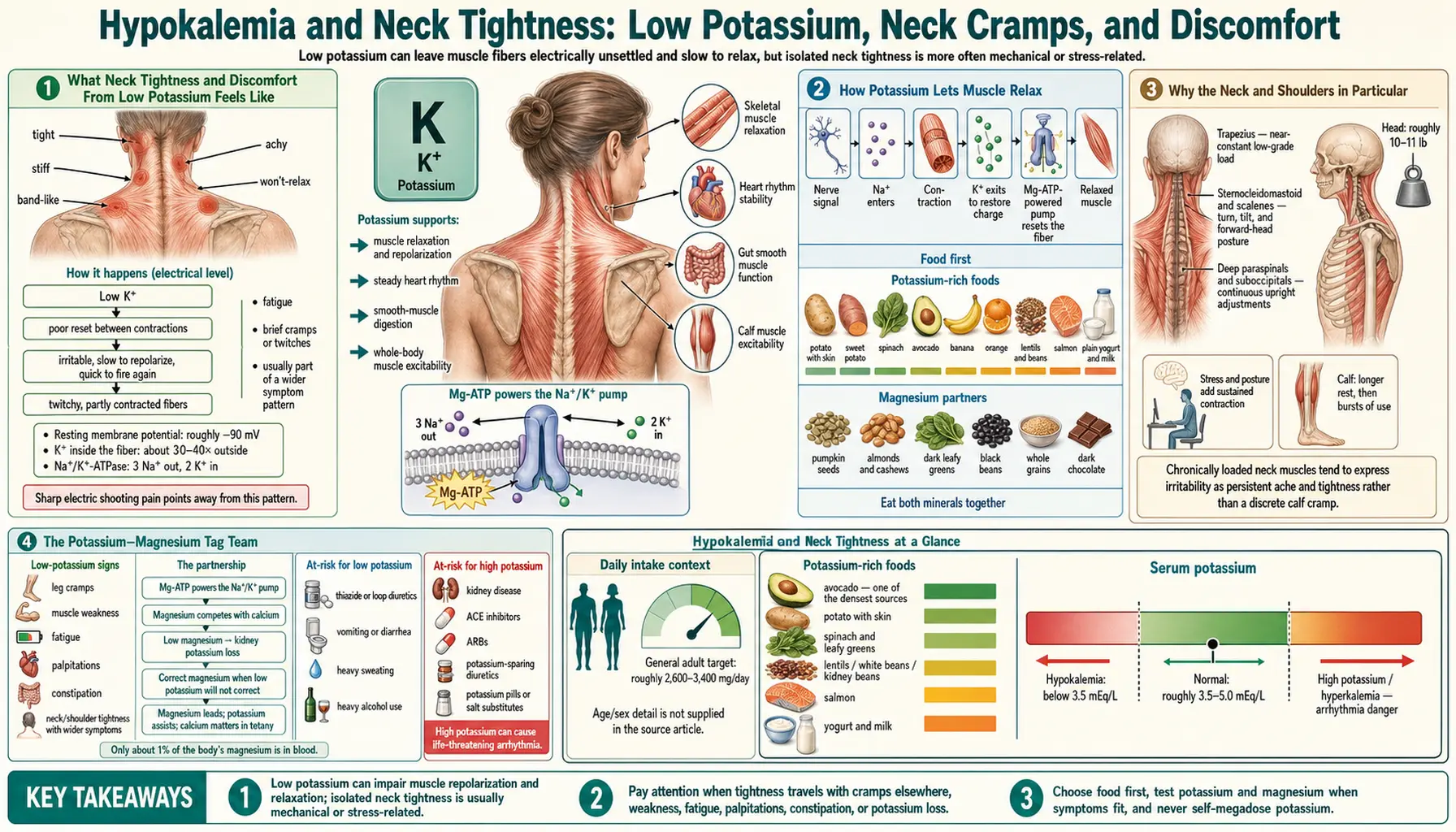
Let's be honest right away: a tight, stiff, won't-relax neck is not a classic textbook sign of low potassium. The famous symptoms of hypokalemia are leg cramps, muscle weakness, fatigue, heart palpitations, and constipation — not neck pain. So if your neck feels like a band of tension across your shoulders, the most likely explanations are posture, "tech neck," stress, dehydration, or a problem in the cervical spine, and those deserve to be checked first. But the sensation is real, and there is a legitimate thread connecting it to potassium: every muscle — including the ones in your neck and shoulders — needs potassium (almost always alongside magnesium) to relax cleanly after it contracts. When those minerals run low, muscle fibers stay irritable and slow to let go, and that can add a layer of cramping, stiffness, or band-like discomfort to muscles already under strain. This usually happens as part of a bigger picture — cramps elsewhere, weakness, fatigue, palpitations — not as an isolated stiff neck. This page explains the real physiology, gives you an honest list of other neck-tightness causes to rule out, shows you the clues that would actually point toward an electrolyte problem, and tells you exactly when neck or jaw tightness is an emergency.
Interactive Visualization The Sodium–Potassium Pump — why you have a voltage Run the pump that gives every cell its charge — three sodium out, two potassium in, on Mg-ATP — then drop the magnesium and see exactly why low potassium refuses to correct. Launch →
Table of Contents
- What Neck Tightness From Low Potassium Feels Like
- How Potassium Lets Muscle Relax
- Why the Neck and Shoulders in Particular
- The Potassium–Magnesium Tag Team
- Other Causes of Neck Tightness to Rule Out
- Clues That Point Toward Low Potassium
- When Neck Tightness Is an Emergency
- Getting Your Potassium (and Magnesium) Tested
- Food First: Potassium- and Magnesium-Rich Foods
- Supplements and Cautions
- Easing the Tight Neck While You Correct the Cause
- Key Research Papers
- Connections
- Featured Videos
What Neck Tightness and Discomfort From Low Potassium Feels Like
People describe this kind of neck discomfort in remarkably similar words: tight, stiff, band-like, achy, or a frustrating "won't-relax" feeling that sits across the back of the neck, the tops of the shoulders, and sometimes up into the base of the skull or down between the shoulder blades. It is not usually the sharp, electric, shooting pain of a pinched nerve. It is a dull, pulling, clenched sensation — as if the muscles have been quietly flexing all day and simply will not let go.
When an electrolyte imbalance is contributing, a few features tend to stand out:
- It is worse when you are tired or run-down. Muscles low on potassium and magnesium are slower to recover, so the tightness often deepens by evening, after a long day, after heavy sweating, or during an illness with vomiting or diarrhea.
- It comes with a feeling of muscle fatigue. The neck may feel not just tight but weak — heavy, as though holding your head up takes more effort than it should.
- It rarely shows up alone. This is the most important point. When low potassium is genuinely involved, the neck is usually one stop on a wider tour: calf or foot cramps, twitchy eyelids, generally weak legs, unusual tiredness, an irregular or fluttery heartbeat, or stubborn constipation. A purely isolated tight neck with no other symptoms points away from potassium and toward something mechanical.
- It may flicker into brief cramps or twitches. Some people notice small fasciculations (visible muscle twitches) or short, grabbing spasms in the neck or shoulder rather than one steady ache.
What it is usually not: a true locked, rigid, painful spasm (torticollis) that wrenches the head to one side is almost always a muscular or cervical-spine event, not a potassium problem. And jaw-clenching tightness with chest symptoms is a red flag covered in the emergency section below — do not wait that one out.
How Potassium Lets Muscle Relax
To understand the honest connection, it helps to know that relaxing a muscle is just as active and demanding as contracting it. A muscle that cannot relax properly feels tight — and potassium sits at the center of the relaxation step.
Every muscle fiber holds a tiny electrical charge across its outer membrane, called the resting membrane potential (roughly −90 millivolts in skeletal muscle). That charge exists because the fiber keeps potassium concentrated inside the cell — about 30 to 40 times more than outside — while keeping sodium mostly outside. A protein pump in the membrane, the sodium-potassium pump (Na+/K+-ATPase), burns energy continuously to maintain that gradient, pushing three sodium ions out and pulling two potassium ions in for each unit of fuel it spends.
Here is the cycle in plain terms. When a nerve tells a muscle to contract, sodium floods in and the charge briefly flips — that is the electrical signal that triggers contraction. To then relax and reset, potassium has to flow back out to restore the resting charge, and the pump has to bail the sodium back out so the fiber is "recharged" and quiet, ready for the next command. When potassium is low, the membrane can't reset cleanly between contractions. The fiber is left slightly off-balance — irritable, slow to repolarize, and quick to fire again — so instead of settling into a calm resting state, it lingers in a low-grade, twitchy, partly-contracted condition. Multiply that across thousands of fibers and you get the subjective feeling of a muscle that simply won't let go.
An analogy. Think of each muscle fiber as a spring-loaded mousetrap. Contraction is the snap. Relaxation is the careful re-setting of the trap — pulling the bar back and latching it so it rests quietly. Potassium flowing out (helped by the pump) is what re-latches the trap. If you're short on potassium, the latch keeps slipping: the trap never sits fully at rest, it stays half-cocked and jumpy, and the slightest nudge sets it off again. A neck full of half-set traps feels exactly like a neck that's tight and ready to cramp.
One nuance worth keeping straight: in the lab, lowering blood potassium actually makes the resting charge more negative, yet the muscle becomes weaker and more easily fatigued rather than stronger — because low potassium also degrades the function of the sodium channels the fiber needs to fire and recover properly. The practical upshot for you is the same: low potassium leaves muscle electrically unsettled, and unsettled muscle does not relax well.
Why the Neck and Shoulders in Particular
If potassium-driven muscle irritability can affect any muscle, why would it ever show up in the neck — when the textbook site is the calf? The answer is not that the neck is uniquely potassium-hungry. It is that the neck and shoulder muscles are almost never fully at rest in modern life, so any tendency toward irritability has a standing invitation to surface there.
Consider what these muscles do all day:
- The trapezius — the big diamond-shaped muscle across the upper back and shoulders — is under near-constant low-grade load just to keep your shoulders from sagging and your head balanced. It is also the muscle that famously hikes up toward your ears when you are stressed or concentrating.
- The sternocleidomastoid (the rope-like muscle running from behind your ear to your collarbone) and the scalenes work whenever you turn, tilt, or jut your head forward — which is most of a day spent looking at screens.
- The deep paraspinal and suboccipital muscles at the back of the neck make tiny continuous adjustments to hold your roughly 10-to-11-pound head upright. They essentially never get a break while you are awake and vertical.
Your calf, by contrast, gets long stretches of genuine rest when you sit or lie down, then bursts of heavy use when you walk — a pattern that makes electrolyte-driven cramps easy to notice as a discrete, dramatic event. The neck and shoulders instead carry a constant, low simmer of tension. So when muscle fibers become a little more irritable and a little slower to relax — whether from low potassium, low magnesium, fatigue, or stress — the neck tends to express that as a persistent ache and tightness rather than a sudden seizing cramp. The textbook still belongs to the calf; the neck is simply where chronically-loaded muscle quietly broadcasts that it isn't relaxing well.
This is also why the same tight-neck feeling is so strongly tied to stress and posture (see other causes): those postural muscles are the body's first responders to both physical load and emotional tension, and they hold the result.
The Potassium–Magnesium Tag Team
If you take one idea from this page, make it this: tightness and tension are more classically a magnesium story than a potassium story, and in real life the two minerals usually rise and fall together. Treating the neck as a "potassium problem" alone often misses the larger and more relevant deficiency.
Magnesium matters here for two concrete reasons:
- Magnesium powers the pump. The sodium-potassium pump runs on ATP, and ATP only works as magnesium-bound ATP. Without enough magnesium, the very pump that resets muscle after each contraction runs poorly — so a magnesium shortage produces a functional potassium problem inside the cell even when a blood test says potassium is "normal."
- Magnesium is a natural muscle relaxant. Inside the fiber, magnesium competes with calcium — and calcium is the trigger for contraction. Adequate magnesium helps muscle quiet down and let go; low magnesium leaves muscle more excitable and prone to cramping and tension.
There is also a hidden trap that clinicians know well: you often cannot fix low potassium until you fix low magnesium first. When magnesium is depleted, the kidney leaks potassium into the urine and refuses to hold onto it — so potassium supplements can fail to raise the level until magnesium is replaced. The two deficiencies frequently travel together and frequently need to be corrected together. This is exactly why the testing section below urges you to ask for a magnesium level, not just a potassium level.
Now the careful part, so we don't overclaim. The most dramatic neck-and-jaw phenomenon — tetany, the involuntary cramping and spasm of muscles — is principally a calcium and magnesium event, driven by low calcium and low magnesium making nerves hyper-excitable, not by low potassium. Potassium's contribution to neck tightness is real but supporting: it impairs the clean relaxation of muscle fibers and amplifies cramping when other things (overuse, magnesium loss, dehydration) are already in play. So the accurate framing is a tag team — magnesium leading, potassium assisting, and calcium relevant when true spasm or tetany appears — not a solo potassium act.
Other Causes of Neck Tightness to Rule Out
Because an isolated tight neck is far more likely to be mechanical or stress-related than electrolyte-related, an honest page has to put the common culprits front and center. For most people reading this, the answer is on this list — not in the mineral panel. Neck pain is genuinely one of the most common complaints worldwide and a leading cause of years lived with disability, and the overwhelming majority of it is musculoskeletal.
- Posture and "tech neck." The single most common cause. Looking down at a phone, laptop, or steering wheel pushes the head forward of the shoulders; for every inch the head drifts forward, the effective load on the neck muscles climbs steeply. Hours of this leaves the trapezius and neck extensors holding a sustained, fatiguing contraction — which feels exactly like the "won't-relax" tightness described above. The fix is ergonomic, not nutritional.
- Stress and anxiety (muscle guarding). Emotional tension translates directly into physical tension in the upper trapezius and jaw — the classic "carrying the weight on your shoulders" and "clenched" pattern. Chronic stress keeps these muscles partly contracted for hours, producing tightness, tension headaches, and jaw soreness.
- Dehydration. Poor hydration concentrates and disturbs all of your electrolytes at once and makes muscle cramps and stiffness more likely. It also frequently travels with low potassium and magnesium (for example, after heavy sweating, illness, or diuretic use), so it can be both a cause and a clue.
- Cervical spine and disc issues. Arthritis of the neck joints (cervical spondylosis), a bulging or herniated disc, or muscle strain can produce stiffness and tightness, sometimes with pain, numbness, or tingling radiating into an arm. Radiating arm symptoms or weakness deserve medical assessment.
- Thyroid problems. Both an underactive thyroid (which can cause muscle aches, stiffness, and cramps) and, less commonly, thyroid-related muscle conditions can present with vague muscular discomfort. Thyroid disease is also a recognized cause of fatigue that overlaps with the hypokalemia picture.
- Fibromyalgia. A chronic pain condition that produces widespread muscle tightness, tenderness, fatigue, and poor sleep — the neck and shoulders are frequently among the most affected areas.
- Poor sleep posture. An unsupportive pillow, sleeping on your stomach with the head turned, or falling asleep in a chair can leave the neck stiff and tight on waking. If your tightness is reliably worst first thing in the morning, look here.
The practical takeaway: if your neck tightness has an obvious mechanical pattern — tied to screen time, a desk setup, stress, a new pillow, or a specific movement — and you have none of the broader symptoms in the next section, an electrolyte cause is unlikely and you'll get more relief from posture, movement, and stress management than from a potassium pill.
Clues That Point Toward Low Potassium
So when should you take the potassium angle seriously? Not when the neck is tight in isolation — but when it travels in company. Low potassium earns suspicion when neck or shoulder tightness comes together with one or more of the following:
- Cramps somewhere else, especially the legs. Calf, foot, or thigh cramps alongside the tight neck point toward a body-wide muscle-irritability problem rather than a local neck issue. See Muscle Cramps.
- General muscle weakness. Legs that feel heavy climbing stairs, difficulty rising from a chair, or arms that tire quickly — weakness is one of the truly classic signs of low potassium. See Muscle Weakness.
- Marked, unexplained fatigue. A bone-deep tiredness out of proportion to your activity, often with the muscle symptoms. See Fatigue.
- Heart palpitations or a fluttery, skipped, or irregular heartbeat. Potassium is essential to a steady heart rhythm; palpitations together with muscle symptoms raise the priority of getting tested. See the cardiology links in the Connections below.
- Constipation, bloating, or sluggish digestion. Low potassium slows the smooth muscle of the gut. See Constipation.
- You are on a diuretic ("water pill"). Thiazide and loop diuretics are among the most common real-world causes of low potassium. If you take one and have these symptoms, this is a strong clue.
- You have had vomiting, diarrhea, or heavy sweating. Each can drain potassium (and magnesium, sodium, and water) quickly. A stretch of stomach flu followed by tight, crampy, weak muscles fits the pattern well.
One symptom from this list plus a tight neck does not prove anything — but it does change the math. The more of these boxes you tick, the more it makes sense to stop blaming your pillow and get a simple blood test, described next.
When Neck Tightness Is an Emergency
This is the one section to read even if you skip the rest. Most neck tightness is harmless. A small fraction is a warning of something dangerous, and the warning sometimes feels like simple muscle tightness in the neck or jaw.
Call emergency services (911 in the US) right away if neck or jaw tightness comes with any of the following:
- Chest pain, pressure, squeezing, or heaviness — especially if it spreads to the jaw, neck, shoulder, back, or arm. Neck or jaw tightness can be a presentation of a heart attack, and this pattern is more common in women, older adults, and people with diabetes, who may have little or no classic chest pain.
- Sweating, nausea, lightheadedness, or shortness of breath accompanying the neck or jaw tightness.
- Fainting or near-fainting, or a pounding/racing/irregular heartbeat with the symptoms — possible dangerous arrhythmia, which severe potassium imbalance can cause.
- Severe, rapidly worsening generalized weakness, trouble breathing, or difficulty swallowing — very low potassium can progress to dangerous muscle paralysis.
Separately, seek same-day medical care (not necessarily 911) if neck stiffness comes with fever and headache and sensitivity to light (to rule out meningitis), follows a significant injury or fall, or comes with new numbness, tingling, or weakness in an arm or hand.
Do not try to figure out at home whether jaw or neck tightness with chest, sweating, or breathing symptoms is "just a muscle." The cost of being wrong is far too high. When in doubt, get it checked immediately.
Getting Your Potassium (and Magnesium) Tested
If the clues point toward an electrolyte cause, confirming it is simple and inexpensive. Potassium is measured on a routine blood draw — usually as part of a Comprehensive Metabolic Panel (CMP) or a basic metabolic panel, which most clinicians can order at a regular visit.
- The number to know. Normal serum potassium runs roughly 3.5–5.0 mEq/L. Below 3.5 is hypokalemia; symptoms tend to track with how low and how fast it dropped.
- Ask for magnesium — specifically. Standard panels routinely omit magnesium, even though it's central to muscle relaxation and to your body's ability to hold onto potassium (see the tag-team section). Request a serum magnesium level explicitly, or you may not get one.
- Know magnesium's blind spot. Only about 1% of the body's magnesium is in the blood, so a "normal" serum magnesium can still hide a real tissue deficiency. A normal result doesn't fully rule magnesium out, especially if your symptoms and risk factors fit.
- Bring context. Tell your clinician about diuretics, recent vomiting/diarrhea, heavy alcohol use, and your other symptoms (cramps, weakness, fatigue, palpitations). It changes how the result is interpreted and what else gets checked.
- One caution on the draw itself: a clenched fist or a difficult blood draw can falsely raise a potassium reading, so a surprising result is sometimes rechecked.
If potassium and magnesium both come back normal and you have no red-flag symptoms, that's genuinely good news — it redirects you toward the mechanical and stress-related causes in the rule-out section, where the real fix for most tight necks lives.
Food First: Potassium- and Magnesium-Rich Foods
For garden-variety low intake (as opposed to a medical potassium-wasting condition), food is the safest and most effective fix — it raises potassium gradually, comes packaged with magnesium and other nutrients, and carries essentially none of the overdose risk of pills. Aim to eat both minerals together, since they work as a team.
Potassium-rich foods (general adult targets are roughly 2,600–3,400 mg/day):
- Vegetables & tubers: baked potato with skin, sweet potatoes, spinach and other leafy greens, beet greens, winter squash, tomatoes and tomato paste.
- Fruit: avocado (one of the densest sources), bananas, oranges and orange juice, cantaloupe, dried apricots, prunes, and raisins.
- Legumes & fish: lentils, white beans, kidney beans, and salmon.
- Dairy: plain yogurt and milk.
Magnesium-rich foods (because the two go hand in hand):
- Pumpkin seeds, almonds, cashews, and other nuts and seeds.
- Dark leafy greens such as spinach and Swiss chard.
- Black beans and other legumes.
- Whole grains and a square or two of dark chocolate.
Helpfully, several foods — spinach, avocado, beans, and nuts — deliver both minerals at once. For a fuller, sortable list with amounts, see the Potassium-Rich Foods page.
One important exception: if you have kidney disease or take a potassium-affecting medication (see below), do not load up on high-potassium foods without medical guidance — for you, the safe potassium target may be deliberately lower.
Supplements and Cautions
Potassium is a mineral where more is decidedly not better, and self-prescribing high-dose potassium can be genuinely dangerous. The same property that makes potassium essential to heart rhythm means that pushing the blood level too high (hyperkalemia) can cause life-threatening arrhythmia — sometimes more abruptly than low potassium does.
- Do not self-megadose potassium. Over-the-counter potassium pills in the US are capped at a low dose for exactly this reason. Prescription-strength potassium repletion should be guided and monitored by a clinician, particularly if your level is being actively corrected.
- Kidney disease is the big danger. Healthy kidneys excrete excess potassium; impaired kidneys cannot. In kidney disease, even modest extra potassium — from supplements, salt substitutes (which are often potassium chloride), or a sudden high-potassium diet — can accumulate to dangerous levels.
- Watch these medications. Several common drugs raise potassium and make supplements risky: ACE inhibitors (lisinopril, enalapril), ARBs (losartan, valsartan), and potassium-sparing diuretics (spironolactone, eplerenone, amiloride, triamterene). Combining these with potassium pills or potassium-based salt substitutes is a recognized cause of dangerous hyperkalemia.
- Magnesium is the gentler companion. Because tightness leans more on magnesium and because magnesium is often the limiting mineral, many people benefit more from correcting magnesium. Magnesium glycinate is a well-tolerated, gentle form that is less likely to cause the loose stools common with magnesium oxide or citrate. Even so, people with significant kidney disease should not take magnesium supplements without medical advice.
The honest bottom line: use food first, get tested if symptoms warrant, and reserve supplements — especially potassium supplements — for situations where a clinician has confirmed a deficiency and cleared you for them. For a deeper, practitioner-oriented approach to restoring magnesium, see Magnesium Replenishment.
Easing the Tight Neck While You Correct the Cause
Whatever the underlying reason, you can take pressure off a tight, achy neck right now. None of this replaces fixing a confirmed deficiency or evaluating red flags — but for the everyday tight neck (which is usually mechanical), these are the highest-yield, patient-friendly steps.
- Gentle stretching and movement. Slow, easy range-of-motion — ear toward shoulder, chin gentle tucks, slow head turns — and shoulder rolls help loosen the trapezius and neck extensors. Aim for gentle and frequent, not forceful; never crank or yank a tight neck. Moving regularly through the day beats one big stretch session.
- Heat. A warm shower, a heating pad, or a warm compress on the neck and shoulders increases blood flow and helps tight muscles relax. (Use ice instead if the tightness followed an acute injury and feels inflamed.)
- Hydrate. Since dehydration worsens cramps and stiffness — and often coexists with low potassium and magnesium — steady water intake is a simple win, especially around exercise, heat, or illness.
- Fix your screen ergonomics. This is the big one for "tech neck." Raise your monitor or laptop so the top of the screen is near eye level, bring your phone up toward your face instead of dropping your head down to it, support your forearms, and take a short posture break every 30–60 minutes. Small, permanent setup changes outperform any amount of stretching done on top of bad posture.
- Sleep position. Use a pillow that keeps your neck in line with your spine — not so high that your head is pushed up, not so flat that it droops. Side and back sleeping are kinder to the neck than stomach sleeping (which forces the head to stay turned all night).
- Down-regulate stress. Because the upper trapezius and jaw hold emotional tension, anything that genuinely relaxes you — slow breathing, a short walk, consciously dropping the shoulders away from the ears, unclenching the jaw — directly releases neck tightness. Notice and release the shoulder-hike when you catch it.
If tightness persists for weeks despite these measures, keeps you from sleeping or working, or comes with any of the low-potassium clues or red flags above, move from self-care to a medical evaluation.
Key Research Papers
- Gennari FJ (1998). Hypokalemia. New England Journal of Medicine;339(7):451-458. — DOI: 10.1056/NEJM199808133390707
- Kardalas E, Paschou SA, Anagnostis P, et al. (2018). Hypokalemia: a clinical update. Endocrine Connections;7(4):R135-R146. — DOI: 10.1530/EC-18-0109
- Palmer BF (2015). Regulation of Potassium Homeostasis. Clinical Journal of the American Society of Nephrology;10(6):1050-1060. — DOI: 10.2215/CJN.08580813
- Unwin RJ, Luft FC, Shirley DG (2011). Pathophysiology and management of hypokalemia: a clinical perspective. Nature Reviews Nephrology;7(2):75-84. — DOI: 10.1038/nrneph.2010.175
- Clausen T (2003). Na+-K+ pump regulation and skeletal muscle contractility. Physiological Reviews;83(4):1269-1324. — DOI: 10.1152/physrev.00011.2003
- de Baaij JHF, Hoenderop JGJ, Bindels RJM (2015). Magnesium in Man: Implications for Health and Disease. Physiological Reviews;95(1):1-46. — DOI: 10.1152/physrev.00012.2014
- Huang CL, Kuo E (2007). Mechanism of Hypokalemia in Magnesium Deficiency. Journal of the American Society of Nephrology;18(10):2649-2652. — DOI: 10.1681/ASN.2007070792
- Garrison SR, Korownyk CS, Kolber MR, et al. (2020). Magnesium for skeletal muscle cramps. Cochrane Database of Systematic Reviews;(9):CD009402. — DOI: 10.1002/14651858.CD009402.pub2
- Maughan RJ, Shirreffs SM (2019). Muscle Cramping During Exercise: Causes, Solutions, and Questions Remaining. Sports Medicine;49(Suppl 2):115-124. — DOI: 10.1007/s40279-019-01162-1
- Boyle NB, Lawton C, Dye L (2017). The Effects of Magnesium Supplementation on Subjective Anxiety and Stress — A Systematic Review. Nutrients;9(5):429. — DOI: 10.3390/nu9050429
- Gröber U, Schmidt J, Kisters K (2015). Magnesium in Prevention and Therapy. Nutrients;7(9):8199-8226. — DOI: 10.3390/nu7095388
- Shin DW, Shin JI, Koyanagi A, et al. (2022). Global, regional, and national neck pain burden in the general population, 1990-2019. Frontiers in Neurology;13:955367. — DOI: 10.3389/fneur.2022.955367
- Viera AJ, Wouk N (2015). Potassium Disorders: Hypokalemia and Hyperkalemia. American Family Physician;92(6):487-495. — PubMed: 26371733
- Statland JM, Tawil R (2018). Periodic Paralysis. Continuum (Minneapolis, Minn.);24(6):1696-1711. — Search PubMed
PubMed Topic Searches
- PubMed — Hypokalemia, muscle weakness, and cramps
- PubMed — Magnesium deficiency, hypokalemia, and muscle
- PubMed — Neck pain, muscle tension, and posture
- PubMed — "Text neck," smartphones, and cervical posture
- PubMed — Magnesium supplementation for muscle cramps (trials)
Connections
- All Minerals
- The Sodium–Potassium Pump — interactive animation
- Hypokalemia (Low Potassium) Hub
- Hypokalemia and Muscle Weakness
- Hypokalemia and Muscle Cramps
- Hypokalemia and Fatigue
- Hypokalemia and Nausea
- Hypokalemia and Constipation
- Potassium Overview
- Potassium and Muscle Function
- Potassium-Rich Foods
- Magnesium (Muscle Relaxation & the Pump)
- Calcium (Tetany & Muscle Contraction)
- Sodium
- Cramp Prevention
- Magnesium Replenishment
- Comprehensive Metabolic Panel
- Heart Palpitations
- Arrhythmia
- Kidney Disease
- Avocado
- Spinach
- Bananas
- Sweet Potatoes
- Lentils