Hypokalemia and Constipation: Low Potassium and a Sluggish Gut
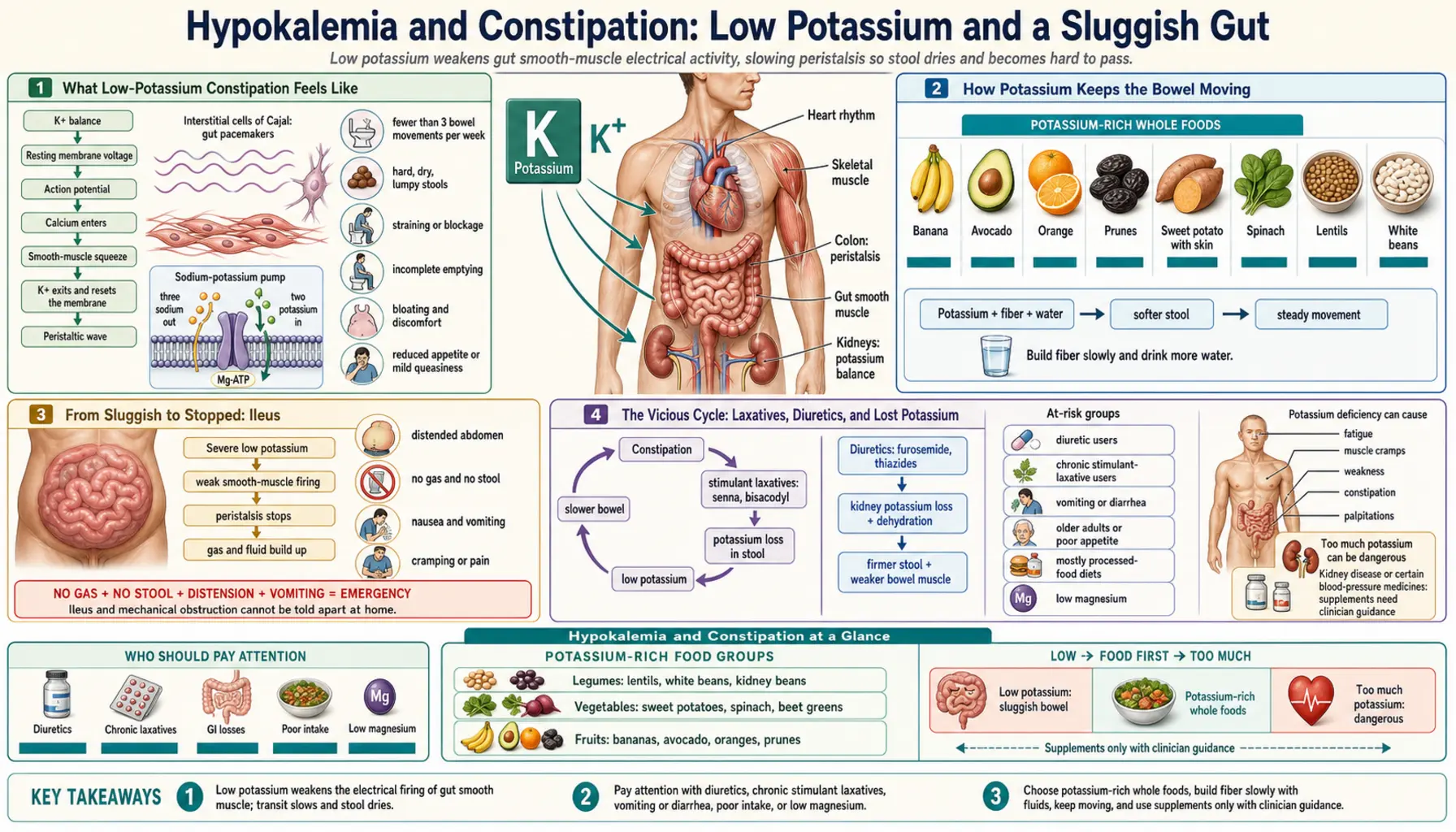
Your bowel is a muscle — a long, coiled tube of smooth muscle that squeezes its contents along in slow, rhythmic waves called peristalsis. Like every muscle, it runs on electricity, and that electricity depends on potassium. When potassium runs low, those waves weaken: stool moves too slowly, sits too long, dries out, and becomes hard and difficult to pass. People notice it as fewer bowel movements, straining, bloating, and a frustrating sense of never quite emptying. In the most severe cases, very low potassium can quiet the bowel almost completely — a dangerous state called ileus. The good news is that low-potassium constipation usually responds beautifully to the same things that help most sluggish bowels — more potassium- and fiber-rich food, more fluid, and more movement — once the underlying cause is found and corrected.
Interactive Visualization The Sodium–Potassium Pump — why you have a voltage Run the pump that gives every cell its charge — three sodium out, two potassium in, on Mg-ATP — then drop the magnesium and see exactly why low potassium refuses to correct. Launch →
Table of Contents
- What Low-Potassium Constipation Feels Like
- How Potassium Keeps the Bowel Moving
- From Sluggish to Stopped: Ileus
- The Vicious Cycle: Laxatives, Diuretics, and Lost Potassium
- Common Causes
- The Magnesium Overlap
- Getting Tested
- Relief: Food, Fiber, Fluids, and Correcting Potassium
- When to Seek Care / Red Flags
- Key Research Papers
- Connections
- Featured Videos
What Low-Potassium Constipation Feels Like
Constipation is one of the quieter consequences of low potassium, and it is easy to miss because the symptoms overlap with so many everyday digestive complaints. There is no single sensation that says "this is your potassium" — but when a sluggish bowel shows up alongside fatigue, muscle cramps, or weakness, or in someone taking water pills or laxatives, low potassium deserves a serious look.
People with hypokalemia-related constipation commonly describe:
- Fewer bowel movements than usual — going every two, three, or more days when you used to be regular. Doctors formally define constipation as fewer than three bowel movements per week, but any meaningful drop from your own normal counts.
- Hard, dry, lumpy stools — the longer stool sits in the colon, the more water gets reabsorbed from it, so it becomes firm, pellet-like, and difficult to pass.
- Straining and a feeling of blockage — needing to push hard, sometimes for several minutes, and feeling as though something is stuck at the exit.
- Incomplete emptying — the nagging sense that the rectum is never fully evacuated, so you go back to the toilet again and again with little result.
- Bloating, fullness, and abdominal discomfort — gas and stool backing up produce a swollen, heavy, uncomfortable belly that often eases briefly after a bowel movement.
- Reduced appetite and mild queasiness — a backed-up, sluggish gut can dull hunger and produce some nausea. Nausea is a substantial symptom in its own right when potassium falls; it has its own page in this cluster — see Hypokalemia and Nausea.
Two honest caveats. First, constipation is enormously common and usually has nothing to do with potassium — low fiber, low fluid, inactivity, travel, ignoring the urge, and many medications (opioids being the classic example) are far more frequent culprits. Second, when low potassium is involved, it rarely acts alone; it tends to travel with magnesium depletion and other electrolyte shifts, which is why repleting potassium without also checking magnesium can disappoint. The picture is most convincing when constipation appears together with other signs of low potassium and a plausible cause such as diuretic use, vomiting, diarrhea, or chronic laxative use.
How Potassium Keeps the Bowel Moving
To understand why low potassium slows the bowel, picture how the gut actually moves its contents. The wall of the intestine is wrapped in layers of smooth muscle. To push food and stool forward, this muscle contracts in a coordinated, traveling squeeze — the ring of muscle tightens behind the contents and relaxes ahead of it, so the bolus is milked along the tube. Repeated over and over, this produces the slow waves of peristalsis that move material from stomach to colon to rectum.
Every one of those contractions is an electrical event. Muscle cells, including the smooth muscle of the gut, hold a small voltage across their outer membrane — the inside is electrically negative compared with the outside. This resting voltage is built and maintained largely by potassium: the cell pumps potassium in and sodium out, and potassium then leaks back out through tiny channels, and that controlled leak is what sets the negative resting charge. When a contraction is needed, the membrane briefly flips its charge (an "action potential"), calcium floods in, and the muscle squeezes. Then potassium flows back out to reset the membrane so it is ready to fire again.
Potassium therefore does two jobs in gut muscle at once: it sets the stable starting voltage the muscle needs in order to fire cleanly, and its outward flow is what ends each contraction and re-arms the muscle for the next wave. The gut also has its own built-in pacemaker cells — the interstitial cells of Cajal — that generate rhythmic electrical "slow waves" and set the tempo of peristalsis, and these too depend on a normal balance of ions across their membranes.
When potassium in the blood and tissues falls, the math behind that resting voltage shifts. The muscle becomes sluggish to depolarize and slow to recover between contractions, so the peristaltic waves weaken and become less coordinated. The result is straightforward: contents move down the tube too slowly. And here is the part patients feel directly — the colon's main job, besides moving stool, is to reabsorb water. The longer stool lingers in a slow colon, the more water is pulled out of it, so it arrives at the rectum hard, dry, and hard to pass. Slow transit and dehydrated stool are the two mechanical reasons low potassium produces constipation.
This is the same family of mechanism behind low potassium's effects elsewhere — weak skeletal muscle and cramps come from the very same loss of clean electrical firing in muscle. The bowel is simply the smooth-muscle version of that story.
From Sluggish to Stopped: Ileus
If potassium falls far enough, the bowel does not just slow down — it can effectively stop. This is called ileus (more precisely, a paralytic or adynamic ileus): the smooth muscle becomes so under-powered that peristalsis ceases, and nothing moves forward. It is one of the recognized complications of severe hypokalemia, typically when serum potassium drops well below normal, and it is a genuine medical emergency.
Ileus looks and feels very different from ordinary constipation. The hallmarks are:
- A distended, swollen abdomen — because gas and fluid pile up behind the stalled segment with nowhere to go.
- No passage of gas and no stool at all — not "less than usual" but a complete halt. The inability to pass gas is an especially important warning sign.
- Nausea and vomiting — as the upper gut backs up. (Ileus is one of the places the constipation and nausea stories overlap; the shared mechanism is covered on the Hypokalemia and Nausea page — this page does not repeat it.)
- Cramping, bloating, and abdominal discomfort or pain.
A critical point for safety: the symptoms of paralytic ileus can be nearly identical to those of a mechanical bowel obstruction — an actual physical blockage from a tumor, scar tissue, a twist, or impacted stool. From the outside, "no gas, no stool, distended, vomiting" can mean either one, and the two are managed very differently. That is exactly why this combination is never something to wait out at home. It needs prompt in-person evaluation, usually with imaging and blood tests, to tell paralytic ileus (treated by correcting the potassium and other electrolytes, resting the bowel, and treating the cause) apart from a true obstruction (which may need a procedure or surgery). See the red-flags section below.
The Vicious Cycle: Laxatives, Diuretics, and Lost Potassium
One of the most important and most human things to understand about low-potassium constipation is that the treatments people reach for can quietly become part of the problem. This is not a moral failing or a sign anyone did something wrong — it is a predictable trap, and recognizing it is the way out.
Here is how the loop forms. Someone is constipated, so they take a stimulant laxative (senna, bisacodyl) — the kind that whips the bowel into contracting. It works, but stimulant laxatives, especially used heavily or daily over months, increase potassium losses through the stool and through the watery output they produce. Now potassium drifts lower. Lower potassium slows the bowel further. The constipation comes back, often worse, so the person takes more laxative, or a stronger one, or adds another. Potassium falls again. Round and round it goes, and over time the bowel can become reliant on the stimulation while the underlying potassium deficit deepens.
A very similar loop runs through diuretics ("water pills" such as furosemide and the thiazides, taken for blood pressure, heart failure, or swelling). These medications are among the most common causes of low potassium because they make the kidney dump potassium along with the extra fluid and salt. The dehydration they cause can also firm up the stool, and the potassium loss saps the bowel muscle — a double hit toward constipation. People in this situation sometimes then add a laxative, layering one potassium-wasting habit on top of another.
The compassionate, practical message is this: if you are stuck in either loop, the answer is almost never "just push through with more laxatives." It is to bring it to a clinician who can check your potassium (and magnesium), look at whether a diuretic dose or type can be adjusted, and help you shift toward gentler, sustainable bowel support — fiber, fluids, movement, and where appropriate osmotic agents — while the electrolytes are corrected. Stimulant laxatives have a real place for short-term and occasional use; the trouble is chronic daily reliance combined with ongoing potassium loss. Breaking the cycle, not white-knuckling it, is what restores a bowel that moves on its own.
Common Causes
Low potassium severe enough to slow the bowel usually has an identifiable cause. The big ones to think about:
- Diuretics ("water pills"). Thiazide and loop diuretics are the single most common reason for low potassium in everyday medicine, because they increase potassium loss in the urine. Constipation can result both from the potassium loss and from the mild dehydration these drugs cause.
- Laxative overuse. As described above, chronic stimulant-laxative use drives potassium out through the gut and can entrench the very constipation it was meant to treat.
- Vomiting and diarrhea. This sounds paradoxical — diarrhea is the opposite of constipation — but bouts of vomiting or diarrhea (a stomach bug, food poisoning, ongoing GI illness) flush large amounts of potassium out of the body. As the acute illness resolves, the person can be left potassium-depleted, and the lingering low potassium then leaves the bowel sluggish and constipated.
- Poor intake. Diets low in fruits, vegetables, beans, and other whole foods deliver little potassium and little fiber — a combination that promotes constipation on two fronts. Older adults, people with poor appetite, and those eating mostly processed food are especially vulnerable.
- Hyperaldosteronism and related hormonal causes. Conditions in which the body makes too much of the hormone aldosterone (such as Conn's syndrome) drive the kidney to waste potassium continuously. Genuine licorice (containing glycyrrhizin) and some Cushing-type states do the same. These can produce stubborn low potassium that does not respond until the underlying hormonal cause is addressed.
- Magnesium depletion. Low magnesium frequently accompanies low potassium and makes it hard for the body to hold onto potassium at all — important enough to get its own section below.
Several of these overlap with the other symptoms in this cluster. The same diuretic that constipates one person triggers muscle cramps in another and bone-tired fatigue in a third — one electrolyte problem with many faces.
The Magnesium Overlap
You cannot tell the full story of low-potassium constipation without magnesium, for two distinct reasons.
First, low magnesium and low potassium travel together. The same situations that waste potassium — diuretics, vomiting, diarrhea, poor intake, alcohol use — also waste magnesium, so the two deficiencies frequently coexist. More than that, magnesium is needed for the kidney to retain potassium; when magnesium is low, the kidney keeps leaking potassium no matter how much potassium you take in. This is why low potassium that "won't come up" despite supplements is a classic clue that magnesium is also low and needs correcting first. Repleting potassium while ignoring a magnesium deficit is one of the commonest reasons treatment stalls.
Second, magnesium also helps the bowel directly — by a completely separate mechanism from its potassium connection. Magnesium salts (magnesium oxide, magnesium hydroxide, magnesium citrate) act as osmotic agents: they are poorly absorbed, so they draw water into the colon, softening stool and gently stimulating movement. Magnesium oxide in particular has reasonable trial evidence as a treatment for chronic constipation. So in someone who is low in both minerals, correcting magnesium can help the constipation from two directions at once — restoring the body's ability to hold potassium, and softening the stool osmotically.
The important caution: more is not better with magnesium. Taking large doses of magnesium as a laxative can tip you into diarrhea (which then wastes more potassium, looping back to the problem this page is about) and, in people with reduced kidney function, magnesium can build up to genuinely dangerous levels. Magnesium repletion for a documented deficiency, and modest osmotic doses for constipation, are sensible; megadosing is not. If your kidneys are impaired, any magnesium product should be a conversation with your clinician first. For more on safely restoring magnesium, see Magnesium and Magnesium Replenishment.
Getting Tested
Because constipation has so many causes, the value of testing is in confirming whether low potassium is genuinely part of your picture — and in catching the other electrolyte and organ problems that travel with it. The work-up is simple, cheap, and informative.
- A basic blood panel. The core test is a Comprehensive Metabolic Panel (CMP) — a single blood draw that reports your serum potassium along with sodium, chloride, bicarbonate, glucose, and kidney markers (creatinine and BUN). It shows in one snapshot whether potassium is low and how the kidneys, which govern potassium balance, are doing. A basic metabolic panel (BMP) covers the same electrolytes if a CMP is not ordered.
- Magnesium. Magnesium is not included on a standard CMP and must be requested separately. Given how tightly magnesium and potassium are linked, asking for a magnesium level whenever potassium is low is one of the most useful add-ons available.
- One honest limitation. The blood test measures potassium in the bloodstream, but the vast majority of the body's potassium lives inside cells. It is possible to be meaningfully depleted in total-body potassium while the blood level still reads in the low-normal range, so results are interpreted alongside your symptoms, medications, and diet — not in isolation.
- Looking for a cause. Depending on the findings, a clinician may review your medication list (especially diuretics and laxatives), check urine electrolytes to see whether potassium is being lost through the kidney, or test for hormonal causes such as excess aldosterone when low potassium is unexplained or stubborn.
If constipation is severe, new, or accompanied by the red-flag features below, the evaluation widens beyond electrolytes to look directly at the bowel.
Relief: Food, Fiber, Fluids, and Correcting Potassium
The encouraging news is that low-potassium constipation usually responds well to a sensible, food-first plan — the same plan that helps most sluggish bowels, with the bonus that potassium-rich foods correct the deficiency and ease the constipation at the same time.
Food first. The best way to restore potassium for most people is through whole foods, which deliver potassium together with the fiber and water that independently keep stool soft and moving. Many of the richest potassium foods are also gentle, natural laxatives:
- Fruits — bananas, avocado, oranges, cantaloupe, apricots, and dried fruits like prunes and figs (prunes are a time-tested constipation remedy in their own right).
- Vegetables — sweet potatoes (with skin), regular potatoes, spinach, beet greens, squash, and tomatoes.
- Legumes — lentils, white beans, kidney beans, and other pulses, which are exceptional sources of both potassium and fiber.
- For a fuller, organized list, see Potassium-Rich Foods.
Fiber — built up gradually. Soluble fiber, in particular, softens and bulks stool and speeds transit; fiber supplementation has trial evidence for improving chronic constipation. The keys are to increase fiber slowly (a sudden jump causes gas and bloating) and to drink more water as you do — fiber without enough fluid can actually make a sluggish bowel worse.
Fluids. Adequate hydration keeps stool soft and is especially important if a diuretic or a prior bout of vomiting/diarrhea is in the picture. There is no need to flood yourself; the aim is consistent, sensible fluid intake through the day.
Movement. Physical activity — even a daily walk — stimulates the natural muscular activity of the colon. Prolonged inactivity is itself a cause of constipation, so regular movement is genuinely therapeutic, not just generic advice.
Correcting the potassium (and magnesium) itself. When a true deficiency is documented, the underlying cause is addressed — for example, reviewing a diuretic, treating ongoing GI losses, or stepping down chronic stimulant-laxative use — and potassium (and, where needed, magnesium) is repleted. Potassium supplements deserve respect: taking potassium pills on your own can be hazardous, because too much potassium — especially in people with kidney disease or on certain blood-pressure medications — is itself dangerous. Prescription potassium repletion should be guided and monitored by a clinician. Food potassium, by contrast, is safe for nearly everyone and is the right first move. If constipation needs more help while the cause is sorted out, osmotic agents (including magnesium-based products and polyethylene glycol) are generally preferred over leaning harder on stimulant laxatives.
When to Seek Care / Red Flags
Most constipation is a nuisance, not an emergency, and improves with the food-fiber-fluid-movement approach above. But a few patterns mean you should be evaluated promptly — and one of them is a true emergency.
Seek emergency care right away if you have signs of a stopped bowel (ileus or obstruction):
- No stool and no gas for an extended period, especially with a swollen, distended abdomen and vomiting. This combination can mean paralytic ileus from severe low potassium or a mechanical bowel obstruction, and the two cannot be told apart at home — both need urgent in-person assessment.
- Severe, worsening abdominal pain or a belly that is rigid and tender to touch.
Arrange prompt (non-emergency) medical evaluation for:
- Blood in the stool — bright red, dark, or black, tarry stools — or unexplained weight loss along with the constipation.
- Severe muscle weakness, an irregular or pounding heartbeat, or palpitations occurring alongside the constipation. These suggest potassium has fallen low enough to affect heart and skeletal muscle, which is more serious than the bowel symptom alone. See Heart Palpitations and Arrhythmia.
- A sudden, persistent change in bowel habits (new constipation that does not let up over a few weeks), constipation alternating with diarrhea, or stools that have become persistently thin or pencil-like.
- Constipation in someone taking diuretics or chronic laxatives — worth a potassium and magnesium check rather than simply adding more laxative.
- Constipation that does not respond to a genuine trial of more fiber, fluids, and movement.
You do not need to add "see your doctor" to every twinge of a slow bowel. But the no-gas/no-stool-with-distension-and-vomiting picture, blood in the stool, and constipation alongside cardiac or severe muscle symptoms are the lines that warrant getting checked without delay.
Key Research Papers
- Gennari FJ (1998). Hypokalemia. New England Journal of Medicine;339(7):451-458. — DOI: 10.1056/NEJM199808133390707
- Kardalas E, Paschou SA, Anagnostis P, Muscogiuri G, Siasos G, Vryonidou A (2018). Hypokalemia: a clinical update. Endocrine Connections;7(4):R135-R146. — DOI: 10.1530/EC-18-0109
- Unwin RJ, Luft FC, Shirley DG (2011). Pathophysiology and management of hypokalemia: a clinical perspective. Nature Reviews Nephrology;7(2):75-84. — DOI: 10.1038/nrneph.2010.175
- Palmer BF (2015). Regulation of Potassium Homeostasis. Clinical Journal of the American Society of Nephrology;10(6):1050-1060. — DOI: 10.2215/CJN.08580813
- Viera AJ, Wouk N (2015). Potassium Disorders: Hypokalemia and Hyperkalemia. American Family Physician;92(6):487-495. — PubMed
- Lembo A, Camilleri M (2003). Chronic Constipation. New England Journal of Medicine;349(14):1360-1368. — DOI: 10.1056/NEJMra020995
- Bharucha AE, Pemberton JH, Locke GR (2013). American Gastroenterological Association Technical Review on Constipation. Gastroenterology;144(1):218-238. — DOI: 10.1053/j.gastro.2012.10.028
- Sanders KM, Koh SD, Ward SM (2006). Interstitial Cells of Cajal as Pacemakers in the Gastrointestinal Tract. Annual Review of Physiology;68:307-343. — DOI: 10.1146/annurev.physiol.68.040504.094718
- Camilleri M (2012). Peripheral Mechanisms in Irritable Bowel Syndrome. New England Journal of Medicine;367(17):1626-1635. — DOI: 10.1056/NEJMra1207068
- Mori S, Tomita T, Fujimura K, et al. (2019). A Randomized Double-blind Placebo-controlled Trial on the Effect of Magnesium Oxide in Patients With Chronic Constipation. Journal of Neurogastroenterology and Motility;25(4):563-575. — DOI: 10.5056/jnm18194
- Christodoulides S, Dimidi E, Fragkos KC, Farmer AD, Whelan K, Scott SM (2016). Systematic review with meta-analysis: effect of fibre supplementation on chronic idiopathic constipation in adults. Alimentary Pharmacology & Therapeutics;44(2):103-116. — DOI: 10.1111/apt.13662
- Crockett SD, Greer KB, Heidelbaugh JJ, et al. (2019). American Gastroenterological Association Institute Guideline on the Medical Management of Opioid-Induced Constipation. Gastroenterology;156(1):218-226. — DOI: 10.1053/j.gastro.2018.07.016
- Whang R, Ryder KW (1990). Frequency of hypomagnesemia and hypermagnesemia requested vs. routine. JAMA;263(22):3063-3064. — PubMed
PubMed Topic Searches
- PubMed — Hypokalemia, ileus, and intestinal motility
- PubMed — Potassium and gastrointestinal smooth-muscle peristalsis
- PubMed — Stimulant laxative abuse and hypokalemia
- PubMed — Diuretic-induced hypokalemia
- PubMed — Magnesium for chronic constipation
Connections
- All Minerals
- The Sodium–Potassium Pump — interactive animation
- Hypokalemia (Symptom Hub)
- Hypokalemia and Nausea
- Hypokalemia and Fatigue
- Hypokalemia and Muscle Weakness
- Hypokalemia and Muscle Cramps
- Potassium Overview
- Potassium-Rich Foods
- Magnesium
- Magnesium Replenishment
- Comprehensive Metabolic Panel
- Kidney Disease
- Heart Palpitations
- Bananas
- Sweet Potatoes
- Lentils
- Constipation — the full symptom page covering every cause, not just low potassium.