Goldenseal Sustainability & Cautions
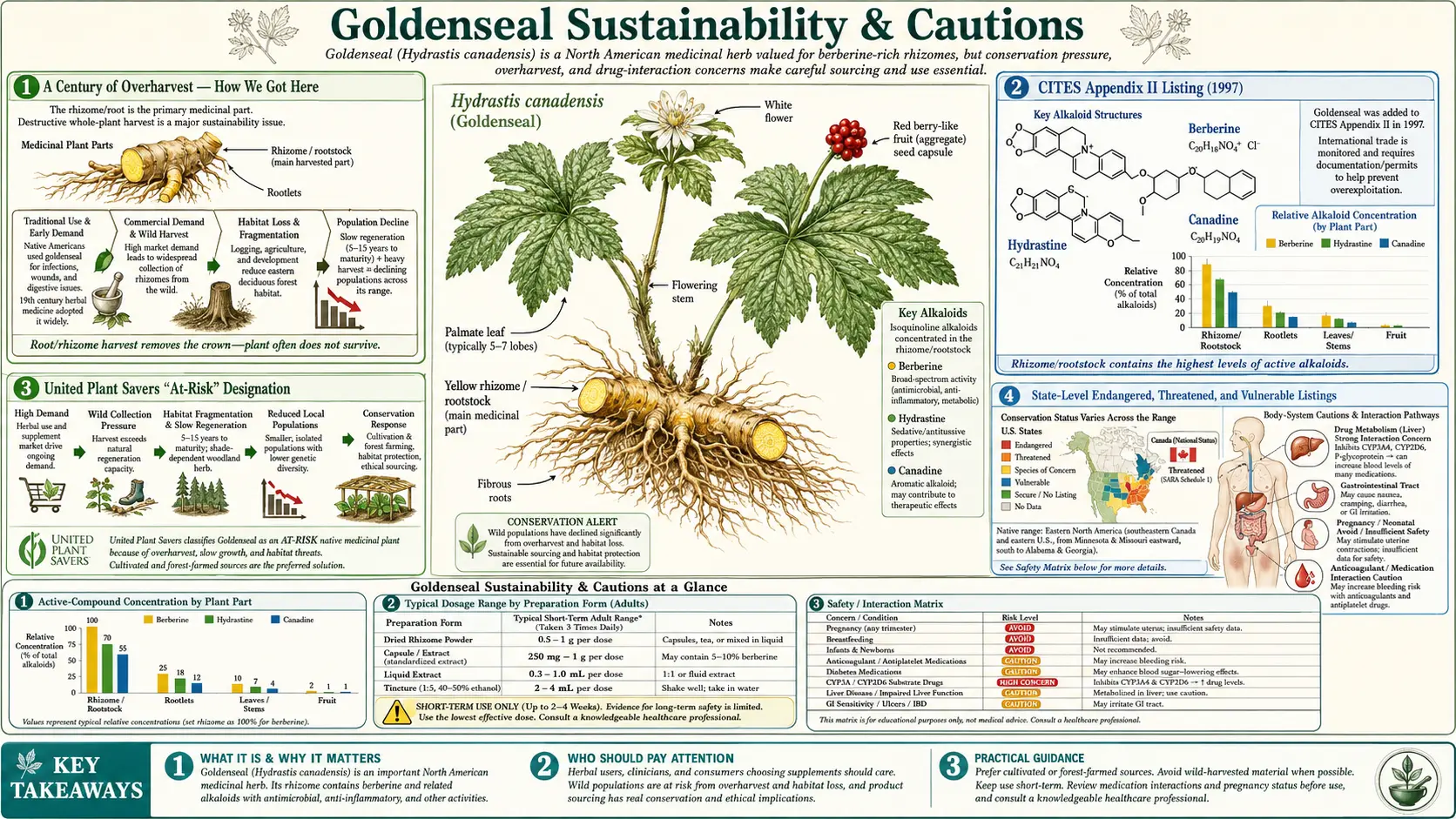
Goldenseal (Hydrastis canadensis) is one of the most overharvested medicinal plants in North America — arguably the most overharvested woodland herb in the entire Western herbal tradition. CITES placed H. canadensis on Appendix II in 1997. The United Plant Savers organization lists goldenseal on its "At-Risk" register, the most urgent botanical conservation category. Twelve or more U.S. states list goldenseal as endangered, threatened, or vulnerable under state-level statutes. Wild populations have collapsed by approximately 50% over the past century, driven by the combination of intensive wildcrafting for the medicinal trade and the loss of the mature deciduous-forest habitat that goldenseal requires. The ethical use of goldenseal in the 21st century requires three simultaneous commitments: purchase only cultivated or Forest Grown Verified material, never wild-crafted; substitute cheaper and more abundant berberine sources (Oregon grape, barberry, purified berberine HCl) for any indication that does not specifically require goldenseal's unique alkaloid profile; and respect the strict pregnancy/neonatal contraindications and the extensive drug-interaction profile that make goldenseal one of the more hazardous "natural" herbs on the shelf. This deep-dive walks through the full conservation story, the decision framework for choosing between goldenseal and alternatives, the certification systems that allow ethical sourcing, and the complete safety profile.
Table of Contents
- A Century of Overharvest — How We Got Here
- CITES Appendix II Listing (1997)
- United Plant Savers "At-Risk" Designation
- State-Level Endangered, Threatened, and Vulnerable Listings
- The Habitat Problem — Mature Hardwood Forest Loss
- Cultivated vs Woods-Grown vs Wild-Crafted
- Forest Grown Verified (FGV) Certification
- Oregon Grape, Barberry, and Pure Berberine HCl as Alternatives
- When (If Ever) to Actually Use Goldenseal
- Pregnancy, Breastfeeding, and Neonatal Contraindications
- Drug Interactions (CYP450 and P-Glycoprotein)
- Other Cautions (Hypertension, Hypoglycemia, Duration, Children)
- Practical Sourcing Guide — What to Look For, What to Avoid
- Key Research Papers
- Connections
- Featured Videos
A Century of Overharvest — How We Got Here
The decline of wild goldenseal is a multigenerational story that begins with the rapid adoption of Hydrastis canadensis by 19th-century American medicine. European settlers learned about goldenseal from Native American practitioners in the late 18th century. By the 1830s, the Eclectic physicians had elevated goldenseal to one of their most frequently prescribed remedies. By the 1850s, professional goldenseal "diggers" were systematically combing the Appalachian and Ozark hardwood forests for marketable wild root, supplying a national trade that increasingly exported to Europe.
The pressure on wild populations intensified through several waves:
- 1830s-1900s — rise of Eclectic medicine drives the first surge in commercial wild harvest, particularly from West Virginia, eastern Kentucky, Tennessee, and North Carolina
- 1900s-1940s — goldenseal remains a USP-official drug, sustaining steady commercial demand even as overall botanical-medicine prescriptions decline. Combined with timber harvest and clearing for agriculture, wild populations continue to shrink.
- 1970s-1990s — the rise of the modern herbal-supplement industry produces a second major surge in goldenseal demand. By the 1990s, the United States is producing approximately 200,000 to 400,000 pounds of dried goldenseal root per year, the vast majority still wild-harvested.
- 1990s-2000s — conservation groups including United Plant Savers begin actively documenting the wild-population collapse. CITES Appendix II listing in 1997. State-level endangered-species statutes begin to proliferate.
- 2000s-present — gradual shift toward cultivated and woods-grown supply, though wild harvest continues at significant levels. Forest Grown Verified certification launched 2014. Cultivated goldenseal now comprises a growing fraction of supply but wild-harvested material is still widely sold.
The cumulative effect of nearly 200 years of intensive wild harvest, layered onto the parallel loss of mature deciduous-forest habitat across the eastern United States, has produced documented declines of 50% or more in wild population density across goldenseal's native range. The species is not extinct in the wild, but it is significantly more rare than it was a century ago, and remaining wild populations are concentrated in increasingly fragmented forest patches.
CITES Appendix II Listing (1997)
The Convention on International Trade in Endangered Species of Wild Fauna and Flora (CITES) is a multilateral treaty, in force since 1975 and now signed by 184 parties, that regulates international trade in species whose survival is threatened by commercial trade. Species are listed on one of three Appendices according to the level of protection required.
Appendix I includes species threatened with extinction; international commercial trade is generally prohibited.
Appendix II includes species not necessarily threatened with extinction but in which trade must be controlled to ensure that wild populations are not threatened. Trade is allowed but only with CITES-issued export permits, and the exporting country must conclude (and document) that the export is not detrimental to the species' survival.
Appendix III includes species protected in at least one country which has asked other CITES parties for assistance in controlling trade.
Hydrastis canadensis was added to CITES Appendix II in 1997, on a proposal jointly submitted by the United States and Canada. The listing was motivated by documented declines in wild populations, the increasing volume of international trade (particularly to European, Asian, and other markets), and the difficulty of distinguishing cultivated from wild-harvested material once roots had been dried and processed.
Practical effects of the CITES listing:
- All international exports of H. canadensis require a CITES export permit issued by the country of origin (typically the US Fish and Wildlife Service for US-sourced material)
- Each export must be documented as non-detrimental to wild populations — cultivated material qualifies straightforwardly; wild-harvested material requires the exporting country to demonstrate sustainable harvest practices
- Domestic US sale is not directly regulated by CITES, but the listing has spurred state-level regulation and industry self-regulation
- The listing creates a paper trail that allows tracing the supply chain for ethically sourced goldenseal
The CITES listing has been broadly successful in slowing the international export trade of wild goldenseal, though it has not eliminated the domestic US wild-harvest pressure on the remaining wild populations.
United Plant Savers "At-Risk" Designation
United Plant Savers (UpS) is a nonprofit organization founded in 1994 by herbalist Rosemary Gladstar and a coalition of botanical-medicine practitioners, conservationists, and academic ethnobotanists. Its mission is to protect native medicinal plants of North America and their natural habitats. The organization maintains two principal lists:
- "At-Risk" list — the most urgent conservation category. Includes species that are in significant decline due to overharvest, habitat loss, or both, and that warrant immediate conservation action by herbalists, consumers, and regulators.
- "To-Watch" list — species that are not yet in critical decline but that are sufficiently in demand and sufficiently vulnerable to require ongoing monitoring.
Hydrastis canadensis has been on the United Plant Savers "At-Risk" list since the organization's founding in 1994, and remains a centerpiece of UpS conservation advocacy. The organization operates the Goldenseal Botanical Sanctuary in Ohio — a 379-acre forest reserve dedicated specifically to protecting and propagating goldenseal and other at-risk woodland medicinals — and certifies certain cultivated suppliers as meeting UpS sustainability standards.
Other At-Risk species sharing the list with goldenseal include American ginseng (Panax quinquefolius), black cohosh (Actaea racemosa), blue cohosh (Caulophyllum thalictroides), bloodroot (Sanguinaria canadensis), echinacea species (E. angustifolia in particular), helonias root (Chamaelirium luteum), ladyslipper orchids, lomatium, osha, partridge berry, pink ladyslipper, ramps, sandalwood, slippery elm, sundew, trillium species, true unicorn, Venus flytrap, white sage, and wild yam. The breadth of the list reflects the broader crisis facing North American medicinal woodland flora.
The United Plant Savers framework offers consumers a clear ethical standard: prefer cultivated material from any At-Risk species, support Forest Grown Verified suppliers when available, and substitute non-threatened alternatives when therapeutically appropriate.
State-Level Endangered, Threatened, and Vulnerable Listings
In addition to the federal CITES listing, more than a dozen U.S. states have placed Hydrastis canadensis on state-level endangered, threatened, or vulnerable species lists. The specific designation varies by state, but the practical effect is restrictions or prohibitions on wild harvest, transportation, and sale of state-origin wild goldenseal.
States that list goldenseal as endangered, threatened, or otherwise of special conservation concern include:
- Connecticut — Endangered (Connecticut Endangered Species Act)
- Georgia — Unusual (state-protected)
- Maine — Endangered
- Maryland — Highly State Rare
- Massachusetts — Endangered (state MESA listing)
- Michigan — Threatened
- Minnesota — Endangered
- New Jersey — Endangered
- New York — Threatened
- North Carolina — Endangered (Plant Conservation Program)
- Tennessee — Threatened
- Vermont — Endangered
- Other states with regulatory or monitoring requirements: Ohio, Pennsylvania, West Virginia, Virginia, Indiana, Illinois
The strongest wild populations of goldenseal remain in Kentucky, West Virginia, Indiana, southern Ohio, and parts of Virginia and Tennessee. Even in these strongholds, wild populations are under sustained pressure from continued commercial wild harvest, and regulatory frameworks vary in their enforcement effectiveness.
From a consumer perspective, the proliferation of state-level listings reinforces the conclusion that wild-harvested goldenseal should be avoided entirely. The practical impossibility of verifying chain of custody for wild-harvested root, combined with the legal complexities of multi-state regulatory frameworks, makes cultivated material the only ethically defensible choice.
The Habitat Problem — Mature Hardwood Forest Loss
Beyond the direct harvest pressure on goldenseal populations, the broader threat is habitat loss. Hydrastis canadensis is a understory perennial that requires very specific growing conditions:
- Deep shade from a mature hardwood canopy (oak-hickory, beech-maple, mixed mesophytic forest types) — goldenseal cannot tolerate full sun and grows poorly in young or disturbed forests
- Rich, well-drained, calcareous to neutral soil — typically associated with limestone-derived parent material and accumulated leaf litter
- Moist but not waterlogged conditions — well-drained slopes and bottomland margins, never standing water
- Mature forest ecosystem with mycorrhizal partners — goldenseal's root system depends on specific fungal associations that take decades to establish
- Minimal disturbance — goldenseal is extremely sensitive to logging, road construction, recreational trampling, and grazing
This habitat profile is essentially the inverse of what modern land-use trends have produced across the eastern United States. From 1800 to 1920, the original eastern hardwood forest was reduced by approximately 70% through clearing for agriculture and timber. From 1920 to present, regrowth has produced significant forest recovery in area but predominantly in the form of young, structurally simple, even-aged second-growth forest that lacks the mature canopy conditions goldenseal requires.
The current eastern US deciduous forest area is approximately 220 million acres, but mature (old-growth or near-old-growth) hardwood forest accounts for less than 1% of this total. Goldenseal's suitable habitat has been compressed into a small fraction of the area it occupied at European contact.
The habitat dimension of the goldenseal conservation problem is particularly significant because it cannot be reversed quickly. A clear-cut forest can theoretically be replanted, but the mature canopy + mycorrhizal community + soil profile + understory diversity that goldenseal requires takes 100-200 years to develop. The conservation strategy therefore must include not just protecting remaining wild populations and shifting to cultivated supply, but also long-term forest stewardship practices that allow mature forest conditions to gradually recover.
Cultivated vs Woods-Grown vs Wild-Crafted
The supply chain for medicinal goldenseal falls into three broad categories with very different sustainability profiles:
Wild-crafted (wild-harvested) — root dug from naturally occurring wild populations. This is the ethically problematic category. Even where wild harvest is legal under state law, it directly extracts from declining wild populations. There is no practical way for the consumer to verify that wild-harvested root was sustainably collected. Avoid wild-crafted goldenseal in all circumstances.
Cultivated (field-grown) — root grown under artificial shade cloth, in raised beds with amended soil, on commercial farms. This is mass-produced cultivated supply, similar to most other commercial herbs. Alkaloid content can be acceptable but is typically lower than woods-grown or wild material because the artificial growing conditions do not perfectly reproduce the mature-forest microenvironment. Sustainable from a conservation perspective — no wild population is affected. Reasonable choice for any indication where alkaloid concentration is not critical.
Woods-grown (also called "simulated wild" or "forest-cultivated") — root deliberately planted into existing mature hardwood forest understory under conditions that mimic wild growing habitat. The grower selects a suitable forest site, plants goldenseal rhizomes or seeds, manages light competition, and harvests after 4-8 years. Alkaloid content is comparable to wild-harvested material. The gold standard for sustainable goldenseal supply. Woods-grown systems also generate income from standing mature forest, creating economic incentives for landowners to preserve rather than clear-cut their forests.
The practical purchasing rule: buy woods-grown if available, cultivated as a second choice, never wild-crafted. Reputable suppliers will explicitly document their sourcing on the label and on their website; if a vendor cannot or will not document where their goldenseal came from, assume the worst and choose a different vendor.
Several established commercial suppliers of woods-grown goldenseal include United Plant Savers-affiliated growers, Mountain Rose Herbs, Pacific Botanicals, Healing Spirits Herb Farm, and Strictly Medicinal Seeds (for home growers). The Appalachian Sustainable Development cooperative also coordinates woods-grown supply from a network of small-scale growers in the Appalachian region.
Forest Grown Verified (FGV) Certification
The Forest Grown Verified (FGV) certification program was launched in 2014 by United Plant Savers, the American Herbal Products Association, and several allied organizations specifically to address the cultivated-vs-wild supply chain ambiguity that complicates ethical goldenseal sourcing.
The FGV standard requires:
- Forest cultivation — the goldenseal must be deliberately planted into existing mature forest understory (not field-cultivated)
- Chain of custody documentation — from the specific forest plot through processing to the retail product
- Sustainable forest management — the forest itself must be managed in a way consistent with long-term ecological health
- No wild harvest — FGV-certified product must come from intentionally planted populations, not naturally occurring wild stands within the forest plot
- Third-party verification — independent auditing of the farm and supply chain
FGV-certified product is the most sustainably defensible goldenseal currently available in commercial supply. The certification is gradually becoming more common as both growers and consumers recognize the value of the chain-of-custody documentation. For a consumer looking to use goldenseal responsibly, FGV certification is the single most reliable label-level marker of sustainable sourcing.
Other relevant certifications that may appear on goldenseal products:
- USDA Organic — addresses pesticide use and soil management but does not specifically address wild-vs-cultivated
- Fair Wild — an international standard for sustainably wild-collected botanicals; not applicable to goldenseal in the United States where wild collection is the underlying problem
- UpS-certified — older designation from United Plant Savers, similar in intent to FGV but with somewhat different specific requirements
Oregon Grape, Barberry, and Pure Berberine HCl as Alternatives
For the majority of clinical indications where goldenseal is considered, a more sustainable alternative is equally effective. The key sustainable alternatives:
Oregon grape (Mahonia aquifolium and related species) is the closest functional substitute for goldenseal. Native to the Pacific Northwest United States and southwestern Canada, Oregon grape is abundant in the wild and easily cultivated. Its root contains 2-3% berberine plus a distinct supporting alkaloid profile (berbamine, oxyacanthine) that provides efflux-pump inhibition and broader antimicrobial activity. For nearly all gut, urinary, and skin antimicrobial indications, Oregon grape root tincture or extract substitutes for goldenseal without therapeutic loss. Approximately 1/4 to 1/3 the cost of goldenseal per equivalent dose.
Barberry (Berberis vulgaris and related species) is a widely cultivated and naturalized shrub (introduced from Europe; some populations are considered invasive in parts of North America). The root and bark contain 1.5-3% berberine plus berbamine, palmatine, and jatrorrhizine. Similar therapeutic profile to Oregon grape. The fact that some North American barberry populations are managed as invasive species means that using barberry root is actively beneficial for habitat conservation in some regions.
Chinese goldthread (Coptis chinensis) contains the highest natural berberine concentration of any commonly available source (5-8%), and is the dominant source plant for commercial berberine HCl extraction. Cultivated extensively in China; commercial supply is sustainably produced from cultivated stocks. Less commonly available in the Western herbal market in whole-plant form but very common as the source of commercial berberine extract.
Purified berberine HCl (capsules) — the most economical and most precisely dosed option. Berberine extracted from Coptis or Phellodendron, purified to pharmaceutical-grade isolated compound, typically sold in 500 mg capsules at $0.10-0.30 per dose. For any indication where the primary effect is berberine (which is the majority of clinical applications), purified berberine HCl is the rational first choice. Free of sustainability concerns because the source plants are cultivated and the extraction is efficient.
The therapeutic comparison table:
- Antimicrobial in gut: berberine HCl = Oregon grape = barberry = goldenseal (all effective; sustainability wins)
- Blood sugar / metabolic: berberine HCl is the clinical-trial standard; whole-plant sources also work
- Anti-inflammatory / NF-kB: berberine is the active component; all sources equivalent
- Mucous-membrane astringency: only goldenseal contains hydrastine; this is the narrow advantage that justifies goldenseal over alternatives
- Severe MRSA / efflux-resistance contexts: goldenseal's hydrastine + canadine combination has documented advantages in vitro; in vivo clinical translation is less clear
- Topical wound care: tradition favors goldenseal; Oregon grape is an acceptable substitute
When (If Ever) to Actually Use Goldenseal
Putting the sustainability ethics together with the therapeutic alternatives, a practical decision framework emerges:
Indications where the alternative berberine sources are equally or more effective (use Oregon grape, barberry, or berberine HCl instead):
- SIBO eradication and maintenance
- Acute bacterial diarrhea (E. coli, V. cholerae, Shigella)
- Traveler's diarrhea prophylaxis and treatment
- H. pylori adjunct therapy
- C. difficile adjunct therapy
- Blood sugar / metabolic syndrome / type 2 diabetes adjunct
- Anti-inflammatory / NF-kB-pathway indications
- Routine "natural antibiotic" use for self-limited common infections
- General bitter-tonic digestive stimulation (gentian, dandelion root, or wormwood are also effective)
Indications where goldenseal's full alkaloid profile may be genuinely warranted (and where cultivated/FGV goldenseal is justifiable):
- Acute catarrhal mucous-membrane conditions with significant inflammation where hydrastine's mucous-membrane astringency provides meaningful additional benefit (e.g., severe acute postnasal drip with mucousy congestion, severe inflammatory bronchitis with excessive secretion)
- Topical wound care where the traditional multi-alkaloid profile + the historical clinical track record outweighs the alternatives
- Highly resistant Gram-positive infections in a context where the canadine + hydrastine efflux-pump-inhibitor combination is therapeutically meaningful
Even in the justified-use category, the rule is to use cultivated or FGV-certified goldenseal at the minimum effective dose for the shortest effective duration. There is essentially no situation where wild-crafted goldenseal is the right choice in 2025.
The simplest way to frame it: treat goldenseal as a specialized clinical tool rather than as a general-purpose herbal antibiotic. For "antibiotic-like" general use, the alternatives are equally effective and far more sustainable. For the narrow set of conditions where the unique alkaloid profile actually matters, cultivated goldenseal at appropriate dose is reasonable.
Pregnancy, Breastfeeding, and Neonatal Contraindications
Goldenseal is ABSOLUTELY CONTRAINDICATED in pregnancy and breastfeeding, and in infants of any age.
The pregnancy contraindication is based on multiple distinct mechanisms, any one of which would be sufficient to justify avoidance:
- Uterine stimulation — berberine has documented uterine-contractile activity in both animal and ex vivo human uterine tissue studies. Use during pregnancy carries a risk of stimulating premature contractions, miscarriage, or preterm labor.
- Placental transfer — berberine crosses the placental barrier and can reach measurable concentrations in fetal tissues.
- Teratogenic potential — animal studies with high-dose berberine have documented teratogenic effects on developing embryos.
- Bilirubin displacement — kernicterus risk — berberine displaces bilirubin from its albumin binding site. In the neonate, displaced bilirubin can cross the immature blood-brain barrier and deposit in the basal ganglia, producing irreversible kernicterus (bilirubin-induced encephalopathy). The risk is particularly acute in premature infants and in infants with any baseline hyperbilirubinemia. Use of berberine-containing products near term, or by lactating mothers in the immediate postpartum period, carries this risk for the neonate.
- Hydrastine vasoconstriction — the secondary alkaloid in goldenseal, hydrastine, has mild vasoconstrictive activity that could theoretically reduce uteroplacental blood flow.
The lactation contraindication follows from the same mechanisms: berberine is excreted in breast milk in measurable concentrations, and the nursing infant's immature hepatic conjugation system cannot efficiently clear it. Lactating mothers should avoid all berberine-containing products (goldenseal, Oregon grape, barberry, Chinese goldthread, purified berberine HCl) at least throughout the immediate postpartum period and ideally throughout the entire breastfeeding period.
The infant contraindication is absolute: no oral or topical goldenseal use in patients under 2 years of age. The bilirubin displacement risk applies, and infant skin and mucous membranes also have higher absorption of topically applied compounds than adult skin. Any infant with infection or inflammation requiring treatment should be evaluated by a pediatrician; safe pharmaceutical alternatives exist for essentially every indication.
Drug Interactions (CYP450 and P-Glycoprotein)
Goldenseal is one of the most drug-interaction-prone herbs in common use. Berberine is a potent inhibitor of multiple cytochrome P450 enzymes and of the P-glycoprotein efflux transporter, both of which control the absorption, distribution, and clearance of a wide range of prescription drugs.
CYP450 enzyme inhibition — berberine inhibits:
- CYP3A4 — the most abundant hepatic and intestinal cytochrome P450. Substrate drugs include: statins (atorvastatin, simvastatin), calcium channel blockers (amlodipine, diltiazem, verapamil), immunosuppressants (cyclosporine, tacrolimus), antiretrovirals (most protease inhibitors), benzodiazepines (alprazolam, midazolam), opioids (fentanyl, oxycodone), warfarin, sildenafil, many others. CYP3A4 inhibition by berberine can raise blood levels of these drugs substantially.
- CYP2D6 — substrate drugs include: SSRI/SNRI antidepressants (fluoxetine, paroxetine, venlafaxine), beta-blockers (metoprolol, propranolol), opioids (codeine, tramadol — both prodrugs activated by CYP2D6), antipsychotics (risperidone, aripiprazole), tamoxifen. Inhibition can reduce efficacy of prodrugs (codeine, tramadol, tamoxifen) and raise levels of active substrates.
- CYP2C9 — substrate drugs include: warfarin (the most critical interaction), phenytoin, sulfonylureas (glipizide, glyburide), NSAIDs (celecoxib, ibuprofen, naproxen). The warfarin interaction is potentially serious — goldenseal can substantially increase warfarin's anticoagulant effect.
P-glycoprotein (P-gp) inhibition — berberine inhibits the intestinal and blood-brain-barrier P-gp efflux transporter. Substrate drugs that may have increased absorption or CNS penetration include digoxin (narrow therapeutic index, monitor levels), several chemotherapeutic agents (doxorubicin, paclitaxel, etoposide, vincristine), cyclosporine, tacrolimus, and others.
Clinically significant interactions to flag:
- Warfarin — goldenseal can substantially increase INR. Avoid combination or monitor INR closely with dose adjustment.
- Cyclosporine and tacrolimus — goldenseal can raise blood levels to toxic ranges. Avoid combination.
- Sulfonylureas and insulin — additive hypoglycemia risk from berberine's blood-glucose-lowering effect plus CYP2C9 inhibition raising sulfonylurea levels.
- Statins — goldenseal can raise statin levels, increasing myalgia / rhabdomyolysis risk. Avoid or use lowest statin dose with monitoring.
- Antiretrovirals — serious interaction risk with most protease inhibitors and NNRTIs. Coordinate with HIV-specialty prescriber before any use.
- Calcineurin inhibitors in transplant patients — potentially life-threatening interaction. Avoid completely.
For any patient on prescription medications, a knowledgeable prescriber should be consulted before adding goldenseal or any other berberine-containing product. The interactions extend to all berberine sources — switching to Oregon grape, barberry, or purified berberine HCl does not avoid the drug-interaction profile; only the conservation cost differs.
Other Cautions (Hypertension, Hypoglycemia, Duration, Children)
- Hypertension — hydrastine, goldenseal's second alkaloid, has mild vasoconstrictive activity. Patients with uncontrolled hypertension or on multiple antihypertensive medications should monitor blood pressure during use. Avoid in patients with severe or rapidly worsening hypertension.
- Hypoglycemia risk — berberine has significant glucose-lowering activity (comparable to metformin in some clinical trials). Patients on insulin, sulfonylureas, meglitinides, or other hypoglycemic medications may experience additive hypoglycemia. Monitor blood glucose closely if combining.
- Duration of use — do not use goldenseal continuously for more than 3 weeks without practitioner supervision. Cycling protocols (2-3 weeks on, 1-2 weeks off) are standard for any extended use, both to prevent gut microbiota disruption and to allow mucous membranes to recover from the strong astringent effect of the alkaloids.
- Children — goldenseal should not be used in children under 2 years of age under any circumstances. In children 2-12, use only under qualified pediatric integrative-medicine supervision, at reduced doses appropriate to body weight, and for limited durations.
- Liver disease — because berberine is metabolized by the liver, patients with significant hepatic impairment should use reduced doses or avoid goldenseal. Liver function monitoring is appropriate for any extended use in patients with baseline liver disease.
- Kidney disease — berberine and its metabolites are partially excreted through the kidneys. Advanced chronic kidney disease (CKD stage 4-5) is a relative contraindication.
- Microbiota disruption — berberine's broad antimicrobial action will kill commensal as well as pathogenic bacteria. Long-term use without microbiota-restorative support can produce dysbiosis. Combine extended berberine courses with high-fiber diet, fermented foods, and possibly intermittent probiotic support.
- Allergic reactions — uncommon but documented. Patients with known sensitivity to other Ranunculaceae family plants may be at higher risk.
- Photosensitivity — rarely reported; some patients may experience increased skin sensitivity to sunlight during extended use.
Practical Sourcing Guide — What to Look For, What to Avoid
Look for:
- Forest Grown Verified (FGV) certification — the strongest single sustainability marker
- United Plant Savers-certified suppliers — alternative or complementary certification
- Explicit "cultivated" or "woods-grown" labeling on the product
- Documented chain of custody from grower to retailer on the supplier's website
- Standardization to berberine content (e.g., 5% berberine) for consistency between batches
- Suppliers who publish their goldenseal sourcing policy and explicitly state they do not buy wild-harvested material
- USDA Organic certification as an additional quality indicator (though not a substitute for cultivated vs wild sourcing documentation)
Avoid:
- "Wild-crafted," "wild-harvested," or "wildcraft" labeling — for goldenseal specifically, this is the ethically problematic source
- No sourcing information on the label or website — if a supplier won't document where their goldenseal came from, assume the worst
- Very low prices — goldenseal is genuinely expensive to grow sustainably; suspiciously cheap goldenseal is often wild-harvested or adulterated
- Suppliers in regions with weak regulatory oversight or known wild-harvest pressure
- Products with unusually low berberine content (under 2%) — may indicate adulteration with other plant material
- "Goldenseal blend" or "goldenseal complex" products that may contain only trace amounts of actual goldenseal alongside cheaper filler herbs
Reputable suppliers of cultivated or FGV-certified goldenseal include: Mountain Rose Herbs, Pacific Botanicals, Healing Spirits Herb Farm, Frontier Co-op (verify specific products), Gaia Herbs (verify specific products), and other suppliers explicitly affiliated with United Plant Savers or holding FGV certification.
For most clinical indications, the ethically simplest and most cost-effective approach is to use purified berberine HCl capsules from a reputable supplement manufacturer, reserving goldenseal for the specific narrow indications where the full alkaloid profile is genuinely warranted.
Key Research Papers
- Gentry JG et al. (1998). The harvest and trade of goldenseal (Hydrastis canadensis) in the United States. TRAFFIC North America report. — PubMed
- CITES Appendix II listing of Hydrastis canadensis (1997) and ongoing trade monitoring — PubMed
- United Plant Savers At-Risk list methodology and goldenseal listing — PubMed
- Wild goldenseal population genetics and decline documentation — PubMed
- Woods-grown / forest-grown goldenseal cultivation methodology — PubMed
- Berberine drug interactions and CYP450 inhibition profile — PubMed
- Goldenseal effects on P-glycoprotein and drug transporter activity — PubMed
- Berberine teratogenicity and uterine contractile effects — PubMed
- Berberine displacement of bilirubin from albumin (neonatal kernicterus risk) — PubMed
- Berberine + warfarin pharmacokinetic interaction studies — PubMed
- Comparative phytochemistry of Hydrastis canadensis, Mahonia aquifolium, Berberis vulgaris, Coptis chinensis — PubMed
- Sustainable alternatives to At-Risk medicinal plants: the substitution framework — PubMed
PubMed Topic Searches
- PubMed: Goldenseal conservation
- PubMed: Woods-grown cultivation
- PubMed: Berberine drug interactions
- PubMed: Berberine pregnancy / neonatal
- PubMed: Sustainable berberine alternatives
Connections
- All Herbs
- Goldenseal Overview
- Goldenseal Benefits Hub
- Goldenseal Antimicrobial Action
- Goldenseal for Digestive & Gut
- Goldenseal for Eye Health
- Berberine (Pure Supplement)
- Barberry (Sustainable Alternative)
- Berberine Remedy
- Echinacea
- Garlic
- Oregano
- Olive Leaf
- Myrrh
- Jaundice
- Staphylococcus Aureus
- Escherichia Coli
- SIBO
- Immune Boosting
- Gut Healing