Goldenseal — Benefits Deep Dive
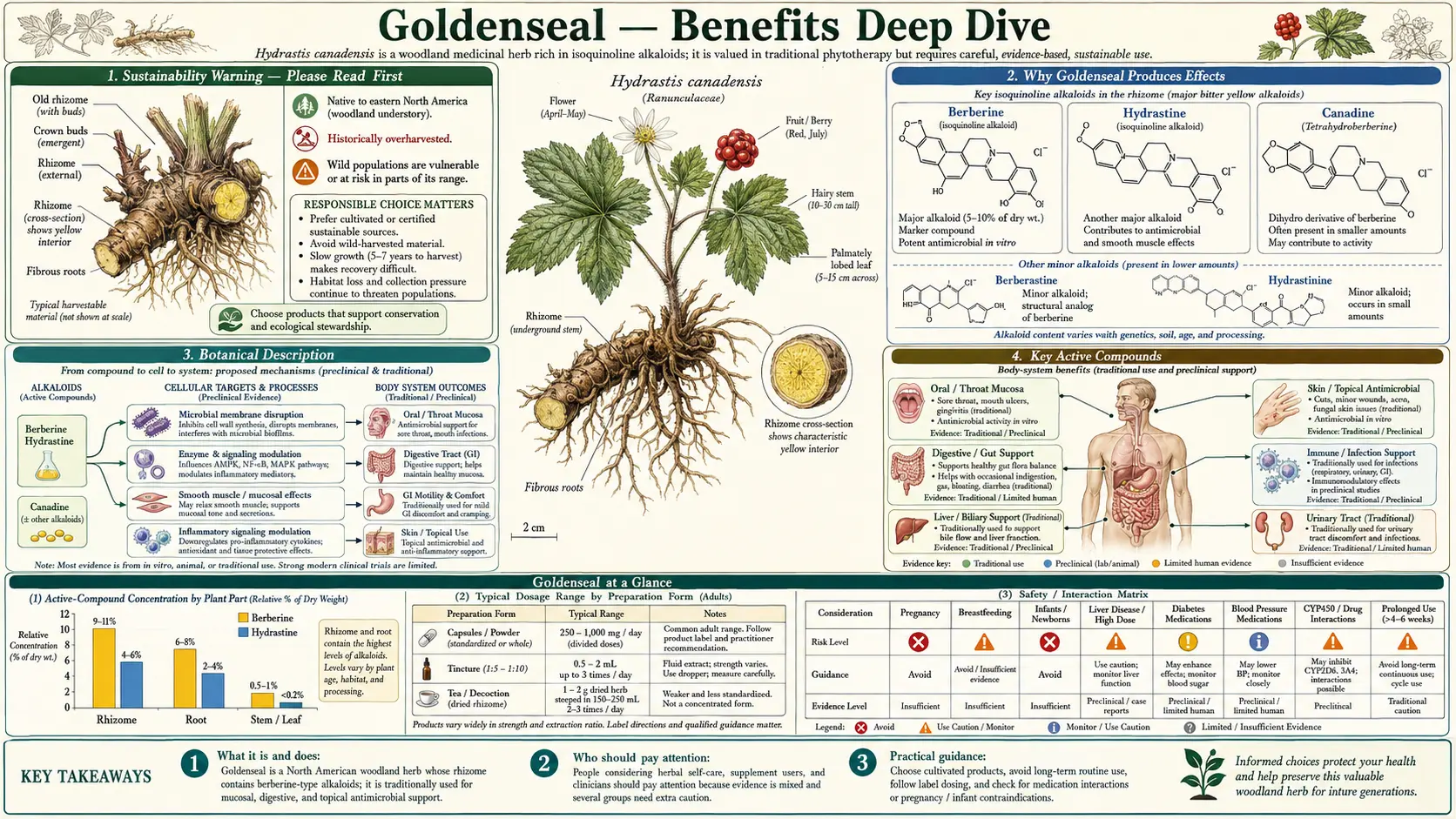
Goldenseal (Hydrastis canadensis), the bright-yellow-rooted woodland perennial Native Americans called "yellow root," is one of the most therapeutically potent and most ecologically endangered herbs in the Western herbal pharmacopeia. Its bioactivity comes from a trio of isoquinoline alkaloids — berberine (broad-spectrum antimicrobial and DNA-gyrase inhibitor), hydrastine (mucous-membrane astringent and vasoconstrictor), and canadine (efflux-pump inhibitor that potentiates berberine). A century of overharvesting from old-growth Appalachian hardwood forests has placed Hydrastis canadensis on CITES Appendix II and the United Plant Savers "At-Risk" list — please purchase only CULTIVATED or woods-grown root, never wild-crafted. For everyday berberine needs, the more abundant Oregon grape (Mahonia aquifolium) or barberry (Berberis vulgaris) deliver the same primary alkaloid without the conservation cost. The four deep-dive pages below cover goldenseal's most clinically supported uses (antimicrobial, digestive/gut, eye health) alongside the sustainability ethics that must shape any responsible use of this herb.
Deep-Dive Articles
Antimicrobial Activity
The berberine + hydrastine + canadine alkaloid trio and its broad-spectrum activity against Gram-positive (MRSA, Strep pyogenes, C. difficile) and Gram-negative (E. coli, H. pylori, Chlamydia) bacteria. DNA-gyrase inhibition, FtsZ blockade, the Stermitz efflux-pump-inhibitor discovery, traditional Native American wound and infection use, and the in vitro MRSA biofilm data that drives modern antibiotic-adjuvant research.
Digestive & Gut Health
Bitter-principle stimulation of saliva, gastric acid, and bile flow; in-gut antimicrobial action against bacterial diarrhea (E. coli, V. cholerae, Shigella); SIBO efficacy comparable to rifaximin in the 2014 Johns Hopkins trial; berberine inhibition of C. difficile toxin A/B; pilot IBD adjunct studies; and the practical comparison to cheaper berberine sources (barberry, Oregon grape, purified berberine HCl) for gut applications.
Eye Health
Goldenseal's traditional "eye-cleaning" name origin from Cherokee and Iroquois conjunctivitis eyewashes. Berberine's in vitro activity against common conjunctivitis organisms (Staph aureus, Strep pneumoniae, Haemophilus influenzae). The Indian Journal of Ophthalmology head-to-head berberine vs chloramphenicol drops trial. Critical safety caveats — never use unfiltered home decoctions, never on babies, and why most modern naturopaths now recommend commercial pharmaceutical drops instead.
Sustainability & Cautions
The conservation case: Hydrastis canadensis CITES Appendix II listing (1997), United Plant Savers "At-Risk" placement, state-level endangered listings in 12+ states, and the century of overharvest from Appalachian hardwood forests that produced this crisis. Cultivated vs woods-grown vs wild-crafted distinctions, the FGV (Forest Grown Verified) certification, and the strong recommendation to use cheaper alternatives — Oregon grape (Mahonia aquifolium), barberry (Berberis vulgaris), or purified berberine HCl — for any indication that doesn't specifically require goldenseal's unique alkaloid profile.
Table of Contents
- Deep-Dive Articles
- Why Goldenseal Produces Effects
- Sustainability Warning — Please Read First
- Research Papers: Antimicrobial
- Research Papers: Digestive & Gut
- Research Papers: Eye Health
- Research Papers: Sustainability & Safety
- Research Papers: Cross-Cutting (Mechanism, Synergy, Alternatives)
- External Authoritative Resources
- Connections
- Featured Videos
Sustainability Warning — Please Read First
Goldenseal is one of the most overharvested medicinal plants in North America.
Hydrastis canadensis has been listed on CITES Appendix II since 1997 (Convention on International Trade in Endangered Species) and sits on the United Plant Savers "At-Risk" list, the most urgent botanical conservation category. Wild populations have collapsed by an estimated 50%+ over the past century due to a combination of overharvesting for the medicinal trade and the loss of mature deciduous-forest habitat that goldenseal requires.
Practical guidance for anyone considering goldenseal:
- Purchase only cultivated or woods-grown (Forest Grown Verified) goldenseal. Reputable suppliers will document chain of custody.
- Never buy wild-crafted goldenseal. If a supplier cannot or will not document cultivation, walk away.
- For most indications, consider cheaper and more abundant alternatives: Oregon grape (Mahonia aquifolium), barberry (Berberis vulgaris), or purified berberine HCl supplements. All deliver berberine, the primary antimicrobial alkaloid, without the conservation cost.
- The few clinical indications that genuinely benefit from goldenseal's full alkaloid profile (mucous-membrane astringency from hydrastine, efflux-pump synergy from canadine) are uncommon; for general antimicrobial, blood-sugar, or anti-diarrheal use, an alternative is equally effective.
See the Sustainability & Cautions deep dive for the full conservation story and a structured framework for choosing between goldenseal and its alternatives.
Why Goldenseal Produces Effects
Goldenseal's clinical actions are not the product of a single dominant compound; they are the product of a coordinated three-alkaloid system in which the major alkaloid (berberine) does most of the antimicrobial heavy lifting and two minor alkaloids (hydrastine and canadine) each contribute distinct, complementary effects that are difficult to replicate with a single purified compound.
- Berberine — broad-spectrum antimicrobial (2.5-6% of dried root by weight). Berberine is a quaternary ammonium isoquinoline alkaloid present at the highest concentration of the three. It is the source of goldenseal's most-studied actions: DNA intercalation and gyrase inhibition, FtsZ (bacterial cell-division protein) blockade, AMPK activation (the basis for berberine's blood-glucose-lowering effects), NF-kB suppression (anti-inflammatory), and broad direct antibacterial activity against both Gram-positive and Gram-negative pathogens. Crucially, berberine is also found at therapeutic concentrations in Oregon grape and barberry, which is why those plants are listed as the sustainable substitutes for most goldenseal indications.
- Hydrastine — mucous-membrane astringent and vasoconstrictor (1.5-4% by weight). Hydrastine is a phthalideisoquinoline alkaloid unique to Hydrastis canadensis — it is the alkaloid that distinguishes goldenseal from other berberine-containing plants. Its astringent and mild vasoconstrictive properties give goldenseal its traditional reputation for "tightening up" inflamed mucous membranes, which is why Eclectic-era physicians prized it for catarrhal conditions (nasal congestion, postnasal drip, mucousy diarrhea, bronchial congestion). Hydrastine also functions as an inhibitor of bacterial multidrug-resistance efflux pumps, particularly NorA in Staphylococcus aureus.
- Canadine (tetrahydroberberine) — efflux-pump inhibitor (0.5-1% by weight). Canadine is structurally a fully reduced berberine analogue. Its primary clinical contribution is potent inhibition of bacterial NorA efflux pumps, reducing the minimum inhibitory concentration (MIC) of berberine itself by 4-16-fold when the two compounds are co-administered. This is the molecular basis for the well-documented observation that goldenseal whole-root extract is significantly more antibacterial in vitro than purified berberine alone — the plant produces, alongside its primary antimicrobial alkaloid, its own internal resistance-breaker.
The therapeutic implication is straightforward: for indications where the primary effect comes from berberine (anti-diarrheal action, blood-glucose lowering, basic antimicrobial activity, anti-inflammatory effects), cheaper and more sustainable berberine sources work essentially as well. The indications where goldenseal's full alkaloid profile genuinely matters — mucous-membrane astringency from hydrastine, efflux-pump synergy against highly resistant Gram-positive organisms — are uncommon. This makes responsible use of goldenseal more about not using it as a generic "natural antibiotic" and more about reserving it for the narrow set of indications where its unique profile is genuinely warranted.
A second therapeutic complication is that the same alkaloids that make goldenseal effective also make it among the most drug-interaction-prone herbs on the shelf: berberine is a potent inhibitor of cytochrome P450 enzymes (CYP2D6, CYP2C9, CYP3A4) and P-glycoprotein, both of which control the absorption, distribution, and clearance of a long list of prescription drugs. The fourth deep-dive page explores the full safety profile including the strict pregnancy contraindication (uterine stimulation, bilirubin displacement from albumin, and a documented neonatal jaundice risk).
Research Papers: Antimicrobial
- Stermitz FR et al. (2000). Synergy in a medicinal plant: berberine + 5'-methoxyhydnocarpin as multidrug-pump inhibitor — PubMed: Stermitz PNAS 2000
- Scazzocchio F et al. Antibacterial activity of Hydrastis canadensis extract and major alkaloids (Planta Medica) — PubMed: Scazzocchio Planta Medica
- Ettefagh KA et al. (2011). Goldenseal extracts synergistically enhance berberine antibacterial activity via efflux pump inhibition — PubMed: Ettefagh 2011
- Cech NB et al. Quorum quenching and antimicrobial activity of goldenseal against MRSA — PubMed: Cech MRSA quorum quenching
- Domadia P et al. (2008). Inhibition of FtsZ by berberine (Biochemistry) — PubMed: Domadia FtsZ 2008
- Berberine DNA-gyrase / topoisomerase II inhibition — PubMed: Berberine DNA gyrase
- Berberine activity against MRSA and biofilm formation — PubMed: Berberine MRSA biofilm
- NorA efflux pump inhibition by goldenseal alkaloids — PubMed: NorA efflux pump
- Berberine + beta-lactam antibiotic synergy against MRSA — PubMed: Berberine + beta-lactam
- Berberine antibacterial against Chlamydia trachomatis — PubMed: Berberine + Chlamydia
Research Papers: Digestive & Gut
- Rabbani GH et al. (1987). Berberine sulphate for enterotoxigenic E. coli and V. cholerae diarrhea (J Infect Dis) — PubMed: Rabbani 1987
- Berberine inhibition of C. difficile toxin A and toxin B production — PubMed: Berberine + C. difficile toxin
- Chedid V et al. Herbal therapy equivalent to rifaximin for SIBO (Global Adv Health Med 2014, Johns Hopkins) — PubMed: Chedid SIBO 2014
- Berberine inhibition of cholera toxin / heat-labile enterotoxin Cl- channels — PubMed: Berberine + cholera Cl- channels
- Berberine activity against Helicobacter pylori — PubMed: Berberine + H. pylori
- Bitter principles, vagal stimulation, and gastric acid / bile secretion — PubMed: Bitter principles + GI secretion
- Berberine pilot data in inflammatory bowel disease (IBD adjunct) — PubMed: Berberine + IBD
- Berberine and intestinal barrier / tight junction protein expression — PubMed: Berberine + tight junctions
- Berberine modulation of gut microbiota composition — PubMed: Berberine + gut microbiota
- Berberine for traveler's diarrhea prophylaxis — PubMed: Berberine + traveler's diarrhea
Research Papers: Eye Health
- Mohan M et al. Berberine sulphate vs chloramphenicol eye drops in acute bacterial conjunctivitis (Indian J Ophthalmol) — PubMed: Berberine vs chloramphenicol
- Berberine in vitro activity against conjunctivitis pathogens (S. aureus, S. pneumoniae, H. influenzae) — PubMed: Berberine + conjunctivitis pathogens
- Berberine activity against Chlamydia trachomatis ocular infection (trachoma) — PubMed: Berberine + trachoma
- Berberine suppression of conjunctival IL-1beta and TNF-alpha — PubMed: Berberine + conjunctival cytokines
- Goldenseal eyewash historical pharmacopeia documentation (Eclectic and USP) — PubMed: Goldenseal eyewash history
- Bacterial conjunctivitis pathogen distribution (modern epidemiology) — PubMed: Bacterial conjunctivitis epidemiology
- Berberine ocular pharmacokinetics and safety — PubMed: Berberine ocular pharmacokinetics
- Self-prepared herbal eyewash contamination / endophthalmitis case reports — PubMed: Eyewash contamination risks
- Neonatal jaundice and ophthalmic berberine exposure (kernicterus risk) — PubMed: Berberine + neonatal jaundice
- Berberine and corneal epithelial wound healing — PubMed: Berberine + corneal healing
Research Papers: Sustainability & Safety
- Gentry JG et al. (1998). The harvest and trade of goldenseal in the United States (TRAFFIC North America report) — PubMed: Gentry TRAFFIC report
- CITES Appendix II listing of Hydrastis canadensis (1997) — PubMed: CITES Hydrastis
- United Plant Savers At-Risk list methodology and goldenseal status — PubMed: United Plant Savers
- Goldenseal wild population decline and habitat loss in Appalachia — PubMed: Wild population decline
- Woods-grown / forest-grown verified goldenseal cultivation methods — PubMed: Woods-grown cultivation
- Berberine and CYP450 cytochrome P450 drug interactions — PubMed: Berberine + CYP450
- Goldenseal effects on P-glycoprotein drug transporter — PubMed: Goldenseal + P-glycoprotein
- Berberine teratogenicity and uterine stimulation in animal studies — PubMed: Berberine + pregnancy
- Berberine displacement of bilirubin from albumin (neonatal jaundice mechanism) — PubMed: Berberine + bilirubin
- Hydrastine vasoconstriction and blood pressure effects — PubMed: Hydrastine + blood pressure
Research Papers: Cross-Cutting (Mechanism, Synergy, Alternatives)
- Mahonia aquifolium (Oregon grape) berberine content and antimicrobial profile — PubMed: Oregon grape berberine
- Berberis vulgaris (barberry) berberine pharmacology — PubMed: Barberry berberine
- Berberine HCl oral bioavailability and absorption — PubMed: Berberine HCl bioavailability
- Berberine activation of AMPK and metabolic effects — PubMed: Berberine + AMPK
- Berberine vs metformin in type 2 diabetes meta-analysis — PubMed: Berberine vs metformin
- Berberine NF-kB inhibition and anti-inflammatory effects — PubMed: Berberine + NF-kB
- Goldenseal + echinacea combination for upper respiratory infection — PubMed: Goldenseal + echinacea
- Comparative phytochemistry of berberine-containing plants — PubMed: Comparative berberine plants
- Coptis chinensis (Chinese goldthread) as sustainable berberine alternative — PubMed: Coptis chinensis
- Bryan Stuart Memorial study series on berberine plant ethnopharmacology — PubMed: Berberine ethnopharmacology
External Authoritative Resources
- United Plant Savers — Goldenseal Species Profile (At-Risk listing, cultivation guidance, conservation primer)
- CITES — Convention on International Trade in Endangered Species (Hydrastis canadensis on Appendix II since 1997)
- US Forest Service — Hydrastis canadensis Plant of the Week (ecology, habitat, conservation status)
- MedlinePlus — Goldenseal (NIH-curated patient-facing summary, drug interactions)
- NIH NCCIH — Goldenseal Fact Sheet (National Center for Complementary and Integrative Health)
- PubMed — All research on goldenseal / Hydrastis / berberine (5,000+ papers)
Connections
- All Herbs
- Goldenseal (Main Page)
- Goldenseal for Antimicrobial Action
- Goldenseal for Digestive & Gut
- Goldenseal for Eye Health
- Goldenseal Sustainability & Cautions
- Berberine (Pure Supplement)
- Barberry (Sustainable Alternative)
- Echinacea
- Oregano
- Olive Leaf
- Garlic
- Myrrh
- Berberine Remedy
- Immune Boosting
- Staphylococcus Aureus
- Escherichia Coli
- SIBO
- Clostridium Difficile
- Urinary Tract Infections