Garlic — Benefits Deep Dive
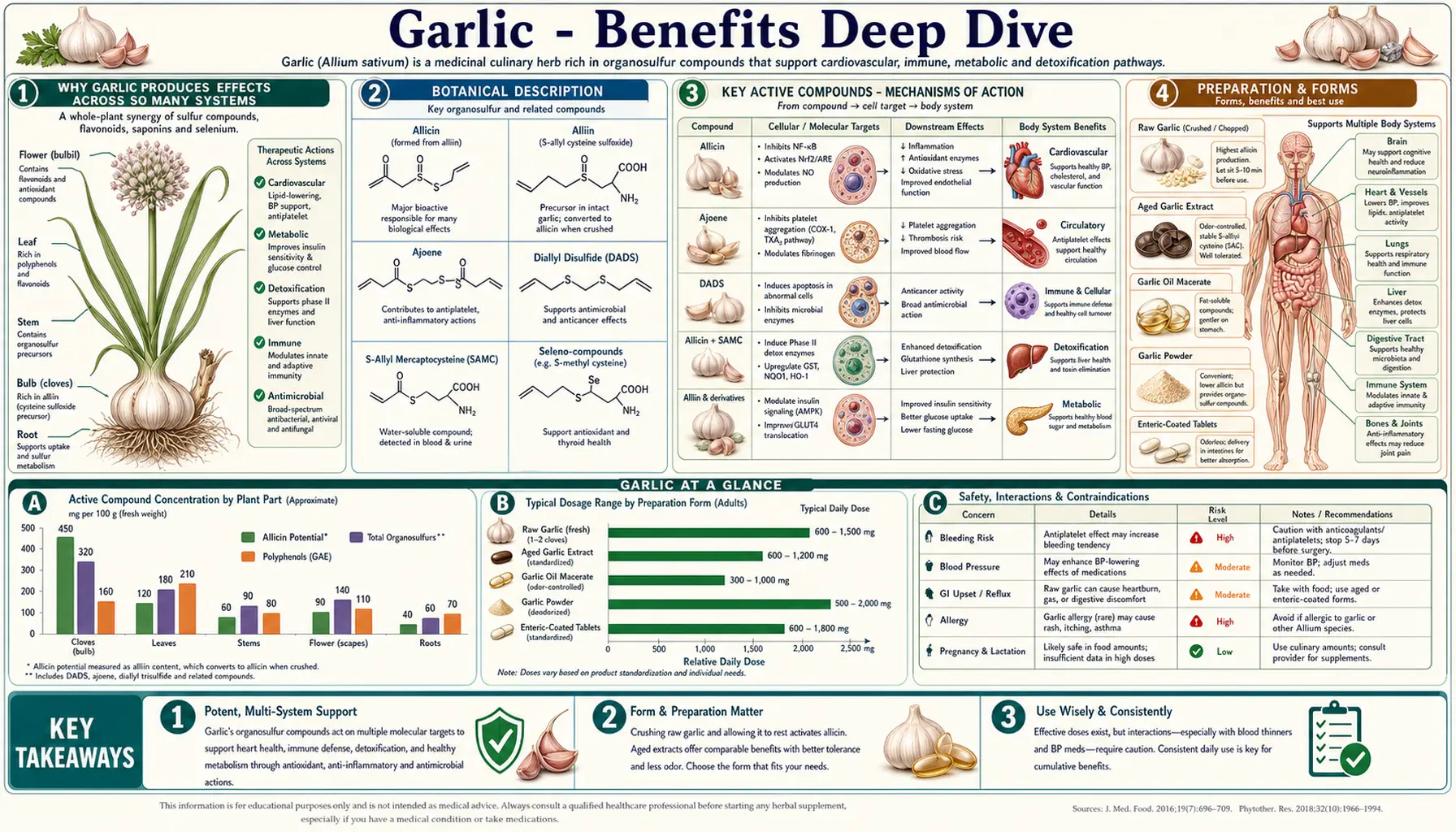
Allium sativum is the most-studied medicinal food on PubMed, with over 6,000 publications spanning cardiology, microbiology, oncology, and immunology. The therapeutic story is one of a sulfur-chemistry cascade: intact garlic stores the inert amino acid alliin, which the wounded clove's alliinase enzyme converts in seconds to allicin, which then decomposes within hours to a family of lipid-soluble diallyl polysulfides (DAS, DADS, DATS) and eventually releases hydrogen sulfide (H2S) — the same gasotransmitter that nitric oxide donors release in the vasculature. Preparation determines which compounds you actually get: aged garlic extract (AGE) is high in stable, water-soluble S-allyl cysteine; fresh crushed garlic is high in transient allicin; garlic oil is high in lipophilic polysulfides; and powdered tablets vary widely in enteric-coating quality and real allicin yield. The four deep-dive pages below map the four conditions where garlic produces its largest documented clinical effect — hypertension, atherosclerotic plaque progression, common-cold prevention, and broad-spectrum antimicrobial activity — with attention to which preparation matters in each setting.
Deep-Dive Articles
Cardiovascular & Blood Pressure
Karin Ried's 2008-2020 series of meta-analyses on Kyolic aged garlic extract for hypertension — the headline finding of roughly −8 mmHg systolic and −5 mmHg diastolic in hypertensive adults at 480-960 mg AGE per day, comparable in magnitude to first-line single-agent antihypertensive drugs. The mechanism: allicin and its metabolites are potent donors of nitric oxide (NO) and hydrogen sulfide (H2S), the two principal endothelium-derived vasodilator gasotransmitters.
Cholesterol & Atherosclerosis
The Stevinson 2000 and Reinhart 2009 meta-analyses on garlic for total and LDL cholesterol (modest 7-10% reduction with sustained use), and the more clinically meaningful Budoff/Williams 2009 randomized coronary artery calcium (CAC) progression trial showing aged garlic extract slowed CAC accumulation over one year. Mechanism: partial inhibition of HMG-CoA reductase by water-soluble allyl sulfur compounds, plus reduced LDL oxidation and improved endothelial function.
Immune Function & Cold
The Josling 2001 prophylaxis trial — 146 colds in the placebo arm versus 24 in the allicin arm over 12 winter weeks — and the Nantz 2012 aged garlic extract trial showing 21% fewer cold/flu symptom-days and enhanced γδ-T-cell and NK-cell function. Critical reading of the Lissiman 2014 Cochrane review (only one trial of acceptable quality), the allicin → diallyl sulfide → NK-cell activation cascade, and an honest discussion of the unsupported COVID-era hype.
Antimicrobial Spectrum
The 1944 Cavallito isolation of pure allicin from crushed garlic and the demonstration of broad-spectrum activity against Gram-positive and Gram-negative bacteria, fungi, and parasites. Modern evidence for activity against MRSA, Helicobacter pylori as adjunctive eradication therapy, Candida albicans, Giardia, and other organisms — with appropriate humility about why allicin has not become a clinical antimicrobial.
Table of Contents
- Deep-Dive Articles
- Why Garlic Produces Effects Across So Many Systems
- Research Papers: Cardiovascular & Blood Pressure
- Research Papers: Cholesterol & Atherosclerosis
- Research Papers: Immune Function & Cold
- Research Papers: Antimicrobial Spectrum
- External Authoritative Resources
- Connections
- Featured Videos
Why Garlic Produces Effects Across So Many Systems
Garlic's unusual therapeutic breadth — spanning hypertension, atherosclerosis, common-cold prevention, antimicrobial activity, and a credible (if smaller) signal in oncology — is best explained not by a single magic ingredient but by a cascade of sulfur-containing compounds that share a common metabolic origin and a common downstream gasotransmitter (hydrogen sulfide). Understanding the cascade clarifies why preparation matters and why apparently contradictory studies often reflect different molecules in different doses, rather than a real disagreement about garlic itself.
- Alliin (the precursor) — the intact, undamaged garlic clove contains S-allyl-L-cysteine sulfoxide (alliin), an odorless, biologically inert amino acid derivative stored in the cytoplasm. The wounded clove also contains the enzyme alliinase, stored separately in the vacuole. Crushing, chopping, or chewing ruptures the cellular compartments, alliinase meets alliin, and within roughly ten seconds alliin is converted to allicin (diallyl thiosulfinate).
- Allicin (the transient warhead) — allicin is the principal pungent molecule, responsible for the garlic smell, the antimicrobial activity in raw crushed garlic, and much of the in vitro biological activity. It is also unstable: in water at body temperature, allicin has a half-life of hours, and in cooking oil at sauteing temperatures it decomposes in seconds. Most of garlic's downstream effects in vivo come not from allicin itself but from its decomposition products.
- Diallyl polysulfides (DAS, DADS, DATS) and ajoene — the lipid-soluble decomposition products of allicin. Diallyl disulfide (DADS) and diallyl trisulfide (DATS) accumulate preferentially in garlic oil and account for much of the antiproliferative, antimicrobial, and gasotransmitter activity in animal models. Ajoene is a separate decomposition product with documented antiplatelet activity (the basis of garlic's well-known bleeding-risk warning).
- S-allyl cysteine (SAC) and the aged-garlic profile — when garlic is aged for ~18-20 months in dilute ethanol (the Kyolic process), the alliin pool is slowly converted not to allicin but to S-allyl cysteine and S-allyl mercaptocysteine, water-soluble, stable, odorless compounds with their own pharmacology. SAC is the dominant marker compound in aged garlic extract (AGE) and the molecule referenced in most of the standardized AGE clinical trials — including Ried's hypertension series and the Budoff coronary calcium trial.
- Hydrogen sulfide (H2S) as the final mediator — the allyl polysulfides slowly release hydrogen sulfide in the presence of reduced glutathione in the vascular endothelium. H2S is the third recognized gasotransmitter (after nitric oxide and carbon monoxide) and produces endothelium-dependent vasodilation, anti-inflammatory effects on the vessel wall, and reduced platelet aggregation. This is the unifying mechanism that links the sulfur chemistry of crushed garlic to the cardiovascular outcomes of standardized AGE supplementation.
The therapeutic complication is that preparation determines the molecule. Fresh raw crushed garlic delivers transient allicin (best for acute antimicrobial use). Sauteing at high heat destroys alliinase before allicin can form (the standard restaurant approach yields very little allicin). Aged garlic extract is dominated by S-allyl cysteine (best characterized in cardiovascular trials). Garlic oil concentrates the lipid-soluble polysulfides (animal evidence for anticancer effects). Garlic powder tablets vary widely in their actual allicin-yielding potential, which depends on tablet enteric coating quality and freshness. Studies that test "garlic" without specifying preparation cannot be directly compared — and most clinical heterogeneity in the meta-analyses is preparation heterogeneity. See the dedicated Cardiovascular & Blood Pressure page for the clinical implications.
The hard rule, in clinical practice: aged garlic extract (Kyolic-type) is the preparation to use when the goal is a cardiovascular or chronic-disease endpoint, both because it has the strongest randomized-trial evidence and because it is stable, odorless, and standardized to S-allyl cysteine content. Fresh crushed garlic is the preparation to use when the goal is acute antimicrobial activity — with the obvious caveat that fresh garlic is a culinary ingredient, not a regulated drug, and is not a substitute for appropriate antibiotic therapy in serious infection. Garlic in any form must be discontinued at least seven days before any surgical or dental procedure with bleeding risk because of allicin- and ajoene-mediated antiplatelet effects, and patients on warfarin, clopidogrel, or aspirin should consult their physician before supplementing high-dose garlic on top of those drugs.
Research Papers: Cardiovascular & Blood Pressure
- Ried K et al. (2008). Effect of garlic on blood pressure: a systematic review and meta-analysis. BMC Cardiovascular Disorders. — PubMed: Ried 2008 meta-analysis
- Ried K et al. (2013). Aged garlic extract reduces blood pressure in hypertensives: a dose-response trial. European Journal of Clinical Nutrition. — PubMed: Ried 2013 AGE dose-response
- Ried K (2020). Garlic lowers blood pressure in hypertensive subjects, improves arterial stiffness and gut microbiota: A review and meta-analysis. Experimental and Therapeutic Medicine. — PubMed: Ried 2020 review
- Stabler SN et al. (2012). Garlic for the prevention of cardiovascular morbidity and mortality in hypertensive patients. Cochrane Database. — PubMed: Stabler Cochrane 2012
- Benavides GA et al. (2007). Hydrogen sulfide mediates the vasoactivity of garlic. PNAS. — PubMed: Benavides H2S mechanism
- Morihara N et al. (2002). Aged garlic extract enhances production of nitric oxide. Life Sciences. — PubMed: Morihara AGE and NO
- Williams MJA et al. (2005). Aged garlic extract improves endothelial function in men with coronary artery disease. Phytotherapy Research. — PubMed: Williams endothelial function
- Wang HP et al. (2015). Effects of garlic on blood pressure in patients with and without systolic hypertension: a meta-analysis. Journal of Hypertension. — PubMed: Wang 2015 BP meta-analysis
- Ginter E, Simko V (2010). Garlic (Allium sativum L.) and cardiovascular diseases. Bratislava Medical Journal. — PubMed: Ginter cardiovascular review
- Ried K, Toben C, Fakler P (2013). Effect of garlic on serum lipids: an updated meta-analysis. Nutrition Reviews. — PubMed: Ried lipids meta-analysis
- Kim-Park S, Ku DD (2000). Garlic elicits a nitric oxide-dependent relaxation. Clinical and Experimental Pharmacology and Physiology. — PubMed: Kim-Park NO relaxation
- PubMed topic search: Garlic and blood pressure — PubMed: Garlic and hypertension
Research Papers: Cholesterol & Atherosclerosis
- Stevinson C, Pittler MH, Ernst E (2000). Garlic for treating hypercholesterolemia. A meta-analysis of randomized clinical trials. Annals of Internal Medicine. — PubMed: Stevinson 2000 meta-analysis
- Reinhart KM et al. (2009). The impact of garlic on lipid parameters: a systematic review and meta-analysis. Nutrition Research Reviews. — PubMed: Reinhart 2009 lipid meta-analysis
- Budoff MJ et al. (2009). Aged garlic extract supplemented with B vitamins, folic acid and L-arginine retards the progression of subclinical atherosclerosis: a randomized clinical trial. Preventive Medicine. — PubMed: Budoff 2009 CAC trial
- Williams MJA, Sutherland WHF (2005). Aged garlic extract and the prevention of cardiovascular disease. Clinical and Experimental Pharmacology. — PubMed: Williams AGE prevention
- Gebhardt R, Beck H (1996). Differential inhibitory effects of garlic-derived organosulfur compounds on cholesterol biosynthesis in primary rat hepatocyte cultures. Lipids. — PubMed: Gebhardt HMG-CoA mechanism
- Liu L, Yeh YY (2002). S-alk(en)yl cysteines of garlic inhibit cholesterol synthesis by deactivating HMG-CoA reductase. Journal of Nutrition. — PubMed: Liu/Yeh HMG-CoA
- Sobenin IA et al. (2008). Lipid-lowering effects of time-released garlic powder tablets in double-blinded placebo-controlled randomized study. Journal of Atherosclerosis and Thrombosis. — PubMed: Sobenin time-released garlic
- Koscielny J et al. (1999). The antiatherosclerotic effect of Allium sativum. Atherosclerosis. — PubMed: Koscielny atherosclerosis
- Zeng T et al. (2012). A meta-analysis of randomized, double-blind, placebo-controlled trials for the effects of garlic on serum lipid profiles. Journal of the Science of Food and Agriculture. — PubMed: Zeng 2012 lipid meta-analysis
- Matsumoto S et al. (2016). Aged garlic extract reduces low attenuation plaque in coronary arteries of patients with metabolic syndrome in a prospective randomized double-blind study. Journal of Nutrition. — PubMed: Matsumoto soft-plaque trial
- Wlosinska M et al. (2020). The effect of aged garlic extract on the atherosclerotic process — a randomized double-blind placebo-controlled trial. BMC Complementary Medicine and Therapies. — PubMed: Wlosinska 2020 AGE trial
- PubMed topic search: Garlic and cholesterol/atherosclerosis — PubMed: Garlic and cholesterol
Research Papers: Immune Function & Cold
- Josling P (2001). Preventing the common cold with a garlic supplement: a double-blind, placebo-controlled survey. Advances in Therapy. — PubMed: Josling 2001 cold trial
- Lissiman E, Bhasale AL, Cohen M (2014). Garlic for the common cold. Cochrane Database of Systematic Reviews. — PubMed: Lissiman Cochrane 2014
- Nantz MP et al. (2012). Supplementation with aged garlic extract improves both NK and γδ-T cell function and reduces the severity of cold and flu symptoms: a randomized, double-blind, placebo-controlled nutrition intervention. Clinical Nutrition. — PubMed: Nantz 2012 immune trial
- Percival SS (2016). Aged garlic extract modifies human immunity. Journal of Nutrition. — PubMed: Percival immunity review
- Kyo E et al. (2001). Immunomodulatory effects of aged garlic extract. Journal of Nutrition. — PubMed: Kyo immunomodulation
- Lau BHS (2001). Suppression of LDL oxidation by garlic compounds is a possible mechanism of cardiovascular health benefit. Journal of Nutrition. — PubMed: Lau LDL oxidation
- Arreola R et al. (2015). Immunomodulation and anti-inflammatory effects of garlic compounds. Journal of Immunology Research. — PubMed: Arreola anti-inflammatory
- Salman H et al. (1999). Effect of a garlic derivative (alliin) on peripheral blood cell immune responses. International Journal of Immunopharmacology. — PubMed: Salman alliin and PBMCs
- Andrianova IV et al. (2003). Effect of a long-acting garlic-based drug allicor on incidence of acute respiratory viral infections. Terapevticheskii Arkhiv. — PubMed: Andrianova respiratory infections
- Ishikawa H et al. (2006). Aged garlic extract prevents a decline of NK cell number and activity in patients with advanced cancer. Journal of Nutrition. — PubMed: Ishikawa NK cells in cancer
- Charron CS et al. (2016). A single meal containing raw, crushed garlic influences expression of immunity- and cancer-related genes in whole blood of humans. Journal of Nutrition. — PubMed: Charron gene-expression
- PubMed topic search: Garlic and common cold/immune function — PubMed: Garlic and cold/immune
Research Papers: Antimicrobial Spectrum
- Cavallito CJ, Bailey JH (1944). Allicin, the antibacterial principle of Allium sativum. I. Isolation, physical properties and antibacterial action. Journal of the American Chemical Society. — PubMed: Cavallito 1944 isolation
- Ankri S, Mirelman D (1999). Antimicrobial properties of allicin from garlic. Microbes and Infection. — PubMed: Ankri/Mirelman review
- Cutler RR, Wilson P (2004). Antibacterial activity of a new, stable, aqueous extract of allicin against methicillin-resistant Staphylococcus aureus. British Journal of Biomedical Science. — PubMed: Cutler MRSA
- Sivam GP (2001). Protection against Helicobacter pylori and other bacterial infections by garlic. Journal of Nutrition. — PubMed: Sivam H. pylori review
- Ledezma E, Apitz-Castro R (2006). Ajoene the main active compound of garlic (Allium sativum): a new antifungal agent. Revista Iberoamericana de Micologia. — PubMed: Ledezma ajoene antifungal
- Soffar SA, Mokhtar GM (1991). Evaluation of the antiparasitic effect of aqueous garlic (Allium sativum) extract in hymenolepiasis nana and giardiasis. Journal of the Egyptian Society of Parasitology. — PubMed: Soffar Giardia trial
- Davis SR (2005). An overview of the antifungal properties of allicin and its breakdown products — the possibility of a safe and effective antifungal prophylactic. Mycoses. — PubMed: Davis allicin antifungal
- Reuter HD, Koch HP, Lawson LD (1996). Therapeutic effects and applications of garlic and its preparations. Garlic: The Science and Therapeutic Application of Allium sativum L. — PubMed: Lawson textbook
- Iwalokun BA et al. (2004). In vitro antimicrobial properties of aqueous garlic extract against multidrug-resistant bacteria and Candida species from Nigeria. Journal of Medicinal Food. — PubMed: Iwalokun MDR bacteria
- Tsai CW et al. (2012). Garlic: Health benefits and actions. BioMedicine. — PubMed: Tsai health benefits review
- Bayan L, Koulivand PH, Gorji A (2014). Garlic: a review of potential therapeutic effects. Avicenna Journal of Phytomedicine. — PubMed: Bayan therapeutic review
- PubMed topic search: Allicin antimicrobial / MRSA / H. pylori / Candida — PubMed: Allicin antimicrobial
External Authoritative Resources
- NCCIH (National Center for Complementary and Integrative Health) — Garlic — the U.S. National Institutes of Health summary of garlic clinical evidence and safety
- NIH Office of Dietary Supplements — related Allium / supplement fact sheets
- Cochrane Library — Garlic for the common cold (Lissiman 2014)
- WHO Monograph on Selected Medicinal Plants — Bulbus Allii Sativi (Garlic)
- PubMed — All research on Allium sativum / garlic (~6,000+ papers)
Connections
- All Herbs
- Garlic (Main Page)
- Garlic for Cardiovascular & Blood Pressure
- Garlic for Cholesterol & Atherosclerosis
- Garlic for Immune Function & Cold
- Garlic Antimicrobial Spectrum
- Oregano
- Ginger
- Turmeric
- Elderberry
- Sulfur
- Cysteine
- Glutathione
- Hypertension
- Atherosclerosis
- Cardiovascular Disease
- Stroke
- Homocysteine
- Immune Boosting
- Blood Sugar Control