Garlic: History and Traditional Use
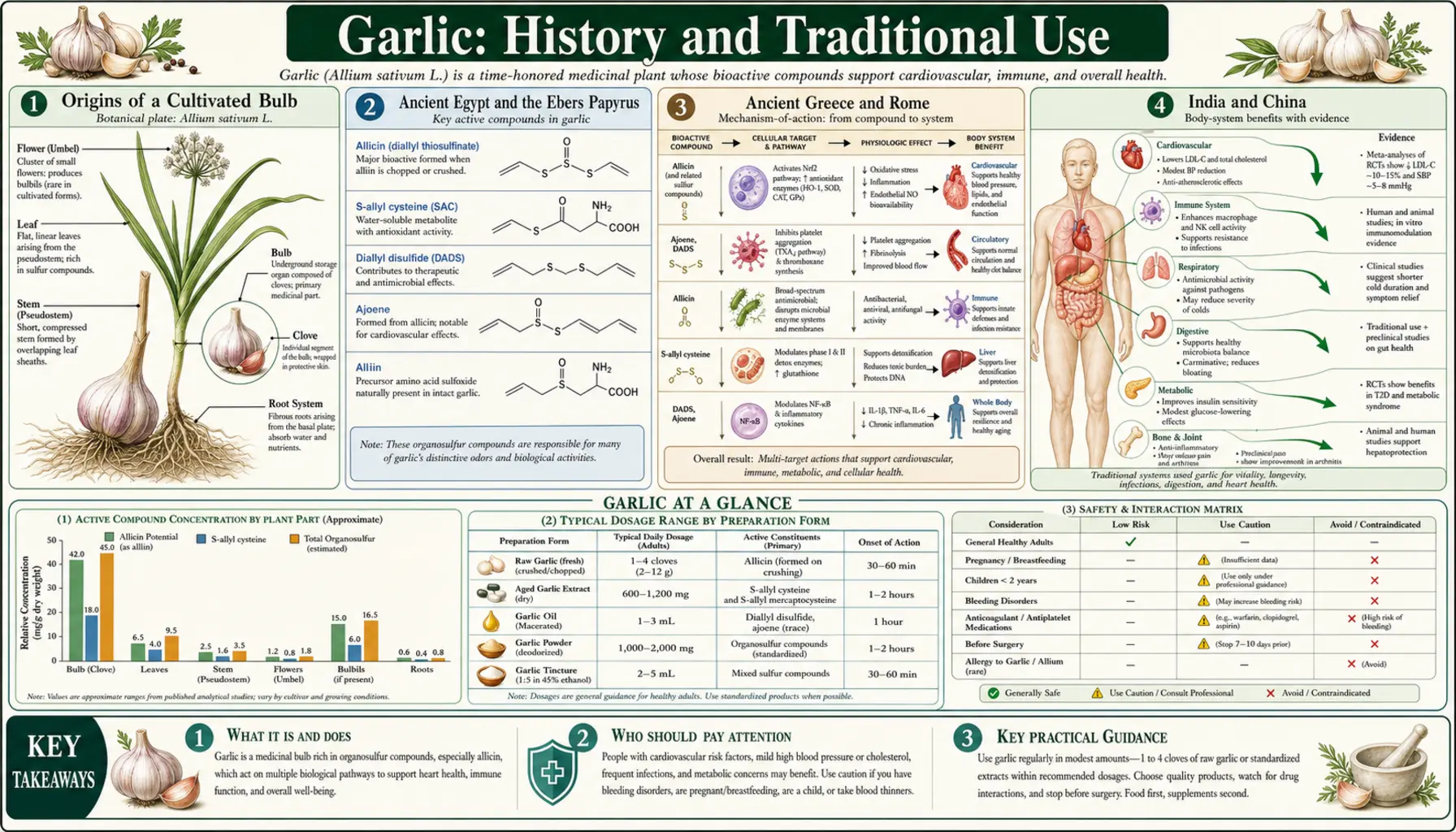
Few plants have walked beside humanity as long as garlic. Allium sativum has been planted, eaten, and used as a medicine for thousands of years, turning up in the medical writings of ancient Egypt, Greece, Rome, India, and China, in the folk remedies of medieval Europe, and on the battlefields of two world wars. This page traces that long story honestly: where the records are solid we say so, and where a claim is really tradition, folklore, or a tale too good to fully verify, we say that too. The thread running through it all is simple — long before anyone could name a single compound, ordinary people noticed that this pungent little bulb seemed to help.
Table of Contents
- Origins of a Cultivated Bulb
- Ancient Egypt and the Ebers Papyrus
- Ancient Greece and Rome
- India and China
- Medieval Europe and the Plague Years
- Folklore, Protection, and the Vampire Legend
- Louis Pasteur and the First Laboratory Evidence
- The World Wars and “Russian Penicillin”
- 1944: Allicin and the Birth of Modern Garlic Science
- From Tradition to Modern Research
- Research Papers and References
- Connections
- Featured Videos
Origins of a Cultivated Bulb
Garlic, Allium sativum, belongs to the onion family (Amaryllidaceae, formerly grouped with the lilies) alongside onions, leeks, shallots, and chives. It is one of the oldest cultivated plants we know of, and it is essentially a human creation: cultivated garlic rarely sets fertile seed and is propagated by replanting its cloves, so for thousands of years every crop has depended on people choosing, saving, and replanting it. Botanists generally trace its wild ancestry to Central Asia — the mountains and steppes stretching across what is now Iran and the surrounding region — with a wild species, Allium longicuspis, often named as its likely relative.
From that homeland garlic spread early and widely along trade and migration routes into Mesopotamia, Egypt, the Mediterranean, India, and China. Because it stores well, travels easily, and grows in many climates, it became one of the first truly global foods and medicines. By the time the earliest surviving written records mention it, garlic was already a familiar, valued plant — which tells us its use as both food and remedy reaches back well before anyone wrote it down. What follows is the documented trail, beginning with the civilization that left us the clearest early record.
Ancient Egypt and the Ebers Papyrus
The clearest early written record of medicinal garlic comes from ancient Egypt. The Ebers Papyrus, an Egyptian medical scroll usually dated to around 1500 BCE and one of the oldest surviving medical documents in the world, lists hundreds of remedies — and garlic is among the plants it names, appearing in a number of preparations for complaints that historians have summarized as including things like headache, bites, worms, and general weakness. (Sources differ on the exact count of garlic recipes — figures around a couple of dozen are commonly cited — so it is safest to say garlic features in numerous Ebers remedies rather than to fix a single number.) The papyrus shows beyond doubt that garlic already had a settled place in Egyptian medicine more than three thousand years ago.
Egypt is also the source of garlic's most famous origin story: that the laborers who built the pyramids were fed garlic (and onions) for strength and stamina. The ancient Greek historian Herodotus, writing in the fifth century BCE, did record an inscription he was told described the radishes, onions, and garlic eaten by the pyramid workers — so the broad tradition has an ancient root. The colorful follow-on detail often repeated today — that workers went on strike when their garlic ration was withheld — is best treated as folklore, widely retold but not found in the ancient sources. (The famous figure of sixteen hundred talents of silver spent on radishes, onions, and garlic, by contrast, really is in Herodotus' own text — though modern scholars suspect the inscription he was shown had been mistranslated for him.) What is solid is that the Egyptians prized garlic enough to write it into their medicine and, by Herodotus' account, to feed it to their laborers.
Ancient Greece and Rome
Garlic carried its reputation into the classical Mediterranean, where it appears in the foundational texts of Western medicine. Hippocrates (c. 460–370 BCE), the Greek physician often called the father of Western medicine, is recorded as using garlic for a range of complaints, including as a treatment for intestinal parasites and as a diuretic, among other uses. A century later the physician and pharmacologist Dioscorides, writing his great herbal De Materia Medica in the first century CE, gave garlic a detailed entry, recommending it to clear the airways and ease coughing, to expel worms, to help against the bites of venomous creatures and dogs, and as a topical remedy for skin troubles. The Roman naturalist Pliny the Elder likewise catalogued garlic in his encyclopedic Natural History, listing it as a remedy for a substantial number of ailments. (Older popular accounts sometimes give very high precise tallies for Pliny; the dependable point is simply that he recorded garlic for many conditions.)
Tradition holds that garlic was also the food of strength and courage in the classical world. Greek Olympic athletes are commonly said to have eaten garlic before competing — making it one of the earliest reputed “performance foods” — and Roman soldiers and laborers are likewise traditionally described as eating garlic for stamina. These athletic and military associations are repeated in many reputable summaries of garlic's history, but they describe cultural practice rather than anything measured, so we present them as the long-standing tradition they are. The harder evidence is the written medicine: from Hippocrates and Dioscorides onward, garlic was a recognized drug in the Western pharmacopeia, and the respiratory, digestive, and antiparasitic uses they named would echo for the next two thousand years.
India and China
Garlic holds a similarly ancient place in the two great Asian medical traditions. In India, garlic (Sanskrit lasuna) is woven into the Ayurvedic system, valued as a warming, strengthening remedy for the chest, the digestion, and the joints. One of the most remarkable documents to survive is the Bower Manuscript, a birch-bark text generally dated to roughly the fourth to sixth centuries CE and named for the British officer Hamilton Bower, who acquired it in 1890. Part of this manuscript is devoted entirely to garlic: it sets the plant within a framing story involving the legendary physician-sage Sushruta and gives dozens of verses on garlic's medicinal properties, recipes, and uses, including for eye complaints. It is one of the oldest detailed treatments of a single medicinal plant anywhere, and it shows how seriously the early Indian tradition took garlic.
In China, garlic appears in the herbal tradition from a very early date; it is often described as having been in use for medicine and food for roughly four to five thousand years, with references traditionally traced back to around 2700 BCE. (Such very early dates rest on later texts looking back, so they should be read as the traditional reckoning rather than a contemporaneous record.) In what became Traditional Chinese Medicine, garlic (da suan) was classed as warm and pungent and used to warm the digestion, resolve what were understood as toxins or stagnation, expel parasites, and treat diarrhea and dysentery. Across both India and China, then, the same broad picture recurs that we saw in Egypt and the Mediterranean: garlic as a warming, cleansing, infection-fighting remedy for the gut, the lungs, and the skin — reached independently by cultures that had little contact with one another.
Medieval Europe and the Plague Years
Through the medieval and early-modern centuries garlic remained a staple of European folk medicine and of the great printed herbals. It was grown in monastery gardens, sold in markets, and used freely by ordinary people who could not afford a physician, chiefly for coughs and chest complaints, digestive troubles, worms, and as a dressing for wounds and skin infections — the same family of uses handed down from the classical authors. Because it was cheap, abundant, and kept through the winter, garlic was very much a medicine of the common household.
Garlic is most vividly associated with Europe's repeated outbreaks of plague. During the Black Death and later epidemics, pungent, aromatic plants were burned, worn, and chewed in the belief that strong-smelling “good air” could drive off the “bad air” thought to spread disease, and garlic was a natural candidate. The famous legend of Four Thieves Vinegar belongs here: a group of thieves who robbed plague victims without falling ill were said to have bought their freedom by revealing a protective recipe of vinegar steeped with herbs and (in many versions) garlic. The story is undoubtedly folklore — it survives in several conflicting versions and recipes — but it captures a real historical reflex: in the face of an unstoppable killer, people reached for garlic. It is worth being honest that this reflex rested on a mistaken theory of disease; garlic did not stop the plague, which is caused by the bacterium Yersinia pestis carried by fleas. The episode belongs to history and folklore, not to medicine.
Folklore, Protection, and the Vampire Legend
Garlic's reputation as a guardian against disease shaded naturally into a reputation as a guardian against evil. Across many cultures, garlic was hung over doorways, carried, or strewn about to ward off harm — an old and widespread piece of protective folklore. Its single most famous appearance in popular culture is, of course, as a charm against vampires. This association is rooted in Eastern European folk belief, where, from roughly the seventeenth to nineteenth centuries, garlic was among the things placed at windows, thresholds, and graves to keep restless dead spirits or “revenants” away. The vampire-and-garlic image most people know today was then cemented in the popular imagination by nineteenth-century Gothic fiction, above all Bram Stoker's Dracula (1897), in which garlic flowers are used to protect a victim from the count.
It is easy to laugh at this, but the folklore likely grew out of the same instinct that put garlic in plague remedies: a strong, “cleansing”-smelling plant felt protective in times of mysterious illness and death, and outbreaks of disease in close-knit communities are exactly the conditions that historically fed vampire and revenant legends. We include this strand because it is a genuine and well-known part of garlic's cultural history — but firmly as legend and symbolism, not as anything medicinal. The serious thread of garlic's story runs elsewhere, and in the nineteenth century it took a decisive turn toward the laboratory.
Louis Pasteur and the First Laboratory Evidence
For all its ancient reputation, garlic's power was, until the nineteenth century, purely a matter of observation and tradition: people saw that it seemed to help, but no one could show why. That began to change with the French chemist and microbiologist Louis Pasteur, one of the founders of the germ theory of disease. In 1858 Pasteur is widely credited with reporting that garlic had an antibacterial effect — an early observation that garlic juice could kill bacteria. (In the interest of accuracy: this often-repeated attribution is surprisingly hard to trace to a specific Pasteur paper, and some modern reviews flag it as unverified, so it is best treated as a strong tradition rather than a firmly sourced fact.) Either way, the nineteenth century is when garlic began to move, at least in principle, out of folk belief and toward the new science of microbiology.
This is a good place to be precise, because accuracy matters on a health page. Both of the famous names attached to garlic's pre-modern antibacterial story deserve a little caution. Pasteur is very widely credited with the 1858 observation, but, as noted, it is hard to pin to a specific source. The medical missionary Albert Schweitzer is similarly widely reported to have used garlic to treat dysentery and other infections at his hospital in Gabon in the early-to-mid twentieth century, though the details and dates vary between accounts. We mention both as frequently-cited reports rather than established facts — the genuinely solid laboratory milestone comes a little later, with the isolation of garlic's key antibacterial compound in 1944.
The World Wars and “Russian Penicillin”
Garlic's last great chapter before the modern era of pills and supplements was as a wartime antiseptic. In World War I, before antibiotics existed and when infected wounds were a leading cause of death, garlic was pressed into service as a wound dressing. In Britain, doctors are recorded as treating wounds with diluted garlic juice — work associated with London's Paddington Infirmary is often cited — washing out wounds with it as an antiseptic that, unlike many of the harsh chemicals of the day, did not damage healthy tissue. (Some popular accounts add sweeping claims about governments buying garlic by the ton; those specific quantities are hard to verify, so we leave them aside and keep to what is documented: garlic was genuinely used as a battlefield and hospital antiseptic in the Great War.) On the home front, during the great 1918 influenza pandemic, frightened people in Europe and America are recorded as wearing strings of garlic around their necks in the hope of warding off infection — a folk response, not an effective one, but a real and telling piece of the historical record.
It was in World War II that garlic earned its most memorable nickname. As the conflict ground on and medical supplies ran short, the Soviet Red Army is recorded as relying heavily on garlic to treat wounds and infections among its soldiers — so much so that garlic came to be called “Russian penicillin.” The name is apt and a little poignant: by the 1940s true penicillin existed but was scarce and desperately needed, and an army short of the new wonder-drug fell back on the oldest of remedies. Garlic was a genuine field antiseptic of real, if modest, value, used because it was abundant and because long experience — later confirmed by laboratory work on its sulfur compounds — suggested it really could fight infection. The nickname captures the exact moment when garlic's ancient role as an infection-fighter brushed up against the dawn of modern antibiotics — and it is, fittingly, almost exactly when the science of garlic finally caught up.
1944: Allicin and the Birth of Modern Garlic Science
The turning point from folklore to chemistry came in 1944. Working in the United States, the chemists Chester J. Cavallito and John Hays Bailey isolated and described the compound chiefly responsible for garlic's antibacterial action and its characteristic pungent smell, and they gave it the name allicin — after the plant's botanical name, Allium sativum. Their paper, published in the Journal of the American Chemical Society, reported allicin's physical properties and its activity against bacteria. This is the kind of milestone that genuinely warrants naming real people, because it is precisely documented: a specific compound, isolated by named scientists, in a named journal, in a known year.
The discovery of allicin transformed garlic from a traditional remedy with a mysterious reputation into a subject of rigorous chemistry. It explained at a stroke why crushed garlic smells and acts as it does — allicin is not present in the intact clove but is produced when the tissue is damaged — and it opened the door to the modern study of garlic's whole family of sulfur compounds. Nearly everything in the science of garlic since 1944 builds on Cavallito and Bailey's foundation. After two thousand years of people simply trusting that garlic worked, the twentieth century could finally begin to say how.
From Tradition to Modern Research
The striking thing about garlic's history is how neatly the old uses line up with what modern research has since explored. For thousands of years and on several continents, independent cultures reached for garlic for the same broad purposes: fighting infection, supporting the heart and circulation, easing the chest and the gut, and bolstering general strength and resistance to illness. Modern science — most firmly from Cavallito and Bailey's 1944 isolation of allicin onward — has given those traditional uses a chemical address, identifying the sulfur compounds behind garlic's antibacterial, cardiovascular, and other effects, and testing them in laboratory and clinical studies. Tradition raised the questions; modern research is steadily testing the answers.
It is important, on a public-health page, to be clear about what this history does and does not mean. That garlic was used for plague or carried against vampires tells us about human hope and human fear, not about garlic's medicine. That it was used as a wound antiseptic in two world wars, and was named “Russian penicillin,” reflects a real but modest antimicrobial effect — not a substitute for the antibiotics and vaccines that actually conquered the great infectious killers. Garlic's documented, research-supported value today is best understood as a supportive, food-based contribution to long-term health, especially for the heart and circulation, rather than a cure for any disease. The detailed evidence for those modern uses — the trials, the doses, the mechanisms — is taken up in the companion Garlic Benefits articles, while the practical guidance on forms, preparation, and safety lives on the main Garlic page. The thread from a clove in an Egyptian healer's hand to a modern laboratory is unbroken — and knowing that thread is part of using this remarkable plant wisely.
Research Papers and References
The list below combines key peer-reviewed reviews of the history and medicine of garlic with curated PubMed topic-search links into the wider literature. Ancient and historical primary texts (the Ebers Papyrus, Dioscorides' De Materia Medica, Pliny's Natural History, and the Bower Manuscript) are named in the article as historical sources rather than as modern citations. Author names and titles are given as plain text; only the stable DOI, PMID, or library link is hyperlinked, and each opens in a new tab.
- Rivlin RS. Historical perspective on the use of garlic. The Journal of Nutrition. 2001;131(3):951S–954S. — doi:10.1093/jn/131.3.951S · PMID 11238795
- Petrovska BB, Cekovska S. Extracts from the history and medical properties of garlic. Pharmacognosy Reviews. 2010;4(7):106–110. — doi:10.4103/0973-7847.65321 · PMID 22228949
- Cavallito CJ, Bailey JH. Allicin, the antibacterial principle of Allium sativum. I. Isolation, physical properties and antibacterial action. Journal of the American Chemical Society. 1944;66(11):1950–1951. — doi:10.1021/ja01239a048
- Bayan L, Koulivand PH, Gorji A. Garlic: a review of potential therapeutic effects. Avicenna Journal of Phytomedicine. 2014;4(1):1–14. — PMID 25050296
- Garlic — history, ethnobotany, and traditional medicinal use (PubMed topic search) — PubMed: garlic history and traditional medicine
- Allicin and the organosulfur compounds of garlic (PubMed topic search) — PubMed: allicin and garlic organosulfur compounds