Garlic for Immune Function & the Common Cold
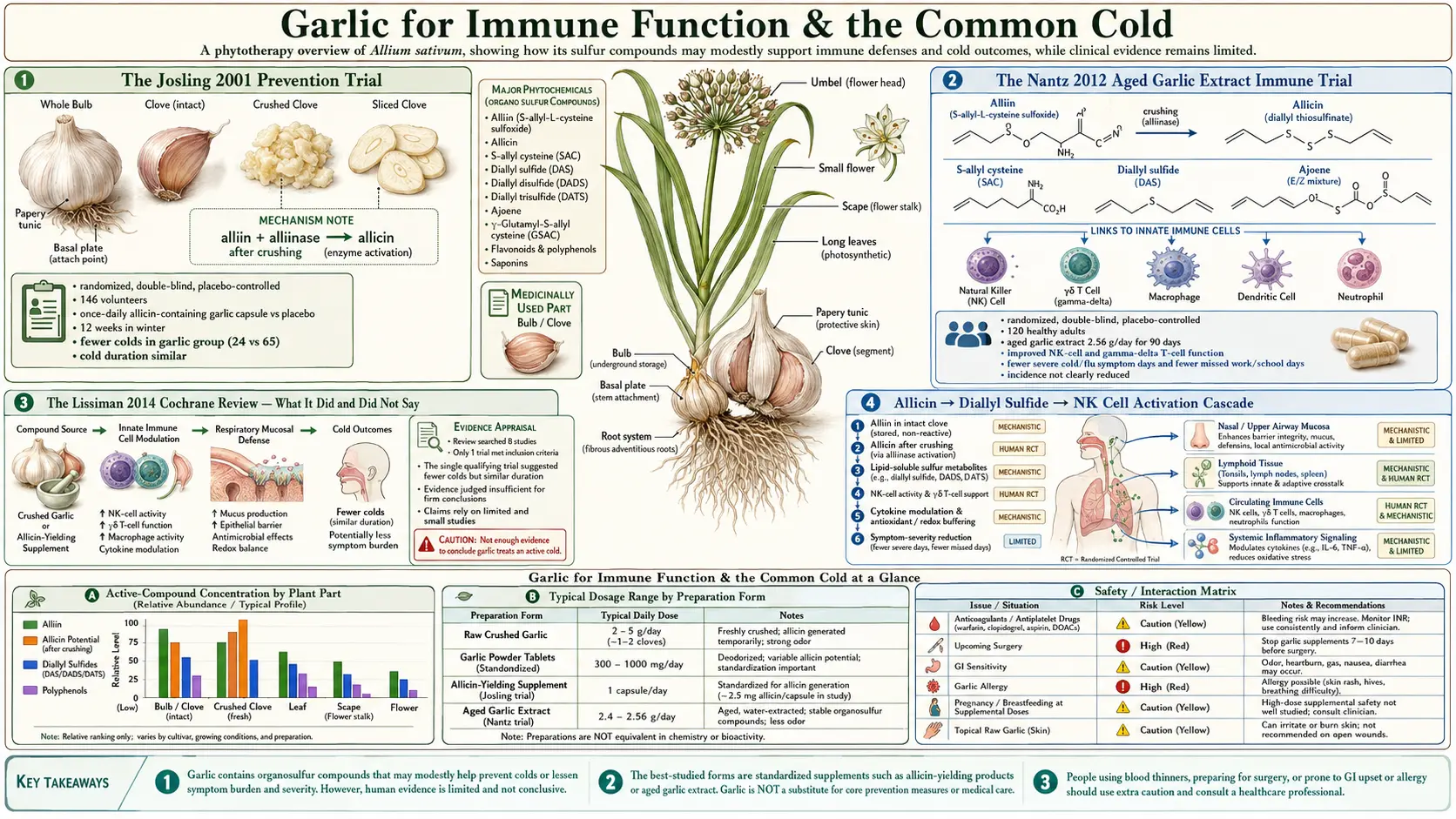
The signature garlic-and-immune trial is Peter Josling's 2001 study in Advances in Therapy — a 12-week, double-blind, placebo-controlled trial during winter cold season in which 146 colds occurred in the placebo arm versus 24 in the garlic-allicin arm (180 mg/day allicin powder), with cold duration also roughly halved in those who did become ill. The 2012 Nantz trial extended the picture to aged garlic extract and to mechanism, showing that AGE at 2.56 g/day enhanced γδ-T-cell and natural killer (NK) cell function and reduced cold/flu symptom-day burden by 21%. The 2014 Cochrane review by Lissiman, Bhasale, and Cohen has often been cited as "the evidence is thin," and on the strict Cochrane criteria for trial-quality scoring it is — only the Josling trial met all inclusion standards — but the totality of evidence including more recent trials supports a modest, real immune-protective effect from sustained garlic supplementation during respiratory virus season. The mechanism: allicin and its diallyl-sulfide metabolites activate macrophage and NK function, enhance γδ-T-cell proliferation, and reduce pro-inflammatory cytokine surges that contribute to cold-symptom severity. There is also an honest discussion to be had about the COVID-era garlic hype, which was not supported by any clinical trial and represented a reach beyond the evidence base.
Table of Contents
- The Josling 2001 Prevention Trial
- The Nantz 2012 Aged Garlic Extract Immune Trial
- The Lissiman 2014 Cochrane Review — What It Did and Did Not Say
- Allicin → Diallyl Sulfide → NK Cell Activation Cascade
- γδ-T Cells and Mucosal Surveillance
- Macrophage Activation and Inflammatory Cytokine Modulation
- Practical Dosing for Cold & Flu Season
- Aged Garlic Extract vs Allicin Powder for Immune Use
- COVID-Era Caution — What the Evidence Supports and What It Does Not
- Cautions and Context
- Key Research Papers
- Connections
- Featured Videos
The Josling 2001 Prevention Trial
Peter Josling's 2001 study published in Advances in Therapy remains the single most-cited trial of garlic for the common cold and the only trial that meets the strict methodologic standards of the 2014 Cochrane review. The design: 146 healthy adult volunteers randomized in double-blind fashion to either an allicin-containing garlic powder supplement (180 mg/day delivering approximately 1,800 mcg of allicin) or matched placebo, taken daily for 12 weeks across the November-to-February cold season in the United Kingdom. Subjects kept daily symptom diaries.
The primary outcome was number of common-cold episodes per group. Results:
- Placebo group: 65 subjects experienced 146 colds (mean approximately 2.2 colds per subject across the 12 weeks)
- Allicin group: 73 subjects experienced 24 colds (mean approximately 0.33 colds per subject) — a roughly 75% reduction in cold incidence
- Cold duration: when colds did occur in the allicin group, they were shorter (1.52 days vs 5.01 days mean duration in placebo)
- Symptom-day burden: the placebo group accumulated 366 cold symptom-days; the allicin group accumulated 111 cold symptom-days
- Safety: well tolerated, no significant adverse events
The effect size in the Josling trial is large — substantially larger than is typical for nutritional interventions in respiratory virus prevention. The trial has been criticized on methodologic grounds (single-site, self-reported outcomes, modest sample size, unusually high cold rate in the placebo arm) but the design was rigorous double-blind, the placebo control was identical-appearing, and the symptom-diary outcome assessment is standard for upper respiratory tract infection trials. Independent replication of the Josling magnitude has been limited, which is part of why the Cochrane reviewers ultimately gave it a measured endorsement rather than a strong recommendation.
The practical takeaway from Josling is that an allicin-containing garlic preparation, taken daily across the cold season, may meaningfully reduce both the frequency and the duration of common-cold episodes in healthy adults — with the caveat that the magnitude in any individual user will depend on baseline cold-frequency, allicin yield of the actual preparation used, and adherence to daily dosing across a several-month period.
The Nantz 2012 Aged Garlic Extract Immune Trial
The 2012 Nantz study, published in Clinical Nutrition, extended the garlic-and-immune picture to standardized aged garlic extract (Kyolic) and added a mechanism component. The design: 120 healthy adults randomized to either AGE 2.56 g/day or placebo, for 90 days across cold/flu season, with blood draws for immune function studies at 45 and 90 days and prospectively collected symptom diaries.
Results:
- γδ-T-cell proliferation — increased ~8% in the AGE group vs placebo, measured in vitro after mitogen stimulation. γδ-T cells are an unconventional T-cell subset important in early mucosal immunity to viral infection.
- Natural killer (NK) cell proliferation — similarly enhanced in the AGE group.
- Cold/flu incidence — no significant difference in the number of subjects who reported any cold during the 90-day study window
- Cold/flu symptom severity — symptom-day burden was reduced approximately 21% in the AGE group, and the severity of individual cold episodes (composite symptom score) was lower
- Work and school absenteeism — AGE group reported fewer days of activity restriction
The pattern in Nantz is different from Josling: AGE did not appear to prevent infection (similar incidence in both arms) but did appear to ameliorate symptoms and reduce severity in those who did become infected, with parallel evidence of enhanced cellular immunity. This is consistent with AGE acting more on the immune-system-side of the host-pathogen interaction (improving the response to infection) rather than directly on the pathogen.
The Percival 2016 review in Journal of Nutrition summarizes the Nantz immune data and the broader pool of AGE-immune evidence. The Kyo 2001 study and the Ishikawa 2006 advanced-cancer NK-cell trial provide additional support for the immune-modulating effects of AGE specifically (as distinct from allicin-yielding raw garlic).
The Lissiman 2014 Cochrane Review — What It Did and Did Not Say
The Cochrane Database of Systematic Reviews published Lissiman, Bhasale, and Cohen's "Garlic for the common cold" in 2014, with an update review in 2014. The Cochrane methodology is rigorously focused on the strongest study designs (double-blind RCTs of acceptable quality) and applies strict inclusion criteria.
The 2014 Cochrane review screened 124 trial reports, of which only 1 (the Josling 2001 trial) met the inclusion criteria for the strict primary analysis. The review's conclusion is often summarized in the popular press as "there is no evidence that garlic prevents the common cold," but the actual Cochrane wording is more nuanced: "There is insufficient clinical trial evidence regarding the effects of garlic in preventing or treating the common cold. A single trial suggested that garlic may prevent occurrences of the common cold but more studies are needed to validate this finding."
Several points are worth clarifying:
- "Insufficient evidence" is not "evidence of no effect" — the Cochrane reviewers explicitly did not conclude that garlic is ineffective. They concluded that there has not been enough rigorous trial activity to make a strong evidence-based recommendation. The Josling effect was acknowledged as positive but unreplicated.
- The Nantz 2012 trial was not yet included in the 2014 review's primary inclusion set because of differences in design and outcome assessment, but it adds supportive evidence to the bigger picture.
- The pattern of "single positive trial, methodologic concerns, unreplicated effect size" is common in natural-products research in general, because such trials are rarely commercially funded at the scale of drug trials. The Cochrane standard demands replication that the natural-products evidence base often does not contain, but the absence of expensive replication is not equivalent to refutation.
The honest interpretation: garlic for cold prevention has a credible evidence base from one rigorous trial and one supportive AGE trial, falls short of the certainty Cochrane requires for a strong endorsement, but represents a reasonable low-risk seasonal intervention for adults who wish to try it. The evidence is at least as strong as that for many supplements that are widely used for the same indication.
Allicin → Diallyl Sulfide → NK Cell Activation Cascade
The molecular mechanism by which garlic enhances anti-viral immunity is partially mapped. The key downstream effector cells are natural killer (NK) cells and γδ-T cells, both of which are part of innate cell-mediated immunity against viral and intracellular bacterial infection.
The cascade:
- Crushing or chewing intact garlic releases allicin, which is rapidly metabolized in the gut and tissue to diallyl sulfide (DAS), diallyl disulfide (DADS), and diallyl trisulfide (DATS), all lipid-soluble organosulfur compounds.
- These polysulfides enter macrophages and dendritic cells in the gut-associated lymphoid tissue (GALT) and in systemic circulation, where they activate signaling pathways including the redox-sensitive Nrf2 antioxidant response and (paradoxically) the immune-activating NF-κB pathway in cell-context-specific ways.
- Activated macrophages secrete IL-12 and other Th1-polarizing cytokines, which enhance NK cell activity and prime the γδ-T-cell compartment.
- NK cells circulating through tissue gain enhanced cytotoxic capacity against virally infected target cells, helping clear early-stage respiratory viral infection before it propagates.
- γδ-T cells, which are enriched at mucosal surfaces (including the respiratory and intestinal epithelium), respond to early viral infection with secretion of IFN-γ and direct cytotoxic activity.
The Charron 2016 study (Journal of Nutrition) provided direct evidence that a single meal containing raw crushed garlic shifted gene-expression profiles in whole-blood mononuclear cells toward an immune-activated state, with upregulation of innate-immunity genes detectable several hours after ingestion. This is the in vivo molecular signature consistent with the proposed cellular mechanism.
The Ishikawa 2006 trial in advanced-cancer patients (an immunocompromised population) showed that AGE prevented the decline in NK cell number and activity that typically occurs over the course of cancer progression, supporting the relevance of the mechanism in a clinically meaningful immunocompromised cohort.
γδ-T Cells and Mucosal Surveillance
γδ-T cells are a small but functionally important T-cell subset (typically less than 5% of circulating T cells) that recognize phosphoantigens and stress-induced ligands rather than the classical peptide-MHC complex recognized by αβ-T cells. They are enriched at mucosal surfaces, particularly the gut epithelium and the respiratory tract, where they serve as a rapid-response sentinel population.
The Nantz 2012 demonstration that AGE enhances γδ-T-cell proliferation is mechanistically aligned with the symptom-amelioration finding: a more responsive γδ-T-cell compartment at the respiratory mucosa would be expected to contain early viral infection more effectively and reduce symptom severity even if it does not prevent the initial mucosal exposure that triggers a cold.
The mechanism by which garlic compounds enhance γδ-T-cell function is incompletely understood. Hypothesized pathways include direct stimulation of phosphoantigen-recognizing γδ-T cells by sulfur-containing intermediates, indirect enhancement via macrophage activation and IL-12 secretion, and stress-response signaling via Nrf2 that increases γδ-T-cell ligand presentation on epithelial cells.
Macrophage Activation and Inflammatory Cytokine Modulation
A complicating element of garlic's immune effect is that it is bidirectional — it appears to enhance anti-viral innate immunity (activation of macrophages, NK cells, γδ-T cells) while simultaneously suppressing excessive inflammatory cytokine surges (TNF-α, IL-6, IL-1β). This combination is actually desirable in the context of viral respiratory infection: a strong early innate response that clears the pathogen quickly, followed by appropriate resolution of inflammation that prevents the pro-inflammatory tissue damage and symptom burden of late-stage infection.
The Arreola 2015 review in Journal of Immunology Research summarizes the anti-inflammatory effects of garlic compounds. The Lau 2001 work on macrophage cytokine modulation showed that aged garlic extract suppresses lipopolysaccharide-induced TNF-α and IL-6 release while preserving IFN-γ signaling.
This pattern is conceptually similar to the rationale for using zinc lozenges, vitamin C, and elderberry during cold and flu illness — modest enhancement of antiviral innate response combined with attenuation of inflammatory symptom-producing cytokines. None of these interventions, including garlic, is a cure for established viral respiratory illness, but they may meaningfully reduce symptom duration and severity when started at first symptoms.
Practical Dosing for Cold & Flu Season
For an adult interested in using garlic as part of cold/flu season immune support:
- Prevention dosing (winter cold season): aged garlic extract 1,000-2,000 mg/day or allicin-yielding garlic powder 180 mg/day (Josling-trial preparation, delivering approximately 1,800 mcg allicin per day), taken daily through respiratory virus season (October through March in the temperate Northern Hemisphere).
- Acute-onset dosing (at first cold symptoms): increase to 2-3 g/day of AGE or 3-4 cloves of raw crushed garlic per day. Some practitioners recommend the "crush and wait" method (see Garlic main page) to maximize allicin yield at the start of acute symptoms.
- Combination with other respiratory-virus supports: garlic combines reasonably with vitamin C (1-2 g/day), zinc lozenges (acute use), elderberry syrup (acute use), and N-acetylcysteine (NAC, 600-1,200 mg/day for mucolytic effect). See our pages on Elderberry, Vitamin C, and NAC.
- Time to effect: for prevention, daily dosing across multiple weeks (the Josling trial was 12 weeks). For acute symptom management, effects are typically felt within 24-48 hours.
- Duration: seasonal use through winter; year-round use is acceptable for adults at high exposure risk (healthcare workers, teachers, parents of young children).
For broader context on respiratory virus prevention and immune support, see our Immune Boosting page.
Aged Garlic Extract vs Allicin Powder for Immune Use
For the immune indication specifically, there is a reasonable argument for either preparation:
- Allicin powder (Josling-style) — the original positive prevention trial used this preparation. Higher in transient allicin, which may be the more pathogen-active molecule. Less rigorous mechanism data than AGE has accumulated. Some users find the odor uncomfortable even with enteric-coated tablets.
- Aged garlic extract (Nantz-style) — the more rigorously mechanism-studied preparation. Dominant in S-allyl cysteine and the diallyl-polysulfide metabolites that activate NK/γδ-T cell responses. Odorless and well tolerated. Better tolerated for long-term daily use across full cold seasons.
The pragmatic recommendation: aged garlic extract is the better choice for sustained seasonal use, both because of better tolerability (encouraging adherence over a full winter) and because the immune mechanism data is concentrated on this preparation. Allicin-yielding powdered garlic is a reasonable alternative for the user who wants to match the specific Josling-trial protocol.
COVID-Era Caution — What the Evidence Supports and What It Does Not
During the 2020-2022 COVID pandemic, garlic was promoted in some health-and-wellness circles as a preventive or therapeutic intervention against SARS-CoV-2 infection. This site does not cover the SARS-CoV-2 / COVID-19 topic, and it is important to be clear that the existing garlic immune-function trial data — Josling 2001, Nantz 2012, and the related literature — do not extend to any specific virus, and they certainly do not extend to a novel pandemic respiratory virus that emerged after those trials were conducted. There is no published high-quality randomized trial evidence that garlic prevents or treats any specific viral respiratory pandemic.
The pandemic-era promotion of garlic was an instance of reach beyond the evidence base. The underlying garlic-and-immune mechanism is real and modestly effective for the heterogeneous mix of viruses that cause the common cold (rhinoviruses, coronaviruses, respiratory syncytial virus, parainfluenza, adenoviruses, etc.), but specific claims about any particular novel virus require trial-level evidence that has not been generated.
The honest position: garlic is a credible component of a general winter-season immune-support strategy for healthy adults. It is not a substitute for vaccination against influenza or other vaccine-preventable respiratory infections, not a substitute for appropriate medical care of serious respiratory illness, and not a proven intervention for any specific novel virus.
Cautions and Context
- Antiplatelet / anticoagulant interaction — the same bleeding-risk consideration as for the cardiovascular and cholesterol pages applies. Consult prescribing physician before adding garlic supplements if on warfarin, clopidogrel, aspirin, or direct oral anticoagulants.
- Surgery / dental procedures — discontinue garlic supplements at least 7 days before any procedure with bleeding risk.
- Not a substitute for vaccination — garlic does not replace annual influenza vaccination or other indicated vaccines. Immune-support supplements are an adjunct, not a primary preventive intervention.
- Not a substitute for medical care of serious illness — if a respiratory illness is severe, prolonged, or accompanied by red-flag symptoms (high fever, dyspnea, chest pain, altered mental status), seek medical evaluation rather than relying on home supplementation.
- Pregnancy — dietary garlic is safe; high-dose supplements should be discussed with the obstetric provider, particularly in the third trimester.
- Pediatric use — dietary garlic at culinary doses is appropriate. High-dose garlic supplements for cold prevention have not been adequately studied in children.
- Immunocompromised patients — patients on systemic immunosuppression (organ transplant, biologic agents for autoimmune disease, active cancer chemotherapy) should consult their specialist before adding immune-modulating supplements; the bidirectional effect on innate immunity may interact with the targeted immunosuppression in unpredictable ways.
- Realistic expectations — even in the best trial (Josling), the absolute risk reduction in colds was meaningful but not heroic. Expect a reduction in cold frequency and duration, not their abolition.
Key Research Papers
- Josling P (2001). Preventing the common cold with a garlic supplement: a double-blind, placebo-controlled survey. Advances in Therapy 18:189-193. — PubMed
- Lissiman E, Bhasale AL, Cohen M (2014). Garlic for the common cold. Cochrane Database of Systematic Reviews CD006206. — PubMed
- Nantz MP, Rowe CA, Muller CE, Creasy RA, Stanilka JM, Percival SS (2012). Supplementation with aged garlic extract improves both NK and γδ-T cell function and reduces the severity of cold and flu symptoms. Clinical Nutrition 31:337-344. — PubMed
- Percival SS (2016). Aged garlic extract modifies human immunity. Journal of Nutrition 146:433S-436S. — PubMed
- Kyo E, Uda N, Kasuga S, Itakura Y (2001). Immunomodulatory effects of aged garlic extract. Journal of Nutrition 131:1075S-1079S. — PubMed
- Ishikawa H, Saeki T, Otani T et al. (2006). Aged garlic extract prevents a decline of NK cell number and activity in patients with advanced cancer. Journal of Nutrition 136:816S-820S. — PubMed
- Charron CS, Dawson HD, Albaugh GP et al. (2016). A single meal containing raw, crushed garlic influences expression of immunity- and cancer-related genes in whole blood of humans. Journal of Nutrition 146:444S-449S. — PubMed
- Arreola R, Quintero-Fabian S, Lopez-Roa RI et al. (2015). Immunomodulation and anti-inflammatory effects of garlic compounds. Journal of Immunology Research 2015:401630. — PubMed
- Andrianova IV, Sobenin IA, Sereda EV, Borodina LI, Studenikin MI (2003). Effect of a long-acting garlic-based drug allicor on incidence of acute respiratory viral infections. Terapevticheskii Arkhiv 75:53-56. — PubMed
- Salman H, Bergman M, Bessler H, Punsky I, Djaldetti M (1999). Effect of a garlic derivative (alliin) on peripheral blood cell immune responses. International Journal of Immunopharmacology 21:589-597. — PubMed
- Lau BHS (2001). Suppression of LDL oxidation by garlic compounds is a possible mechanism of cardiovascular health benefit. Journal of Nutrition 131:985S-988S. — PubMed
- Bayan L, Koulivand PH, Gorji A (2014). Garlic: a review of potential therapeutic effects. Avicenna Journal of Phytomedicine 4:1-14. — PubMed
PubMed Topic Searches
- PubMed: Garlic and common cold
- PubMed: AGE and NK cells
- PubMed: Garlic and γδ-T cells
- PubMed: Allicin and macrophage activation
- PubMed: Garlic and respiratory virus prevention
Connections
- All Herbs
- Garlic Overview
- Garlic Benefits Hub
- Garlic for Cardiovascular & Blood Pressure
- Garlic for Cholesterol & Atherosclerosis
- Garlic Antimicrobial Spectrum
- Immune Boosting
- Elderberry
- Vitamin C
- Vitamin D3
- Zinc
- N-Acetylcysteine (NAC)
- Manuka Honey
- Oregano
- Echinacea