Eucalyptus — Benefits Deep Dive
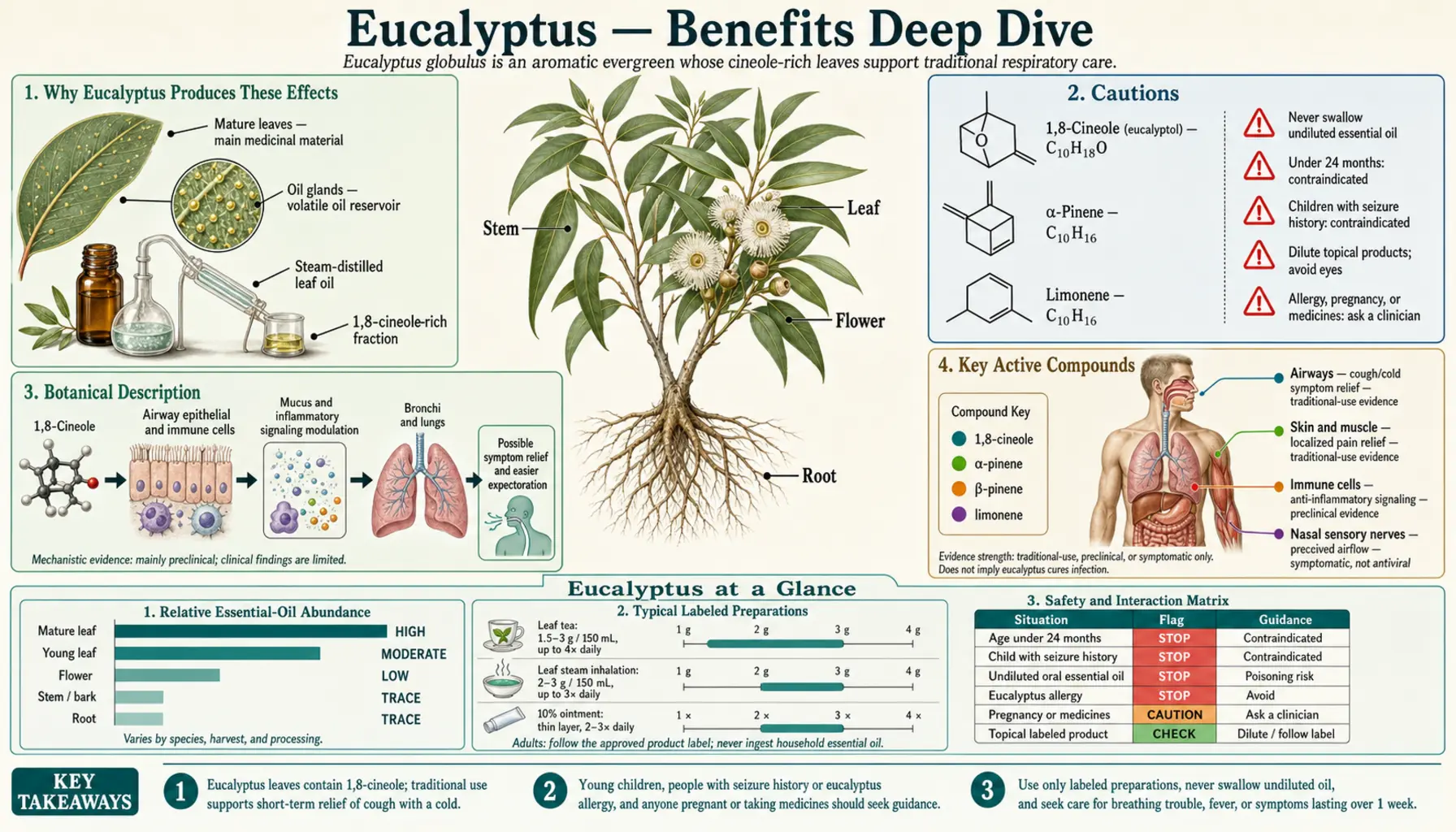
Eucalyptus is the rare medicinal plant that bridges Australian Aboriginal traditional medicine and twenty-first-century pharmacology — the same kino resin that Aboriginal healers applied to wounds for tens of thousands of years yields the steam-distilled essential oil whose principal active compound, 1,8-cineole (eucalyptol), is the molecule behind every box of Vicks VapoRub on the chemist's shelf, every Halls Mentho-Lyptus cough drop, and the Soledum cineole capsules now standard care for acute sinusitis in Europe. Two species do most of the medicinal work: Eucalyptus globulus (Tasmanian Blue Gum) supplies the 70–90% 1,8-cineole oil that drives the respiratory benefits, and Eucalyptus citriodora (lemon eucalyptus) supplies citronellal, which the body converts to para-menthane-3,8-diol (PMD) — the only plant-derived mosquito repellent the CDC formally recommends as comparable to low-concentration DEET. The four benefit pages below explore the four clinical domains where eucalyptus produces the largest measurable effect: respiratory tract infections and COPD exacerbations, broad-spectrum antimicrobial action including MRSA, topical pain and joint relief, and antifungal plus insect-repellent applications.
Deep-Dive Articles
Respiratory Health
1,8-cineole as the principal secretolytic, expectorant, and mucolytic active. The Soledum 200 mg enteric-coated capsule trials — Kehrl 2004 in acute non-purulent rhinosinusitis and Worth 2009 in COPD — the traditional steam-inhalation route, OTC chest rubs (Vicks VapoRub), Halls Mentho-Lyptus cough drops, and how cineole liquefies mucin disulfide bonds while disrupting respiratory biofilms.
Antimicrobial & Wound
Broad-spectrum essential-oil activity against Gram-positive and Gram-negative pathogens, MRSA inhibition in vitro at 0.125–1.0% v/v, dental and oral biofilm disruption (Streptococcus mutans, Porphyromonas gingivalis), Listerine's eucalyptol component, and Australian Aboriginal use of kino gum-resin as a topical wound antiseptic.
Pain & Joint Relief
Topical eucalyptus for arthritis, muscle pain, tension headache, and post-surgical pain. The counter-irritant mechanism: 1,8-cineole and alpha-pinene activate TRPM8 cold receptors and inhibit TRPA1 pain receptors. Comparison to the menthol and camphor counter-irritant class, with which it is commonly co-formulated.
Antifungal & Insect Repellent
Candida inhibition in vitro, oil of lemon eucalyptus (OLE) for onychomycosis (nail fungus), and the standout application: lemon-eucalyptus-derived PMD (para-menthane-3,8-diol) as the only plant-source mosquito repellent the CDC ranks alongside low-concentration DEET, picaridin, and IR3535. PMD chemistry, EPA registration, and protection-time data against Aedes, Anopheles, and Culex.
Table of Contents
- Deep-Dive Articles
- Why Eucalyptus Produces These Effects
- Key Research Papers
- External Authoritative Resources
- Cautions
- Connections
- Featured Videos
Why Eucalyptus Produces These Effects
Most medicinal plants are studied as crude leaf or bark preparations whose active compound mixture is poorly characterized. Eucalyptus is unusual in that its principal active compound, 1,8-cineole (also called eucalyptol), has been isolated to pharmaceutical purity, formulated into enteric-coated capsules (Soledum, marketed by Cassella-med in Europe), and tested in over twenty randomized controlled clinical trials. The mechanism behind each of the four benefit categories on this hub maps to a different physical or biochemical property of cineole and its companion terpenoids.
- 1,8-cineole as a secretolytic and mucolytic — cineole breaks the disulfide bonds in mucin glycoproteins, the high-molecular-weight gel-formers that give respiratory mucus its viscous character. By liquefying mucus, cineole both eases expectoration and exposes mucus-embedded respiratory bacteria (Haemophilus influenzae, Streptococcus pneumoniae, Moraxella catarrhalis) to immune clearance. This is the mechanism behind every result on the Respiratory Health page.
- Membrane-disrupting terpenoid mixture — cineole, alpha-pinene, limonene, p-cymene, and globulol are all lipophilic terpenoids that integrate into the phospholipid bilayer of bacterial cell membranes, increasing permeability and collapsing the proton motive force. Because the antibacterial effect is multi-target, bacteria struggle to develop resistance — the basis for the in-vitro MRSA activity covered on the Antimicrobial & Wound page.
- Counter-irritant action through TRP channels — 1,8-cineole and alpha-pinene activate TRPM8 cold receptors (producing the characteristic cooling sensation) while inhibiting TRPA1 pain receptors. This is the same chemical-cooling counter-irritant mechanism used by menthol (from peppermint) and camphor; the three are commonly co-formulated in chest rubs and topical muscle balms. Mechanism is detailed on the Pain & Joint Relief page.
- PMD from lemon eucalyptus as a non-DEET repellent — E. citriodora produces a fundamentally different oil dominated by citronellal, which the body and acid catalysis convert into para-menthane-3,8-diol (PMD). PMD interferes with mosquito olfactory receptors (octenol-sensing and CO2-sensing) at concentrations that approach DEET's efficacy. It is the only plant-derived active ingredient the CDC and EPA recommend with the same protection-time confidence as DEET, picaridin, and IR3535. Detail on the Antifungal & Insect Repellent page.
One overriding safety constraint deserves emphasis before any reader experiments with concentrated essential oil: undiluted eucalyptus oil must never be applied to mucous membranes, the inside of the nostrils, or the face of a young child. Concentrated 1,8-cineole vapor applied near the airway of a child under six can trigger reflex laryngospasm or bronchospasm severe enough to cause respiratory arrest. The same caution applies to ingestion — as little as 3.5 mL of essential oil has been fatal in pediatric case reports. The properly purified Soledum cineole capsules described on the Respiratory Health page are a separate pharmaceutical preparation, not a substitute for the raw essential oil.
Key Research Papers
- Kehrl W, Sonnemann U, Dethlefsen U (2004). Therapy for acute nonpurulent rhinosinusitis with cineole: results of a double-blind, randomized, placebo-controlled trial. Laryngoscope 114(4):738–742. — PubMed: Kehrl 2004 sinusitis trial
- Worth H, Schacher C, Dethlefsen U (2009). Concomitant therapy with cineole (eucalyptol) reduces exacerbations in COPD: a placebo-controlled double-blind trial. Respiratory Research 10(1):69. — PubMed: Worth 2009 COPD trial
- Juergens UR, Dethlefsen U, Steinkamp G, Gillissen A, Repges R, Vetter H (2003). Anti-inflammatory activity of 1,8-cineol (eucalyptol) in bronchial asthma: a double-blind placebo-controlled trial. Respiratory Medicine 97(3):250–256. — PubMed: Juergens 2003 asthma trial
- Carroll SP, Loye J (2006). PMD, a registered botanical mosquito repellent with deet-like efficacy. Journal of the American Mosquito Control Association 22(3):507–514. — PubMed: Carroll & Loye PMD vs DEET
- Mulyaningsih S, Sporer F, Zimmermann S, Reichling J, Wink M (2010). Synergistic properties of the terpenoids aromadendrene and 1,8-cineole from the essential oil of Eucalyptus globulus against antibiotic-susceptible and antibiotic-resistant pathogens. Phytomedicine 17(13):1061–1066. — PubMed: Mulyaningsih MRSA synergy
External Authoritative Resources
- CDC — Preventing Mosquito Bites (lists oil of lemon eucalyptus / PMD among the four formally recommended active ingredients)
- EPA — Registered Skin-Applied Repellent Active Ingredients (PMD as one of seven registered actives)
- European Medicines Agency — Eucalypti aetheroleum (Eucalyptus oil) HMPC monograph
- European Medicines Agency — Eucalypti folium (Eucalyptus leaf) HMPC monograph
- MedlinePlus — Eucalyptus
- NIH NCCIH — Eucalyptus
- PubMed — All eucalyptus globulus / 1,8-cineole research (>5,000 papers)
Cautions
- Never apply undiluted essential oil to mucous membranes. Concentrated 1,8-cineole on nasal, oral, or ocular mucosa can cause chemical burns. The Vicks VapoRub label specifically warns against applying inside the nostrils.
- Children under six. Topical eucalyptus or mentholated chest rubs on the face, chest near the chin, or inside the nostrils of an infant or toddler can trigger reflex laryngospasm and bronchospasm severe enough to cause respiratory arrest. The American Academy of Pediatrics advises against any application of camphor- or eucalyptus-containing topical preparations under age two; many pediatricians extend the caution to age six. Pure E. radiata oil at low dilution is generally considered the safer eucalyptus species for older children under aromatherapist supervision.
- Asthma patients can experience paradoxical bronchospasm on inhaling concentrated essential oil, even though the same patients often tolerate (and benefit from) purified oral cineole capsules. Test inhalation at low concentration first.
- Ingestion of essential oil is potentially fatal. Three-and-a-half millilitres of pure eucalyptus essential oil has caused death in pediatric case reports; 5 mL has caused serious adult toxicity. Only the pharmaceutical-grade enteric-coated cineole capsules (Soledum, etc.) are intended for oral use, and only at the studied 200 mg dose.
- Seizure threshold. High-dose monoterpene exposure can lower seizure threshold. Avoid concentrated inhalation and oral cineole in patients with epilepsy without neurology approval.
- CYP450 induction. Cineole induces CYP3A4 and CYP2B6, potentially accelerating metabolism of warfarin, cyclosporine, tacrolimus, carbamazepine, phenytoin, and many statins. Confirm with pharmacist before regular use alongside any of these.
- Pregnancy and breastfeeding. Topical at proper dilution and brief steam inhalation are generally considered low-risk. Oral cineole capsules should be avoided in pregnancy and lactation due to limited safety data.
Connections
- All Herbs
- Eucalyptus (Main Page)
- Eucalyptus for Respiratory Health
- Eucalyptus — Antimicrobial & Wound
- Eucalyptus for Pain & Joint Relief
- Eucalyptus — Antifungal & Insect Repellent
- Antibacterial Herbs
- Peppermint (Menthol)
- Tea Tree
- Thyme
- Oregano
- Rosemary
- Sinusitis
- COPD
- Asthma
- Pneumonia
- Staphylococcus aureus & MRSA
- Cold & Flu Treatments
- Immune Boosting