Eucalyptus — Antifungal & Insect Repellent
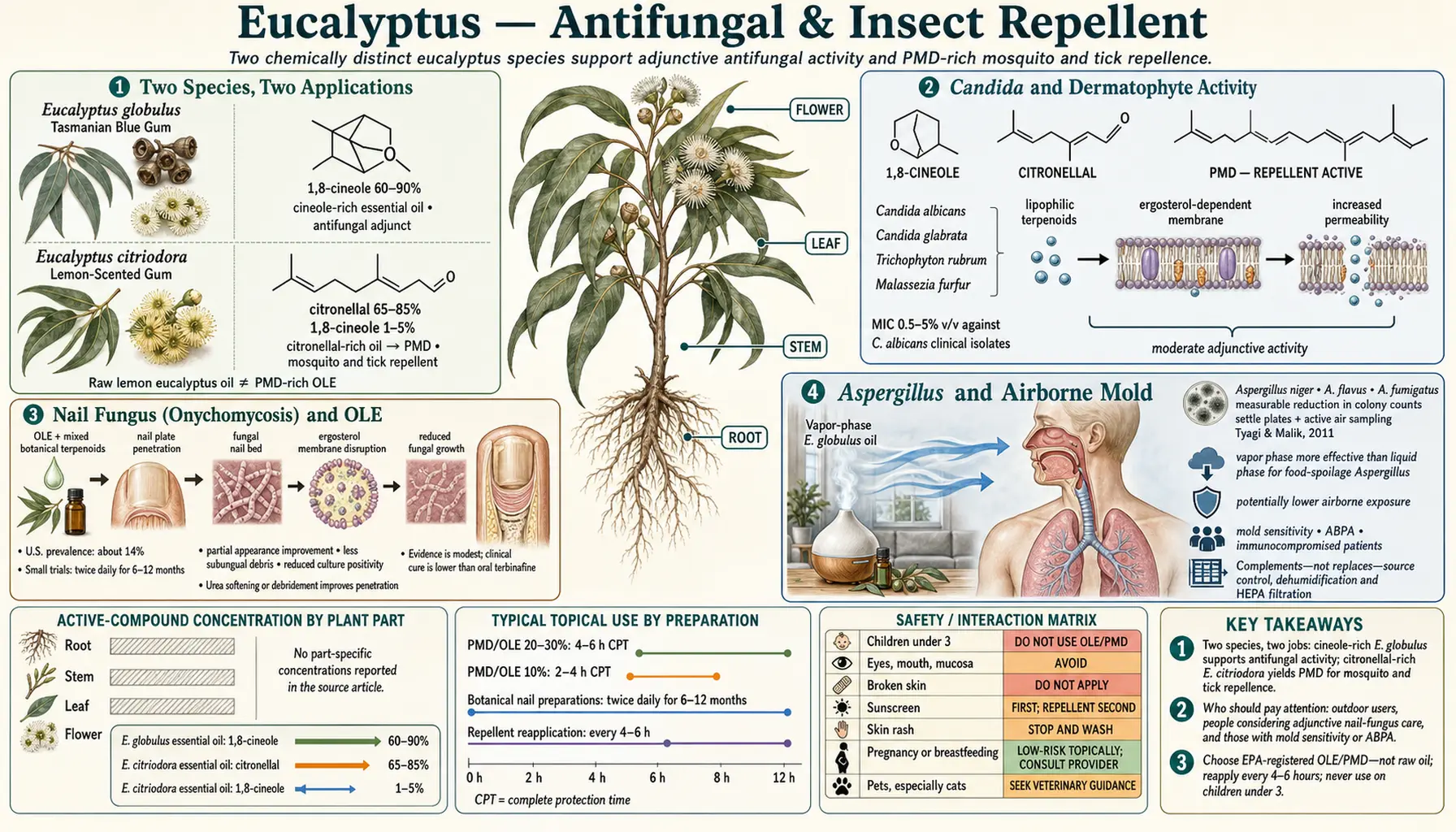
Two related but distinct eucalyptus applications meet here. The first is antifungal activity — E. globulus essential oil inhibits Candida albicans and C. glabrata in vitro, dermatophytes including Trichophyton rubrum (responsible for athlete's foot and nail fungus), and the airborne mold Aspergillus. Oil of lemon eucalyptus (OLE) has been studied as a botanical adjunct for nail fungus (onychomycosis), with modest evidence of clinical benefit. The second — and the more famous application — is mosquito and tick repellence. Lemon eucalyptus (Eucalyptus citriodora), a chemically distinct species dominated by citronellal rather than 1,8-cineole, is the source of para-menthane-3,8-diol (PMD), the only plant-derived active ingredient the United States Centers for Disease Control and Prevention (CDC) places on equal footing with DEET, picaridin, and IR3535 for protection against mosquito-borne disease. PMD is EPA-registered, provides 4–7 hours of protection against Aedes, Anopheles, and Culex species, and is the standard answer to the question "is there a natural, plant-based alternative to DEET that actually works?" This page covers the antifungal mechanism, the OLE nail-fungus literature, the chemistry connecting citronellal to PMD, the CDC and EPA recommendations, and how PMD compares to DEET in field-trial protection time.
Table of Contents
- Two Species, Two Applications
- Candida and Dermatophyte Activity
- Nail Fungus (Onychomycosis) and OLE
- Aspergillus and Airborne Mold
- Citronellal Chemistry and the Path to PMD
- PMD as a Mosquito Repellent — Mechanism
- CDC and EPA Recognition
- PMD vs DEET — Protection-Time Data
- Tick Repellence
- Products and Application Guidance
- Cautions
- Key Research Papers
- Connections
- Featured Videos
Two Species, Two Applications
The eucalyptus genus contains over 700 species, but two specific species do the medicinal work covered on this page, and the difference between them is chemically fundamental.
Eucalyptus globulus (Tasmanian Blue Gum, the species behind most respiratory and antimicrobial applications) produces an essential oil dominated by 1,8-cineole at 60–90%, with smaller amounts of alpha-pinene, limonene, p-cymene, and globulol. This is the cineole-rich oil discussed on the Respiratory Health and Antimicrobial & Wound pages.
Eucalyptus citriodora (Lemon-Scented Gum, also called lemon eucalyptus) produces a chemically very different essential oil dominated by citronellal at 65–85%, with isopulegol, citronellol, and only 1–5% 1,8-cineole. This is the oil that has been processed (commercially and naturally) into the mosquito-repellent active ingredient para-menthane-3,8-diol (PMD).
The implication is that "eucalyptus oil" is not one substance — the bottle labeled "eucalyptus essential oil" on the shelf and the bottle labeled "oil of lemon eucalyptus" (OLE) or "lemon eucalyptus repellent" are two entirely different products with different active compounds and different appropriate uses. Confusing the two can result in attempted use of E. globulus oil as an insect repellent (poor performance, not CDC-recommended) or attempted use of E. citriodora for respiratory steam inhalation (works as a mild decongestant from the small cineole fraction but inferior to E. globulus for the indication).
Both species have antifungal activity, with E. citriodora showing stronger activity against several dermatophytes due to citronellal's independent antifungal mechanism. The antifungal section below applies to both; the insect-repellent section is specifically about E. citriodora and its PMD-rich refined preparations.
Candida and Dermatophyte Activity
Eucalyptus essential oil from both E. globulus and E. citriodora demonstrates antifungal activity in standardized in-vitro tests. While the activity is moderate compared to dedicated antifungal essential oils like tea tree (Melaleuca alternifolia, terpinen-4-ol) or oregano (Origanum vulgare, carvacrol), eucalyptus provides useful adjunctive activity, particularly in combination products that also exploit the cineole anti-inflammatory and antibacterial effects.
Documented in-vitro activity:
- Candida albicans — the dominant Candida species in human oral, vaginal, and gut commensal flora; the principal cause of mucocutaneous candidiasis (thrush, vulvovaginal candidiasis, diaper dermatitis). Eucalyptus oil shows MIC values in the 0.5–5% v/v range against clinical C. albicans isolates.
- Candida glabrata, C. krusei, C. tropicalis, C. parapsilosis — the non-albicans Candida species, increasingly important in immunocompromised patients and notable for fluconazole resistance. Similar MIC range to C. albicans.
- Dermatophytes — Trichophyton rubrum (the most common cause of athlete's foot and nail fungus), T. mentagrophytes, T. interdigitale, Microsporum canis (ringworm), Epidermophyton floccosum. Eucalyptus oil is moderately active against this group, with E. citriodora typically more potent than E. globulus.
- Malassezia furfur — the yeast involved in seborrheic dermatitis and dandruff. Eucalyptus has shown activity in shampoo and topical-formulation studies.
The antifungal mechanism parallels the antibacterial mechanism: lipophilic terpenoids integrate into the fungal cell membrane, disrupting ergosterol-dependent membrane organization and increasing permeability. Cineole and citronellal both contribute to this membrane-disruption effect. Fungi have an additional vulnerability that bacteria do not: their cell membranes use ergosterol as the principal sterol (humans use cholesterol). The terpenoid-cell-membrane interaction is particularly effective in fungi because of this composition difference.
Nail Fungus (Onychomycosis) and OLE
Onychomycosis (fungal nail infection) is one of the most prevalent dermatologic conditions, affecting an estimated 14% of the United States population and a higher fraction of older adults. The vast majority of cases are caused by Trichophyton rubrum, with smaller contributions from other dermatophytes and the occasional Candida or non-dermatophyte mold. Treatment is notoriously difficult: oral terbinafine and itraconazole have meaningful clinical-cure rates (40–60%) but require months of therapy with hepatotoxicity and drug-interaction concerns. Topical ciclopirox, efinaconazole, and tavaborole have lower cure rates (10–35%) with months-to-years of daily application.
Oil of lemon eucalyptus (OLE) and related botanical preparations have been studied as alternatives or adjuncts for onychomycosis, with the appeal of a simpler safety profile and no oral medication required. The evidence is modest but consistent:
- Small clinical trials of botanical preparations containing OLE, tea tree oil, oregano oil, and clove oil applied twice daily to affected nails show partial improvement in nail appearance, reduction in subungual debris, and reduction in mycologic culture positivity rates over 6–12 month treatment courses.
- The mechanism involves penetration of the lipophilic terpenoids through the nail plate to reach the fungal infection in the underlying nail bed.
- Combination botanical preparations consistently outperform single-oil preparations, consistent with the multi-target additive activity discussed throughout the eucalyptus pages.
- Pre-treatment of the nail with urea cream (to soften the nail plate) or mechanical debridement (filing down the affected area) markedly improves penetration and clinical outcomes.
OLE preparations are widely available as over-the-counter nail-fungus treatments and as Australian-traditional-medicine adjuncts. The clinical-cure rates are lower than oral terbinafine, but for patients who cannot tolerate or are unwilling to take systemic antifungals, OLE is a reasonable option with modest evidence of benefit and a clean safety profile when properly applied.
For more on dermatologic fungal infections, see our Fungal Infections page.
Aspergillus and Airborne Mold
Eucalyptus oil has been studied against airborne mold species, particularly Aspergillus (A. niger, A. flavus, A. fumigatus). Aspergillus is the dominant indoor mold contaminant in many residential and industrial environments, an important pathogen in immunocompromised patients (invasive pulmonary aspergillosis in neutropenic patients), and a recognized allergen in atopic individuals (allergic bronchopulmonary aspergillosis, ABPA).
Vapor-phase eucalyptus oil at concentrations achievable through aromatherapy diffusion or HVAC integration produces measurable reductions in Aspergillus colony counts on settle plates and active air sampling. The Tyagi & Malik 2011 Food Chemistry study is the most-cited demonstration of this effect, showing that vapor-phase E. globulus oil was significantly more effective than the liquid-phase equivalent for inhibiting food-spoilage Aspergillus growth — an important practical observation because vapor-phase delivery is the dominant route in real-world air-disinfection applications.
The clinical translation to indoor-air-quality management is modest but real. Aromatherapy diffusion of eucalyptus oil in residential spaces appears to reduce ambient mold spore counts, an effect that complements (does not replace) source control, dehumidification, and HEPA filtration in mold-remediation protocols. For patients with documented mold sensitivity or ABPA, every reduction in airborne mold exposure is potentially helpful.
For more on mold-related illness, see our Mold & Mycotoxins page.
Citronellal Chemistry and the Path to PMD
This is the key chemistry to understand the insect-repellent story. Fresh Eucalyptus citriodora essential oil contains citronellal (about 65–85%), citronellol, and isopulegol. Citronellal itself is only modestly repellent — comparable to citronella candles, which provide brief and partial mosquito protection but are nowhere near DEET-equivalent.
The active mosquito-repellent compound is para-menthane-3,8-diol (PMD), a cyclic terpenoid diol formed by acid-catalyzed intramolecular cyclization of citronellal. PMD does not occur in fresh lemon eucalyptus oil in significant quantity; it forms slowly when the oil is exposed to acidic conditions and warmth.
Commercial production of mosquito-repellent OLE uses one of two approaches:
- Naturally aged OLE. Lemon eucalyptus essential oil that has been stored under conditions promoting partial conversion of citronellal to PMD — typically with mild acid catalyst, controlled heat, and time. The result is an oil that still contains the natural citronellal and isopulegol components but is enriched in PMD to roughly 65% of the active fraction. This is sometimes called "matured" OLE.
- Refined PMD. Pure synthetic or semi-synthetic PMD isolated from citronellal precursors. Many commercial repellent products use this purified form for consistency and shelf stability.
The EPA-registered active ingredient on insect-repellent labels is "p-menthane-3,8-diol" (PMD); when the source is naturally-aged OLE, the label may also list "oil of lemon eucalyptus." The two product types — matured OLE and refined PMD — both contain PMD as the active repellent and have similar protection profiles. The EPA does not recognize unrefined lemon eucalyptus essential oil (containing primarily citronellal) as having the same protection profile, and CDC recommendations specifically refer to OLE or PMD, not to raw lemon eucalyptus oil.
This is the source of significant consumer confusion: many "natural" mosquito repellents sold as "eucalyptus oil" or "lemon eucalyptus" do not contain meaningful PMD and provide substantially less protection than CDC-approved OLE/PMD products. Consumers seeking actual DEET-equivalent protection should look specifically for "oil of lemon eucalyptus (OLE)" or "para-menthane-3,8-diol (PMD)" on the active-ingredient line of the EPA registration label.
PMD as a Mosquito Repellent — Mechanism
The mosquito-repellent mechanism of PMD differs from that of DEET. DEET appears to work primarily by interfering with mosquito olfactory receptors that detect human-produced 1-octen-3-ol (an attractant in human sweat and breath), masking the human from the mosquito's odor-tracking system. Recent work has also identified DEET as an ionotropic-receptor antagonist on the mosquito antennae.
PMD appears to work through a similar but not identical mechanism: it interferes with mosquito olfactory detection of human-emitted volatile attractants including 1-octen-3-ol, lactic acid, and carbon dioxide. PMD also has some repellent effect via direct contact with mosquito tarsal sensory receptors when the insect lands on a treated surface. The net behavioral effect — mosquitoes do not detect and orient toward the treated human — is similar to DEET in field-trial protection times at appropriate concentrations.
PMD is active against the principal disease-vector mosquito genera:
- Aedes aegypti — the vector for yellow fever, dengue, chikungunya, and Zika virus
- Aedes albopictus — the Asian tiger mosquito, secondary vector for the same viruses
- Anopheles species — the vectors for malaria worldwide
- Culex species — the vectors for West Nile virus, Japanese encephalitis, and St. Louis encephalitis
The repellent effect is similar against all of these, though individual studies report slightly different protection times depending on species, geographic strain, and assay conditions. Importantly, PMD's repellent activity is similar against day-biting mosquitoes (Aedes) and night-biting mosquitoes (Anopheles, Culex) — the same single product covers both daytime dengue/Zika risk and nighttime malaria risk in endemic regions.
CDC and EPA Recognition
The United States Centers for Disease Control and Prevention publishes a recurring guidance document titled "Preventing Mosquito Bites" that identifies the active ingredients with sufficient evidence to recommend for protection against mosquito-borne disease. As of the most recent guidance, the recognized active ingredients are:
- DEET (N,N-diethyl-meta-toluamide) — the longest-standing and most-studied active; concentrations of 20–30% for routine use, up to 50% for high-exposure settings
- Picaridin (also called icaridin) — a synthetic piperidine derivative; 20% concentration provides DEET-equivalent protection
- IR3535 (ethyl butylacetylaminopropionate) — a synthetic beta-amino acid derivative; somewhat shorter duration than DEET
- Oil of Lemon Eucalyptus (OLE) / Para-menthane-3,8-diol (PMD) — the only plant-derived active on the recommended list
- 2-undecanone (a synthetic compound originally isolated from wild tomato leaves)
The EPA, under separate authority, registers PMD as a "biopesticide" — a category for naturally-derived active ingredients that have demonstrated repellent efficacy and acceptable safety profiles. Registration requires submission of efficacy data, toxicology studies, and consumer-use safety data.
Critically, the CDC and EPA explicitly state that "essential oil of lemon eucalyptus" (the unrefined, citronellal-dominant raw essential oil) is not a CDC-approved repellent and is not EPA-registered for repellent use. Only the PMD-rich refined or naturally-aged form qualifies. This distinction is important because many "all-natural" mosquito repellents sold in health-food and outdoor-retail stores label themselves as "eucalyptus oil" without clarifying which form is used.
PMD vs DEET — Protection-Time Data
The standard measure of repellent efficacy is "complete protection time" (CPT) — the duration after application during which the user receives zero mosquito bites in a controlled exposure environment. CPT depends on active-ingredient concentration, formulation vehicle, mosquito species, ambient temperature and humidity, and individual user skin chemistry. Published trial data converge on the following:
- DEET 25–30% — 5–7 hours CPT against Aedes aegypti
- DEET 7–10% — 1–3 hours CPT (the low-concentration DEET in many consumer products)
- PMD/OLE 20–30% — 4–6 hours CPT against Aedes aegypti (the percentage refers to PMD concentration in the formulation)
- PMD/OLE 10% — 2–4 hours CPT
- Picaridin 20% — 5–7 hours CPT (comparable to high-concentration DEET)
- Citronella candles or pure citronella oil — 30–90 minutes partial protection, not full protection. Not equivalent to OLE/PMD.
The clinically important observation: at appropriate concentrations (20–30% PMD), OLE provides protection times approaching low-to-medium concentration DEET, and roughly equivalent to the protection most consumers experience from typical 7–10% DEET commercial formulations. For high-exposure settings — deep-jungle or tropical hiking, prolonged outdoor work in disease-endemic areas — high-concentration (50%) DEET still provides the longest single-application protection. For routine consumer use in temperate-zone outdoor activities, PMD-based OLE repellent is genuinely comparable.
The Carroll & Loye 2006 Journal of the American Mosquito Control Association study formalized the PMD-vs-DEET comparison and is the most-cited reference for the "PMD has DEET-like efficacy" claim. The CDC's recognition of OLE/PMD as a recommended active ingredient is based on that evidence base plus subsequent confirmation in independent trials.
Tick Repellence
PMD/OLE has demonstrated repellent activity against ticks, including the black-legged tick (Ixodes scapularis, the Lyme-disease vector in eastern North America), the lone star tick (Amblyomma americanum), and the American dog tick (Dermacentor variabilis). In standard finger-bioassay studies (a person dips a treated finger into a vial containing ticks and counts how many crawl onto the finger), PMD provides 60–90% tick repellence at concentrations equivalent to those used for mosquito repellence.
The CDC's tick-bite-prevention recommendations include OLE/PMD as one of the EPA-registered options, alongside DEET and picaridin, for use on skin. For clothing and gear, the CDC recommends a separate active ingredient — permethrin — which is sprayed or factory-treated onto fabric and provides longer-duration tick protection that survives multiple washings. Permethrin is not for skin application; PMD and DEET are skin-applied actives.
The practical implication for outdoor activities in tick-endemic regions (which now includes much of the eastern and midwestern United States, parts of Europe, and portions of east Asia): PMD repellent on exposed skin combined with permethrin-treated clothing is the CDC-recommended layered protection strategy. PMD provides DEET-comparable protection without the strong synthetic-chemical odor that some users find objectionable about DEET.
For more on tick-borne disease, see our Lyme Disease page.
Products and Application Guidance
Commercial PMD/OLE products (representative examples):
- Repel Plant-Based Lemon Eucalyptus — 30% OLE, EPA-registered, 6 hours CPT
- Cutter Lemon Eucalyptus — 30% OLE, EPA-registered
- OFF! Botanicals Insect Repellent — 10% OLE, shorter duration but appropriate for casual outdoor use
- Murphy's Naturals Lemon Eucalyptus — 30% OLE in plant-based vehicle
- Various international brands marketed in Australia, Europe, and Asia — check the active-ingredient line for PMD or OLE percentage
Application guidance:
- Apply to exposed skin and over (not under) clothing — sufficient for full coverage without saturating skin.
- Reapply every 4–6 hours for sustained protection (PMD has shorter half-life on skin than DEET).
- Reapply after swimming, heavy sweating, or towel-drying.
- Apply sunscreen first, then repellent over it. Combined sunscreen-plus-repellent products generally underperform separate applications because sunscreen needs to be reapplied more frequently.
- Do not use on children under 3 years. EPA registration of PMD/OLE specifically excludes use on children under three. DEET (at low concentration) and picaridin remain the recommended options for that age group.
- Avoid eyes, mouth, and broken skin.
- Wash off after returning indoors when protection is no longer needed.
Antifungal product options:
- Pure tea tree oil — the more potent antifungal essential oil; often combined with eucalyptus for spectrum.
- Botanical nail-fungus drops — commercial preparations containing OLE alongside tea tree, oregano, and clove oils.
- Eucalyptus-containing foot powders — for athlete's-foot prevention and adjunctive treatment.
- Antifungal shampoos containing eucalyptus — for dandruff and seborrheic dermatitis.
Cautions
- OLE/PMD is not approved for children under 3 years. The EPA label specifically excludes use on infants and toddlers under age three. DEET at concentrations of 10–30% and picaridin at 20% remain the CDC-recommended options for younger children.
- Avoid eyes, mouth, and mucous membranes. PMD irritates conjunctival and oral mucosa. Wash hands thoroughly after application and do not touch the face.
- Skin irritation. Rare contact dermatitis. Discontinue and wash off if redness, itching, or rash develops.
- Do not apply to broken skin. Repellent products are for intact skin only.
- Combination with sunscreen. Apply sunscreen first; allow to dry; then apply repellent. Sunscreen-plus-repellent combination products are less effective than separate applications.
- Pregnancy and breastfeeding. Topical OLE/PMD at proper application appears to be low-risk; consult provider if concerned. The same safety guidance applies to DEET.
- Pet safety. Do not apply human repellent products to pets without veterinary guidance. Cats are particularly sensitive to essential oils, and feline metabolism cannot efficiently process many terpenoids.
- Confusion with raw lemon eucalyptus essential oil. Pure unrefined E. citriodora essential oil — sold in aromatherapy contexts — is not EPA-registered as a repellent and does not contain meaningful PMD. Use only EPA-registered OLE or PMD products for actual mosquito protection.
Key Research Papers
- Carroll SP, Loye J (2006). PMD, a registered botanical mosquito repellent with deet-like efficacy. Journal of the American Mosquito Control Association 22(3):507–514. — PubMed
- Trongtokit Y, Rongsriyam Y, Komalamisra N, Apiwathnasorn C (2005). Comparative repellency of 38 essential oils against mosquito bites. Phytotherapy Research 19(4):303–309. — PubMed
- Fradin MS, Day JF (2002). Comparative efficacy of insect repellents against mosquito bites. NEJM 347(1):13–18. — PubMed
- Drapeau J, Verdier M, Touraud D, Krockel U, Geier M, Rose A, Kunz W (2009). Effective insect repellent formulation in both surfactantless and classical microemulsions with a long-lasting protection for human beings (PMD comparator). Chemistry & Biodiversity 6(6):934–947. — PubMed
- Frances SP, Waterson DG, Beebe NW, Cooper RD (2004). Field evaluation of repellent formulations containing deet and picaridin against mosquitoes in Northern Territory, Australia (PMD comparator). Journal of Medical Entomology 41(3):414–417. — PubMed
- Tisgratog R, Sanguanpong U, Grieco JP, Ngoen-Klan R, Chareonviriyaphap T (2016). Plants traditionally used as mosquito repellents and the implication for their use in vector control (OLE/PMD discussed). Acta Tropica 157:136–144. — PubMed
- Bissinger BW, Roe RM (2010). Tick repellents: past, present, and future. Pesticide Biochemistry and Physiology 96(2):63–79. — PubMed
- Maciel MV, Morais SM, Bevilaqua CML, Silva RA, Barros RS, Sousa RN, Sousa LC, Brito ES, Souza-Neto MA (2010). Chemical composition of Eucalyptus spp. essential oils and their insecticidal effects on Lutzomyia longipalpis. Veterinary Parasitology 167(1):1–7. — PubMed
- Elaissi A, Rouis Z, Salem NAB, Mabrouk S, Salem YB, Salah KBH, Aouni M, Farhat F, Chemli R, Harzallah-Skhiri F, Khouja ML (2012). Chemical composition of 8 eucalyptus species' essential oils and the evaluation of their antibacterial, antifungal and antiviral activities. BMC Complementary and Alternative Medicine 12:81. — PubMed
- Tolba H, Moghrani H, Benelmouffok A, Kellou D, Maachi R (2015). Essential oil of Algerian Eucalyptus citriodora: chemical composition, antifungal activity. Journal de Mycologie Médicale 25(4):e128–e133. — PubMed
- Tyagi AK, Malik A (2011). Antimicrobial potential and chemical composition of Eucalyptus globulus oil in liquid and vapour phase against food spoilage microorganisms. Food Chemistry 126(1):228–235. — PubMed
- Ramsewak RS, Nair MG, Stommel M, Selanders L (2003). In vitro antagonistic activity of monoterpenes and their mixtures against 'toe nail fungus' pathogens. Phytotherapy Research 17(4):376–379. — PubMed
PubMed Topic Searches
- PubMed: PMD and mosquito repellence
- PubMed: OLE vs DEET
- PubMed: Lemon eucalyptus chemistry
- PubMed: Eucalyptus and Candida
- PubMed: Botanical onychomycosis
- PubMed: Aspergillus and airborne mold
- PubMed: PMD and ticks
Connections
- All Herbs
- Eucalyptus Overview
- Eucalyptus Benefits Hub
- Eucalyptus — Respiratory Health
- Eucalyptus — Antimicrobial
- Eucalyptus — Pain & Joint
- Tea Tree (Antifungal)
- Oregano (Antifungal)
- Antibacterial Herbs
- Mold & Mycotoxins
- Fungal Infections
- Lyme Disease
- Malaria
- West Nile Virus
- Dengue
- Immune Boosting