Tibicos Water Kefir vs Milk Kefir
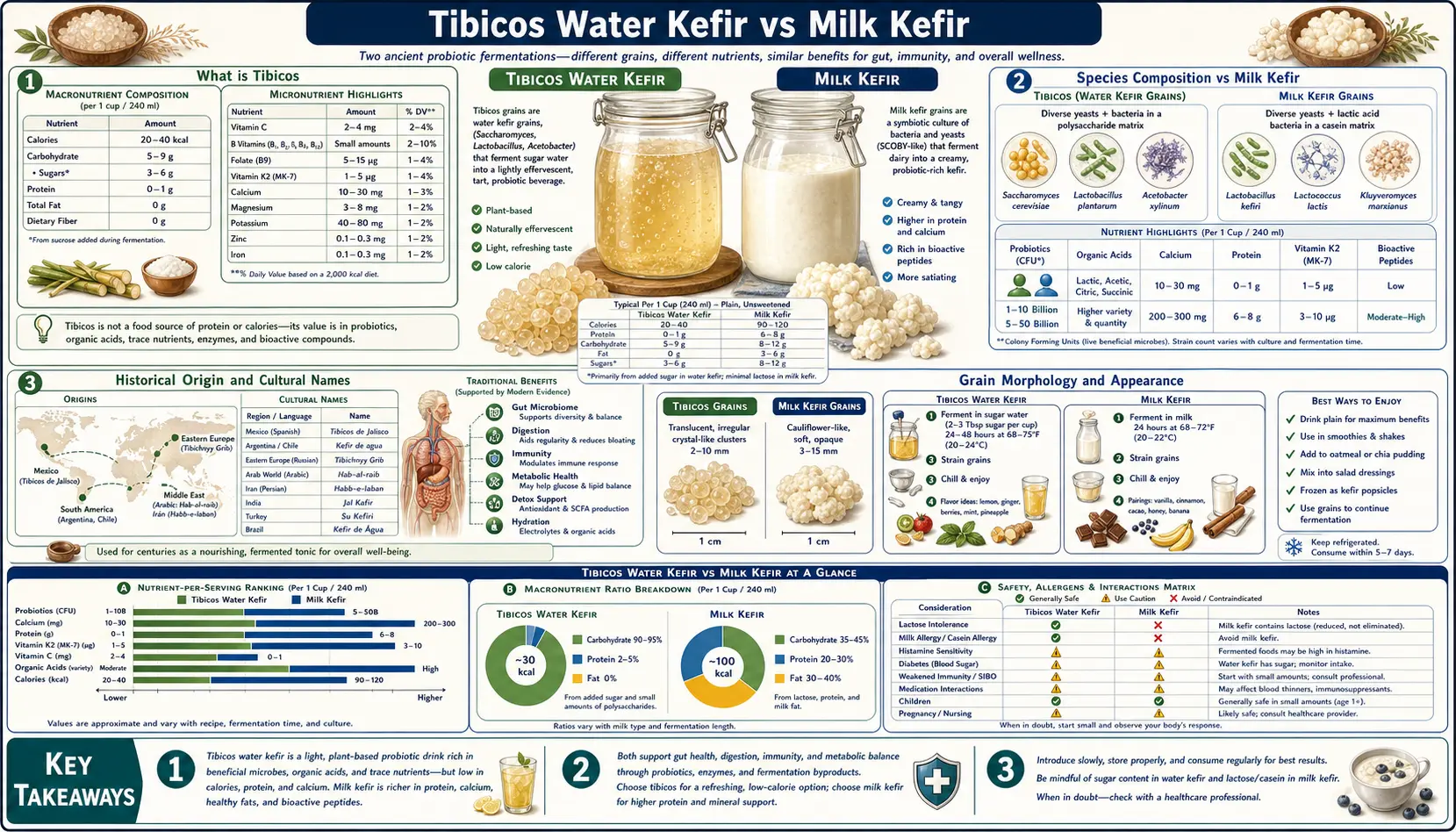
Tibicos — also called water kefir, sugary kefir, tibi, California bees, Japanese water crystals, or Tibetan crystals depending on the cultural lineage — is the dairy-free alternative to traditional milk kefir. The grains are translucent, gelatinous, and crystalline in appearance (versus the opaque cauliflower-shaped milk kefir grains), and they ferment a simple solution of sucrose-water with lemon and dried fruit rather than milk. The resulting beverage is mildly carbonated, slightly tart-sweet, low-alcohol (typically less than 1%), and contains a probiotic community of approximately 15-30 microbial species — smaller than milk kefir's 30-60 but still well above any commercial probiotic capsule or kombucha. Water kefir is the standard kefir option for the lactose-intolerant, casein-sensitive, vegan, and Whole30 populations, and provides most of the gut-health benefits of milk kefir with a different but overlapping microbial ecology.
Table of Contents
- What is Tibicos
- Species Composition vs Milk Kefir
- Historical Origin and Cultural Names
- Grain Morphology and Appearance
- Fermentation Process and Recipe
- Nutritional Comparison
- Clinical Evidence Base
- Who Should Choose Water Over Milk Kefir
- Tibicos vs Kombucha
- Cautions
- Key Research Papers
- Connections
- Featured Videos
What is Tibicos
Tibicos is a fermented beverage produced by a symbiotic community of lactic acid bacteria, acetic acid bacteria, and yeasts that live together in a translucent crystalline matrix — the water kefir grain. The grain ferments a simple medium of dechlorinated water, cane sugar, lemon juice, and a piece of dried fruit (typically fig, raisin, apricot, or date) over 24-72 hours at room temperature. The result is a lightly fizzy, mildly tart, marginally sweet beverage similar in mouthfeel to a soft sparkling cider but with active probiotic culture.
Unlike milk kefir, which depends on lactose as the primary fermentation substrate, water kefir uses sucrose. The yeasts hydrolyze sucrose to glucose and fructose, then ferment the monosaccharides anaerobically to ethanol and CO2. The lactic acid bacteria simultaneously ferment glucose to lactic acid (and some heterofermentative strains additionally produce acetic acid, ethanol, and CO2). The acetic acid bacteria, which are more abundant in water kefir than in milk kefir, partially oxidize ethanol back to acetic acid. The dried fruit and lemon provide trace minerals (potassium, calcium, magnesium) that the microbial community needs and pH-buffer the early stages of fermentation.
The end product is a beverage at approximately pH 3.3-3.7, alcohol content 0.5-1.5% (less than near beer, similar to ripe kombucha), residual sugar 1-3% (depending on ferment time), and probiotic load of 108-109 CFU/mL of mixed lactic acid bacteria and yeasts.
Species Composition vs Milk Kefir
The microbiology of water kefir differs systematically from milk kefir. Both are diverse symbiotic communities, but the species composition is dictated by the substrate (sucrose-water vs lactose-milk) and the pH-buffering of fruit acids vs milk proteins. The major differences:
- Lactose-utilizing yeasts dominate milk kefir (Kluyveromyces marxianus, K. lactis) but are minimal in water kefir, where sucrose-utilizing Saccharomyces cerevisiae and Saccharomyces florentinus predominate.
- Lactobacillus kefiranofaciens — the keystone milk kefir species — is absent or trace-level in water kefir. The water kefir keystone species is typically Lactobacillus hilgardii, named for the eponymous wine microbiologist, which produces the dextran-glucan polysaccharide matrix that holds water kefir grains together.
- Acetic acid bacteria are much more abundant in water kefir (10-30% of cells) versus milk kefir (less than 5%), reflecting the more aerobic surface conditions and higher oxygen-tolerant niche.
- Total species count is lower in water kefir (typically 15-30 species) versus milk kefir (30-60 species).
- The yeast-to-bacteria ratio is more balanced in water kefir (often 30-50% yeasts) versus milk kefir (10-20% yeasts).
The reduced total diversity in water kefir does not necessarily translate to reduced clinical effect — the abundance of acetic acid bacteria and the higher yeast load produce a distinct profile of bioactive metabolites including more acetic acid, more glucan polysaccharide, and a different B-vitamin spectrum.
Historical Origin and Cultural Names
The geographic and cultural origin of tibicos is poorly documented compared to milk kefir, which has clear roots in the North Caucasus mountains. Water kefir grains have been found independently in Mexico (where they were called "tibicos" by indigenous communities, possibly Nahuatl in origin), California (where they were called "California bees" in 19th-century homesteading texts), Tibet (where they were associated with monastery practice), Japan (where they were called "Tibetan crystals" or "Japanese water crystals"), the British Isles (where they were called the "gingerbeer plant" and used to ferment ginger-flavored water before the rise of commercial soft drinks), and Eastern Europe (where they were called "tibi" or "tibicos"). The diversity of names suggests the same or similar microbial community may have arisen independently in multiple locations, or may have been carried by traders and travelers without record.
The modern English-language literature largely uses "water kefir" as the inclusive term, with "tibicos" preserved as an older Spanish-derived label. The "gingerbeer plant" name historically referred to a specific water kefir lineage used in the British gingerbeer tradition before the 19th-century industrialization of soft drink production replaced it with commercial yeasted ginger ale.
Grain Morphology and Appearance
Water kefir grains differ dramatically from milk kefir grains in appearance:
- Color — translucent and crystalline (often described as resembling small ice cubes or quartz crystals) versus the opaque white-to-cream color of milk kefir grains
- Shape — irregular polyhedral or crystalline shapes 2-10 mm across, versus the cauliflower-like clusters of milk kefir grains
- Texture — gelatinous and firm, with a glassy surface, versus the soft and somewhat crumbly texture of milk kefir grains
- Smell — mildly fruity and yeasty, versus the dairy-tangy aroma of milk kefir grains
- Growth pattern — visible new crystal formation at the edges of existing grains, with grain mass approximately doubling every 1-2 weeks under good conditions
The matrix polysaccharide of water kefir grains is primarily dextran — a glucose homopolymer with alpha-1,6 glycosidic linkages and some branching — produced by Lactobacillus hilgardii and related species. This is chemically distinct from kefiran (the heteropolysaccharide of milk kefir grains, made of glucose and galactose). The dextran matrix is what gives water kefir grains their translucent crystalline appearance, similar to the translucent dextran-based grains used in chromatography.
Fermentation Process and Recipe
The classic water kefir recipe scales linearly. For a 1-liter batch:
- Dissolve 60-80 grams cane sugar (about 1/4 to 1/3 cup) in 1 liter dechlorinated water (filtered or chlorine-evaporated tap water). Organic unrefined cane sugar (such as Sucanat or rapadura) works better than refined white sugar because it contains trace minerals the microbes need. White sugar works if a 1/8-teaspoon of unsulfured molasses is added.
- Add 1 tablespoon water kefir grains (about 30 grams). Grains must be live — freeze-dried starter does not work for water kefir.
- Add 1 slice of organic lemon or lime (peel may be left on or removed; if left on, the citrus oils provide additional flavor and antimicrobial activity) and 1-2 pieces of dried fruit (fig, raisin, apricot, or date). Avoid sulfured dried fruit, which inhibits the microbes. The fruit provides trace minerals (particularly potassium and magnesium) that the grains need to thrive.
- Cover loosely with a cloth or coffee filter held by a rubber band — the ferment needs gas exchange. A sealed jar will explode.
- Ferment at room temperature (68-78°F / 20-25°C) for 24-72 hours. Shorter time = sweeter, less acidic, lower alcohol. Longer time = more acidic, higher alcohol, less sugar. Most home brewers aim for 36-48 hours in summer, 48-72 hours in winter.
- Strain through a non-metallic sieve (plastic, bamboo, or stainless steel; avoid reactive metals like aluminum, copper, brass), reserving the grains for the next batch. The grains can be stored in fresh sugar water in the refrigerator for up to 2-3 weeks between batches without dying.
- Optional second fermentation for carbonation: pour the strained kefir into airtight bottles with a small amount of fresh fruit juice (1-2 tablespoons per 250 mL), seal, and leave at room temperature for 24-48 hours. The remaining yeasts ferment the fruit sugars and build pressure, producing a champagne-like fizz. Burp the bottles daily to prevent overpressure.
Common troubleshooting: grains that fail to multiply or that smell off may be mineral-deficient (try a higher-mineral sugar source or add 1-2 drops of liquid mineral concentrate); grains that float on the surface are typically producing gas and are healthy; grains that sink with no gas are sluggish (try warmer temperature); persistent kahm yeast (a wrinkly white surface film) usually means temperature too high or ferment too long — skim off and shorten ferment time.
Nutritional Comparison
The nutritional profiles of milk kefir and water kefir differ substantially in protein, calcium, fat, and B-vitamin content:
- Protein — milk kefir provides 6-8 g/cup (complete protein from milk casein and whey); water kefir provides essentially zero protein.
- Calcium — milk kefir provides ~250 mg/cup; water kefir provides only trace calcium from the dried fruit (typically less than 10 mg/cup).
- Fat — milk kefir from whole milk provides 6-8 g/cup including saturated and short-chain fats; water kefir provides essentially zero fat.
- Carbohydrates — both products start with substantial carbohydrate (lactose vs sucrose) and reduce it during fermentation. End-state sugar is similar (3-6 g/cup).
- Vitamin B12 — milk kefir provides ~1 mcg/cup (from the milk plus yeast biosynthesis); water kefir provides 0.2-0.5 mcg/cup (yeast biosynthesis only).
- Vitamin K2 — milk kefir provides modest amounts (5-15 mcg/cup MK-4/MK-7 from microbial synthesis); water kefir provides less.
- Biotin and folate — both products have yeast-derived biotin and folate at similar levels.
- Probiotic CFU — milk kefir at 109-1010 CFU/g; water kefir at 108-109 CFU/mL (one order of magnitude lower).
The practical takeaway is that water kefir is a probiotic beverage but not a nutritionally significant food — the calories are almost entirely residual sugar and trace alcohol. Patients relying on water kefir as a sole source of probiotic should ensure protein, calcium, and B12 from other sources in the diet.
Clinical Evidence Base
The clinical research literature on water kefir is meaningfully smaller than on milk kefir — perhaps a factor of 10 fewer published trials and case series. Most of the available evidence is animal-model work demonstrating reduced inflammatory markers, improved insulin sensitivity, and modulation of gut microbiome composition. Human trials are limited to a handful of small studies in healthy volunteers showing tolerability, microbiome modulation similar to milk kefir, and immune effects qualitatively similar to but smaller in magnitude than milk kefir.
The mechanistic plausibility of water kefir clinical effect is strong (broadly similar to milk kefir — SCFA production, gut microbiome diversification, GALT modulation, Th17/Treg balance, bacteriocin-mediated pathobiont exclusion). The lack of large-scale trials is more a reflection of research funding priorities (commercial milk kefir manufacturers fund milk kefir research; there is no equivalent industry sponsor for water kefir) than of any negative finding.
For patients who can tolerate milk kefir, the larger evidence base argues for milk kefir as the first-choice probiotic food. For patients who cannot, water kefir is a reasonable second choice that retains most of the mechanistic basis if not the same volume of clinical evidence.
Who Should Choose Water Over Milk Kefir
- Severe lactose intolerance — the small minority of lactose-intolerant patients who cannot tolerate even the dramatically lactose-reduced milk kefir.
- Cow's milk protein (casein) allergy — for whom dairy in any form is contraindicated.
- Vegan dietary preference — water kefir is fully plant-based when fermented with cane sugar and fruit.
- Whole30 and AIP (autoimmune protocol) diets — both protocols exclude dairy. Water kefir is compatible.
- Galactosemia — rare genetic disorder; water kefir contains no galactose.
- Patients who simply prefer the taste profile — water kefir is mildly fizzy and fruit-flavored, more like a craft soft drink than a dairy product.
- Children resistant to fermented dairy taste — water kefir flavored with strawberry, mango, or other child-friendly fruit during second fermentation is often more accepted than tart milk kefir.
For most adults without these constraints, milk kefir offers more clinical evidence and higher nutrient density and is the better first-choice probiotic food. Water kefir is the workaround when milk kefir is not an option.
Tibicos vs Kombucha
Kombucha and tibicos are both fermented sweet beverages and are often grouped together, but they are microbiologically distinct:
- Kombucha ferments sweetened tea using a SCOBY (symbiotic culture of bacteria and yeasts) that is structurally a leathery cellulose mat. The dominant microbes are Acetobacter, Komagataeibacter, and yeasts (Brettanomyces, Zygosaccharomyces, Schizosaccharomyces). Acetic acid is the dominant acid produced. Ferment time is typically 7-14 days.
- Water kefir / tibicos ferments sweetened mineral-rich water using crystalline grains held together by dextran. The dominant microbes are Lactobacillus (especially L. hilgardii), Leuconostoc, and Saccharomyces yeasts. Lactic acid is the dominant acid produced. Ferment time is 1-3 days.
Tibicos generally has higher lactic acid bacteria CFU, lower acetic acid taste, faster fermentation, and less caffeine (none, versus residual tea caffeine in kombucha). Kombucha has higher polyphenol content from the tea leaves, more pronounced acetic acid character, and longer fermentation cycle. From a probiotic-diversity standpoint, tibicos and kombucha are roughly comparable to each other but both are lower-diversity than milk kefir.
Cautions
- Diabetes / strict carbohydrate restriction — water kefir contains 3-6 g residual sugar per cup. Longer ferment reduces sugar but raises alcohol. Diabetics should monitor blood glucose response when introducing water kefir.
- Alcohol-restricted populations — water kefir contains 0.5-1.5% alcohol (more than typical milk kefir at 0.5-1%). Patients in alcohol recovery or with strict religious restrictions should be aware.
- Children — the low alcohol content (similar to ripe fruit juice) is generally not a concern for older children, but parents may wish to avoid water kefir in young children for that reason.
- Yeast overgrowth concerns — the high yeast content of water kefir is generally not a concern in immunocompetent patients but may be relevant in those with documented intestinal candidiasis or severe SIFO (small intestinal fungal overgrowth).
- Histamine intolerance — some water kefir strains produce biogenic amines including histamine during fermentation. Shorter ferment times reduce histamine.
- Pressure injuries — sealed second-fermentation bottles can explode if not burped daily. Use thick-walled bottles designed for carbonated beverages (champagne-style or swing-top), and store in a contained location during second fermentation.
Key Research Papers
- Laureys D, De Vuyst L (2014). Microbial species diversity, community dynamics, and metabolite kinetics of water kefir fermentation. Applied and Environmental Microbiology. — PubMed
- Gulitz A, Stadie J, Wenning M, Ehrmann MA, Vogel RF (2011). The microbial diversity of water kefir. International Journal of Food Microbiology. — PubMed
- Marsh AJ, O'Sullivan O, Hill C, Ross RP, Cotter PD (2013). Sequence-based analysis of the microbial composition of water kefir from multiple sources. FEMS Microbiology Letters. — PubMed
- Pidoux M (1989). The microbial flora of sugary kefir grain (the gingerbeer plant): biosynthesis of the grain from Lactobacillus hilgardii producing a polysaccharide gel. MIRCEN Journal. — PubMed
- Fels L et al. (2018). Structural characterization of the exopolysaccharide produced by Lactobacillus hilgardii TMW 1.828 isolated from water kefir. Carbohydrate Polymers. — PubMed
- Magalhaes KT et al. (2010). Microbial communities and chemical changes during fermentation of sugary Brazilian kefir. World Journal of Microbiology and Biotechnology. — PubMed
- Lynch KM, Wilkinson S, Daenen L, Arendt EK (2021). An update on water kefir: Microbiology, composition and production. International Journal of Food Microbiology. — PubMed
- Diosma G et al. (2014). Yeasts from kefir grains: isolation, identification, and probiotic characterization. World Journal of Microbiology and Biotechnology. — PubMed
- Bueno RS et al. (2021). Production of healthy beverages by fermentation of plant matrices with water kefir grains. Beverages. — PubMed
- Verce M, De Vuyst L, Weckx S (2019). Comparative genomics of Lactobacillus species present in water kefir. Frontiers in Microbiology. — PubMed
- Stadie J, Gulitz A, Ehrmann MA, Vogel RF (2013). Metabolic activity and symbiotic interactions of lactic acid bacteria and yeasts isolated from water kefir. Food Microbiology. — PubMed
- Moretti AF et al. (2018). Water kefir, a fermented beverage containing probiotic microorganisms. LWT - Food Science and Technology. — PubMed
PubMed Topic Searches
- PubMed: Water kefir / tibicos
- PubMed: Sugary kefir grain
- PubMed: L. hilgardii dextran
- PubMed: Dairy-free probiotics
- PubMed: Kombucha vs water kefir
Connections
- All Food
- Kefir Overview
- Kefir Benefits Hub
- Probiotic Diversity
- Gut Microbiome and Immune
- Make Kefir at Home
- Kombucha
- Fermented Foods
- Probiotics
- Lactose Intolerance
- Irritable Bowel Syndrome
- Cow's Milk Protein Allergy
- Yogurt
- Milk
- Immune Boosting