Kefir Probiotic Diversity
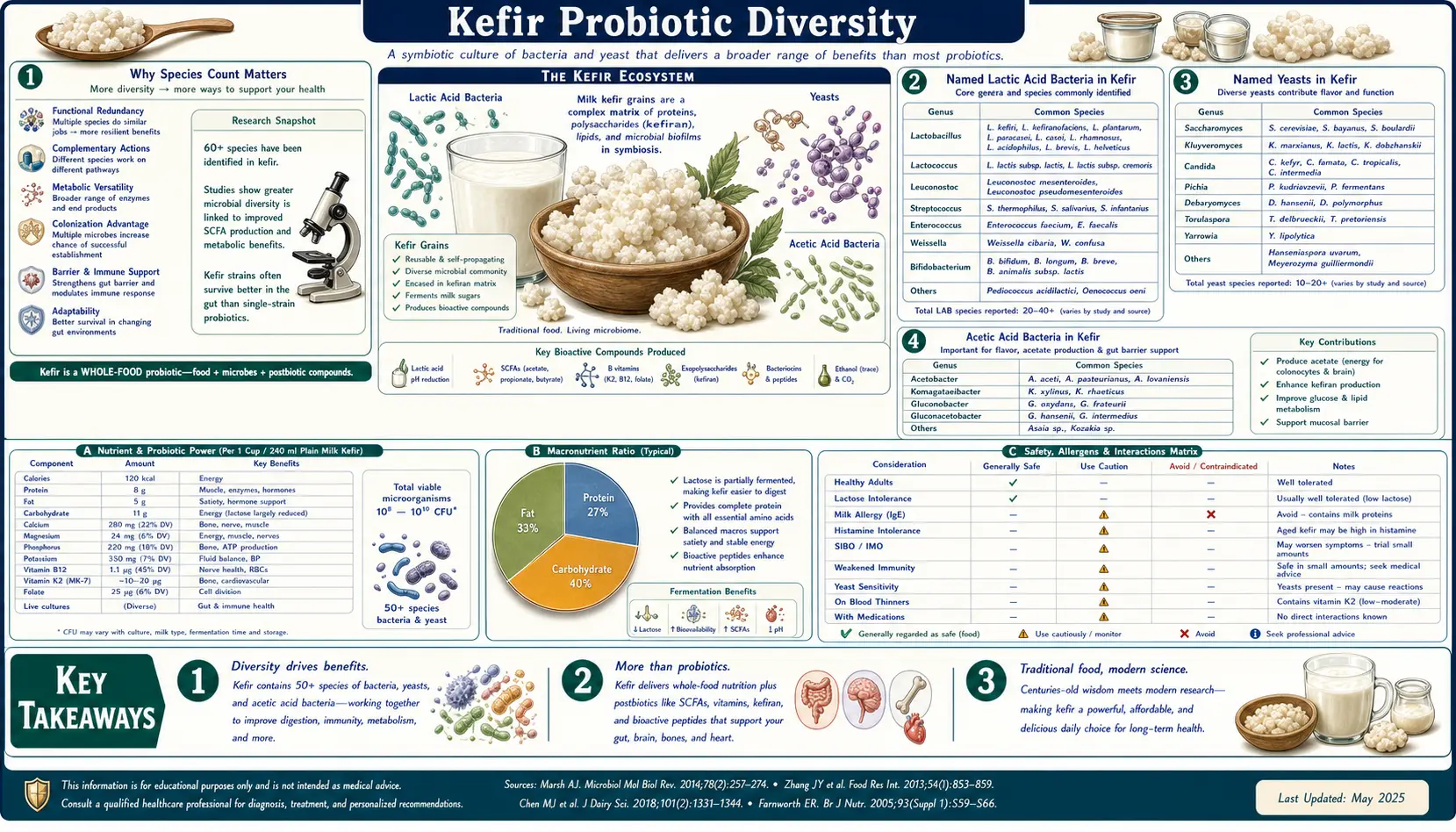
Kefir is uniquely diverse among commercially available probiotic foods. Traditional kefir grains harbor 30 to 60 distinct microbial species — lactic acid bacteria, acetic acid bacteria, and yeasts — coexisting in a stable symbiotic matrix held together by the polysaccharide kefiran. By contrast, federally-defined yogurt requires only two species (Lactobacillus delbrueckii subsp. bulgaricus and Streptococcus thermophilus), and even probiotic-enhanced yogurts typically add only one or two more. Most commercial probiotic capsules contain between one and ten strains. The species-diversity gap between traditional grain-fermented kefir and any other widely available probiotic source is at least one order of magnitude, and the practical implications for gut ecology are significant.
Table of Contents
- Why Species Count Matters
- Named Lactic Acid Bacteria in Kefir
- Named Yeasts in Kefir
- Acetic Acid Bacteria
- The Kefiran Polysaccharide Matrix
- Bacteria-Yeast Symbiosis
- Home-Fermented vs Commercial Kefir
- Strain Survival and Transient Colonization
- Practical Implications for the Consumer
- Key Research Papers
- Connections
- Featured Videos
Why Species Count Matters
A common misconception is that probiotic effect scales with colony-forming units (CFU) alone — the more bacteria the better. The clinical literature on probiotics, microbiome research, and ecology suggests species diversity matters at least as much as total dose. A healthy human gut microbiome typically contains several hundred bacterial species, and the loss of microbial diversity (low alpha-diversity in 16S rRNA sequencing) is a well-documented signature of multiple disease states — inflammatory bowel disease, obesity, autoimmune disease, neurodegenerative disease, and post-antibiotic dysbiosis.
Re-supplementing a depleted gut with a single high-dose probiotic strain at 1010 CFU has limited ecological effect, because no single strain occupies all the niches that are needed for full ecosystem function. Re-supplementing the same gut with a multi-species community has a more substantial effect because the imported community shares metabolic load (cross-feeding), produces a broader range of antimicrobial peptides (bacteriocins), and competitively excludes a broader range of pathobionts. Kefir, by virtue of delivering 30-60 species simultaneously, more closely approximates microbiome restoration than any single-strain probiotic.
This is why even very high-dose monostrain probiotics (e.g., 100 billion CFU of one Lactobacillus) often show modest clinical effects, while broad multi-strain products like VSL#3 (8 strains) and the much more diverse kefir grain (30-60 strains) produce more consistent results in head-to-head trials. The species-count advantage is one reason kefir consistently outperforms commercial probiotic capsules in trials of H. pylori eradication, antibiotic-associated diarrhea prevention, and irritable bowel syndrome symptom reduction.
Named Lactic Acid Bacteria in Kefir
Kefir grain microbiota studies using 16S rRNA sequencing have identified a stable core of lactic acid bacteria across kefir grains from many geographic origins. The composition varies somewhat between grains, but the species below are repeatedly identified:
- Lactobacillus kefiranofaciens — the keystone species of the kefir grain. Produces the kefiran exopolysaccharide that forms the structural matrix holding all other species together. Without L. kefiranofaciens, the grain dissolves.
- Lactobacillus kefiri — named for kefir, the most well-studied immunomodulatory species in the kefir community. Implicated in the anti-inflammatory effect on the gut.
- Lactobacillus brevis — widespread heterofermentative species, also found in sourdough and sauerkraut. Produces D-lactic acid plus CO2.
- Lactobacillus parakefiri — closely related to L. kefiri, often co-occurs.
- Lactobacillus acidophilus — classical probiotic species, also found in commercial yogurts and probiotic capsules.
- Lactobacillus delbrueckii subsp. bulgaricus — one of the two species in commercial yogurt.
- Lactobacillus helveticus — produces ACE-inhibitor peptides (potential antihypertensive effect).
- Lactococcus lactis subsp. lactis — the species used in most cheese starter cultures.
- Lactococcus lactis subsp. cremoris — the species behind the longevity-correlated Caucasian kefir tradition.
- Leuconostoc mesenteroides — heterofermentative, produces dextran-like polysaccharide, also in sauerkraut.
- Streptococcus thermophilus — the second yogurt species.
Less consistently present but documented include L. casei, L. plantarum, L. paracasei, L. rhamnosus, L. fermentum, Enterococcus faecium, Lactobacillus crispatus, and various Bifidobacterium species. The total bacterial component typically represents 80-90% of the live cell count in mature kefir.
Named Yeasts in Kefir
What truly distinguishes kefir from yogurt is the yeast component — a stable yeast community living in symbiosis with the lactic acid bacteria. Yogurt has no yeast component at all. The yeasts contribute the characteristic effervescence (CO2), small amounts of ethanol (0.5-2% in extended ferments), the gentle tangy-yeasty aroma, and a distinct B-vitamin biosynthesis capability (particularly B12, biotin, riboflavin, and folate).
- Saccharomyces cerevisiae — the same species as brewing/baking yeast. Predominant carbohydrate fermenter in many kefir grains.
- Saccharomyces unisporus — closely related to S. cerevisiae, commonly isolated from kefir.
- Kluyveromyces marxianus — uniquely able to ferment lactose (most yeasts cannot). One mechanism by which kefir reduces lactose content during fermentation.
- Kluyveromyces lactis — another lactose-fermenting yeast, contributes to lactose reduction.
- Candida kefyr — despite the name (Candida), not a clinically significant Candida albicans-class pathogen. A regular kefir resident.
- Pichia fermentans — produces characteristic flavor esters.
- Torulaspora delbrueckii — widely studied in wine and beer fermentation, common in kefir.
- Issatchenkia orientalis (syn. Candida krusei) — documented in some kefir grain analyses.
The yeast load is typically 10-20% of the live cell count, equating to 107-108 yeast cells per gram of mature kefir. Critically, the yeast species in kefir are not pathogenic in immunocompetent hosts, and a century of routine kefir consumption across the Caucasus, Russia, and Eastern Europe with no documented infectious outbreak speaks to safety. Patients with severe immunosuppression (HIV/AIDS, post-transplant, chemotherapy-induced neutropenia) should consult their physician before consuming any live-yeast-containing fermented food.
Acetic Acid Bacteria
A third microbial category often overlooked in discussions of kefir is the acetic acid bacteria — species in genera Acetobacter and Gluconobacter. These are obligate aerobes that produce acetic acid (vinegar) from ethanol, the same biochemistry behind kombucha and vinegar production. In kefir, they:
- Consume some of the ethanol produced by the yeasts, keeping ethanol concentration low
- Produce acetic acid that lowers pH and inhibits pathobionts
- Produce gluconic acid (from glucose) that has prebiotic properties
- Contribute to the slightly vinegary note in well-developed kefir
Acetic acid bacteria are most abundant in water kefir (where they have direct access to dissolved oxygen) and less abundant in milk kefir, where milk provides relatively little dissolved oxygen for their aerobic metabolism. Their role in milk kefir is concentrated at the surface of the ferment (the meniscus exposed to room air).
The Kefiran Polysaccharide Matrix
Kefir grains are not loose populations of microbes — they are physical, gelatinous, cauliflower-shaped clusters held together by a glucose-galactose heteropolysaccharide called kefiran. Kefiran is produced primarily by Lactobacillus kefiranofaciens, the keystone species that gives the grain its name. The kefiran matrix:
- Provides physical structure that allows the grain to remain intact through strain-and-rinse cycles for years to decades
- Creates anaerobic micro-niches inside the grain where strict anaerobes can survive in an otherwise oxygen-rich environment
- Acts as a slowly-released bioactive in the consumed kefir — studies suggest kefiran itself has anti-inflammatory, hypocholesterolemic, and antimicrobial effects independent of the live cells
- Provides a prebiotic substrate that selectively feeds beneficial gut bacteria after ingestion
The kefiran-producing capability of L. kefiranofaciens is also why kefir grains can be passed down through generations: as long as the keystone species remains viable, the entire grain ecosystem can be reconstituted. Historical Russian and Caucasian families report kefir grain lineages passed mother-to-daughter for many decades.
Bacteria-Yeast Symbiosis
The 30-60 species in kefir do not coexist by accident — they are mutually dependent in well-characterized ways:
- Yeasts produce amino acids and vitamins that bacteria need. Several lactic acid bacteria are auxotrophic for B-vitamins and certain amino acids; yeasts (particularly Saccharomyces) overproduce these as metabolic byproducts.
- Bacteria produce lactic acid that yeasts tolerate but competitors do not. The low pH from lactic acid fermentation (~3.8-4.5 in mature kefir) excludes most pathobionts but does not impair the kefir yeast species.
- Yeasts produce CO2 that helps maintain anaerobic conditions for bacteria. Inside the grain, yeast respiration consumes oxygen and produces CO2, creating the low-oxygen environment that obligate anaerobes need.
- Acetic acid bacteria consume yeast-produced ethanol, preventing toxicity. Without acetic acid bacteria, ethanol could accumulate to bacteria-inhibitory concentrations.
- Bacteriocin-producing strains exclude invaders. Several kefir Lactobacillus species produce species-specific antimicrobial peptides (bacteriocins) that prevent contamination with non-kefir bacteria.
This mutual interdependence is why kefir grains are remarkably stable over time — the symbiosis is robust enough to exclude most invading microbes while preserving the resident community. Lose one keystone species (as in a contamination event or overheating), and the entire grain can collapse rapidly.
Home-Fermented vs Commercial Kefir
The dirty secret of the commercial probiotic-food industry is that the kefir sold in most supermarkets is dramatically less diverse and less viable than fresh home-fermented kefir from live grains. The reasons:
- Pasteurization after fermentation. Most commercial kefirs are pasteurized to extend shelf life and ensure consistent flavor. This kills the live microbes, after which the product is re-inoculated with a small subset of laboratory-grown strains (typically 3-7) — far below the 30-60 of traditional kefir.
- Selection for shelf life over diversity. Commercial producers select strains for slow post-pasteurization growth, predictable flavor, and survival through refrigerated distribution. These selection criteria eliminate most of the original kefir grain community.
- Use of starter cultures rather than grains. Industrial production uses freeze-dried starter cultures rather than living grains. Freeze-dried cultures lose strain diversity over time even when the same recipe is followed.
- Lower CFU/g at point of consumption. Commercial kefir typically delivers 107-109 CFU/g at expiration, compared to 109-1010 CFU/g for fresh home-fermented kefir.
This is the main practical reason the home-fermentation route described on our Make at Home page produces meaningfully different clinical effects than buying kefir at the grocery store. Commercial kefir is still better than no kefir — it has more strains and higher CFU than yogurt, and the clinical literature on commercial kefir is generally positive. But the diversity gap between commercial and home-fermented is substantial, and patients with serious indications (IBD, post-antibiotic dysbiosis, severe IBS, H. pylori adjunct therapy) generally benefit from upgrading to home fermentation.
Strain Survival and Transient Colonization
A separate question from how many strains are in the kefir is how many actually reach the colon alive and how long they persist. The literature here is more nuanced:
- Gastric acid survival is variable. Most kefir lactic acid bacteria are acid-tolerant due to the low pH of the kefir itself (~3.8-4.5), and a substantial fraction survive transit through the stomach. Lactobacillus kefiri and L. kefiranofaciens have been specifically demonstrated to survive gastric transit in human studies.
- Bile salt tolerance is variable. Some kefir species (particularly L. kefiri) tolerate bile salts well; others are sensitive and lose viability in the small intestine.
- Transient colonization rather than permanent. Even strains that survive transit typically do not permanently colonize the gut — they pass through over 1-2 weeks of regular consumption and are lost when consumption stops. This is consistent with the broader probiotic literature.
- The transient population still produces effect. Even without permanent colonization, the transit through the gut produces metabolic effects: bacteriocin secretion, short-chain fatty acid production, immune modulation, and competitive exclusion of pathobionts. These effects persist as long as consumption is maintained.
The practical implication is that kefir benefit is maintained through ongoing consumption, not a one-time inoculation. A daily glass of kefir for two weeks produces measurable changes in stool microbiome composition; the changes regress over the next two to four weeks after kefir is stopped.
Practical Implications for the Consumer
- Prefer live-grain home fermentation over commercial pasteurized kefir. The diversity and CFU gap is substantial. See our Make at Home page for the protocol.
- If buying commercial kefir, look for "live and active cultures" labeling and avoid extended-shelf-life ultra-pasteurized products. Lifeway is the dominant US brand and is generally well-regarded.
- Plain unsweetened kefir is the high-diversity form. Flavored, sugar-added kefirs typically have lower CFU because the added sugar accelerates post-packaging fermentation and the producer compensates by sterilizing more aggressively.
- Maintain consumption to maintain benefit. Most strains do not permanently colonize the gut. Daily 100-200 mL servings are typical for clinical benefit.
- Start low if previously inexperienced. The shock of 30-60 new microbial species can produce transient bloating, gas, and looser stools in the first 3-7 days. Begin with 50 mL/day and ramp up.
- Lactose-intolerant consumers usually tolerate kefir well because the resident Kluyveromyces yeasts and several bacterial species ferment lactose during the ferment. A typical 24-hour fermented kefir has 60-80% less lactose than the starting milk. For severe intolerance, the dairy-free alternative described on our Tibicos page is an option.
Key Research Papers
- Garrote GL, Abraham AG, De Antoni GL (2010). Microbial interactions in kefir: a natural probiotic drink. Biotechnology of Lactic Acid Bacteria. — PubMed
- Marsh AJ, O'Sullivan O, Hill C, Ross RP, Cotter PD (2013). Sequence-based analysis of the bacterial and fungal compositions of multiple kefir products. FEMS Microbiology Ecology. — PubMed
- Witthuhn RC, Schoeman T, Britz TJ (2005). Characterisation of the microbial population at different stages of Kefir production and Kefir grain mass cultivation. International Dairy Journal. — PubMed
- Nielsen B, Gurakan GC, Unlu G (2014). Kefir: a multifaceted fermented dairy product. Probiotics and Antimicrobial Proteins. — PubMed
- Pogacic T et al. (2013). Microbiota of kefir grains. Mljekarstvo. — PubMed
- Walsh AM et al. (2016). Microbial succession and flavor production in the fermented dairy beverage kefir. mSystems. — PubMed
- Plessas S et al. (2017). Microbiology of kefir, koumiss, and related fermented dairy products. Fermentation. — PubMed
- Hamet MF et al. (2013). Selection of EPS-producing Lactobacillus strains isolated from kefir grains. Journal of Dairy Science. — PubMed
- Hsieh HH et al. (2012). Lactobacillus kefiranofaciens M1 isolated from milk kefir grains ameliorates experimental colitis. British Journal of Nutrition. — PubMed
- Kakisu E et al. (2013). Lactobacillus plantarum isolated from kefir protects vero cells from cytotoxicity. Anaerobe. — PubMed
- Diosma G et al. (2014). Yeasts from kefir grains: isolation, identification, and probiotic characterization. World Journal of Microbiology and Biotechnology. — PubMed
- Korsak N et al. (2015). Short communication: Evaluation of the microbiota of kefir samples using metagenetic analysis targeting the 16S and 26S ribosomal DNA fragments. Journal of Dairy Science. — PubMed
PubMed Topic Searches
- PubMed: Kefir microbial diversity
- PubMed: Kefiran polysaccharide
- PubMed: Kefir grain symbiosis
- PubMed: L. kefiri probiotic
- PubMed: Kluyveromyces lactose
Connections
- All Food
- Kefir Overview
- Kefir Benefits Hub
- Gut Microbiome and Immune
- Tibicos vs Milk Kefir
- Make Kefir at Home
- Yogurt
- Milk
- Probiotics
- Fermented Foods
- Irritable Bowel Syndrome
- SIBO
- H. pylori Infection
- Immune Boosting
- Vitamin B12