Numbness and Tingling
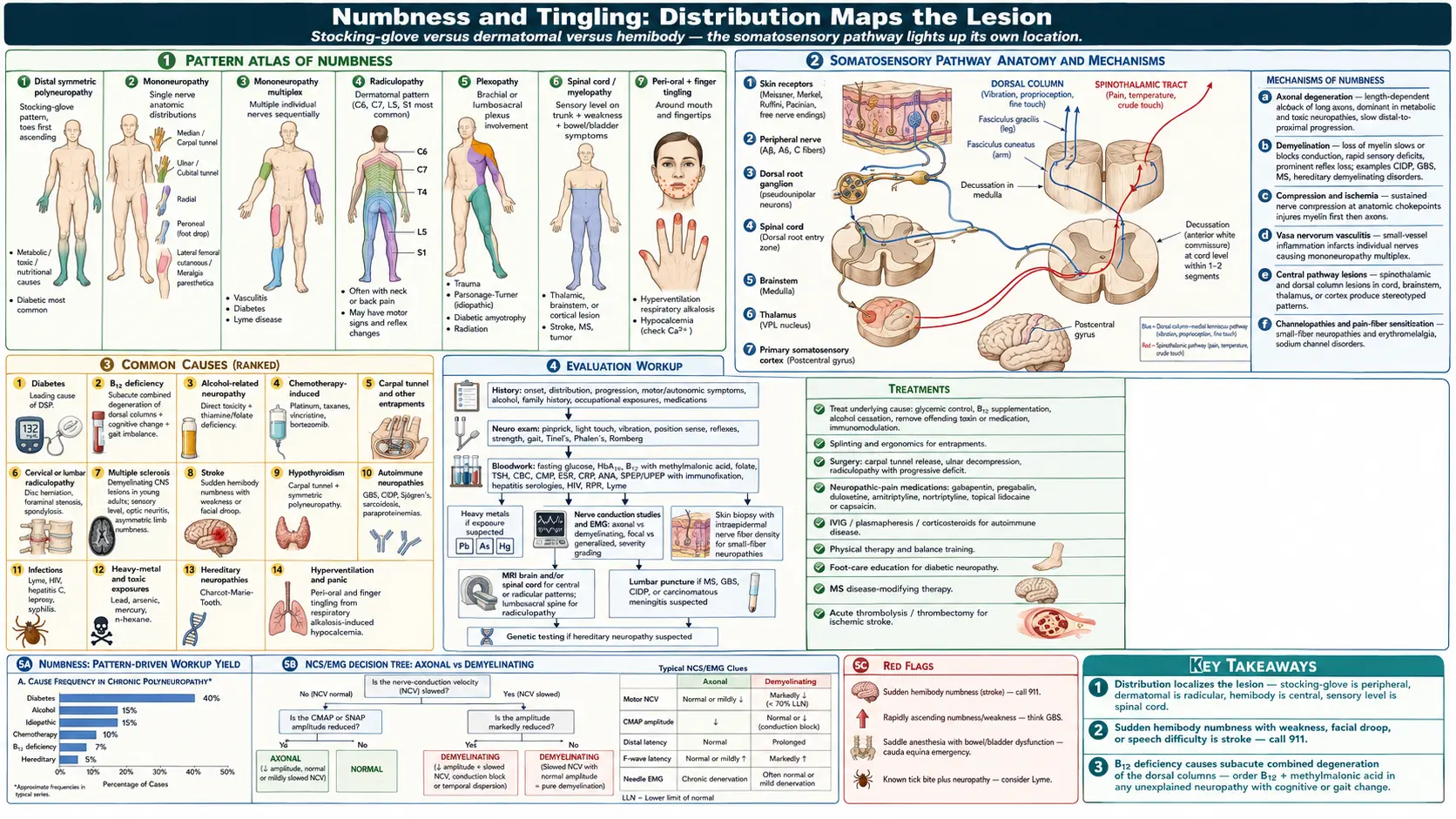
Table of Contents
Overview
Numbness (loss of sensation) and tingling (paresthesia, "pins and needles") reflect dysfunction anywhere along the somatosensory pathway — small or large peripheral nerve fibers, dorsal roots, spinal cord tracts, brainstem nuclei, thalamus, or sensory cortex. The distribution of the symptoms is the single most useful clue: distal symmetric stocking-glove patterns suggest a length-dependent peripheral neuropathy (most often diabetic, alcohol-related, B12 deficiency, or chemotherapy); focal asymmetric patterns suggest a single nerve, plexus, or root lesion; multifocal or central patterns raise concern for multiple sclerosis, stroke, or spinal cord pathology and are often more urgent.
Patterns of Numbness
- Distal symmetric polyneuropathy (stocking-glove) — the most common pattern; toes first, slowly ascending; usually metabolic, toxic, or nutritional.
- Mononeuropathy — single nerve in its anatomic distribution: median (carpal tunnel), ulnar (cubital tunnel), radial, peroneal, lateral femoral cutaneous (meralgia paresthetica).
- Mononeuropathy multiplex — multiple individual nerves involved sequentially; classic in vasculitis, diabetes, and Lyme disease.
- Radiculopathy — nerve-root distribution; cervical (C6, C7) or lumbar (L5, S1) most common; often with neck or back pain and motor signs.
- Plexopathy — brachial or lumbosacral plexus; trauma, idiopathic (Parsonage-Turner), diabetic, or radiation-related.
- Spinal cord (myelopathy) — sensory level on the trunk, often with weakness and bowel/bladder involvement; emergencies include cord compression and transverse myelitis.
- Hemibody — thalamic, brainstem, or cortical lesion; consider stroke, MS, tumor.
- Peri-oral and finger tingling — often hyperventilation or hypocalcemia.
Common Causes
- Diabetes — the leading cause of distal symmetric polyneuropathy in developed countries.
- B12 deficiency — can produce subacute combined degeneration of the dorsal columns, with paresthesias, gait imbalance, and cognitive change.
- Alcohol-related neuropathy — from direct toxicity and associated thiamine and folate deficiencies.
- Chemotherapy-induced peripheral neuropathy — platinum agents, taxanes, vincristine, bortezomib.
- Carpal tunnel syndrome and other entrapments — median nerve at the wrist, ulnar at the elbow, peroneal at the fibular head.
- Cervical or lumbar radiculopathy — disc herniation, foraminal stenosis, spondylosis.
- Multiple sclerosis — demyelinating CNS lesions; often present in young adults with a sensory level, optic neuritis, or asymmetric limb numbness.
- Stroke — sudden hemibody numbness, often with weakness or facial droop.
- Hypothyroidism — can cause carpal tunnel syndrome and symmetric polyneuropathy.
- Autoimmune neuropathies — Guillain-Barré syndrome, chronic inflammatory demyelinating polyneuropathy (CIDP), Sjögren's, sarcoidosis, paraproteinemias.
- Infections — Lyme disease, HIV, hepatitis C, leprosy, syphilis.
- Heavy-metal and toxic exposures — lead, arsenic, mercury, n-hexane.
- Hereditary neuropathies — Charcot-Marie-Tooth disease.
- Hyperventilation and panic — produces peri-oral and finger tingling from respiratory alkalosis-induced hypocalcemia.
Mechanisms
- Axonal degeneration — length-dependent dieback of long axons; the dominant mechanism in metabolic and toxic neuropathies, with slow distal-to-proximal progression.
- Demyelination — loss of myelin slows or blocks conduction; rapid sensory deficits, often with prominent reflex loss out of proportion to atrophy. Seen in CIDP, Guillain-Barré, MS, hereditary demyelinating neuropathies.
- Compression and ischemia — sustained nerve compression at anatomic chokepoints injures myelin first, then axons.
- Vasa nervorum vasculitis — small-vessel inflammation infarcts individual nerves, producing mononeuropathy multiplex.
- Central pathways — spinothalamic and dorsal column pathway lesions in cord, brainstem, thalamus, or cortex produce stereotyped patterns.
- Channelopathies and pain-fiber sensitization — small-fiber neuropathies and erythromelalgia involve sodium channels.
Evaluation
- History — onset, distribution, progression, motor or autonomic symptoms, alcohol, family history, occupational exposures, medications.
- Neurologic exam — pinprick, light touch, vibration, position sense, reflexes, strength, gait, Tinel's and Phalen's signs, Romberg.
- Bloodwork — fasting glucose, HbA1c, B12 with methylmalonic acid, folate, TSH, CBC, comprehensive metabolic panel, ESR, CRP, ANA, SPEP/UPEP with immunofixation, hepatitis serologies, HIV, RPR, Lyme.
- Heavy metals — if exposure or unexplained neuropathy.
- Nerve conduction studies and electromyography (NCS/EMG) — classify axonal vs demyelinating, focal vs generalized, and grade severity.
- Skin biopsy with intraepidermal nerve fiber density — for small-fiber neuropathies.
- MRI — brain and/or spinal cord for central or radicular patterns; lumbosacral spine for radiculopathy.
- Lumbar puncture — if MS, GBS/CIDP, or carcinomatous meningitis suspected.
- Genetic testing — if hereditary neuropathy suspected.
Management
- Treat the underlying cause — glycemic control, B12 supplementation, alcohol cessation, removal of offending toxin or medication, immunomodulation in autoimmune neuropathies.
- Splinting and ergonomic changes — carpal tunnel and other entrapments often respond to splinting, posture changes, and physical therapy before surgery.
- Surgery — carpal tunnel release, ulnar nerve decompression, radiculopathy with progressive deficit.
- Neuropathic-pain medications — gabapentin, pregabalin, duloxetine, amitriptyline, nortriptyline; topical lidocaine or capsaicin.
- IVIG, plasmapheresis, corticosteroids — for autoimmune and inflammatory neuropathies.
- Physical therapy and balance training — reduces falls in distal sensory loss.
- Foot care education — daily inspection and good footwear in diabetic neuropathy to prevent ulcers.
- Disease-modifying therapy — in MS, B-cell-depleting agents and other DMTs.
- Acute thrombolysis or thrombectomy — for ischemic stroke causing sudden numbness.
When to Seek Medical Care
- Sudden onset of one-sided numbness, especially with weakness, facial droop, or speech difficulty — call 911 (possible stroke).
- Rapidly ascending numbness and weakness from feet upward — possible Guillain-Barré syndrome.
- Saddle-area numbness, new bowel or bladder incontinence, or progressive leg weakness — possible cauda equina syndrome.
- Numbness with severe back pain after trauma or in someone with cancer or immunosuppression.
- Numbness with vision change or loss in one eye (consider optic neuritis or MS).
- Rapidly progressive numbness in an immunocompromised patient.
- Numbness following a known tick bite.
Connections
- All Symptoms
- Diabetes
- Multiple Sclerosis
- Vitamin B12
- Peripheral Neuropathy
- ALS
- Joint Pain
- Chronic Pain
- Brain Fog
- Thyroid Disorders
- Vitamin B9 (Folate)
- Stroke
- Carpal Tunnel Syndrome
- Lyme Disease
- Heavy Metals
- Comprehensive Metabolic Panel
- Dizziness
- Cold Hands Feet
- Herniated Disc
- Peripheral Neuropathy
- Muscle Cramps
Key Research Papers
Historical Background
The systematic classification of peripheral neuropathies began with electrodiagnostic studies in the 1960s and 1970s. Diabetic neuropathy was epidemiologically characterized in the Pittsburgh and Rochester studies; the discovery that intensive glycemic control reduces incidence (DCCT, 1993) reshaped management. Idebenone, alpha-lipoic acid, and acetyl-L-carnitine have been studied as neuroprotective agents with mixed results, while neuropathic-pain therapeutics have advanced from older tricyclics to gabapentinoids and SNRIs.
Key Research Papers
- Pop-Busui R, Boulton AJM, Feldman EL, et al. Diabetic neuropathy: a position statement by the American Diabetes Association. Diabetes Care. 2017;40(1):136-154. — doi:10.2337/dc16-2042
- DCCT Research Group. The effect of intensive treatment of diabetes on the development and progression of long-term complications in insulin-dependent diabetes mellitus. New England Journal of Medicine. 1993;329(14):977-986. — doi:10.1056/NEJM199309303291401
- Hanewinckel R, van Oijen M, Ikram MA, van Doorn PA. The epidemiology and risk factors of chronic polyneuropathy. European Journal of Epidemiology. 2016;31(1):5-20. — doi:10.1007/s10654-015-0094-6
- England JD, Asbury AK. Peripheral neuropathy. The Lancet. 2004;363(9427):2151-2161. — doi:10.1016/s0140-6736(04)16508-2
- Reich DS, Lucchinetti CF, Calabresi PA. Multiple sclerosis. New England Journal of Medicine. 2018;378(2):169-180. — doi:10.1056/nejmra1401483
- Stalberg E, Falck B. Clinical motor nerve conduction studies. Methods in Clinical Neurophysiology. 1996. — doi:10.1097/00004691-199505010-00004
- Callaghan BC, Price RS, Chen KS, Feldman EL. The importance of rare subtypes in diagnosis and treatment of peripheral neuropathy: a review. JAMA Neurology. 2015;72(12):1510-1518. — doi:10.1001/jamaneurol.2015.2347
- Lauria G, Hsieh ST, Johansson O, et al. European Federation of Neurological Societies / Peripheral Nerve Society guideline on the use of skin biopsy in the diagnosis of small fiber neuropathy. European Journal of Neurology. 2010;17(7):903-912. Find on PubMed
- Hughes RAC, Cornblath DR. Guillain-Barré syndrome. The Lancet. 2005;366(9497):1653-1666. — doi:10.1016/s0140-6736(05)67665-9
- Finnerup NB, Attal N, Haroutounian S, et al. Pharmacotherapy for neuropathic pain in adults: a systematic review and meta-analysis. Lancet Neurology. 2015;14(2):162-173. — doi:10.1016/j.jvs.2015.08.010
PubMed Topic Searches
Featured Videos