Central Sensitization and Nociplastic Pain
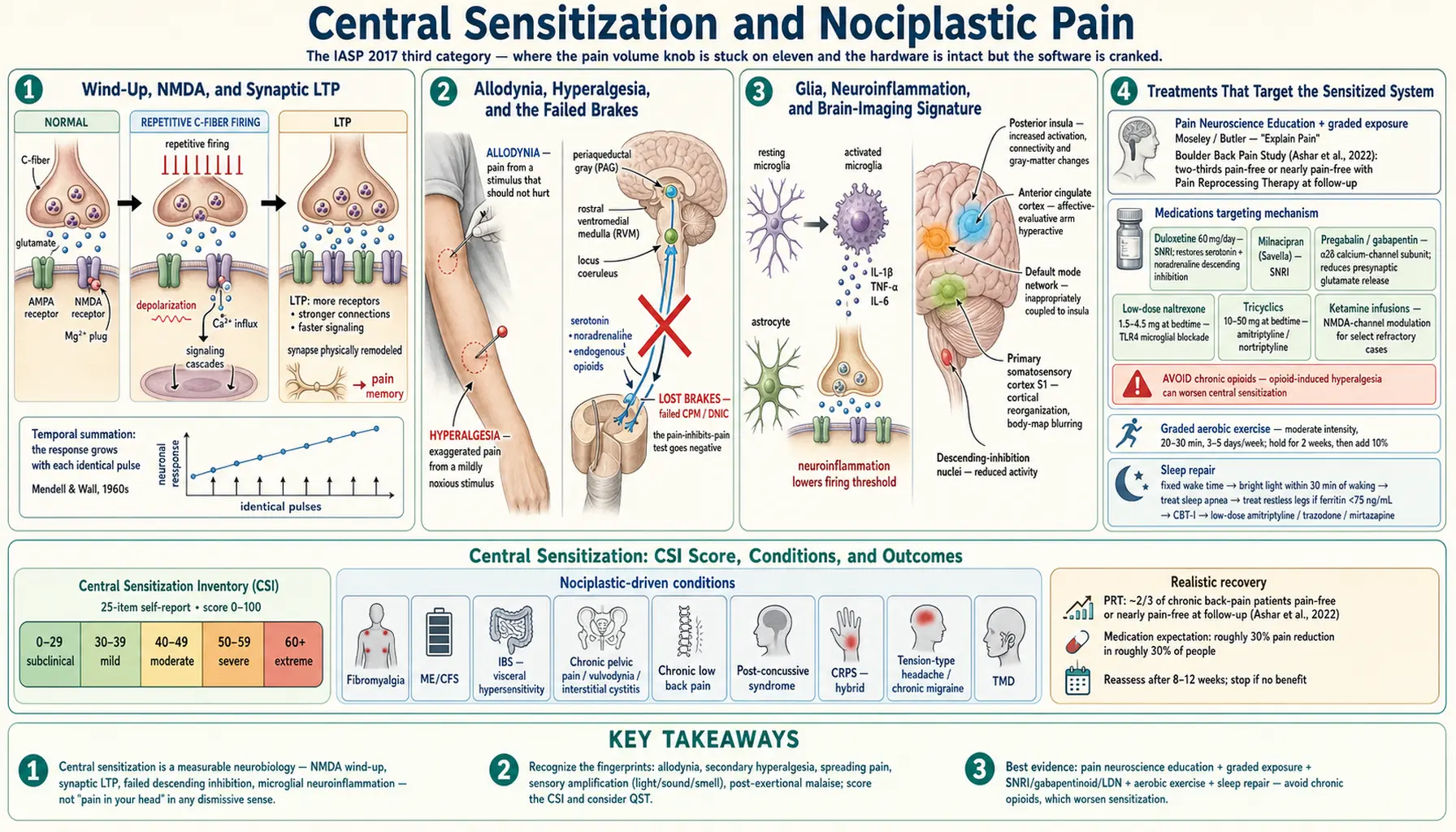
Table of Contents
- What Central Sensitization Actually Is
- Wind-Up, NMDA, and Temporal Summation
- Long-Term Potentiation of Pain Synapses
- Allodynia and Hyperalgesia — The Tell-Tale Signs
- Lost Brakes: Descending Inhibition and CPM
- Glia, Microglia, and Neuroinflammation
- Conditions Driven by Central Sensitization
- Measuring It: CSI and Quantitative Sensory Testing
- What the Brain Scans Show
- Treatment 1 — Pain Neuroscience Education and Graded Exposure
- Treatment 2 — Medications That Calm the System
- Treatment 3 — Aerobic Exercise and Sleep Repair
- What Recovery Actually Looks Like
- Key Research Papers
- Connections
- Featured Videos
What Central Sensitization Actually Is
If you have been told your pain is "real but not from tissue damage," or that imaging keeps coming back unremarkable while you feel like you are on fire, you have probably run into the concept of central sensitization. This is not a vague hand-wave. It is a specific, well-documented change in how your spinal cord and brain process signals. The International Association for the Study of Pain (IASP) gave this kind of pain its own name in 2017: nociplastic pain. It sits alongside the two older categories — nociceptive pain (tissue injury) and neuropathic pain (nerve injury) — as a third mechanism.
The short version: your nervous system has learned to amplify danger signals. Inputs that used to be ignored or filtered out now get forwarded to conscious awareness as pain. Inputs that used to be mildly uncomfortable now feel excruciating. The hardware is intact. The software is cranked to maximum gain.
This matters because the treatments that work for a pulled muscle or a pinched nerve usually do not work here. No amount of anti-inflammatory medication fixes a volume knob that is stuck on eleven. You need different strategies — ones that target the processing itself.
Wind-Up, NMDA, and Temporal Summation
The foundational phenomenon in central sensitization is called wind-up, first described by Lorne Mendell and Patrick Wall in the 1960s. Here is how it works.
When a C-fiber (a small, slow pain nerve) fires repeatedly at a steady intensity — say, once per second — the second-order neuron in the dorsal horn of your spinal cord does not just respond steadily. Its response grows with each pulse. The tenth identical input produces a far larger signal than the first. This is temporal summation.
The molecular culprit is the NMDA receptor. Under normal conditions, NMDA receptors in the dorsal horn are plugged by a magnesium ion and largely silent. Ordinary pain signaling runs through AMPA receptors. But if C-fibers fire fast enough and long enough, the neuron depolarizes strongly enough to kick the magnesium out of the NMDA channel. Calcium floods in. Signaling cascades switch on. The neuron becomes hyper-responsive — not just for the duration of the input but for minutes, hours, and eventually, if the barrage continues, for months or years.
This is why chronic pain states often begin with a legitimate injury — surgery, a car accident, an infection, a bout of shingles — that lasts long enough to wind the spinal cord up. By the time the original tissue heals, the dorsal horn is stuck in amplification mode. The pain persists without the injury.
Long-Term Potentiation of Pain Synapses
Wind-up is the acute version. The chronic version borrows its machinery from the same brain system that stores memories: long-term potentiation (LTP). Pain-carrying synapses in the dorsal horn can undergo the same strengthening that happens when you learn a phone number or a piano piece. Once LTP sets in, the synapse is physically remodeled — more receptors, stronger connections, faster signaling.
In other words, your spinal cord has learned to be in pain. The learning is involuntary and nobody chose it, but it is a genuine form of neural plasticity. The good news hidden inside this grim fact: plasticity runs in both directions. What was learned can, with effort, be unlearned. That is the entire premise behind modern nociplastic-pain treatment.
Allodynia and Hyperalgesia — The Tell-Tale Signs
Two words describe the clinical face of central sensitization, and if you learn to recognize them in your own experience you will understand what your nervous system is doing.
- Allodynia — pain from a stimulus that should not hurt at all. A T-shirt seam feels like sandpaper. A gentle hug feels like bruising. A breeze across your arm burns. The sensory input is normal; the output is pain.
- Hyperalgesia — exaggerated pain from a stimulus that should hurt a little. A pinprick that would rate a 2/10 in most people rates a 7/10. A sore muscle feels like a torn one. The input is painful; the output is disproportionate.
Both can be primary (at the original injury site) or secondary (spreading outward into uninjured skin). Secondary hyperalgesia — a ring of tenderness around a wound, or tender spots far from any obvious cause — is the clearest clinical fingerprint of central sensitization. The original nerves in those tender zones are perfectly healthy. The spinal cord is the problem.
Other features that point toward a centralized pain picture:
- Pain that spreads over time rather than staying put.
- Pain that is worse with stress, poor sleep, and infections, and better with calm and rest.
- Non-painful amplifications: loud noises feel louder, bright lights feel brighter, smells feel stronger, emotions feel bigger. The whole sensory system is turned up, not just pain.
- Post-exertional malaise — mild activity today flares pain and fatigue for days.
- Pain that outlasts any plausible tissue cause.
Lost Brakes: Descending Inhibition and CPM
Your brain has a pain-damping system built in. Nuclei in the brainstem — the periaqueductal gray, the rostral ventromedial medulla, and the locus coeruleus — send fibers down the spinal cord that release serotonin, noradrenaline, and endogenous opioids onto dorsal-horn neurons. This is the descending inhibitory system. In healthy people, it filters a constant stream of noise out of the pain signal before it ever reaches consciousness.
In chronic nociplastic pain, these brakes fail. The classic way to test this in a clinic is a conditioned pain modulation (CPM) protocol, historically called diffuse noxious inhibitory control (DNIC). The examiner applies a mildly painful stimulus (say, a pressure on your thumb) and measures your threshold. Then they add a second, stronger noxious stimulus somewhere else on the body (often a cold-water bath for the other hand). In a healthy nervous system, the distant pain raises your thumb threshold — pain inhibits pain. In fibromyalgia, chronic low back pain, and many other central-sensitization states, CPM is weak or absent. The brakes are gone.
This finding matters practically because a medication that acts on descending inhibition — a serotonin-noradrenaline reuptake inhibitor such as duloxetine — is working at exactly the system that has failed. You are putting the brakes back in.
Glia, Microglia, and Neuroinflammation
For most of the twentieth century, pain research was a story about neurons. The last twenty years have rewritten the story. The glial cells — microglia, astrocytes — that were thought to be passive scaffolding turn out to be active participants.
When a nerve injury or prolonged nociceptive barrage hits the spinal cord, microglia switch on. They change shape, multiply, and start dumping inflammatory cytokines (IL-1 beta, TNF-alpha, IL-6) and chemokines into the synaptic cleft. These substances lower the firing threshold of nearby pain neurons, pull glutamate receptors to the surface, and strip away the mechanisms that normally shut signaling off. Astrocytes follow, often with a slower but longer-lasting inflammatory response.
This is why chronic pain has an inflammatory signature even when nothing in the peripheral tissue is inflamed. The inflammation is in the central nervous system itself — a process sometimes called neuroinflammation. It is also why drugs that target glial activation, such as low-dose naltrexone (LDN, typically 1.5–4.5 mg at bedtime), can produce pain relief that makes no sense if you are thinking only about neurons. LDN is believed to work in part by blocking toll-like receptor 4 (TLR4) on microglia, quieting the glial contribution to the sensitized state.
Conditions Driven by Central Sensitization
Once you have the framework, a long list of otherwise puzzling syndromes makes sense. They are not random. They share a mechanism.
- Fibromyalgia — the prototype. Widespread pain, fatigue, sleep disturbance, cognitive fog. Central sensitization is now considered the core mechanism. See fibromyalgia and the deep dive on central sensitization in fibromyalgia.
- Myalgic encephalomyelitis / chronic fatigue syndrome — overlaps massively with fibromyalgia and features post-exertional malaise, sensory amplification, and sleep fragmentation. See ME/CFS.
- Irritable bowel syndrome — visceral hypersensitivity is the gut version of central sensitization. A balloon inflated to a modest volume in the rectum triggers severe pain in IBS patients but not in controls. See visceral hypersensitivity and the brain-gut axis.
- Chronic pelvic pain, vulvodynia, interstitial cystitis — pelvic versions, often layered with pelvic-floor muscle guarding. See pelvic-floor therapy and central sensitization.
- Chronic low back pain — the majority of cases that outlast three months have a central-sensitization component, even when structural findings exist. See chronic low back pain.
- Post-concussive syndrome and chronic whiplash — a significant fraction of people whose symptoms fail to resolve over months have developed central sensitization on top of whatever initial injury occurred.
- Complex regional pain syndrome — hybrid, with neuropathic and nociplastic features. See CRPS.
- Tension-type headache and chronic migraine — central sensitization of trigeminal pathways is a major mechanism.
- Temporomandibular disorders — chronic TMD patients demonstrate reduced CPM and lowered pain thresholds across the whole body, not only in the jaw.
This is not a diagnosis of exclusion and it is not code for "we give up." It is a positive, mechanism-based label that points to specific treatments.
Measuring It: CSI and Quantitative Sensory Testing
Two tools are most commonly used to quantify central sensitization in clinic and research.
The Central Sensitization Inventory (CSI). A 25-item self-report questionnaire validated by Neblett and colleagues. Each item asks how often you experience symptoms such as widespread pain, fatigue, non-restorative sleep, heightened sensitivity to light or sound, jaw pain, memory problems, restless legs, and stress-triggered flare-ups. Scores range 0–100. Cutoffs:
- 0–29: subclinical
- 30–39: mild
- 40–49: moderate
- 50–59: severe
- 60+: extreme
A score above 40 on the CSI — particularly in someone with widespread pain and normal imaging — is a strong signal that central sensitization is a driver of the clinical picture. It does not replace a clinical evaluation, but it gives you and your clinician a number to track over time.
Quantitative sensory testing (QST). A structured set of bedside tests that a trained provider (often a physical therapist or pain specialist) can run in about thirty minutes. Typical components:
- Pressure pain thresholds using an algometer — measured at the site of pain and at distant "control" sites. In central sensitization, both are lowered.
- Temporal summation — repeated pinpricks at a steady intensity. A growing pain rating across the series indicates dorsal-horn wind-up.
- Conditioned pain modulation (CPM) — the pain-inhibits-pain test described above. Weak or absent CPM indicates failed descending inhibition.
- Thermal thresholds — cold and heat detection and pain thresholds on a controlled probe.
QST is not available at every clinic, but academic pain centers and many research-oriented physical-therapy practices offer it. You do not need a positive QST to get treatment, but it can be useful for patients whose pain has been dismissed — it provides objective evidence that something is wrong with how the nervous system processes input.
What the Brain Scans Show
Functional MRI and related imaging have mapped central sensitization onto specific brain networks. You will not get this imaging clinically — it is research-grade — but knowing what it shows helps you understand your own experience.
- Insula — the interoceptive hub that integrates signals from the body. The posterior insula, in particular, shows increased activation and altered connectivity in fibromyalgia and chronic pain states. Patients have more insular gray-matter changes, and those changes correlate with symptom severity.
- Anterior cingulate cortex — the affective-evaluative arm of pain ("how bad is this? do I care?") Hyperactive in chronic pain.
- Default mode network (DMN) — the set of regions active when you are at rest, ruminating, mind-wandering. In chronic pain, the DMN intrudes into pain processing even during task performance. The insula becomes inappropriately coupled to the DMN, which may be the neural basis for pain-preoccupation and rumination.
- Primary somatosensory cortex (S1) — shows reorganization, with the cortical representation of painful body areas blurring into neighboring zones. This cortical blurring is thought to underlie some of the spread of pain across body regions.
- Descending-inhibition nuclei — reduced activity in the periaqueductal gray and rostral ventromedial medulla mirrors the weak CPM seen behaviorally.
The crucial point: none of these findings means your pain is "in your head" in the dismissive sense. The changes are physical, measurable, and located in the same nervous system that registers every other bodily signal. Pain is always a brain output, whether the driver is a broken bone or a sensitized dorsal horn.
Treatment 1 — Pain Neuroscience Education and Graded Exposure
The single most well-evidenced intervention for nociplastic pain is, counter-intuitively, education. Not the "drink more water and stretch" kind. Pain Neuroscience Education (PNE, sometimes called Explain Pain) teaches patients the biology of central sensitization — NMDA wind-up, glial activation, failed descending inhibition, LTP. The working premise: understanding that your nervous system has learned to amplify danger signals, and that learning can be unlearned, measurably reduces pain and disability.
Randomized trials — including work by Louw, Moseley, and Butler — show that PNE plus physiotherapy produces larger improvements in pain, disability, catastrophizing, and fear-avoidance than physiotherapy alone, and the effects persist at one-year follow-up. This article itself is, in a small way, doing PNE.
Once you understand the mechanism, the behavioral corollary is graded exposure — gradually and systematically returning to movements and activities that have become pain-associated. A classic fear-avoidance cycle: bending hurt once, so bending became scary, so bending was avoided, so the nervous system flagged bending as dangerous, so bending hurt more when tried. Graded exposure reverses this in tiny, planned increments. The body learns that bending is safe. The sensitized system turns its volume down.
This is the foundation for a family of modern talk-based therapies, including Pain Reprocessing Therapy and PNE. The Boulder Back Pain Study (Ashar et al., 2022) found that two-thirds of chronic back pain patients treated with PRT were pain-free or nearly pain-free at follow-up — a result unheard of in chronic pain.
Treatment 2 — Medications That Calm the System
Medications that work in nociplastic pain target the specific mechanisms above. None are miracle drugs. Expect roughly 30% pain reduction in roughly 30% of people — worth trying, worth stopping if no benefit appears in eight to twelve weeks.
- Duloxetine (Cymbalta). SNRI that boosts serotonin and noradrenaline, the main descending-inhibition neurotransmitters. FDA-approved for fibromyalgia, diabetic neuropathy, and chronic musculoskeletal pain. Typical target dose 60 mg/day, sometimes 120 mg. Start low (20–30 mg) for a week to minimize nausea.
- Milnacipran (Savella). Another SNRI with a stronger noradrenaline profile, FDA-approved specifically for fibromyalgia. Often tried when duloxetine fails.
- Pregabalin (Lyrica) and gabapentin. Bind the alpha-2-delta subunit of calcium channels in presynaptic dorsal-horn terminals, reducing glutamate release onto the sensitized second-order neuron. Pregabalin is FDA-approved for fibromyalgia; gabapentin is used off-label. Watch for sedation, weight gain, and edema.
- Low-dose naltrexone (LDN). Typically 1.5–4.5 mg at bedtime — a tiny fraction of the addiction-medicine dose. Proposed to act by blocking TLR4 on microglia, calming neuroinflammation. Small RCTs in fibromyalgia (Younger lab, Stanford) show meaningful pain reduction with few side effects. Must be compounded — no standard pharmacy stocks the microdose.
- Tricyclic antidepressants (amitriptyline, nortriptyline) at low bedtime doses (10–50 mg). Older, cheap, effective in fibromyalgia and chronic tension headache, work partly through descending inhibition and partly through sleep depth.
- NMDA-channel modulators — ketamine infusions and, less commonly, dextromethorphan or memantine. Directly target the receptor at the heart of wind-up. Ketamine is effective for select refractory cases but requires specialty infusion centers and has limited durability.
What does not work well in pure nociplastic pain: NSAIDs, acetaminophen beyond minor benefit, and chronic opioids. Opioids are particularly risky in this population because they can induce their own form of central sensitization (opioid-induced hyperalgesia), worsening the underlying problem. See opioids for chronic non-cancer pain for the full discussion.
Treatment 3 — Aerobic Exercise and Sleep Repair
Two non-drug interventions have the best evidence base in nociplastic pain, and they are both hard to do when you feel terrible.
Graded aerobic exercise. In fibromyalgia and chronic widespread pain, aerobic training — walking, cycling, swimming, water aerobics — performed at moderate intensity for 20–30 minutes, three to five days a week, reliably reduces pain and improves function. The key word is graded. Start at a level you can sustain today without a flare tomorrow, hold it for two weeks, then add 10%. If you crash, step back to the last tolerated level and hold there longer. Many patients need to start at five minutes of slow walking. That is fine. The goal is to teach the nervous system that movement is safe, and the dose that accomplishes this grows over months. See sleep, exercise, and lifestyle.
Sleep repair. Non-restorative sleep is both a symptom of central sensitization and a driver of it. A single night of disrupted sleep measurably lowers pain thresholds in healthy controls the next day. Chronic sleep fragmentation inflames microglia and feeds the sensitization loop. Practical priorities, in order of impact:
- Anchor a fixed wake time, even on weekends.
- Get bright light in your eyes within thirty minutes of waking.
- Avoid screens and alcohol in the two hours before bed.
- Treat obstructive sleep apnea if present — get a sleep study if you snore, gasp, or wake unrefreshed.
- Treat restless legs (ferritin below 75 ng/mL is a common missed cause; iron repletion often fixes it).
- Consider low-dose amitriptyline, trazodone, or mirtazapine for sleep consolidation if lifestyle measures fail.
Cognitive behavioral therapy for insomnia (CBT-I) is more effective than any sleeping pill and does not lose effect over time. Most major U.S. cities now have CBT-I providers, and several free apps (CBT-i Coach from the VA, for example) deliver the program.
What Recovery Actually Looks Like
Recovery from central sensitization is not a linear curve. It is a series of two-steps-forward, one-step-back oscillations over months to years. A few realistic points that most patients wish they had been told early:
- Full remission is possible. Studies of PRT and graded exposure show a substantial minority of patients become essentially pain-free. Many more reach a level where pain is present but no longer dominates life.
- Flares do not mean failure. A sensitized nervous system responds to stress, illness, and life events by re-amplifying for days or weeks. That is the system doing what it learned to do. It does not erase progress.
- Checking in on pain less often makes it better. Constant body scanning feeds the default mode network's intrusion into pain processing. Setting your phone down, returning to work and hobbies, and letting attention drift elsewhere are treatments.
- Multiple therapies together beat any single one. Medication + aerobic exercise + sleep repair + PNE + graded exposure outperforms any one component. Most pain clinics that publish good outcomes run exactly this stack.
- You are not imagining it and you did not cause it. The nervous system changed. Nervous systems can change back. That is the whole story.
Key Research Papers
- Woolf CJ. Central sensitization: implications for the diagnosis and treatment of pain. Pain. 2011;152(3 Suppl):S2–S15.
- Kosek E, et al. Chronic nociplastic pain affecting the musculoskeletal system: clinical criteria and grading system. Pain. 2021.
- Ashar YK, et al. Effect of Pain Reprocessing Therapy vs placebo and usual care on chronic back pain: a randomized clinical trial. JAMA Psychiatry. 2022.
- Neblett R, et al. The Central Sensitization Inventory (CSI): establishing clinically significant values. J Pain. 2013.
- Younger J, Noor N, McCue R, Mackey S. Low-dose naltrexone for the treatment of fibromyalgia: randomized, double-blind, placebo-controlled, counterbalanced, crossover trial. Arthritis Rheum. 2013.
- Ji RR, Nackley A, Huh Y, Terrando N, Maixner W. Neuroinflammation and central sensitization in chronic and widespread pain. Anesthesiology. 2018.
- Louw A, Diener I, Butler DS, Puentedura EJ. The effect of neuroscience education on pain, disability, anxiety, and stress in chronic musculoskeletal pain. Arch Phys Med Rehabil. 2011.
Live PubMed Searches
For further reading, these PubMed topic searches return current peer-reviewed work on the mechanisms and management of central sensitization and nociplastic pain:
- Central sensitization and chronic pain
- Nociplastic pain — clinical criteria and mechanisms
- NMDA wind-up and dorsal-horn temporal summation
- Conditioned pain modulation in fibromyalgia
- Microglia, neuroinflammation, and chronic pain
- Central Sensitization Inventory validation studies
- Pain neuroscience education outcomes
- Low-dose naltrexone in fibromyalgia
- Duloxetine and milnacipran in centralized pain
- Default mode network and chronic pain
Connections
- Pain & Allergy
- Chronic Low Back Pain
- Fibromyalgia
- Complex Regional Pain Syndrome
- Pain Reprocessing Therapy
- Opioids for Chronic Pain
- Chronic Fatigue Syndrome
- Non-Opioid Medications
- Sleep and Lifestyle for Chronic Pain
- Central Sensitization Explained
- Pelvic Floor Therapy and Central Sensitization
- Visceral Hypersensitivity and Brain-Gut Axis
- Chronic Pain Overview
- Interventional Pain
- Pain Mechanisms
- Peripheral Neuropathy
- Migraine