Leukemia
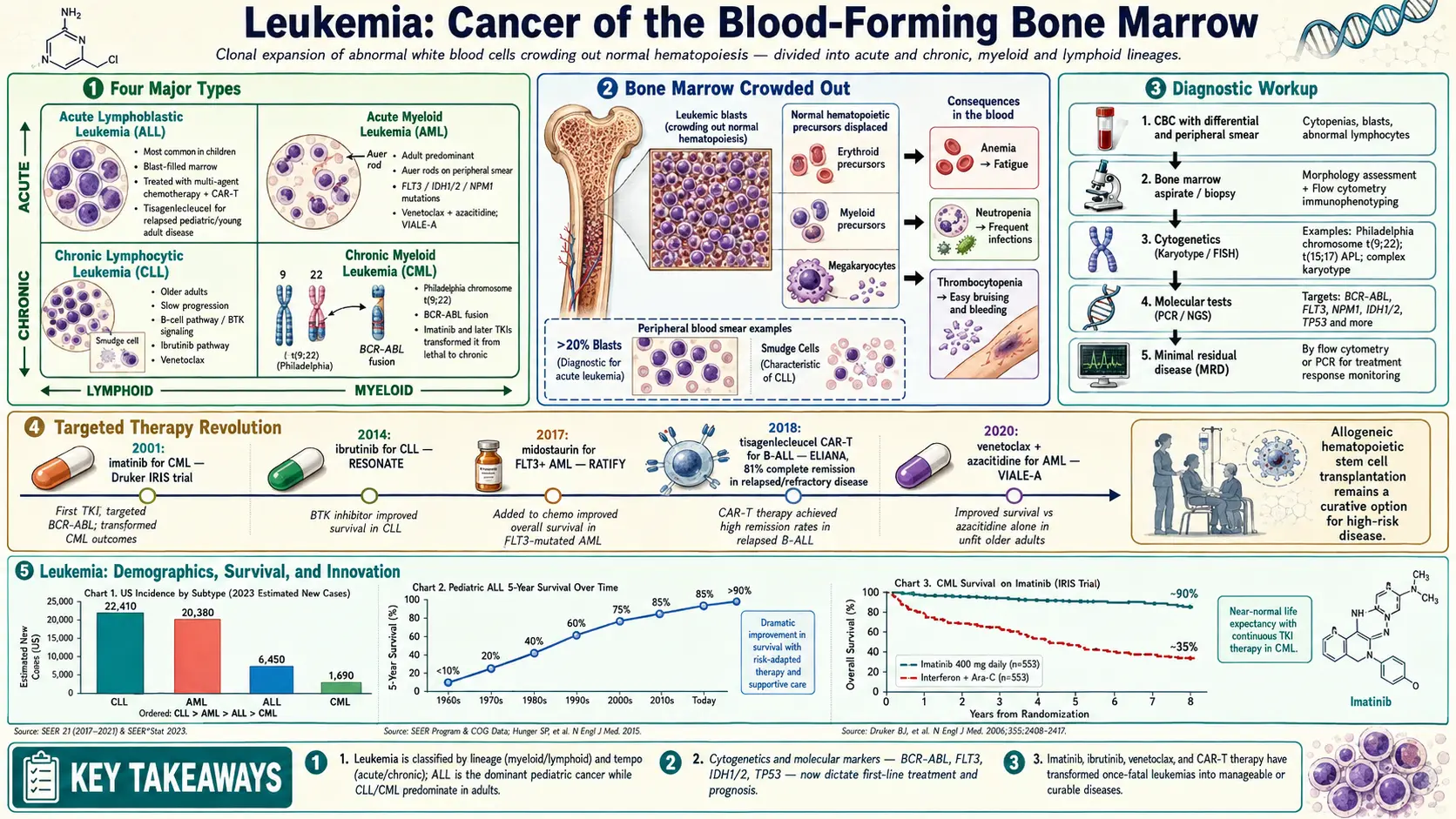
Table of Contents
- What is Leukemia?
- Types of Leukemia
- Causes and Risk Factors
- Symptoms of Leukemia
- Diagnosis and Treatment
- Prognosis
- Research Papers
- Connections
- Featured Videos
What is Leukemia?
Leukemia is a type of cancer that originates in the blood-forming tissues, such as the bone marrow and lymphatic system. It results in the excessive production of abnormal white blood cells, which impairs the body’s ability to fight infections.
Types of Leukemia
1. Acute Leukemia
- Acute Lymphocytic Leukemia (ALL): Most common in children but can occur in adults.
- Acute Myeloid Leukemia (AML): Affects adults more frequently but can occur in children as well.
2. Chronic Leukemia
- Chronic Lymphocytic Leukemia (CLL): Common in older adults and may progress slowly over years.
- Chronic Myeloid Leukemia (CML): Typically affects adults and may have a slow progression before accelerating.
Causes and Risk Factors
The exact cause of leukemia is not known, but several risk factors have been identified:
- Genetic mutations: Certain genetic disorders like Down syndrome can increase risk.
- Exposure to radiation: High levels of radiation, such as from radiation therapy or nuclear exposure, can contribute.
- Family history: A history of leukemia in the family can increase risk.
- Previous cancer treatment: Chemotherapy and radiation therapy for other cancers can be a risk factor.
- Exposure to chemicals: Prolonged exposure to chemicals like benzene is linked to a higher risk of leukemia.
Symptoms of Leukemia
Common symptoms include:
- Fatigue and weakness
- Frequent or severe infections
- Unexplained weight loss
- Easy bruising or bleeding
- Swollen lymph nodes
- Pain or tenderness in the bones
- Fever or night sweats
Diagnosis and Treatment
Diagnosis
Diagnosis of leukemia involves several tests and procedures, including:
- Blood tests: To check for abnormal levels of white blood cells, red blood cells, or platelets.
- Bone marrow biopsy: A sample of bone marrow is taken to identify leukemia cells.
- Genetic tests: To detect specific mutations related to leukemia.
Treatment Options
Common treatment methods include:
- Chemotherapy: The primary treatment, which involves using drugs to destroy leukemia cells.
- Radiation therapy: Uses high-energy radiation to target and kill cancer cells.
- Stem cell transplant: Replaces diseased bone marrow with healthy stem cells.
- Targeted therapy: Drugs that specifically target the abnormalities in cancer cells.
- Immunotherapy: Boosts the body's natural defenses to fight cancer cells.
Prognosis
The prognosis for leukemia varies based on factors such as the type of leukemia, patient’s age, and overall health. Early detection and advances in treatment have significantly improved outcomes for many patients.
References & Research
Historical Background
Leukemia was first described independently by physicians Rudolf Virchow in Germany and John Hughes Bennett in Scotland in 1845. Virchow coined the term "leukemia" (from the Greek "leukos" meaning white and "haima" meaning blood) after observing the abnormal excess of white blood cells. Sidney Farber’s pioneering use of aminopterin in 1947 to achieve the first remission in childhood leukemia marked the dawn of modern chemotherapy.
Key Research Papers
- Kantarjian HM, DeAngelo DJ, Stelljes M, et al. Inotuzumab ozogamicin versus standard therapy for acute lymphoblastic leukemia (INO-VATE ALL). N Engl J Med. 2016;375(8):740-753.
- Maude SL, Laetsch TW, Buechner J, et al. Tisagenlecleucel in children and young adults with B-cell lymphoblastic leukemia (ELIANA). N Engl J Med. 2018;378(5):439-448.
- Druker BJ, Guilhot F, O’Brien SG, et al. Five-year follow-up of patients receiving imatinib for chronic myeloid leukemia (IRIS trial). N Engl J Med. 2006;355(23):2408-2417.
- Byrd JC, Brown JR, O’Brien S, et al. Ibrutinib versus ofatumumab in previously treated chronic lymphocytic leukemia (RESONATE). N Engl J Med. 2014;371(3):213-223.
- DiNardo CD, Stein EM, de Botton S, et al. Durable remissions with ivosidenib in IDH1-mutated relapsed or refractory AML. N Engl J Med. 2018;378(25):2386-2398.
- Döhner H, Estey E, Grimwade D, et al. Diagnosis and management of AML in adults: 2017 ELN recommendations. Blood. 2017;129(4):424-447.
- Hunger SP, Mullighan CG. Acute lymphoblastic leukemia in children. N Engl J Med. 2015;373(16):1541-1552.
- Hallek M, Cheson BD, Catovsky D, et al. iwCLL guidelines for diagnosis, indications for treatment, response assessment, and supportive management of CLL. Blood. 2018;131(25):2745-2760.
- Hochhaus A, Baccarani M, Silver RT, et al. European LeukemiaNet 2020 recommendations for treating chronic myeloid leukemia. Leukemia. 2020;34(4):966-984.
- Stone RM, Mandrekar SJ, Sanford BL, et al. Midostaurin plus chemotherapy for acute myeloid leukemia with a FLT3 mutation (RATIFY). N Engl J Med. 2017;377(5):454-464.
- Pui CH, Yang JJ, Hunger SP, et al. Childhood acute lymphoblastic leukemia: progress through collaboration. J Clin Oncol. 2015;33(27):2938-2948.
- Wei AH, Montesinos P, Ivanov V, et al. Venetoclax plus LDAC for newly diagnosed AML ineligible for intensive chemotherapy (VIALE-C). J Clin Oncol. 2020;38(31):3603-3615.
Research Papers
The following PubMed topic searches surface the current peer-reviewed literature on Leukemia. Each link opens a live PubMed query; results update as new papers are indexed.
- PubMed search: leukemia
- PubMed search: acute myeloid leukemia
- PubMed search: acute lymphoblastic leukemia
- PubMed search: chronic lymphocytic leukemia
- PubMed search: chronic myeloid leukemia
- PubMed search: leukemia imatinib tyrosine kinase inhibitor
- PubMed search: leukemia allogeneic stem cell transplantation
- PubMed search: leukemia CAR T cell therapy
- PubMed search: leukemia FLT3 inhibitor
- PubMed search: leukemia venetoclax
- PubMed search: leukemia minimal residual disease
- PubMed search: pediatric leukemia
Connections
- Oncology
- Cancer Overview
- Lymphoma
- Multiple Myeloma
- Metastatic Cancers
- Chronic Myeloid Leukemia (CML)
- Anemia
- Vitamin B9 (Folate)
- Vitamin D3
- Turmeric
- Reishi Mushroom
- Turkey Tail Mushroom
- Gerson Therapy Cancer Treatment
- Complete Blood Count
- Sarcoma
- Fatigue
- Pesticides
- Thrombocytopenia
- Disseminated Intravascular Coagulation
- Sodium Benzoate
- Acute Myeloid Leukemia (AML) — most common acute leukemia in adults.
- Acute Lymphoblastic Leukemia (ALL) — the most common leukemia of childhood.
- Hairy Cell Leukemia (HCL) — rare indolent B-cell leukemia with decade-long remissions after one week of cladribine.
- Bishop & Varmus: the oncogene discovery behind imatinib — how understanding BCR-ABL turned chronic myeloid leukaemia from a fatal disease into a managed one
- Fischer & Krebs — reversible phosphorylation — why a kinase inhibitor works at all