Sarcoma
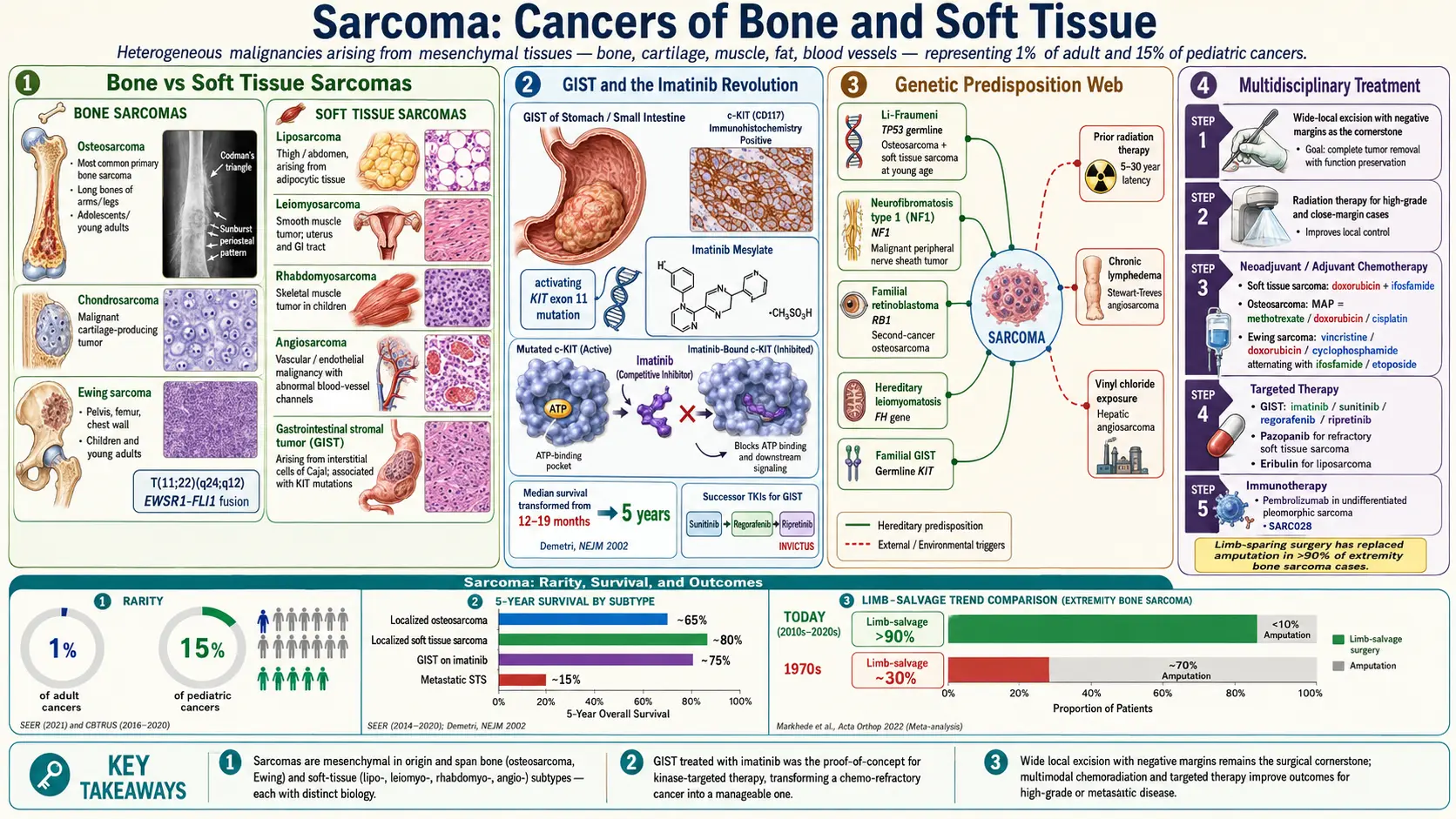
Table of Contents
- What is Sarcoma?
- Types of Sarcoma
- Causes and Risk Factors
- Symptoms of Sarcoma
- Diagnosis and Staging
- Treatment Options
- Prognosis
- Research Papers
- Connections
- Featured Videos
What is Sarcoma?
Sarcoma is a type of cancer that originates in the body's connective tissues, such as bones, muscles, fat, cartilage, and blood vessels. It can occur in any part of the body but is most commonly found in the arms, legs, and abdomen.
Types of Sarcoma
1. Bone Sarcoma
- Osteosarcoma: The most common type of bone cancer, usually occurring in the long bones of the arms and legs.
- Ewing Sarcoma: Often found in the pelvis, legs, or chest wall, more common in children and young adults.
2. Soft Tissue Sarcoma
- Liposarcoma: Develops in fat tissues, often in the thigh or abdomen.
- Leiomyosarcoma: Originates in smooth muscles, such as those in the uterus or digestive tract.
- Rhabdomyosarcoma: Affects skeletal muscle tissues and is more common in children.
- Angiosarcoma: Develops in the lining of blood or lymph vessels.
Causes and Risk Factors
The exact cause of sarcoma is unknown, but there are several risk factors:
- Genetic disorders: Conditions like Li-Fraumeni syndrome, neurofibromatosis, and retinoblastoma increase the risk.
- Radiation exposure: Previous radiation therapy for cancer can increase the risk of developing sarcoma.
- Chronic lymphedema: Prolonged swelling due to lymph fluid buildup may increase the risk of angiosarcoma.
- Chemical exposure: Contact with certain chemicals, such as dioxins or herbicides, may increase the risk.
- Age: Although sarcomas can occur at any age, certain types are more common in children, while others occur more frequently in adults.
Symptoms of Sarcoma
Symptoms of sarcoma vary depending on the location and type, but common signs include:
- Noticeable lump under the skin, which may or may not be painful
- Swelling and tenderness in the affected area
- Bone pain, particularly at night or during activity
- Unexplained weight loss
- Limited range of motion if near joints
Diagnosis and Staging
Diagnostic Tests
To diagnose sarcoma, doctors may use the following tests:
- Physical examination: To identify lumps and swelling.
- Imaging tests: Such as X-rays, MRI, CT scans, or PET scans to visualize the tumor.
- Biopsy: A sample of tissue is taken to confirm the diagnosis and identify the type of sarcoma.
Staging
The staging of sarcoma depends on the size, location, and spread of the tumor:
- Stage I: Low-grade tumor, confined to the original site.
- Stage II: High-grade tumor, confined but more aggressive.
- Stage III: High-grade tumor that may have spread to nearby lymph nodes.
- Stage IV: Tumor that has spread to distant parts of the body (metastasis).
Treatment Options
Treatment depends on the type, location, and stage of the sarcoma:
- Surgery: The primary treatment to remove the tumor, often with some surrounding healthy tissue to ensure complete removal.
- Radiation therapy: Used before or after surgery to shrink the tumor or kill remaining cancer cells.
- Chemotherapy: May be used for certain types of sarcoma, such as Ewing sarcoma or high-grade soft tissue sarcomas.
- Targeted therapy: Drugs that specifically target cancer cell mutations.
- Immunotherapy: Stimulates the body’s immune system to fight cancer cells.
Prognosis
The prognosis for sarcoma depends on various factors, including the type, stage at diagnosis, and response to treatment. Early detection and treatment can improve the chances of a positive outcome, especially for low-grade and localized sarcomas.
References & Research
Historical Background
The term "sarcoma" was coined by English surgeon John Abernethy in 1804, deriving from the Greek "sarx" (flesh). James Ewing described Ewing sarcoma in 1921, distinguishing it from other bone tumors. Major advances in sarcoma treatment came in the 1970s when Norman Jaffe and Gerald Rosen demonstrated that adjuvant chemotherapy dramatically improved survival in osteosarcoma, transforming it from a nearly uniformly fatal disease to one with a majority survival rate.
Key Research Papers
- Gronchi A, Miah AB, Dei Tos AP, et al. Soft tissue and visceral sarcomas: ESMO-EURACAN-GENTURIS Clinical Practice Guidelines. Ann Oncol. 2021;32(11):1348-1365.
- Tap WD, Jones RL, Van Tine BA, et al. Olaratumab and doxorubicin versus doxorubicin alone for treatment of soft-tissue sarcoma. The Lancet. 2016;388(10043):488-497.
- Casali PG, Abecassis N, Aro HT, et al. Soft tissue and visceral sarcomas: ESMO Clinical Practice Guidelines. Ann Oncol. 2018;29(Suppl 4):iv51-iv67.
- Demetri GD, von Mehren M, Blanke CD, et al. Efficacy and safety of imatinib mesylate in advanced gastrointestinal stromal tumours. N Engl J Med. 2002;347(7):472-480.
- Fletcher CDM, Bridge JA, Hogendoorn PCW, Mertens F (eds). WHO Classification of Tumours of Soft Tissue and Bone (4th edition). Lyon: IARC Press. 2013.
- Gaspar N, Hawkins DS, Dirksen U, et al. Ewing sarcoma: current management and future approaches. J Clin Oncol. 2015;33(27):3036-3046.
- Pisters PW, Leung DH, Woodruff J, et al. Analysis of prognostic factors in 1,041 patients with localized soft tissue sarcomas of the extremities. J Clin Oncol. 1996;14(5):1679-1689.
- Stacchiotti S, Sommer J. Building a global consensus approach to chordoma: a position paper. Lancet Oncol. 2015;16(2):e71-e83.
- Tawbi HA, Burgess M, Bolejack V, et al. Pembrolizumab in advanced soft-tissue sarcoma and bone sarcoma (SARC028). Lancet Oncol. 2017;18(11):1493-1501.
- Schöffski P, Chawla S, Maki RG, et al. Eribulin versus dacarbazine in previously treated patients with advanced liposarcoma or leiomyosarcoma. The Lancet. 2016;387(10028):1629-1637.
- Blay JY, Serrano C, Heinrich MC, et al. Ripretinib in patients with advanced gastrointestinal stromal tumours (INVICTUS). The Lancet. 2020;395(10229):1045-1057.
- Burningham Z, Hashibe M, Spector L, Schiffman JD. The epidemiology of sarcoma. Clin Sarcoma Res. 2012;2(1):14.
Research Papers
The following PubMed topic searches surface the current peer-reviewed literature on Sarcoma. Each link opens a live PubMed query; results update as new papers are indexed.
- PubMed search: sarcoma
- PubMed search: soft tissue sarcoma
- PubMed search: osteosarcoma
- PubMed search: Ewing sarcoma
- PubMed search: leiomyosarcoma
- PubMed search: liposarcoma
- PubMed search: gastrointestinal stromal tumor GIST imatinib
- PubMed search: sarcoma chemotherapy doxorubicin
- PubMed search: sarcoma surgical resection margins
- PubMed search: sarcoma radiation therapy
- PubMed search: rhabdomyosarcoma pediatric
- PubMed search: sarcoma pazopanib
Connections
- Oncology
- Cancer Overview
- Soft Tissue Sarcoma
- Leukemia
- Lymphoma
- Metastatic Cancers
- Multiple Myeloma
- Thyroid Cancer
- Vitamin D3
- Turmeric
- Osteoporosis
- Gerson Therapy Cancer Treatment
- Dioxins
- Pleural Effusion
- Ewing Sarcoma