Lymphoma
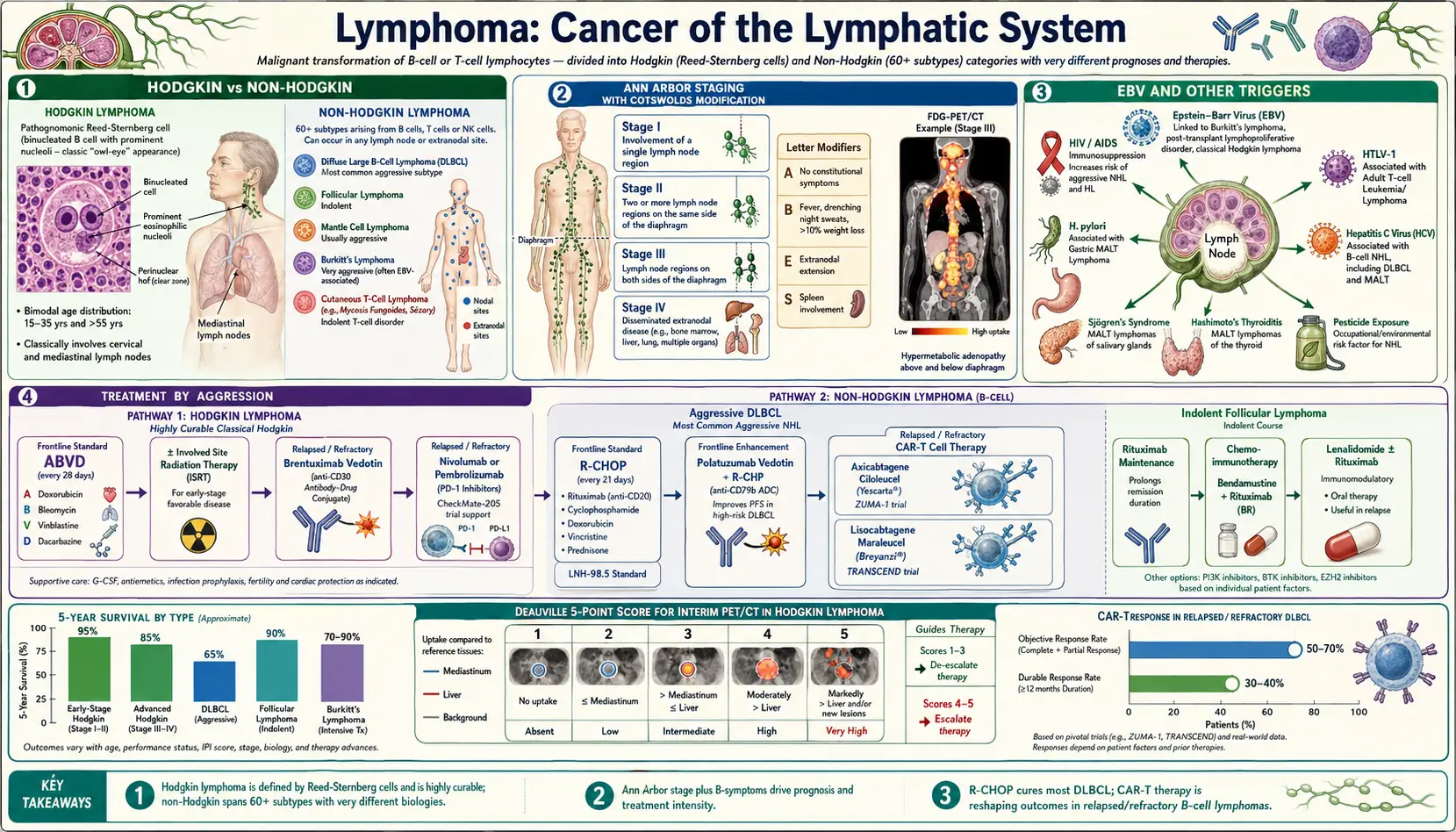
Table of Contents
- What is Lymphoma?
- Types of Lymphoma
- Causes and Risk Factors
- Symptoms of Lymphoma
- Diagnosis and Treatment
- Prognosis
- Research Papers
- Connections
- Featured Videos
What is Lymphoma?
Lymphoma is a type of cancer that begins in the lymphatic system, which is part of the body's immune system. It affects lymphocytes, a type of white blood cell that helps the body fight infections.
Types of Lymphoma
1. Hodgkin Lymphoma (HL)
- Distinctive feature: Presence of Reed-Sternberg cells, which are large, abnormal cells.
- Commonly affects: Often seen in young adults and those over 55.
2. Non-Hodgkin Lymphoma (NHL)
- Varied subtypes: Includes several different subtypes based on the specific type of lymphocyte affected (B cells or T cells).
- Commonly affects: More common than Hodgkin lymphoma and can occur at any age.
Causes and Risk Factors
The exact cause of lymphoma is not fully understood, but certain risk factors have been identified:
- Weakened immune system: Individuals with weakened immune systems, such as those with HIV/AIDS or on immunosuppressant drugs, are at higher risk.
- Infections: Certain infections like Epstein-Barr virus (EBV) and human T-cell leukemia/lymphoma virus (HTLV) are linked to higher risk.
- Age: Hodgkin lymphoma is more common in young adults and older individuals, while non-Hodgkin lymphoma risk increases with age.
- Gender: Some types of lymphoma are more common in men than women.
- Family history: A family history of lymphoma can increase the risk.
Symptoms of Lymphoma
Common signs and symptoms include:
- Swollen lymph nodes: Often in the neck, armpits, or groin.
- Persistent fatigue
- Unexplained weight loss
- Fever and night sweats
- Itchy skin
- Shortness of breath or coughing
Diagnosis and Treatment
Diagnosis
Diagnosing lymphoma involves a variety of tests and procedures:
- Physical examination: To check for swollen lymph nodes or spleen.
- Biopsy: A sample of lymph node tissue is examined for cancer cells.
- Imaging tests: Such as CT, MRI, or PET scans to identify affected areas.
- Blood tests: To check for abnormal levels of cells or markers.
Treatment Options
Treatment depends on the type and stage of lymphoma and may include:
- Chemotherapy: The main treatment, using drugs to kill cancer cells.
- Radiation therapy: Often used in early-stage Hodgkin lymphoma or combined with chemotherapy.
- Immunotherapy: Utilizes the body's immune system to target cancer cells.
- Targeted therapy: Drugs designed to target specific abnormalities in cancer cells.
- Stem cell transplant: Replaces damaged bone marrow with healthy stem cells, often used for aggressive types or relapsed lymphoma.
Prognosis
The prognosis for lymphoma varies based on factors such as the type (Hodgkin or non-Hodgkin), stage at diagnosis, and the patient’s overall health. Advances in treatment have significantly improved survival rates for many forms of lymphoma.
References & Research
Historical Background
Hodgkin lymphoma was first described by English physician Thomas Hodgkin in 1832, who identified the distinctive pattern of lymph node enlargement in autopsy specimens. The identification of Reed-Sternberg cells by Dorothy Reed and Carl Sternberg around 1900 provided the histological hallmark of Hodgkin disease. Non-Hodgkin lymphomas were later classified as a separate group, with Henry Rappaport’s classification system in 1966 being an early milestone.
Key Research Papers
- Younes A, Gopal AK, Smith SE, et al. Results of a pivotal phase II study of brentuximab vedotin for patients with relapsed or refractory Hodgkin’s lymphoma. J Clin Oncol. 2012;30(18):2183-2189.
- Schmitz R, Wright GW, Huang DW, et al. Genetics and pathogenesis of diffuse large B-cell lymphoma. N Engl J Med. 2018;378(15):1396-1407.
- Neelapu SS, Locke FL, Bartlett NL, et al. Axicabtagene ciloleucel CAR T-cell therapy in refractory large B-cell lymphoma (ZUMA-1). N Engl J Med. 2017;377(26):2531-2544.
- Shanbhag S, Ambinder RF. Hodgkin lymphoma: a review and update on recent progress. CA Cancer J Clin. 2018;68(2):116-132.
- Ansell SM, Lesokhin AM, Borrello I, et al. PD-1 blockade with nivolumab in relapsed or refractory Hodgkin’s lymphoma. N Engl J Med. 2015;372(4):311-319.
- Coiffier B, Thieblemont C, Van Den Neste E, et al. Long-term outcome of patients in the LNH-98.5 trial, the first randomized study comparing R-CHOP to standard CHOP in DLBCL. Blood. 2010;116(12):2040-2045.
- Swerdlow SH, Campo E, Pileri SA, et al. The 2016 revision of the World Health Organization classification of lymphoid neoplasms. Blood. 2016;127(20):2375-2390.
- Younes A, Santoro A, Shipp M, et al. Nivolumab for classical Hodgkin’s lymphoma after failure of both autologous stem-cell transplantation and brentuximab vedotin (CheckMate 205). J Clin Oncol. 2016;34(31):3733-3739.
- A predictive model for aggressive non-Hodgkin’s lymphoma. International Non-Hodgkin’s Lymphoma Prognostic Factors Project. N Engl J Med. 1993;329(14):987-994.
- Sehn LH, Gascoyne RD. Diffuse large B-cell lymphoma: optimizing outcome in the context of clinical and biologic heterogeneity. Blood. 2015;125(1):22-32.
- Armitage JO, Gascoyne RD, Lunning MA, Cavalli F. Non-Hodgkin lymphoma. The Lancet. 2017;390(10091):298-310.
- Abramson JS, Palomba ML, Gordon LI, et al. Lisocabtagene maraleucel for relapsed or refractory large B-cell lymphoma (TRANSCEND NHL 001). The Lancet. 2020;396(10254):839-852.
Research Papers
The following PubMed topic searches surface the current peer-reviewed literature on Lymphoma. Each link opens a live PubMed query; results update as new papers are indexed.
- PubMed search: lymphoma
- PubMed search: Hodgkin lymphoma
- PubMed search: non Hodgkin lymphoma
- PubMed search: diffuse large B cell lymphoma
- PubMed search: follicular lymphoma
- PubMed search: mantle cell lymphoma
- PubMed search: lymphoma rituximab
- PubMed search: lymphoma CAR T cell therapy
- PubMed search: lymphoma PET CT staging
- PubMed search: lymphoma Ann Arbor staging
- PubMed search: lymphoma checkpoint inhibitor
- PubMed search: cutaneous T cell lymphoma
Connections
- Oncology
- Cancer Overview
- Leukemia
- Multiple Myeloma
- Metastatic Cancers
- Turmeric
- Vitamin D3
- Anemia
- Reishi Mushroom
- Turkey Tail Mushroom
- Gerson Therapy Cancer Treatment
- Complete Blood Count
- Thyroid Disorders
- Sarcoma
- Fatigue
- Shortness of Breath
- Pesticides
- Sjogrens Syndrome
- Silver Nanoparticles
- Mononucleosis
- Non-Hodgkin Lymphoma — the largest lymphoma group, over 60 distinct subtypes.
- Primary CNS Lymphoma (PCNSL) — the rare form confined to the brain, spinal cord and eyes.
- Cryoglobulinemia — chronic clonal B-cell expansion that can progress to frank B-cell lymphoma.
- Hodgkin Lymphoma — the Reed-Sternberg-cell subtype with a bimodal age peak and cure rates above 85% in early-stage disease.
- Cold Agglutinin Disease — a cold-antibody hemolytic anemia driven by an underlying clonal B-cell lymphoproliferative process.