Multiple Myeloma
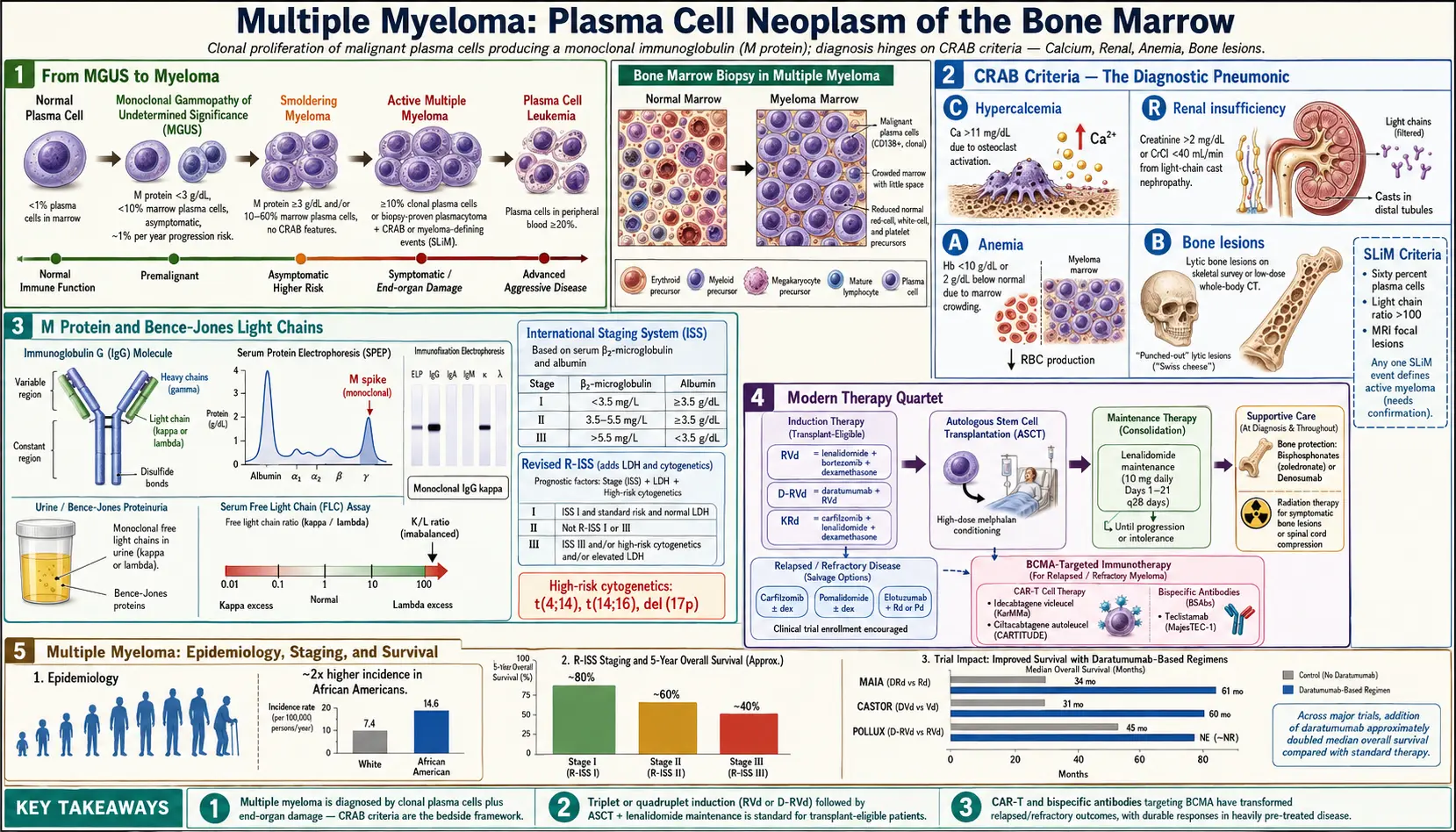
Table of Contents
- What is Multiple Myeloma?
- Causes and Risk Factors
- Symptoms of Multiple Myeloma
- Diagnosis and Staging
- Treatment Options
- Prognosis
- Research Papers
- Connections
- Featured Videos
What is Multiple Myeloma?
Multiple Myeloma is a type of cancer that forms in plasma cells, a kind of white blood cell that helps the body fight infections by making antibodies. In multiple myeloma, cancerous plasma cells accumulate in the bone marrow and crowd out healthy blood cells.
Causes and Risk Factors
The exact cause of multiple myeloma is not fully understood, but several risk factors have been identified:
- Age: Most people diagnosed with multiple myeloma are over 65.
- Gender: Men are slightly more likely to develop the disease than women.
- Race: African Americans have a higher risk compared to other races.
- Family history: A family history of multiple myeloma or other blood cancers may increase risk.
- Monoclonal gammopathy of undetermined significance (MGUS): This condition can develop into multiple myeloma over time.
Symptoms of Multiple Myeloma
Common symptoms include:
- Bone pain, especially in the spine or chest
- Frequent infections due to a weakened immune system
- Fatigue or feeling weak
- Weight loss without trying
- Excessive thirst and dehydration
- Nausea or constipation
- Kidney problems caused by high levels of abnormal proteins
Diagnosis and Staging
Diagnostic Tests
To diagnose multiple myeloma, doctors may use the following tests:
- Blood tests: To detect abnormal proteins (M proteins), calcium levels, and other indicators.
- Urine tests: To check for the presence of Bence Jones proteins, which indicate multiple myeloma.
- Bone marrow biopsy: A sample of bone marrow is taken to look for myeloma cells.
- Imaging tests: Such as X-rays, MRI, CT scans, or PET scans to detect bone damage.
Staging
Staging of multiple myeloma helps determine the extent of the disease:
- Stage I: Early stage with fewer cancerous cells.
- Stage II: Intermediate stage, with a moderate amount of myeloma cells.
- Stage III: Advanced stage with many cancerous cells and potential organ damage.
Treatment Options
Treatment varies based on the stage and the patient’s overall health:
- Targeted therapy: Drugs that target specific proteins in myeloma cells, such as proteasome inhibitors.
- Immunotherapy: Utilizes the immune system to fight cancer, using drugs that enhance the immune response.
- Chemotherapy: Kills rapidly growing cancer cells and is often used before stem cell transplant.
- Stem cell transplant: Involves replacing damaged bone marrow with healthy stem cells, typically following high-dose chemotherapy.
- Radiation therapy: Used to relieve pain and reduce the size of tumors in specific areas.
Prognosis
The prognosis for multiple myeloma depends on various factors, including the stage at diagnosis and the patient's response to treatment. While it is generally considered incurable, advancements in treatment have significantly improved survival rates and quality of life for patients.
References & Research
Historical Background
Multiple myeloma was first described in 1844 by Samuel Solly, who reported a case of bone disease associated with fragile bones. In 1848, Henry Bence Jones identified the characteristic urinary protein (now called Bence Jones protein). The disease was formally characterized by Otto Kahler in 1889, and for many years was known as "Kahler's disease." Jan Gosta Waldenstrom further distinguished myeloma from other plasma cell disorders in the 1940s.
Key Research Papers
- Facon T, Kumar S, Plesner T, et al. Daratumumab plus lenalidomide and dexamethasone for untreated myeloma (MAIA). N Engl J Med. 2019;380(22):2104-2115.
- Munshi NC, Anderson LD Jr, Shah N, et al. Idecabtagene vicleucel in relapsed and refractory multiple myeloma (KarMMa). N Engl J Med. 2021;384(8):705-716.
- Rajkumar SV. Multiple myeloma: 2020 update on diagnosis, risk-stratification, and management. Am J Hematol. 2020;95(5):548-567.
- Lonial S, Dimopoulos M, Palumbo A, et al. Elotuzumab therapy for relapsed or refractory multiple myeloma (ELOQUENT-2). N Engl J Med. 2015;373(7):621-631.
- Dimopoulos MA, Oriol A, Nahi H, et al. Daratumumab, lenalidomide, and dexamethasone for multiple myeloma (POLLUX). N Engl J Med. 2016;375(14):1319-1331.
- Palumbo A, Chanan-Khan A, Weisel K, et al. Daratumumab, bortezomib, and dexamethasone for multiple myeloma (CASTOR). N Engl J Med. 2016;375(8):754-766.
- Rajkumar SV, Dimopoulos MA, Palumbo A, et al. International Myeloma Working Group updated criteria for the diagnosis of multiple myeloma. Lancet Oncol. 2014;15(12):e538-e548.
- Stewart AK, Rajkumar SV, Dimopoulos MA, et al. Carfilzomib, lenalidomide, and dexamethasone for relapsed multiple myeloma (ASPIRE). N Engl J Med. 2015;372(2):142-152.
- Cowan AJ, Green DJ, Kwok M, et al. Diagnosis and management of multiple myeloma: a review. JAMA. 2022;327(5):464-477.
- Greipp PR, San Miguel J, Durie BGM, et al. International staging system for multiple myeloma (ISS). J Clin Oncol. 2005;23(15):3412-3420.
- Moreau P, Garfall AL, van de Donk NWCJ, et al. Teclistamab in relapsed or refractory multiple myeloma (MajesTEC-1). N Engl J Med. 2022;387(6):495-505.
- Richardson PG, Oriol A, Beksac M, et al. Pomalidomide, bortezomib, and dexamethasone for patients with relapsed or refractory multiple myeloma (OPTIMISMM). J Clin Oncol. 2019;37(2):138-148.
Research Papers
The following PubMed topic searches surface the current peer-reviewed literature on Multiple Myeloma. Each link opens a live PubMed query; results update as new papers are indexed.
- PubMed search: multiple myeloma
- PubMed search: multiple myeloma CRAB criteria
- PubMed search: multiple myeloma bortezomib proteasome inhibitor
- PubMed search: multiple myeloma lenalidomide
- PubMed search: multiple myeloma daratumumab
- PubMed search: multiple myeloma CAR T cell therapy
- PubMed search: multiple myeloma autologous stem cell transplant
- PubMed search: smoldering multiple myeloma
- PubMed search: monoclonal gammopathy undetermined significance
- PubMed search: multiple myeloma bone disease
- PubMed search: multiple myeloma minimal residual disease
- PubMed search: multiple myeloma bispecific antibody
Connections
- Oncology
- Cancer Overview
- Leukemia
- Lymphoma
- Metastatic Cancers
- Calcium
- Vitamin D3
- Kidney Disease
- Osteoporosis
- Turmeric
- Reishi Mushroom
- Anemia
- Fatigue
- Sarcoma
- Thyroid Cancer
- Full Body MRI
- Secondary Osteoporosis Causes