Guillain-Barré Syndrome
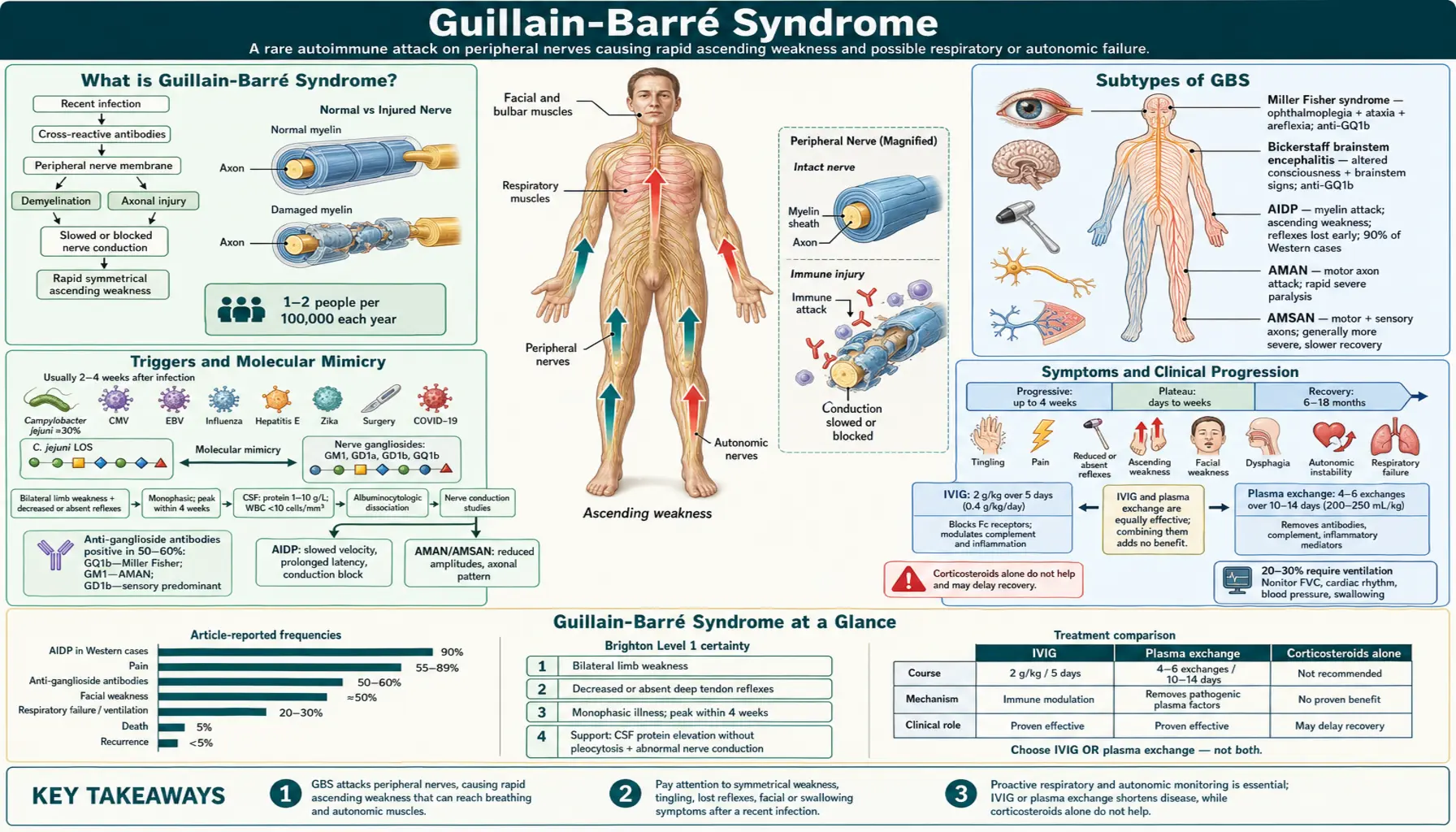
Table of Contents
- What is Guillain-Barré Syndrome?
- Subtypes of GBS
- Triggers and Molecular Mimicry
- Symptoms and Clinical Progression
- Risk Factors
- Diagnosis: CSF and Nerve Conduction Studies
- Respiratory Monitoring and ICU Admission
- Treatment: IVIG and Plasmapheresis
- Recovery and Long-Term Outlook
- Supportive and Natural Approaches
- Key Research Papers
- Connections
- Featured Videos
What is Guillain-Barré Syndrome?
Guillain-Barré syndrome (GBS) is a rare but serious autoimmune disorder in which the body's immune system mistakenly attacks the peripheral nervous system — the nerves that carry signals between the brain/spinal cord and the rest of the body. This attack causes rapid-onset muscle weakness that typically begins in the legs and ascends toward the upper body.
GBS affects approximately 1–2 people per 100,000 each year worldwide, making it the most common cause of acute flaccid paralysis in countries where poliovirus has been eradicated. It affects all ages and both sexes, with a slight male predominance and a bimodal age distribution (peaks in young adults and adults over 50).
GBS is potentially life-threatening when it reaches the respiratory muscles or causes severe autonomic dysfunction, but most patients recover substantially with appropriate treatment. About 80% are able to walk independently at six months, though up to 30% have residual weakness or fatigue at one year.
Subtypes of GBS
GBS is not a single disease but a family of related inflammatory neuropathies:
- Acute inflammatory demyelinating polyneuropathy (AIDP): The most common form in Western countries (90% of cases). The immune attack targets the myelin sheath — the insulating covering of peripheral nerves — slowing or blocking nerve conduction. Reflexes are lost early. Weakness ascends from legs to arms to face. Sensory symptoms (tingling, pain) are common.
- Acute motor axonal neuropathy (AMAN): More common in Asia and following Campylobacter jejuni infection. The attack targets the axon directly rather than myelin. Can cause rapid severe paralysis; nerve conduction studies show axonal rather than demyelinating pattern. Some patients recover quickly; others have persistent axonal damage.
- Acute motor and sensory axonal neuropathy (AMSAN): Similar to AMAN but with sensory axon involvement. Generally more severe with slower recovery.
- Miller Fisher syndrome (MFS): A distinct variant characterized by the clinical triad of ophthalmoplegia (eye muscle paralysis), ataxia, and areflexia — without prominent limb weakness. Strongly associated with anti-GQ1b antibodies. Usually benign with good recovery.
- Bickerstaff brainstem encephalitis: A GBS spectrum disorder with altered consciousness and brainstem signs, also anti-GQ1b positive. Overlaps with Miller Fisher syndrome.
Triggers and Molecular Mimicry
GBS typically begins 2–4 weeks after an infection. The infection primes the immune system, which then generates antibodies that cross-react with components of peripheral nerve membranes — a process called molecular mimicry.
Campylobacter jejuni is the single most important trigger, preceding GBS in approximately 30% of cases worldwide. The bacterial surface lipooligosaccharides (LOS) have structural similarities to gangliosides found in human nerve membranes (particularly GM1, GD1a, GD1b, and GQ1b). Anti-ganglioside antibodies generated against the bacterium then attack peripheral nerves.
Other documented triggers include:
- Cytomegalovirus (CMV): Second most common infectious trigger; associated with anti-GM2 antibodies and often severe disease.
- Epstein-Barr virus (EBV): Mononucleosis followed by GBS is well-documented.
- Influenza and influenza vaccination: The 1976 swine flu vaccine had a 1-in-100,000 risk of GBS — higher than seasonal flu vaccines, which carry a very small background risk (approximately 1–2 per million doses). The benefit of flu vaccination overwhelmingly outweighs this risk.
- Hepatitis E virus, Zika virus: Zika was associated with GBS outbreaks in French Polynesia and Brazil in 2013–2016.
- Surgery: Major surgery can occasionally trigger GBS, possibly via immune activation.
- COVID-19: Case series documented GBS following SARS-CoV-2 infection; the association is recognized but causation remains under investigation.
Symptoms and Clinical Progression
GBS classically evolves through three phases:
- Progressive phase (up to 4 weeks): Weakness ascends from the legs upward. It typically begins as symmetrical leg weakness — difficulty climbing stairs, rising from a chair — and ascends to the arms, face, and breathing muscles. Tingling or pins-and-needles sensations in hands and feet often precede weakness. Pain (often described as aching, burning, or cramping in the lower back and legs) is underrecognized but affects 55–89% of patients. Deep tendon reflexes are reduced or absent early — this is a hallmark finding.
- Plateau phase: Weakness stabilizes. May last days to weeks. Respiratory failure requiring ventilation occurs in approximately 20–30% of patients. Autonomic dysfunction (heart rate instability, blood pressure swings, urinary retention, ileus) can occur and is a leading cause of mortality.
- Recovery phase: Nerve remyelination and axonal regrowth drive recovery, which is slow — typically 6–18 months for full or near-full recovery.
Facial weakness occurs in approximately 50% of patients. Bilateral facial palsy (unlike Bell's palsy which is unilateral) should prompt consideration of GBS. Dysphagia (difficulty swallowing) occurs and requires feeding assessment. Ophthalmoplegia suggests Miller Fisher variant.
Risk Factors
- Recent infection: Diarrheal illness or respiratory infection in the preceding 2–6 weeks, especially C. jejuni gastroenteritis.
- Age: Risk increases with age, with a second peak after age 50. Younger patients generally recover better than older patients.
- Male sex: Approximately 1.5× higher incidence in men than women.
- Immunocompromised state: Lymphoma and HIV infection increase GBS risk.
- Surgery or trauma: Perioperative GBS accounts for a small percentage of cases.
Diagnosis: CSF and Nerve Conduction Studies
GBS is a clinical diagnosis supported by laboratory findings. No single test is diagnostic — the diagnosis requires the right clinical picture plus supportive findings.
Brighton Collaboration Criteria (Level 1 certainty)
- Bilateral limb weakness
- Decreased or absent deep tendon reflexes in the weak limbs
- Monophasic illness (symptoms peak within 4 weeks, then plateau or improve)
- Supporting: CSF protein elevation without pleocytosis; nerve conduction study abnormalities
Cerebrospinal Fluid (CSF) — Albuminocytologic Dissociation
Lumbar puncture classically shows albuminocytologic dissociation: elevated protein (typically 1–10 g/L, normal <0.45 g/L) with normal white cell count (fewer than 10 cells/mm³). This pattern — high protein, no cells — reflects nerve root inflammation leaking protein into CSF without active meningitis. It is present in 80% of cases at 2 weeks but may be normal in the first week of illness.
Nerve Conduction Studies (NCS) and EMG
Electrodiagnostic studies help classify GBS subtype and assess severity:
- AIDP pattern: Prolonged distal latencies, slowed conduction velocities, conduction block, and prolonged F-waves — indicating demyelination.
- AMAN/AMSAN pattern: Normal conduction velocities but reduced amplitude motor/sensory potentials — indicating axonal loss. Can be difficult to distinguish early from AIDP due to transient conduction failure at nodes of Ranvier.
- Miller Fisher: Sensory NCS may show absent sural and H-reflex; motor NCS relatively preserved.
Anti-ganglioside Antibodies
Serum anti-ganglioside antibody panels can support diagnosis and predict variant: anti-GQ1b (Miller Fisher), anti-GM1 (AMAN), anti-GD1b (sensory predominant). These are positive in only 50–60% of cases and are not required for diagnosis.
Respiratory Monitoring and ICU Admission
Respiratory failure is the most feared acute complication of GBS, occurring in 20–30% of patients. It can develop rapidly — sometimes within hours of admission. Proactive monitoring is essential.
The key respiratory parameters monitored are:
- Forced vital capacity (FVC): The single most important measure. Elective intubation is typically indicated when FVC falls below 20 mL/kg (or below 15 mL/kg in some guidelines). Normal FVC is 60–70 mL/kg.
- Maximal inspiratory pressure (MIP) and maximal expiratory pressure (MEP): MIP more negative than −30 cmH₂O or MEP less positive than +40 cmH₂O also indicate severe respiratory compromise.
- The "20-30-40 rule": ICU admission is warranted if FVC <20 mL/kg, MIP >−30 cmH₂O, or MEP <40 cmH₂O.
- Oxygen saturation: A late marker — patients can have severe respiratory muscle weakness with normal SpO₂ until respiratory arrest is imminent.
All newly diagnosed GBS patients should have respiratory measurements every 4 hours initially, especially during the progressive phase. Bulbar dysfunction (difficulty swallowing or speaking) significantly increases aspiration risk and often indicates impending respiratory failure.
Autonomic monitoring is equally important: continuous cardiac monitoring for arrhythmias (bradycardia during suctioning is a danger sign), blood pressure monitoring for dangerous swings, and bladder assessment for urinary retention.
Treatment: IVIG and Plasmapheresis
Two treatments are proven to shorten the duration and severity of GBS: intravenous immunoglobulin (IVIG) and plasmapheresis (plasma exchange, PE). Landmark trials showed these two treatments are equally effective — combining them offers no additional benefit over either alone.
Intravenous Immunoglobulin (IVIG)
IVIG at a total dose of 2 g/kg given over 5 days (0.4 g/kg/day) is the most widely used treatment. IVIG works through multiple mechanisms: blocking Fc receptors, modulating complement, and downregulating inflammatory responses. IVIG is easier to administer than plasmapheresis and can be given in most hospitals.
The Dutch GBS RCT (1997) and subsequent meta-analyses confirmed IVIG and PE are equivalent. IVIG is preferred in patients with cardiovascular instability (safer in hemodynamic terms) and in patients where vascular access for apheresis is difficult.
Plasmapheresis (Plasma Exchange)
Plasmapheresis removes pathogenic antibodies, complement, and inflammatory mediators from plasma. The standard course is 4–6 exchanges over 10–14 days (total 200–250 mL/kg plasma removed). PE works best when started within 4 weeks of symptom onset. It is preferred in patients with selective IgA deficiency (who cannot receive IVIG) and in some centers with extensive PE expertise.
Corticosteroids
Despite intuitive appeal as anti-inflammatory agents, corticosteroids alone do not help in GBS and may delay recovery. The Dutch GBS-RCT showed no benefit, and oral prednisolone actually slightly worsened outcomes. Steroids are not recommended for isolated GBS.
Supportive Care
- DVT prophylaxis (compression stockings, anticoagulation) — immobility greatly increases thrombosis risk.
- Pain management — neuropathic pain is severe; gabapentin, pregabalin, and opioids may be needed.
- Physical and occupational therapy beginning as soon as respiratory status is stable.
- Bowel and bladder care during autonomic phase.
- Psychological support — GBS is terrifying; patients are awake and aware even when paralyzed.
Recovery and Long-Term Outlook
Most patients with GBS recover substantially, but recovery is slow and incomplete for many:
- 80% walk independently by 6 months.
- 60% achieve full strength recovery by 1 year.
- 20–30% have persistent weakness, fatigue, or pain at one year.
- 5% die from respiratory failure, autonomic instability, or infectious complications.
Predictors of poor outcome include: age over 60, rapid progression to maximum weakness within 7 days, preceding Campylobacter infection, AMAN subtype on electrophysiology, and requirement for ventilation.
The GBS disability score and IGOS (International GBS Outcome Study) prognostic model can help predict outcome and guide rehabilitation planning.
Fatigue is the most persistent and often disabling residual symptom — present in 60–80% of patients at 1 year. "GBS fatigue" differs from normal tiredness and can severely limit return to work and daily life. Energy conservation strategies, graded exercise programs, and psychological support are important.
A small proportion of patients experience GBS recurrence (fewer than 5%), or later develop CIDP (chronic inflammatory demyelinating polyneuropathy) — a chronic variant of GBS requiring long-term treatment.
Supportive and Natural Approaches
While IVIG or plasmapheresis is the cornerstone of treatment, supportive strategies matter enormously for recovery quality:
- Physical rehabilitation: Structured physiotherapy throughout recovery — from passive ranging and positioning in the ICU phase to active strengthening and gait training later. Water-based therapy (hydrotherapy) reduces joint stress while allowing movement training.
- Nutrition: Patients on mechanical ventilation require nutritional support (enteral feeding via nasogastric tube preferred over parenteral nutrition). Adequate protein intake (1.5–2 g/kg/day) supports muscle recovery. Omega-3 fatty acids and antioxidants may support nerve regeneration (preclinical evidence).
- B vitamins: Vitamin B12 is essential for myelin synthesis and axonal integrity; deficiency should be corrected. B6 at low doses and folate support neurological function.
- Vitamin D: Deficiency is associated with poorer neurological recovery across multiple demyelinating diseases. Correction to optimal levels (50–80 ng/mL) is reasonable.
- Sleep hygiene: Sleep quality is profoundly disrupted in GBS — by pain, autonomic instability, position changes, and anxiety. Good sleep is critical for nerve repair and immune regulation.
- Psychological support and counseling: Depression and post-traumatic stress disorder (PTSD) affect 20–40% of GBS survivors. Cognitive-behavioral therapy (CBT) and support groups (GBS/CIDP Foundation International) have documented benefit.
- Avoiding re-exposure triggers: Patients with a documented preceding Campylobacter infection should be counseled on food safety (cooking poultry thoroughly, handwashing) to reduce re-exposure risk — though GBS recurrence after reinfection is rare.
Key Research Papers
Foundational trials and systematic reviews in GBS:
- Search PubMed
- Search PubMed
- Search PubMed
- Search PubMed
- Search PubMed
- Search PubMed
- Search PubMed
- Search PubMed
- Search PubMed
- Search PubMed
- Search PubMed
Connections
- Neurology
- Peripheral Neuropathy
- Multiple Sclerosis
- ALS
- Bell's Palsy
- Myasthenia Gravis
- POTS (Autonomic Dysfunction)
- Lupus (Autoimmune)
- Vitamin B12
- Vitamin D3
- Vitamin B6
- Magnesium
- Glutamine
- Salmon (Omega-3)
- Epilepsy
- Parkinson's Disease
- Trigeminal Neuralgia