Lyme Disease Prevention and Proper Tick Removal
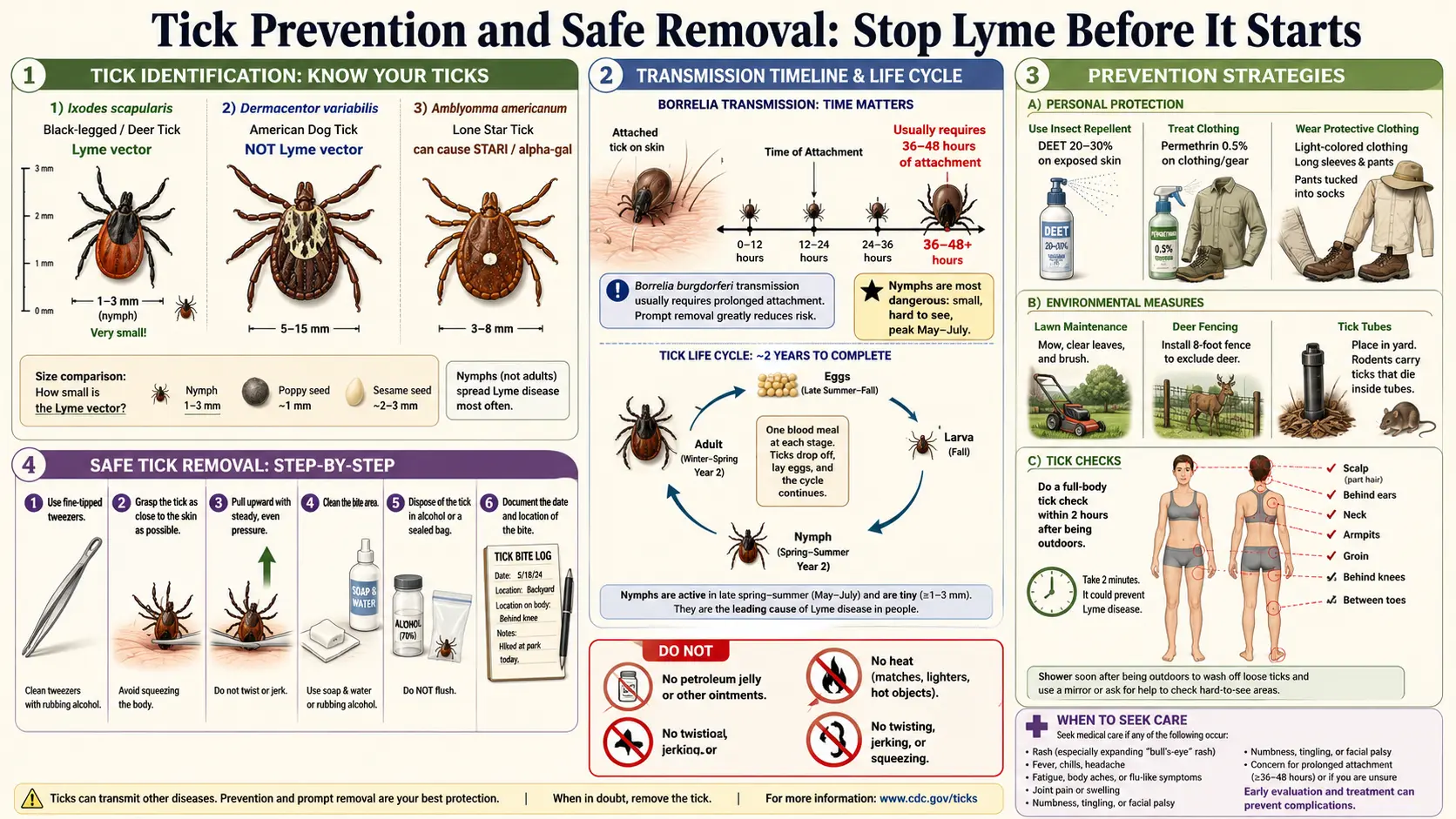
Table of Contents
- Why Prevention Matters More Than Treatment
- The Three-Tier Prevention Model
- Skin Repellents — DEET, Picaridin, IR3535, OLE/PMD
- Permethrin-Treated Clothing
- Clothing Strategy — The Dork Look
- Daily Tick Check Routine — The Six Zones
- Hot Tumble Dryer — The Ten-Minute Rule
- Shower Within Two Hours
- Landscape and Yard Management
- Acaricide Yard Treatments
- Tick Tubes
- Pets — The Hidden Vector
- Proper Tick Removal Step-by-Step
- After Removal — What to Do With the Tick
- Travel to Endemic Areas
- Kids and Summer Camp
- Key Research Papers
- Connections
- Featured Videos
Why Prevention Matters More Than Treatment
Most Lyme articles start with treatment. This one starts with prevention because even textbook-perfect doxycycline does not always leave you where you were before the bite. Roughly 10–20% of patients treated promptly for confirmed Lyme report lingering fatigue, joint pain, or cognitive symptoms for months after antibiotics — post-treatment Lyme disease syndrome (PTLDS). Nobody knows how to predict who gets it.
Then there are the co-infections. The same Ixodes tick that carries Borrelia burgdorferi can also transmit Babesia, Anaplasma, Ehrlichia, Borrelia miyamotoi, and Powassan virus. One bite can start two or three diseases; standard Lyme antibiotics treat only one. Powassan has no treatment and a 10% mortality rate.
A good repellent, permethrin pants, and a five-minute body check cost almost nothing and cut risk by an estimated 90% or more. Prevention is the highest-leverage medical decision you make every time you step into tick habitat.
The Three-Tier Prevention Model
Think of tick defense as three concentric rings, each one catching what the last ring missed:
- Tier 1 — Personal repellents on skin. DEET, picaridin, IR3535, or oil of lemon eucalyptus. These stop ticks from climbing onto exposed skin.
- Tier 2 — Permethrin-treated clothing. An insecticide bonded to fabric that kills ticks on contact before they reach skin. This is the single most effective measure for anyone spending serious time outdoors.
- Tier 3 — Environmental controls. Yard management, acaricide sprays, tick tubes, pet prevention. Shrinks the tick population in the places you spend time.
No single tier is enough — repellent on bare arms does nothing for a tick on a pant leg, and permethrin pants do nothing for a tick on your neck. Stack all three and the residual risk becomes very small.
Skin Repellents — DEET, Picaridin, IR3535, OLE/PMD
Four active ingredients are well-studied against ticks. Pick one — they are roughly equivalent at comparable concentrations.
DEET. The gold standard since 1957. For ticks, 20–30% is adequate — higher concentrations give longer duration, not better protection. 20% protects 4–5 hours, 30% extends to 6–7 hours, above 30% offers diminishing returns. Safe in pregnancy (CDC and ACOG confirm) and on children over 2 months. Damages synthetic fabrics, plastics, and watch crystals.
Picaridin (KBR 3023). Matches DEET for efficacy without the plastic-eating chemistry. Use 20% picaridin for 8–12 hours of tick protection. Odorless, non-greasy, gear-safe. Safe in pregnancy and on kids over 2 months. What most wilderness guides now carry.
IR3535. A biopesticide common in Europe and in some Avon Skin So Soft products. Effective at 20%, but duration is shorter (4–6 hours). Very safe profile; fine for pregnancy and children.
Oil of lemon eucalyptus (OLE) / PMD. CDC-endorsed plant-based option. 30% OLE gives 4–6 hours. Not for children under 3 years. "Pure lemon eucalyptus essential oil" from a health-food store is not the same product — buy registered OLE/PMD formulations only.
Apply to exposed skin, avoiding eyes and mouth. For children, spray your hands first and then apply to their face. Reapply per the bottle's duration or after heavy sweating or swimming.
Permethrin-Treated Clothing
Permethrin is the single biggest upgrade most people can make to their tick defense, and most people have never heard of it. Sprayed onto fabric, it bonds to the fibers and stays active for weeks. A tick that crawls onto a treated pant leg gets a lethal dose within seconds — it falls off, convulses, and dies before reaching skin. This is called the "hot-foot effect."
- 0.5% permethrin spray (Sawyer, Repel) applied to clothing lasts about 6 wash cycles.
- Factory-treated garments (Insect Shield, ExOfficio BugsAway, LL Bean No Fly Zone) last 70+ washes — the garment's lifetime.
- Safe on clothing, never on skin. Rapidly metabolized by mammals, highly toxic to cats while wet. Spray outdoors and let clothing dry fully (2+ hours) before bringing it near pets.
- Treat pants, socks, shoes, cuffs, and hat brims — the contact zones. No need for the torso.
The U.S. military adopted permethrin uniforms in the 1990s after field studies showed a >90% reduction in tick bites. If you hunt, fish, hike, garden, or work outdoors, this one intervention probably does more than the other two tiers combined.
Clothing Strategy — The Dork Look
Embrace it. Ticks cannot jump or fly — they climb. The goal is to make the climb as long, as visible, and as hostile as possible.
- Light colors. Tan, beige, pale gray — dark ticks on khaki are obvious.
- Long pants tucked into socks. It looks ridiculous. It works. The tick hits sock fabric and keeps climbing, giving permethrin time to kill it.
- Gaiters. Calf-height sleeves covering the boot-to-pant seam. Treat with permethrin.
- Tight cuffs and collars. Elastic or buttoned cuffs stop ticks from dropping inside sleeves. Wide-brim hats beat hair as a landing zone.
- Shirts tucked into pants. Ticks climbing past the waistband get stopped at the tuck.
Daily Tick Check Routine — The Six Zones
Ticks prefer warm, moist, thin-skinned places where they can feed undisturbed. After any exposure, check the same six zones in the same order every time so nothing is skipped:
- Scalp and hairline. Run fingers slowly through hair in sections; feel for a small bump. A hand mirror or partner helps.
- Behind and in the ears. Including the crease where the ear meets the skull.
- Armpits. Classic nymph hiding spot.
- Bra line, under breasts, belly button. Any skin fold.
- Waistband and groin. Including the pubic area and inner thighs.
- Behind the knees. Back of the knee crease.
Do a full-body mirror check within two hours of coming inside. Have a partner check your back and scalp. Ixodes scapularis nymphs are the size of a poppy seed — easy to mistake for a freckle. If it is new, assume tick until proven otherwise.
Hot Tumble Dryer — The Ten-Minute Rule
The most overlooked trick in the playbook. Ticks survive most wash cycles, especially cold water. They do not survive a hot dryer. Published research (Carroll, 2003) found 10 minutes on high heat killed 100% of Ixodes scapularis adults and nymphs by desiccation. Wet clothes buffer ticks from the heat, so tumble dry first for 10 minutes, then wash if desired. Reverse the usual order.
Shower Within Two Hours
Shower within two hours of coming indoors. Two reasons:
- Unattached ticks wash off. A tick has to feed for 36–48 hours before transmitting Borrelia; if you rinse it down the drain on day zero, you win.
- The act of showering forces a whole-body skin inspection. You feel a bump you would otherwise miss.
Studies in endemic areas link post-exposure showering with a measurable drop in Lyme incidence. Combined with a tick check and a hot-dryer cycle, it is the cheapest prevention habit available.
Landscape and Yard Management
In endemic regions, most Lyme bites happen in the yard — not in deep woods. Ticks ride in on mice, chipmunks, and deer and stay wherever humidity is high. Make the yard hostile:
- Keep grass short. Ticks desiccate in sun; a mowed lawn is a tick-poor zone.
- Clear leaf litter in fall and spring. Damp leaves are the number one tick nursery.
- Three-foot wood-chip or gravel barrier between lawn and woods. The single most effective yard modification — tick density drops by half on the lawn side.
- Move woodpiles off the ground, 10+ feet from the house. Stacked wood harbors mice.
- Remove bird feeders April–September. Feeders draw rodents, the primary Borrelia reservoir.
- Deer fencing. Eight-foot mesh. Expensive but dramatically reduces tick introduction.
- Keep patios and play areas in sun, away from wood edges and shaded groundcover.
Acaricide Yard Treatments
Acaricides are tick-killing chemicals sprayed onto the yard perimeter. Applied once in spring (May, targeting nymphs) and optionally once in fall (October, targeting adults), they typically reduce yard tick populations by 68–100% in controlled studies.
- Synthetic options. Bifenthrin and cyfluthrin pyrethroids, applied by a licensed applicator. Rapid knockdown, low cost, persists 4–6 weeks. The usual environmental concerns apply — do not spray flowering plants while bees are active, keep pets off until dry.
- Organic options. Cedar oil (Nootkatone is EPA-registered; cedarwood oil is the consumer version) and rosemary-peppermint blends work but require more frequent application (every 2–3 weeks during peak season).
- Professional vs DIY. A licensed pest applicator costs $75–$200 per treatment for a typical suburban yard. DIY backpack sprayer kits cost $30–$60 in materials per season. Professional coverage is more reliable; DIY is fine if you follow the label exactly.
Tick Tubes
Cardboard tubes stuffed with permethrin-treated cotton. Field mice harvest the cotton for their nests; larval and nymphal ticks feeding on the mice encounter the residue and die. The mouse is unharmed. Targeted tick reduction without spraying the whole yard.
Place tubes (Damminix, Thermacell, or DIY) along stone walls, brush piles, and wood edges in April and again in July. A quarter-acre lot needs about 24 tubes per round. Studies show 68–97% reduction in tick abundance over 2–3 seasons.
Pets — The Hidden Vector
Dogs and outdoor cats are tick taxis. They brush through vegetation, collect ticks, and drop them in the carpet where they climb onto humans. A protected pet is your protection too.
- Isoxazolines — fluralaner (Bravecto), afoxolaner (NexGard), sarolaner (Simparica). Oral monthly or quarterly tablets that kill attached ticks within hours. The current veterinary standard for dogs.
- Fipronil (Frontline, Effipro). Topical monthly spot-on. Older but still effective; useful for cats (some isoxazolines are dog-only — always check).
- Amitraz collars (Preventic) and flumethrin collars (Seresto). Collar-based options, 6–8 month duration.
- Brush pets down when they come in from walks, especially ears, neck, and belly. Keep a fine-tooth comb or lint roller at the door.
Do not use dog tick products on cats without checking. Permethrin, in particular, is lethal to cats.
Proper Tick Removal Step-by-Step
You found one attached. Stay calm — technique matters more than speed.
- Get fine-tipped tweezers. Not blunt household tweezers — pointed precision tweezers. A dedicated tick-removal tool (TickEase, Tick Twister, Pro-Tick Remedy) also works well. Keep one in every first-aid kit.
- Grasp the tick as close to the skin as possible. Aim at the mouthparts, not the body. Gripping the body squeezes the tick's gut contents into the bite wound — exactly the opposite of what you want.
- Pull straight up with steady, even pressure. No twisting, no jerking, no yanking. The mouthparts have backward-facing barbs; steady pressure slowly releases them. Expect it to take 10–30 seconds of firm pull.
- Do not panic about mouthparts left behind. Small fragments sometimes remain. They are no worse than a splinter — the body rejects them over days. Do not dig into the skin to extract them; you cause more damage than the fragment does.
- Clean the bite site with rubbing alcohol, iodine, or soap and water. Then wash your hands.
What not to do. Never apply a hot match, lit cigarette, petroleum jelly, nail polish, essential oils, or dish soap. These old-wives techniques irritate the tick into regurgitating saliva and gut contents into the wound — raising infection risk — and they waste time. The tick will not "back out." Just pull it out.
After Removal — What to Do With the Tick
Do not flush it. The tick is evidence.
- Save it. Drop it into a zip-top bag with a small piece of damp paper towel, or into a small jar with a drop of water. Label with date, location of bite on your body, and where you were when exposed. Refrigerate.
- Photograph it. Clear close-up on a white background with a coin or ruler for scale. Helps identify species (deer tick vs dog tick vs lone star tick) — only certain species transmit certain diseases.
- Mark your calendar. Start a 30-day rash watch. Check the bite site daily for an erythema migrans rash, which typically appears 3–30 days after the bite, averaging 7–10 days. Also watch for fever, fatigue, headache, or flu-like symptoms in that window.
- Consider commercial tick testing. Labs including TickReport (University of Massachusetts), TickCheck, and IGeneX test the tick itself for Borrelia, Anaplasma, Babesia, and other pathogens for $50–$150. A negative tick result is reassuring; a positive result does not automatically mean you were infected (the tick may not have fed long enough) but shifts the calculus toward prophylaxis.
- Consider prophylaxis eligibility. A single 200 mg dose of doxycycline within 72 hours of removal prevents roughly 87% of Lyme cases in qualifying patients. See the tick bite first aid and prophylaxis article for eligibility criteria and dosing.
Travel to Endemic Areas
Lyme is densely concentrated in the Northeast (Maine to Virginia), the upper Midwest (Wisconsin, Minnesota), and pockets of northern California and the Pacific Northwest. Trip-plan for ticks the way you would for weather:
- Pack before you leave. Permethrin-treated pants, socks, and shirt. Picaridin or DEET in a TSA-friendly container. Fine-tipped tweezers in the first-aid kit. A zip-top bag for saving ticks. A headlamp for the nightly tick check.
- Treat clothes two days out. Permethrin needs 2–4 hours to dry; a day of airing removes the faint solvent smell.
- Know the local species. Lone star ticks (Southeast) transmit alpha-gal syndrome; Rocky Mountain wood ticks transmit Rocky Mountain spotted fever; Ixodes pacificus in the West carries Lyme. Different ticks, same playbook.
- Nightly check, morning check. Two checks a day during the trip. Partners and family members check each other's backs and scalps.
- If something looks wrong after the trip, tell the doctor where you were. Urban ER physicians in non-endemic cities routinely miss Lyme. A "we just got back from Vermont" sentence at intake changes the entire differential.
Kids and Summer Camp
Summer camp is one of the highest-risk settings for pediatric Lyme. Kids are in long grass and leaf piles, less likely to notice a bite, and will lie to skip the tick check.
- Send them with permethrin-treated clothing. Factory-treated Insect Shield gear survives the entire camp session. Label everything — camp laundry is indiscriminate.
- Pack repellent they will actually use. Picaridin wipes are easier than sprays for kids. Put one in every pocket.
- Tick-removal tool in the toiletries bag. Fine-tipped tweezers, a zip-top bag, and a typed note from you: "If you find a tick on me, save it, photograph it, and call Mom or Dad."
- Nightly check as a routine. Frame it as a pre-shower scan, not a punishment. Siblings can check each other's backs.
- Talk to the camp director in advance. Ask about their tick-check policy, yard treatment, and what they do when a camper finds a tick. A camp that shrugs is a red flag.
- Watch for the next 30 days after camp. Rash, fever, fatigue, summer "flu" — low threshold to see the pediatrician and mention the camp location.
Done consistently, this routine is almost absurdly effective. Families in hyperendemic towns report entire summers without a single attached tick when permethrin clothing, repellent, and daily checks are as non-negotiable as sunscreen.
Key Research Papers
- CDC. Vital Signs: Trends in Reported Vectorborne Disease Cases — United States and Territories, 2004–2016. MMWR Morb Mortal Wkly Rep. 2018.
- Piesman J, et al. Efficacy of permethrin-treated clothing for preventing tick bites. J Med Entomol. 2002.
- Vaughn MF, et al. Long-lasting permethrin impregnated uniforms: A randomized‐controlled trial for tick bite prevention. Am J Trop Med Hyg. 2014.
- Lantos PM, et al. 2020 Guidelines for the Prevention, Diagnosis, and Treatment of Lyme Disease (IDSA/AAN/ACR). Clin Infect Dis. 2021.
Live PubMed Searches
For further reading, the following PubMed topic searches return current peer-reviewed work on tick prevention, repellents, and removal technique:
- DEET tick repellent efficacy
- Picaridin tick repellent trials
- Permethrin-treated clothing and tick bites
- Tick removal method comparisons
- Ixodes control in residential yards
- Permethrin tick tubes and rodent hosts
- Tumble dryer heat and tick mortality
- Lyme disease personal prevention behaviors
Connections
- Infectious Disease
- Tick Bite First Aid
- Erythema Migrans Rash
- Alpha-Gal Syndrome
- PTLDS and Chronic Lyme
- Tick-Borne Co-Infections
- Lyme Disease Overview
- Lyme Neuroborreliosis
- Antibiotic Treatment Protocols
- Lyme Testing Explained
- Cellulitis
- Tick Bite Prevention
- Eucalyptus
- Fatigue
- Lyme Carditis
- MCAS
- POTS
- Tick Origin Science