Threonine — Benefits Deep Dive
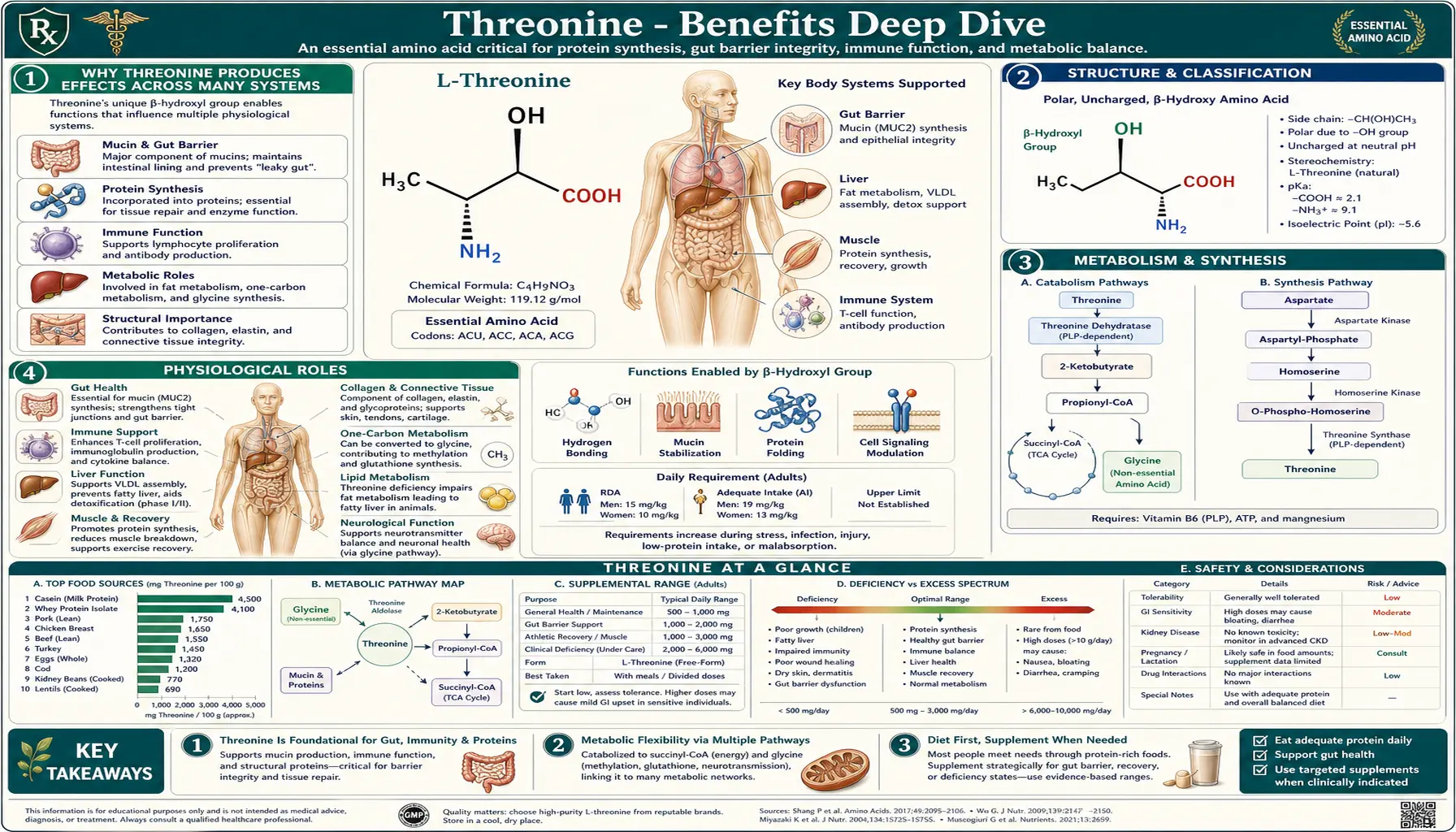
Threonine is one of the nine essential amino acids and one of the least-studied yet most-required of them. It is the dominant building block of intestinal mucin — the MUC2 protein that forms the protective mucus layer of the gut is approximately 30% threonine by amino-acid composition. It is the O-glycosylation residue in immunoglobulin hinges — the threonine-rich linker of IgA1 carries the sugar coat that determines whether the antibody can survive and function at mucosal surfaces. It is one of the four classical lipotropes, alongside choline, methionine, and inositol, whose deficiency in classical rat-feeding studies produces fatty liver within weeks. And it is a quiet but real contributor to collagen and connective-tissue protein synthesis, particularly in the tooth-enamel proteins amelogenin and enamelin where it is the most abundant single residue. Four benefit pages below explore each domain where threonine's role is largest and the clinical translation most actionable.
Deep-Dive Articles
Gut Mucin & the Intestinal Barrier
Threonine accounts for approximately 30% of intestinal mucin (MUC2) amino-acid content. Mucin O-glycosylation requires threonine and serine as the chemical anchors for the dense sugar coat. The gut-bacteria-fed mucin layer that protects against IBD, ulcerative colitis, and bacterial translocation depends on continuous goblet-cell threonine supply. Wang and colleagues' 2010 piglet experiments showed that even modest threonine restriction collapses the mucus layer within days. Parallels to human IBD, ulcerative colitis, and post-antibiotic gut recovery.
Collagen & Connective Tissue
Threonine occupies the X and Y positions of the collagen Gly-X-Y triple helix, sits in the telopeptide regions that participate in crosslinks, and dominates the tooth-enamel matrix proteins amelogenin and enamelin where it is one of the most abundant residues. Less recognized than glycine and proline as a collagen partner but functionally essential. Roles in bone matrix proteins (osteocalcin, osteopontin), cartilage proteoglycans, vascular elastin, and wound healing.
Immune Function
Threonine is the most abundant amino acid in immunoglobulin hinge regions — the IgA1 hinge in particular is a tandem repeat of threonine, serine, and proline densely decorated with O-linked sugars. Class-switching to IgA, mucosal immunity at the gut and respiratory epithelium, lymphocyte proliferation, and the GALT immune compartment all depend on adequate threonine supply. Connection to IgA nephropathy and to recurrent mucosal infection in adults.
Liver & Lipid Metabolism
Threonine is one of the four classical lipotropes (alongside choline, methionine, and inositol). Deficiency produces fatty liver in animal models within weeks. The mechanism runs through one-carbon metabolism: threonine to glycine to the methionine cycle to S-adenosylmethionine to phosphatidylcholine to VLDL assembly. Methionine and choline can partially substitute. Modern NAFLD has different primary drivers but the lipotropic chemistry remains relevant. Phase II detoxification via glycine conjugation.
Table of Contents
- Deep-Dive Articles
- Why Threonine Produces Effects Across Many Systems
- Research Papers: Gut Mucin & Barrier
- Research Papers: Collagen & Connective Tissue
- Research Papers: Immune Function
- Research Papers: Liver & Lipid Metabolism
- Research Papers: Cross-Cutting (Metabolism, Status, Safety)
- External Authoritative Resources
- Connections
- Featured Videos
Why Threonine Produces Effects Across Many Systems
Most essential amino acids have a single dominant role that explains the bulk of their clinical importance — lysine for collagen crosslinking, methionine as the universal methyl donor source, tryptophan for serotonin synthesis, the branched-chain amino acids for muscle protein synthesis signaling. Threonine is unusual because its diverse roles in the body trace back to a single chemical feature: threonine's hydroxyl side chain is one of only two amino acid hydroxyls (the other being serine) that serves as the attachment point for O-linked glycans, the carbohydrate decorations attached to glycoproteins throughout the body.
Glycoproteins are everywhere. They make up the mucin barrier of the gut, the hinge regions of immunoglobulins, the surface markers of cell membranes, the connective tissue proteoglycans of cartilage and bone, the matrix proteins of tooth enamel, and the carrier proteins of the blood. Any time the body needs to attach sugars to a protein for functional purpose — whether to make the protein more soluble, to mark it for tissue-specific targeting, to protect it from proteolysis, or to give it bulk and viscosity — the attachment point is typically a threonine or serine hydroxyl.
This single biochemical fact organizes the entire clinical landscape of threonine effects:
- Mucin glycoproteins (gut barrier) — MUC2 is approximately 30% threonine, with most of those threonines carrying O-linked GalNAc-based glycans. The protective mucus layer of the gut is, in effect, a threonine-built glycan forest. Without adequate threonine supply, mucin production collapses and the gut barrier fails — the central pathology in inflammatory bowel disease as detailed in our Gut Mucin and Barrier deep-dive.
- Immunoglobulin glycoproteins (antibody function) — the IgA1 hinge is a tandem repeat of threonine and serine carrying nine O-glycan attachment sites. Mucosal immunity, class switching, and the IgA nephropathy disease mechanism all trace to this glycosylated hinge. See the Immune Function deep-dive.
- Connective tissue glycoproteins (collagen, enamel, proteoglycans) — threonine occupies key residues in collagen sequences and is the most abundant residue in amelogenin (the enamel matrix protein). Aggrecan and osteopontin carry O-glycans on threonine. See the Collagen and Connective Tissue deep-dive.
- One-carbon metabolism and lipotropic effects — threonine feeds via glycine into the methionine cycle that supports phosphatidylcholine synthesis. PC is the surfactant phospholipid required for VLDL assembly and triglyceride export from the liver. This is the mechanism behind threonine's classical lipotropic role and its protection against fatty liver. See the Liver and Lipid Metabolism deep-dive.
The therapeutic implication of this unified mechanism is that threonine adequacy supports all four domains simultaneously, and threonine inadequacy compromises all four simultaneously. A patient with marginal threonine status (chronic gut disease, restrictive vegan diet, severe burn injury, prolonged parenteral nutrition) is at risk for impaired mucus barrier, reduced antibody production, compromised connective tissue repair, and reduced hepatic lipid export — all linked through the central glycoprotein biology that threonine enables.
The corollary is that threonine is well-supplied by ordinary varied diets containing eggs, dairy, fish, poultry, soy, or legumes. Standalone L-threonine supplementation is rarely necessary; instead, the clinical strategy in patients at risk is to optimize total high-quality protein intake to 1.0-1.5 g/kg/day from biologically complete sources, which inherently delivers ample threonine alongside all the other essential amino acids.
Research Papers: Gut Mucin & Barrier
- Wang X et al. (2010). Threonine-deficient diet affects gut mucin synthesis and reduces intestinal barrier function in piglets — PubMed: Wang 2010 piglet study
- Velcich A et al. (2002). Colorectal cancer in mice genetically deficient in MUC2 — PubMed: Muc2 knockout colitis and cancer
- van der Sluis M et al. (2006). Muc2-deficient mice spontaneously develop colitis — PubMed: Spontaneous colitis in Muc2-null mice
- Johansson MEV et al. (2008). The inner of the two Muc2 mucin-dependent mucus layers in colon is devoid of bacteria — PubMed: Two-layer colonic mucus
- Hansson GC (2012). Role of mucus layers in gut infection and inflammation — PubMed: Mucus layer review
- Pullan RD et al. (1994). Thickness of adherent mucus gel on colonic mucosa in humans and its relevance to colitis — PubMed: Mucus thickness in UC
- Bertolo RF et al. (1998). Threonine requirement of neonatal piglets receiving total parenteral nutrition — PubMed: TPN threonine requirement
- Faure M et al. (2006). Specific amino acids increase mucin synthesis and microbiota in DSS-treated rats — PubMed: Threonine in DSS colitis model
- Desai MS et al. (2016). A dietary fiber-deprived gut microbiota degrades the colonic mucus barrier — PubMed: Fiber deprivation and mucus degradation
- Bansil R, Turner BS (2018). The biology of mucus: composition, synthesis and organization — PubMed: Mucus biology review
Research Papers: Collagen & Connective Tissue
- Shoulders MD, Raines RT (2009). Collagen structure and stability — PubMed: Collagen structure review
- Ramshaw JA, Shah NK, Brodsky B (1998). Gly-X-Y tripeptide frequencies in collagen — PubMed: Gly-X-Y composition
- Eyre DR, Wu JJ (2005). Collagen cross-links — PubMed: Crosslink chemistry
- Margolis HC et al. (2006). Role of macromolecular assembly of enamel matrix proteins in enamel formation — PubMed: Amelogenin self-assembly
- Termine JD et al. (1980). Properties of dissociatively extracted fetal tooth matrix proteins — PubMed: Amelogenin composition
- Mithieux SM, Weiss AS (2005). Elastin — PubMed: Elastin review
- Demling RH (2009). Nutrition, anabolism, and the wound healing process: an overview — PubMed: Nutrition and wound healing
- Zague V et al. (2011). Collagen hydrolysate intake increases skin collagen expression — PubMed: Collagen hydrolysate and skin
- Clark KL et al. (2008). 24-week study on collagen hydrolysate supplementation in athletes with joint pain — PubMed: Collagen and joint pain
- Khatri M et al. (2021). The effects of collagen peptide supplementation: a systematic review — PubMed: Collagen peptide systematic review
Research Papers: Immune Function
- Wang X et al. (2007). Dietary threonine modulates gut immunity in piglets infected with enterotoxigenic E. coli — PubMed: Threonine and gut immunity
- Mao X et al. (2014). Threonine supplementation enhances intestinal mucin synthesis and improves immune function in weaned piglets — PubMed: Threonine supplementation in piglets
- Li P et al. (2007). Amino acids and immune function — PubMed: Amino acids and immunity review
- Mestecky J, Russell MW (1986). IgA subclasses — PubMed: IgA subclasses
- Kerr MA (1990). The structure and function of human IgA — PubMed: IgA structure-function
- Suzuki H et al. (2008). Aberrantly glycosylated IgA1 in IgA nephropathy — PubMed: IgA nephropathy glycosylation
- Field CJ, Johnson IR, Schley PD (2002). Nutrients and their role in host resistance to infection — PubMed: Nutrients and host resistance
- Faure M et al. (2007). Threonine utilization for synthesis of acute-phase proteins and mucins is increased during sepsis in rats — PubMed: Threonine in sepsis
- Calder PC (2006). Branched-chain amino acids and immunity — PubMed: BCAA and immunity
- Hosomi K, Kunisawa J (2017). The specific roles of vitamins in the regulation of immunosurveillance in the gut — PubMed: Gut immunosurveillance
Research Papers: Liver & Lipid Metabolism
- Best CH, Huntsman ME (1932). The effects of the components of lecithine upon deposition of fat in the liver — PubMed: Best 1932 lipotrope foundation
- Channon HJ et al. (1938). The action of various substances on the fatty livers produced in rats by a diet rich in cholesterol — PubMed: Channon lipotrope studies
- Vance DE, Vance JE (2008). Phospholipid biosynthesis in mammalian cells — PubMed: Phospholipid biosynthesis review
- Vance DE (2014). Phospholipid methylation in mammals: from biochemistry to physiological function — PubMed: PEMT pathway review
- Zeisel SH, da Costa KA (2009). Choline: an essential nutrient for public health — PubMed: Choline as essential nutrient
- Corbin KD, Zeisel SH (2012). Choline metabolism and nonalcoholic fatty liver disease progression — PubMed: Choline and NAFLD
- Edgar AJ (2002). The human L-threonine 3-dehydrogenase gene is an expressed pseudogene — PubMed: Human TDH pseudogene
- Wang W et al. (2013). Glycine metabolism in animals and humans — PubMed: Glycine metabolism review
- Niculescu MD, Zeisel SH (2002). Diet, methyl donors and DNA methylation: folate, methionine, choline interactions — PubMed: Methyl donor interactions
- Hayashi H et al. (2000). Phosphatidylcholine deficiency in liver causes fatty liver and reduces VLDL secretion — PubMed: PC deficiency and VLDL
Research Papers: Cross-Cutting (Metabolism, Status, Safety)
- Rose WC (1936). The discovery of L-threonine as an essential amino acid — PubMed: Rose 1936 discovery
- WHO/FAO/UNU (2007). Protein and amino acid requirements in human nutrition — PubMed: WHO protein requirements
- Pencharz PB, Ball RO (2003). Different approaches to define individual amino acid requirements — PubMed: Amino acid requirement methodology
- House JD et al. (1997). Threonine requirements of neonatal piglets receiving total parenteral nutrition — PubMed: TPN threonine requirements
- Wandall HH et al. (1997). Substrate specificities of human GalNAc-transferases — PubMed: GalNAc-transferase specificity
- Bertolo RF, Burrin DG (2008). Comparative aspects of tissue glutamine and proline metabolism — PubMed: Splanchnic AA metabolism
- House JD, Hall BN, Brosnan JT (2001). Threonine metabolism in isolated rat hepatocytes — PubMed: Hepatic threonine metabolism
- Ballevre O et al. (1990). Quantitative partition of threonine oxidation in pigs — PubMed: Threonine catabolic pathways
- Tang Q et al. (2021). Plasma amino acids and inflammatory bowel disease — PubMed: Plasma AAs in IBD
- Wu G (2009). Amino acids: metabolism, functions, and nutrition — PubMed: Comprehensive amino acid review
External Authoritative Resources
- NIH Office of Dietary Supplements — All Fact Sheets (no dedicated threonine fact sheet, but the related amino acid resources are comprehensive)
- Linus Pauling Institute Micronutrient Information Center — the most authoritative continuous-updated nutrient resource (covers choline, methionine, and related lipotropic factors)
- WHO/FAO/UNU Protein and Amino Acid Requirements in Human Nutrition (2007) — the canonical authoritative source on amino acid requirements including the 15 mg/kg/day threonine adult value
- MedlinePlus — NIH consumer health information
- PubMed — All research on threonine (10,000+ papers)
Connections
- All Amino Acids
- Threonine (Main Page)
- Threonine for Gut Mucin and Barrier
- Threonine for Collagen and Connective Tissue
- Threonine for Immune Function
- Threonine for Liver and Lipid Metabolism
- Glycine (Threonine Metabolite)
- Methionine (Lipotrope Partner)
- Serine (Co-glycosylation Residue)
- Proline
- Lysine
- Glutamine
- Arginine
- Collagen
- Bone Broth
- Inflammatory Bowel Disease
- Ulcerative Colitis
- Crohn's Disease
- Hepatology
- Gut-Brain Axis
- Immune Boosting
- Eggs
- Lentils
- Zinc
- Vitamin A for Immune Function