Threonine: History and Discovery
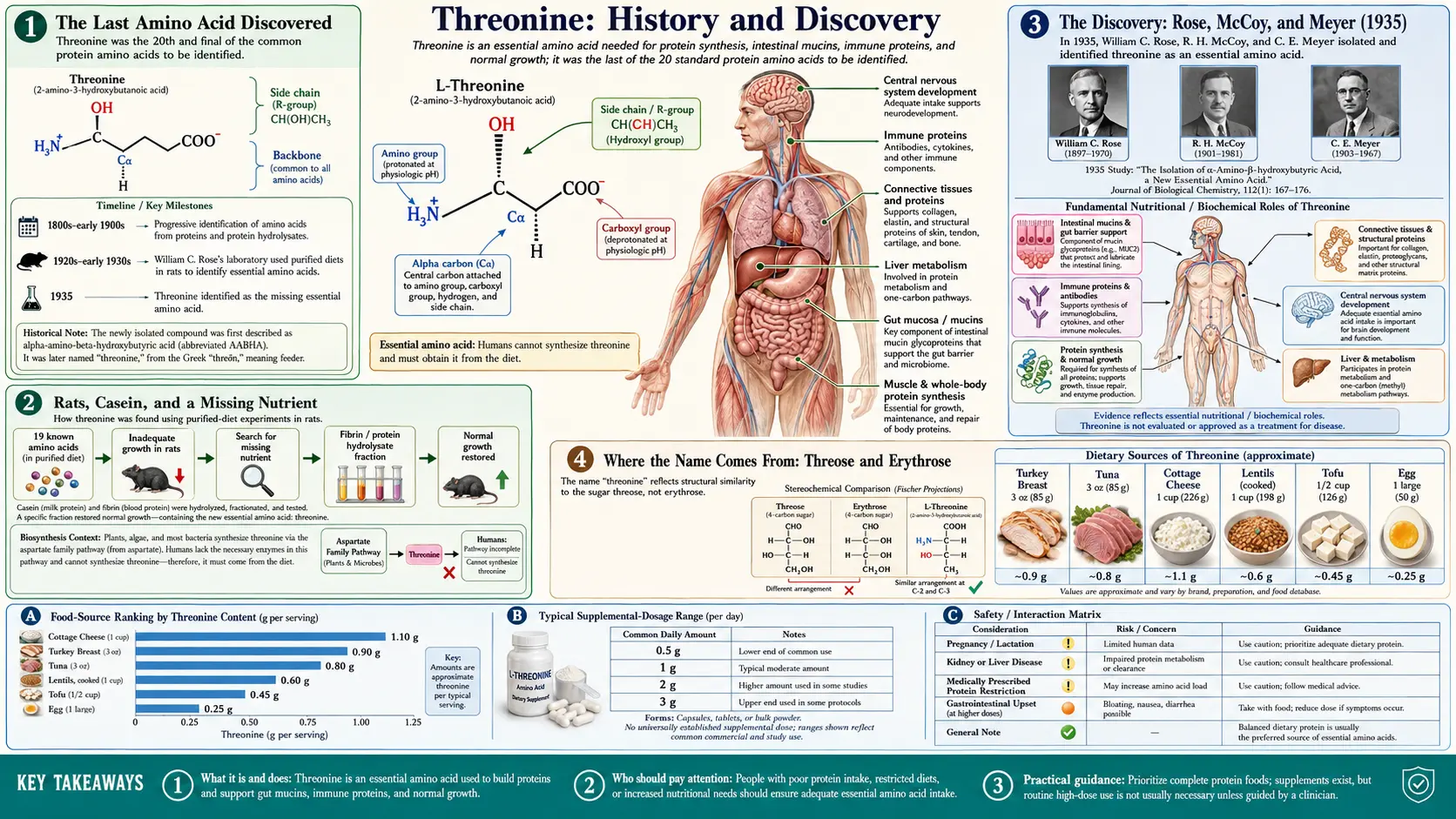
Threonine holds a singular place in the history of biochemistry: it was the last of the twenty common amino acids found in proteins to be discovered. While most of the others were teased out of natural materials across the nineteenth century, threonine eluded chemists until 1935, when the American biochemist William Cumming Rose and his co-workers isolated it from a digest of the blood protein fibrin at the University of Illinois. Its discovery did more than complete the roster of amino acids — it solved a stubborn puzzle about why animals fed certain "complete" mixtures of known amino acids still failed to grow, and it set the stage for Rose's landmark studies establishing which amino acids the human body truly cannot make for itself. This article tells that story: how threonine got its strange name, the rat-feeding experiments that forced its discovery, the scientists credited with the work, and how it fits into the larger arc of protein chemistry from the coining of the word "protein" to Emil Fischer's Nobel-winning work on how amino acids link together.
Table of Contents
- The Last Amino Acid Discovered
- Rats, Casein, and a Missing Nutrient
- The Discovery: Rose, McCoy, and Meyer (1935)
- Where the Name Comes From: Threose and Erythrose
- Defining the Essential Amino Acids
- The Wider Story: From "Protein" to the Peptide Bond
- Legacy and Modern Understanding
- Research Papers and References
- Connections
- Featured Videos
The Last Amino Acid Discovered
The chemistry of the amino acids is, in large part, a nineteenth-century story. One after another, the building blocks of protein were pulled out of natural materials by the great chemists of that era. Asparagine came first, isolated from asparagus juice in 1806. Glycine was crystallised from boiled gelatin in 1820 and named, charmingly, the "sugar of gelatin" for its sweet taste. Tyrosine was obtained from cheese in 1846, its name borrowed from the Greek tyros for cheese. By the start of the twentieth century most of the protein amino acids had been named, and as late as 1901 tryptophan was added to the list.
And then, for more than three decades, the list seemed complete — until it became clear that it was not. Threonine was the last of the twenty common (proteinogenic) amino acids to be discovered, and the last of the nine that the human body cannot manufacture and must obtain from food. Its lateness is no accident of neglect. Threonine is genuinely difficult to isolate from a protein digest in pure form; the chemists who finally cornered it wrote that "no procedure has been found which is not exceedingly laborious." What forced the issue in the end was not a clever new separation technique but a biological clue that something was missing — a clue that came from feeding experiments on laboratory rats.
Rats, Casein, and a Missing Nutrient
By the 1920s and early 1930s, nutrition scientists had a powerful new tool: they could try to keep an animal alive and growing on a diet built not from whole foods but from a measured mixture of purified nutrients — individual amino acids, vitamins, minerals, and a source of energy. If the animal thrived, the mixture was complete; if it failed, something essential was absent. This subtractive logic is what eventually exposed threonine.
William Cumming Rose, a biochemist at the University of Illinois, set out to discover whether rats could grow on diets in which all the protein was replaced by the nineteen amino acids then known. They could not. No matter how carefully the known amino acids were combined, young rats fed these mixtures stopped growing and declined. Yet when the milk protein casein was added back to the diet, growth resumed. The conclusion was inescapable: casein contained some nutrient — almost certainly a previously unrecognised amino acid — that the list of nineteen did not include. As the Wikipedia summary of Rose's work puts it, "he found that the 19 amino acids then known were not sufficient for growth, and this led to his discovery in 1935 of the last of the common amino acids."
This was the heart of Rose's method, and it is worth pausing on, because it shows how the discovery actually happened. Threonine was not stumbled upon while purifying some natural product for its own sake. It was predicted — demanded by an experiment — before it was ever held in a test tube. The growth of a rat had revealed a gap in the chemistry of life, and the job now was to chase down the molecule that filled it.
The Discovery: Rose, McCoy, and Meyer (1935)
The decisive work appeared in 1935 in the Journal of Biological Chemistry, in a paper by Richard H. McCoy, Curtis E. Meyer, and William C. Rose titled "Feeding experiments with mixtures of highly purified amino acids. VIII. Isolation and identification of a new essential amino acid." Working in Rose's laboratory, the team broke down the blood-clotting protein fibrin into its constituent amino acids and, through that laborious separation, isolated the new compound responsible for the growth-promoting activity that the nineteen known amino acids had lacked.
Chemically, the new molecule was identified as α-amino-β-hydroxy-n-butyric acid — a small amino acid carrying a hydroxyl (–OH) group, the structural feature that would later prove central to its biology, since it gives threonine a site that cells can chemically tag during the signalling process called phosphorylation. When this isolated substance was added to the deficient amino acid mixtures, rats grew normally. The missing nutrient had been caught, purified, and proven.
Credit for the discovery is firmly and unambiguously documented. The isolation paper carries three authors — McCoy, Meyer, and Rose — and the broader achievement is universally attributed to William Cumming Rose (April 4, 1887 – September 25, 1985), whose laboratory designed and drove the program of feeding experiments. The work is celebrated as one of the classic episodes in twentieth-century nutritional biochemistry; decades later, the Journal of Biological Chemistry reprinted and commemorated it as a landmark in the field. There is no genuine priority dispute here: threonine has one well-attested discovery, by one named team, in one place and year.
Where the Name Comes From: Threose and Erythrose
The name threonine sounds like it ought to mean something ancient and grand, but its origin is purely chemical — and rather playful once you follow the trail. Threonine was named for its close structural resemblance to a four-carbon sugar called threose. Around 1936, Curtis Meyer and William Rose worked out the spatial (stereochemical) arrangement of the atoms in the new amino acid, and that arrangement mirrored the arrangement in threose closely enough that the sugar lent the amino acid its name.
The sugar's own name has a quirky pedigree. Threose was coined by the chemist Otto Ruff around 1901, simply by rearranging the letters of erythrose, a related four-carbon sugar that is its stereochemical mirror-partner. Erythrose, in turn, takes its name from the Greek erythros, meaning "red," because the compound was observed to turn red under alkaline (basic) conditions. So the lineage runs backward like a small etymological chain: erythrose (Greek for "red") → threose (an anagram of erythrose) → threonine (the amino acid that looks like threose).
One small note for accuracy: some reference sources describe threonine as being named after "threonic acid" rather than the sugar threose. Threonic acid is simply the acid derived from threose, and the two share the same threo- stereochemical root, so the explanations are not in conflict — both point back to the same four-carbon, threo-configured family of molecules. The essential and well-supported point is that threonine's name records a structural kinship to the threose/threonic group of sugars, not any property of the amino acid's biological role.
Defining the Essential Amino Acids
Discovering threonine was, in a sense, the beginning rather than the end of Rose's contribution. With the full set of twenty common amino acids finally in hand, he and his collaborators could ask a deeper question: which of them does the body actually need to be supplied with, and which can it build for itself? This is the distinction between essential amino acids (which must come from the diet) and non-essential ones (which the body can synthesise). Rose's feeding experiments were ideally suited to answer it, because removing a single amino acid from an otherwise complete purified diet revealed at once whether the animal could manage without it.
Through the late 1930s and 1940s, Rose's group systematically established this classification, distinguishing the amino acids that are absolutely required from those needed only for the fastest growth. Crucially, he did not stop at rats. In a remarkable and demanding series of studies, Rose carried the work into human subjects, using nitrogen-balance measurements — comparing the nitrogen a person takes in as protein against the nitrogen they excrete — to determine which amino acids people cannot do without, and in what minimum amounts. Volunteers lived on precisely controlled diets while their intake and output were measured, allowing Rose to define human requirements one amino acid at a time. He summarised these findings in his influential 1949 work on the amino acid requirements of man.
The upshot of all this is the framework still taught today: there are nine amino acids generally considered essential for adult humans — histidine, isoleucine, leucine, lysine, methionine, phenylalanine, threonine, tryptophan, and valine. Threonine's place on that list is a direct legacy of the very experiments that discovered it. The molecule that rats could not grow without turned out to be one that humans cannot grow without either.
The Wider Story: From "Protein" to the Peptide Bond
Threonine's discovery sits inside a much longer effort to understand what proteins are and how they are built — an effort worth sketching, because it explains why finding "the last amino acid" mattered so much. The word protein itself dates to 1838. The Dutch chemist Gerardus Johannes Mulder described these substances, and the renowned Swedish chemist Jöns Jacob Berzelius proposed the name, drawn from the Greek proteios, meaning "primary" or "of first rank" — a fitting label for what were already suspected to be the most fundamental materials of living tissue.
For most of the nineteenth century, chemists could break proteins down into amino acids but could not say how those pieces were joined. That puzzle was solved by the German chemist Emil Fischer, one of the towering figures of organic chemistry. Fischer received the Nobel Prize in Chemistry in 1902 for his work on the sugars and the purines, and in the years that followed (roughly 1899 to 1908) he turned his attention to proteins, establishing that amino acids are linked together through what he named the peptide bond — the chemical connection between the acid group of one amino acid and the amino group of the next. Fischer's insight revealed proteins as long chains of amino acids strung together like beads, which is precisely why identifying every bead in the set was so important.
Seen against this backdrop, the 1935 discovery of threonine completed a picture that had been assembled piece by piece over more than a century: Berzelius and Mulder had given proteins their name; a long line of nineteenth-century chemists had isolated the amino acids one by one; Fischer had shown how those amino acids are bonded into chains; and Rose, with threonine, supplied the final missing building block and then mapped out which blocks the human body must be given ready-made.
Legacy and Modern Understanding
The discovery of threonine closed the catalogue of the common protein amino acids, but its practical consequences reached far beyond bookkeeping. Once threonine was known and its essentiality established, it could be accounted for in the design of nutritionally complete diets — an understanding that underpins everything from clinical nutrition and intravenous feeding formulas to the balancing of animal feeds, where threonine is one of the amino acids most often added to make plant-based rations complete.
The hydroxyl group that made threonine so awkward to isolate also turned out to be biologically pivotal. That same –OH group is the site at which enzymes can attach a phosphate during phosphorylation, one of the cell's central on/off switches for controlling protein activity. So the structural feature that frustrated chemists in the 1930s is the very feature that, decades later, helped explain how cells regulate themselves — a reminder that a molecule's history and its function are often two views of the same chemistry.
What stands out most in threonine's story is how it was found: not by chance, but by a method. Rose's subtractive feeding experiments turned nutrition into a kind of detective work, in which the failure of an animal to thrive pointed directly at a missing molecule. That approach — build a diet from known pure substances, see what is missing, and chase it down — defined an era of nutritional science and gave us the modern concept of essential nutrients. The fuller account of what threonine does in the body — for the gut lining, connective tissue, immune defence, and the liver — is told on the main Threonine page and across the Threonine Benefits articles. This history is concerned with how a small, hydroxyl-bearing molecule came to be known at all, and why its discovery, late as it was, mattered.
Research Papers and References
The references below combine the original discovery literature with authoritative biographical and historical sources. Author names, titles, and journals are given as plain text; only stable DOI, PMID, or archive links are hyperlinked, and each opens in a new tab. Where a fact in this article rests on an interpretation rather than settled record (for example the exact root of the name — threose versus threonic acid), the article says so in the text.
- McCoy RH, Meyer CE, Rose WC. Feeding experiments with mixtures of highly purified amino acids. VIII. Isolation and identification of a new essential amino acid. Journal of Biological Chemistry. 1935;112:283–302. (Reprinted as a Nutrition Classic in Nutrition Reviews. 1974;32(1):16–18.) — PMID: 4591574
- Simoni RD, Hill RL, Vaughan M. The discovery of the amino acid threonine: the work of William C. Rose [classical article]. Journal of Biological Chemistry. 2002;277(37):E25. — PMID: 12218068
- Rose WC. Amino acid requirements of man. Federation Proceedings. 1949;8(2):546–552. (Reprinted as a Nutrition Classic in Nutrition Reviews. 1976;34(10):307–309.) — Search PubMed
- Threonine — discovery and history of the essential amino acids PubMed: threonine discovery and history
- William C. Rose and the history of amino acid nutrition PubMed: Rose, amino acid requirements, nitrogen balance
External Authoritative Resources
- NobelPrize.org — The Nobel Prize in Chemistry 1902 (Emil Fischer)
- William Cumming Rose — biographical overview
- PubMed — All research on threonine