Microplastics and Nanoplastics: What We Know About Sources, Body Burden, and Emerging Health Risks
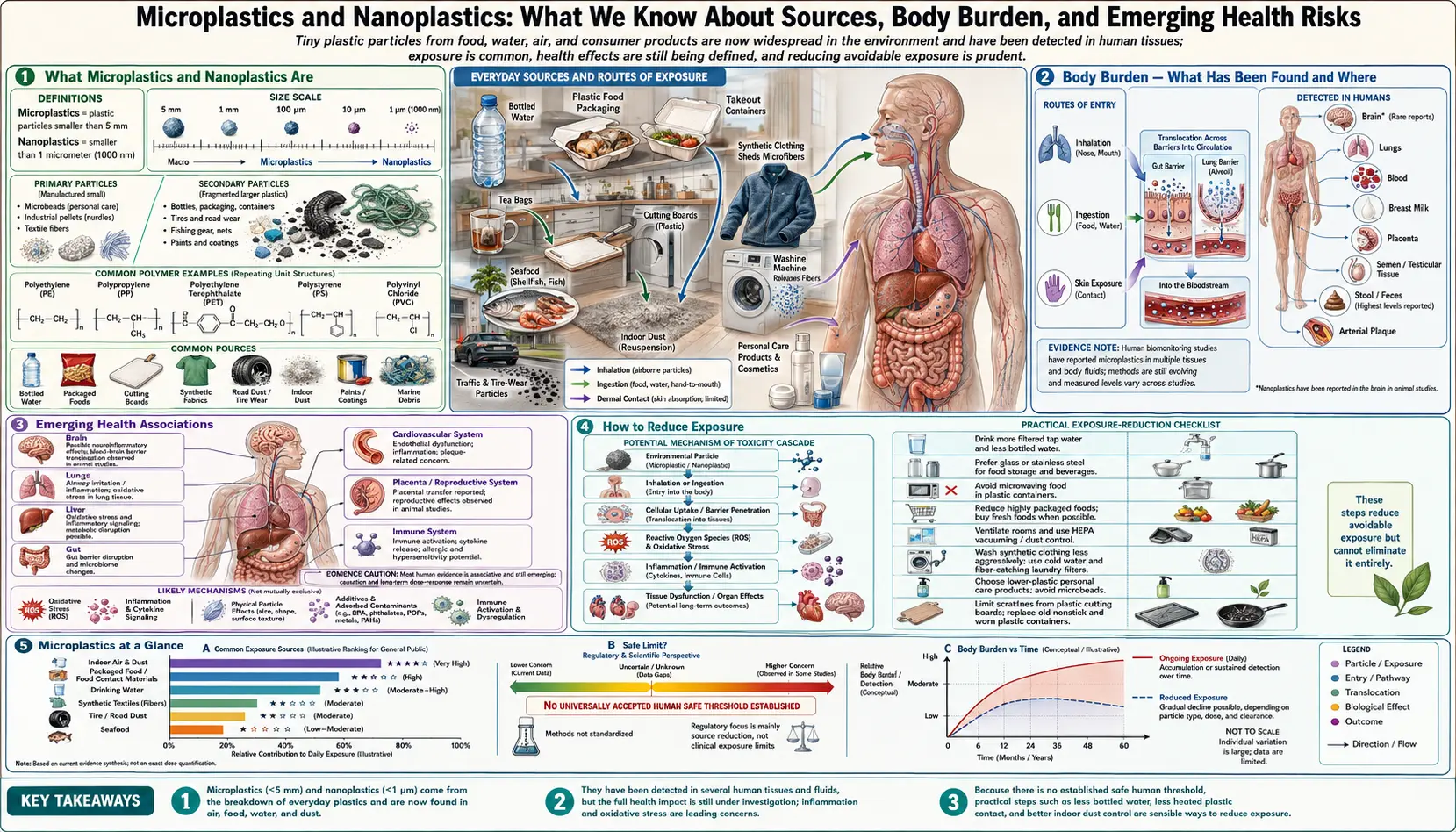
Microplastics — plastic fragments smaller than 5 mm — and their smaller siblings nanoplastics (smaller than 1 µm) are now found in essentially every environmental compartment measured and nearly every human tissue sampled. In just the past two years, studies have documented microplastics in blood, lungs, placenta, testes, breast milk, liver, kidney, and atherosclerotic plaque. A landmark 2024 paper in the New England Journal of Medicine linked the presence of microplastics in carotid-artery plaque to a 4.5-fold higher risk of heart attack, stroke, or death over three years. The research is moving rapidly, and while many mechanisms remain provisional, the cumulative picture warrants taking exposure reduction seriously.
This article explains what microplastics and nanoplastics are, where they come from, how they enter the body, what is known about their health effects, and the evidence-informed steps an individual can take to reduce exposure without chasing impossible zero.
Table of Contents
- What Microplastics and Nanoplastics Are
- Major Exposure Sources
- How Much Are We Actually Taking In?
- Body Burden — What Has Been Found and Where
- Emerging Health Associations
- Proposed Mechanisms
- What We Do Not Know, Stated Plainly
- How to Reduce Exposure
- What Is Not Worth Doing
- Can You Get Tested?
- Pregnancy, Infants and Higher-Risk Groups
- Research Papers
- Connections
- Featured Videos
What Microplastics and Nanoplastics Are
Microplastics are plastic particles smaller than 5 mm — the size of a sesame seed down to invisibility. Nanoplastics are smaller than 1 µm, roughly a hundredth the width of a human hair. That size difference is not a technicality; it decides what the particle can do. A 100 µm fragment passes through the gut and out again. A particle under about 1 µm can cross the gut lining into the bloodstream, and particles in the tens of nanometres can enter individual cells.
A helpful way to picture the scale: if a 5 mm microplastic were the size of a football, a 100 nm nanoplastic would be about the size of a grain of sand next to it — and there would be roughly a hundred billion of those grains for every football. That is why particle counts and mass estimates tell such different stories, and why the smallest particles, which are hardest to measure, are the ones most likely to matter biologically.
They come in two categories by origin:
- Primary microplastics — manufactured small: microbeads in cosmetics (now banned in many countries), industrial pellets (“nurdles”), and abrasives.
- Secondary microplastics — the overwhelming majority. Larger plastic items broken down by ultraviolet light, heat, mechanical abrasion and weathering. A carrier bag, a car tyre or a fleece jacket does not disappear; it becomes progressively smaller pieces of itself.
Chemically they are not one substance. Polyethylene, polypropylene, polyvinyl chloride, polystyrene, polyethylene terephthalate and polyamide behave differently, carry different additives, and adsorb different contaminants from their surroundings. Studies that report “microplastics” as a single exposure are aggregating a chemically diverse mixture, which is one of the main reasons the health literature is hard to synthesise.
Major Exposure Sources
Exposure happens by three routes — ingestion, inhalation and, to a much lesser degree, skin contact.
Drinking water
- Bottled water is a substantially larger source than tap. Qian and colleagues (PNAS, 2024) used a new imaging technique able to see nanoplastics and found roughly 240,000 detectable plastic particles per litre in common bottled water brands — 10 to 100 times more than earlier microplastic-only counts, and around 90% of them nanoplastics that previous methods simply could not see.
- Tap water contains far fewer particles in most municipal systems, and filtration reduces them further.
Food
- Shellfish and small whole fish, because the whole animal including its gut is eaten.
- Salt, particularly sea salt, which concentrates whatever was in the water.
- Food contact materials — plastic packaging, plastic-lined cartons and cups, plastic kettles, plastic cutting boards, and single-use plastic tea bags, which can release billions of particles into a single hot cup.
- Heating is the multiplier. Microwaving food in plastic containers releases orders of magnitude more particles than the same container at room temperature. If you change one thing, change this.
Air and dust
- Indoor air is often the dominant route, and it is the one people think about least. Synthetic carpet, upholstery and clothing shed continuously; indoor microplastic concentrations typically exceed outdoor ones.
- Tyre and road wear particles are among the largest single contributors to environmental microplastics, and to outdoor air near busy roads.
- Synthetic textiles shed fibres both while worn and in the wash; a single laundry load of polyester can release hundreds of thousands of fibres.
How Much Are We Actually Taking In?
You will have seen the claim that we swallow “a credit card a week” — about 5 g of plastic. It is worth knowing where that came from and how much weight it deserves.
Senathirajah and colleagues (Journal of Hazardous Materials, 2021) reviewed the available intake studies and estimated a global average ingestion of roughly 0.1–5 g of microplastics per week. The credit-card figure is the top of that range, and the range spans a fiftyfold spread — which tells you how uncertain the underlying data are. An earlier and more conservative estimate by Cox and colleagues (Environmental Science & Technology, 2019) put annual intake at roughly 39,000 to 52,000 particles from food alone, rising to 74,000–121,000 when inhalation is included — and found that people who drink only bottled water take in an additional ~90,000 particles a year compared with ~4,000 for those drinking tap.
Both are estimates built on incomplete sampling of a small number of foods. The honest summary is that intake is real, measurable, and dominated by a few controllable sources — not that a precise weekly mass is known.
Body Burden — What Has Been Found and Where
The last five years have replaced speculation with detection. Microplastics have now been directly measured in:
- Blood — Leslie and colleagues (Environment International, 2022) found quantifiable plastic particles in 17 of 22 healthy adult donors, at an average of about 1.6 µg/mL, dominated by PET and polystyrene. This was the first demonstration that particles reach the circulation in ordinary people.
- Placenta — Ragusa and colleagues (Environment International, 2021) found microplastic fragments in four of six human placentas, on both the maternal and fetal sides and in the membranes.
- Arterial plaque — Marfella and colleagues (NEJM, 2024), discussed below.
- Brain, liver and kidney — Nihart and colleagues (Nature Medicine, 2025) measured plastics in autopsy tissue and found concentrations in brain substantially higher than in liver or kidney, with higher levels in samples from 2024 than from 2016, and higher still in those with a dementia diagnosis. That last comparison is an association in post-mortem tissue and cannot establish direction of causation — a damaged blood–brain barrier may admit more particles rather than particles causing the damage.
- Testis and semen — Zhao, Zhu and colleagues (Science of the Total Environment, 2023) detected microplastics in human testicular tissue and semen samples.
- Lung tissue, breast milk, urine, and stool in further studies.
A necessary caveat that responsible researchers always attach: contamination during sample collection is a serious methodological problem. Plastic labware, laboratory air and even clothing can introduce particles. The strongest studies run procedural blanks and report them; weaker ones do not, and their numbers should be treated with more caution.
Emerging Health Associations
The cardiovascular finding
The most consequential human study to date is Marfella and colleagues in the New England Journal of Medicine (2024). They analysed carotid plaque removed at surgery from 257 patients and found polyethylene in about 58% and polyvinyl chloride in about 12%. Over a mean follow-up of nearly 34 months, patients whose plaque contained microplastics had a hazard ratio of 4.53 for the composite outcome of heart attack, stroke or death from any cause, compared with those whose plaque did not.
That is a large effect and it deserves to be taken seriously. It also deserves to be described accurately:
- It is a single observational study in one country, in people already unwell enough to need carotid surgery.
- It shows association, not causation. People with more plastic in their plaque may differ in other ways — occupation, diet, socioeconomic position, other exposures — that also affect cardiovascular risk. The authors adjusted for many but cannot exclude all.
- It has not yet been replicated in an independent cohort.
It is the strongest human signal we have, and it is one study. Both halves of that sentence matter.
Everything else
Beyond cardiovascular disease, human evidence is largely absent. There are laboratory and animal findings on inflammation, oxidative stress, gut barrier disruption, altered microbiome and reproductive effects — usually at particle concentrations far above realistic human exposure, and often using pristine spherical polystyrene beads that resemble weathered environmental fragments only loosely.
The World Health Organization’s assessment of microplastics in drinking water concluded that available evidence did not indicate a health risk at current levels, while stressing that the evidence base was too limited to be reassuring and calling for better research. A California regulatory framework (Coffin et al., 2022) reached a similar position: not enough data to set a health-based threshold with confidence. Anyone who tells you the science is settled — in either direction — is ahead of the evidence.
Proposed Mechanisms
These are plausible and partly demonstrated in laboratory systems; none is confirmed as operating in humans at real-world doses.
- Physical and inflammatory irritation. Particles taken up by macrophages that cannot digest them can drive chronic low-grade inflammation — the same general pattern seen with other persistent particulates such as silica and asbestos, though at vastly different potencies.
- Oxidative stress. Particle surfaces can generate reactive oxygen species, particularly when weathered.
- Chemical carrier effect. This may be the most important mechanism, and it is often overlooked. Plastics carry additives deliberately put in during manufacture — phthalate plasticisers, bisphenols, flame retardants, stabilisers — several of which are established endocrine disruptors in their own right. They also adsorb persistent organic pollutants and heavy metals from the environment. The particle may matter less than what it delivers.
- Microbiome disruption. Particles and their additives can alter gut bacterial communities in animal models.
- Barrier crossing. Nanoplastics have been shown in animals to cross the gut, placental and blood–brain barriers; the human evidence is currently detection in those tissues rather than demonstrated transport.
What We Do Not Know, Stated Plainly
An honest page has to be as clear about the gaps as about the findings.
- There is no established dose–response relationship for any human health outcome. We cannot say how much is too much.
- There is no validated human biomarker of exposure and no reference range.
- Measurement methods are not standardised. Different laboratories using different techniques on the same sample can differ by orders of magnitude, and most methods cannot see the smallest and most biologically relevant particles.
- Almost all human data are cross-sectional — a snapshot of tissue at one moment, with no way to establish what came first.
- Animal studies mostly use unrealistic doses and idealised particles, which limits what they can tell us.
- We do not know how much of the effect, if any, belongs to the particle and how much to its chemical additives.
- No intervention trial exists. Nobody has shown that reducing microplastic intake improves any health outcome.
None of this is a reason to dismiss the issue. It is a reason to act proportionately: the exposure-reduction steps below are cheap, harmless and usually improve other things too. That is a sound basis for action under uncertainty; alarm and expensive “detox” products are not.
How to Reduce Exposure
The goal is reasonable minimisation, not obsession. Ranked roughly by expected benefit for effort:
- Stop heating food in plastic. The highest-yield single change. Transfer takeaway food to glass or ceramic before reheating, never microwave in plastic, and avoid plastic-lined cups for hot drinks.
- Drink filtered tap water rather than bottled. Given the 2024 nanoplastic counts, this is the largest identified ingestion source you can remove. A reverse-osmosis or a carbon-block filter rated for particulate removal works; a simple jug filter helps less.
- Use glass or stainless steel for storage, bottles and food preparation.
- Switch to loose-leaf tea or paper bags without plastic sealing.
- Ventilate and vacuum with a HEPA filter, and damp-dust. Indoor dust is a major and easily reduced route.
- Wear natural fibres where practical — cotton, linen, wool — and wash synthetics less often, at lower temperature, in fuller loads, using a microfibre-capture bag or filter.
- Use wooden or stainless cutting boards rather than plastic, which sheds measurably with every cut.
- Replace scratched or degraded plastic containers and utensils; damaged surfaces shed far more.
- Eat mostly whole, minimally packaged food. This reduces plastic contact and improves diet quality at the same time — vegetables, fruit, olive oil, fish, eggs, legumes, nuts and whole grains such as brown rice, oats and barley.
- Moderate shellfish if it is a frequent part of your diet, since the whole gut is eaten.
What Is Not Worth Doing
- “Microplastic detox” supplements, binders, teas and cleanses. There is no evidence any product removes plastic particles from human tissue. Nothing sold for this purpose has been tested for it.
- Chelation. Chelating agents bind metals. They do nothing to plastic polymers, and they carry real risks.
- Colonic irrigation or “cleanses”, for the same reason.
- Paying for a commercial “microplastic blood test”. No validated clinical assay exists, no reference range exists, and no action could be taken on the result.
- Eliminating fish or shellfish entirely. The established cardiovascular and neurodevelopmental benefits of oily fish are far better evidenced than the harms of the microplastics it may carry. Do not trade a documented benefit for a hypothetical risk.
- Anxiety-driven avoidance of everything plastic. Complete avoidance is not achievable, and the stress and cost of trying are real harms with no demonstrated offsetting benefit.
Can You Get Tested?
Not usefully. Microplastic measurement is a research technique requiring pyrolysis gas chromatography–mass spectrometry, Raman or FTIR microscopy in a contamination-controlled laboratory. It is not available as a clinical test, there is no normal range to compare a result against, and there is no treatment that a result would change. Any company selling a consumer microplastic body-burden test is selling a number without a meaning.
Testing your water is different and can be worthwhile: certified laboratories will measure particulate content, and filter manufacturers publish independently verified removal ratings (look for NSF/ANSI certification). That is actionable in a way a blood result is not.
Pregnancy, Infants and Higher-Risk Groups
Where evidence is uncertain, precaution reasonably scales with vulnerability. The groups where extra care is most justified:
- Pregnancy — microplastics have been found on both sides of the placenta, and several plastic additives are established endocrine disruptors during fetal development. Avoiding heated plastic and bottled water during pregnancy is a low-cost precaution.
- Infant feeding — polypropylene feeding bottles release very large numbers of particles when formula is prepared at high temperature and shaken. Practical steps: sterilise the bottle, prepare and cool the formula in a non-plastic container, then transfer; rinse the bottle with cooled boiled water; avoid heating formula in the plastic bottle; and replace scratched bottles. Glass bottles avoid the issue entirely. None of this should discourage formula feeding, which is safe and necessary for many families.
- Young children, who spend more time on floors, put more objects in their mouths, and have higher intake relative to body weight.
- Occupational exposure — textile, plastics manufacturing and recycling workers have much higher inhalation exposure than the general population, and respiratory protection and workplace controls are the appropriate response.
Research Papers
Each citation below was checked against its PubMed record; the linked DOI resolves to the paper named. This is a fast-moving field, and several of these papers are single studies awaiting replication — that is noted where it applies.
- Marfella R, Prattichizzo F, Sardu C, et al. Microplastics and nanoplastics in atheromas and cardiovascular events. N Engl J Med. 2024;390(10):900–910. (PMID 38446676) — observational; not yet replicated.
- Leslie HA, van Velzen MJM, Brandsma SH, et al. Discovery and quantification of plastic particle pollution in human blood. Environ Int. 2022;163:107199. (PMID 35367073)
- Ragusa A, Svelato A, Santacroce C, et al. Plasticenta: first evidence of microplastics in human placenta. Environ Int. 2021;146:106274. (PMID 33395930)
- Nihart AJ, Garcia MA, El Hayek E, et al. Bioaccumulation of microplastics in decedent human brains. Nat Med. 2025;31(4):1114–1119. (PMID 39901044) — post-mortem association; direction of causation unknown.
- Qian N, Gao X, Lang X, et al. Rapid single-particle chemical imaging of nanoplastics by SRS microscopy. Proc Natl Acad Sci U S A. 2024;121(3):e2300582121. (PMID 38190543) — the bottled-water nanoplastic counts.
- Zhao Q, Zhu L, Weng J, et al. Detection and characterization of microplastics in the human testis and semen. Sci Total Environ. 2023;877:162713. (PMID 36948312)
- Cox KD, Covernton GA, Davies HL, et al. Human consumption of microplastics. Environ Sci Technol. 2019;53(12):7068–7074. (PMID 31184127)
- Senathirajah K, Attwood S, Bhagwat G, et al. Estimation of the mass of microplastics ingested — a pivotal first step towards human health risk assessment. J Hazard Mater. 2021;404(Pt B):124004. (PMID 33130380) — the source of the “credit card a week” figure, at the top of a 0.1–5 g/week range.
- Vethaak AD, Legler J. Microplastics and human health. Science. 2021;371(6530):672–674. (PMID 33574197)
- Coffin S, Bouwmeester H, Brander S, et al. Development and application of a health-based framework for informing regulatory action in relation to exposure of microplastic particles in California drinking water. Microplast Nanoplast. 2022;2(1):12. (PMID 35634037)
Live PubMed searches
These queries surface current peer-reviewed work as it is indexed.
- PubMed search: microplastics human health
- PubMed search: nanoplastics toxicity
- PubMed search: microplastics cardiovascular disease
- PubMed search: microplastics bottled water
- PubMed search: microplastics placenta breast milk
- PubMed search: microplastics infant feeding bottles
- PubMed search: microplastics indoor air dust
- PubMed search: microplastics gut microbiome
- PubMed search: plastic additives endocrine disruption
- PubMed search: microplastics sample contamination controls
Connections
- All Toxins
- BPA and Plastics
- Microplastics (BPA)
- PFAS
- Heavy Metals
- Pesticides
- Food Additives
- Cardiovascular Disease
- Stroke
- Dementia
- Detox Protocols
- Liver Cleansing
- Inflammatory Bowel Disease
- Atherosclerosis
- Oxidative Stress