Sodium Nitrite: The Processed Meat Preservative Linked to Cancer
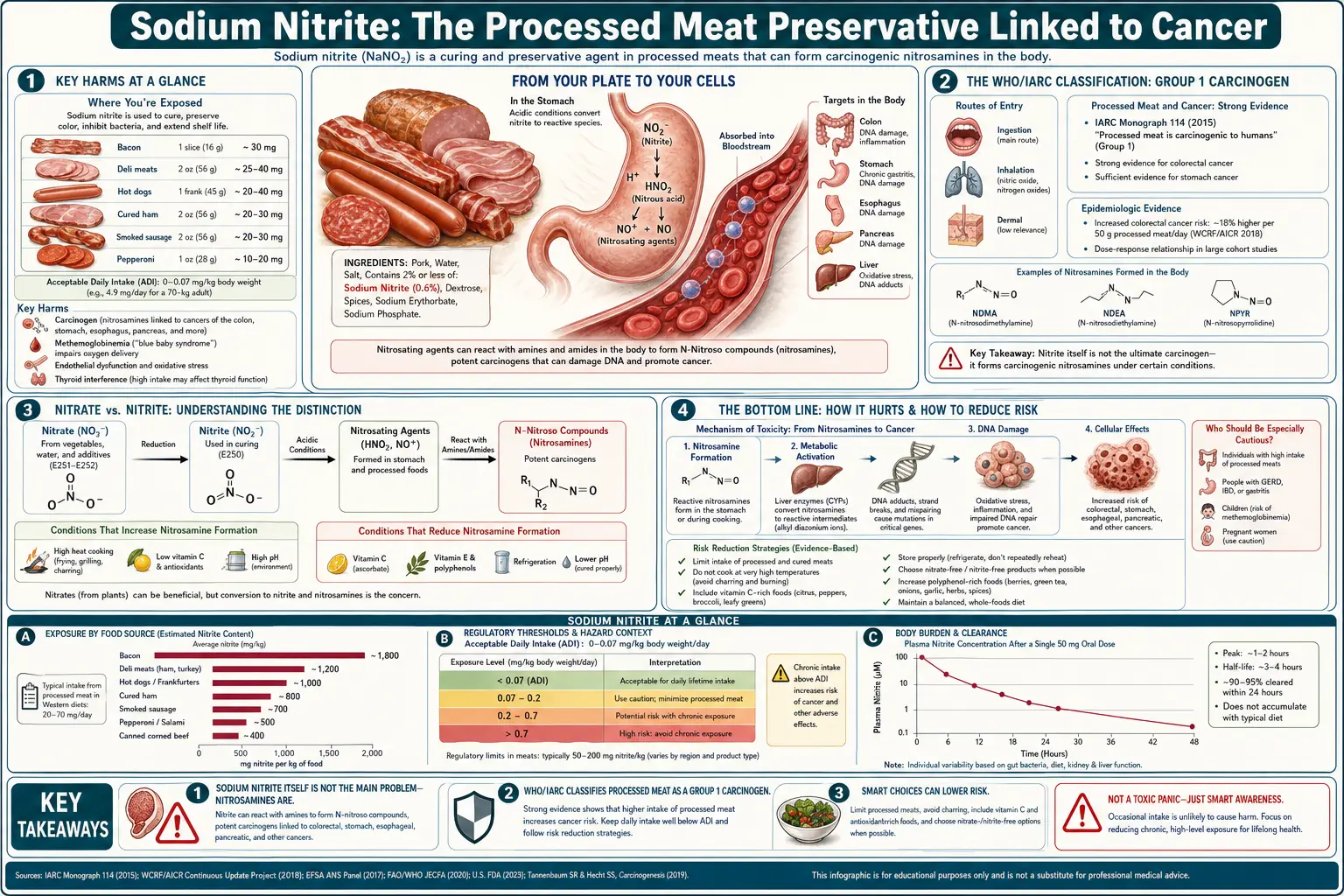
Sodium nitrite (NaNO2) is one of the most consequential food additives in the modern diet. Used almost universally in processed meats — bacon, hot dogs, deli meats, ham, sausages, pepperoni, and jerky — this preservative serves multiple functions: it prevents the growth of deadly Clostridium botulinum bacteria, gives cured meats their characteristic pink color, and contributes to their distinctive flavor. However, sodium nitrite also forms nitrosamines, a class of compounds that are among the most potent carcinogens ever identified, and its presence in processed meat is the primary reason that the World Health Organization classified processed meat as a Group 1 carcinogen in 2015.
Table of Contents
- Key Harms at a Glance
- What Is Sodium Nitrite?
- Where It Is Found (Exposure Routes)
- How Nitrosamines Form: The Cancer Mechanism
- The WHO/IARC Classification: Group 1 Carcinogen
- Cancer Types Linked to Processed Meat and Nitrites
- Why Is Sodium Nitrite Still Used?
- The “Uncured” Meat Labeling Deception
- Nitrate vs. Nitrite: Understanding the Distinction
- Safety Thresholds & Regulatory Limits
- How to Reduce Your Exposure
- The Global Perspective
- Research Papers
- Connections
- Featured Videos
Key Harms at a Glance
- Group 1 human carcinogen (as processed meat) – IARC 2015 classification, same evidence tier as tobacco and asbestos.
- Colorectal cancer – 18% relative risk increase per 50 g/day of processed meat.
- Nitrosamine formation – Occurs during frying/grilling and in stomach acid; nitrosamines are potent DNA alkylating agents.
- Stomach & pancreatic cancer – Consistent positive associations in large cohort studies.
- Methemoglobinemia – Acute high-dose exposure (including accidental ingestion of curing salts) oxidizes hemoglobin and can be fatal.
- Children particularly vulnerable – Higher intake relative to body weight; hot dogs and deli meats are a primary exposure route in pediatric diets.
What Is Sodium Nitrite?
Sodium nitrite is an inorganic compound with the chemical formula NaNO2. It is a white to slightly yellowish crystalline powder that is highly soluble in water. In the food industry, it is designated as E250 and is used as both a preservative and a color fixative in cured meat products.
It is important to distinguish sodium nitrite from the closely related sodium nitrate (NaNO3, E251). Sodium nitrate is a less reactive compound that bacteria gradually convert to sodium nitrite over time. Historically, sodium nitrate (in the form of saltpeter) was the primary curing agent, but modern manufacturers use sodium nitrite directly because it works faster and is more controllable. Both compounds can ultimately lead to the formation of carcinogenic nitrosamines.
Where Is Sodium Nitrite Found?
- Bacon — One of the highest-risk products because sodium nitrite combines with the meat's amines at high cooking temperatures to form nitrosamines. Frying bacon produces particularly high levels of nitrosamines.
- Hot dogs and frankfurters — Nearly all conventional hot dogs contain sodium nitrite. The average American consumes approximately 50 hot dogs per year.
- Deli meats and lunch meats — Ham, turkey breast, roast beef, salami, bologna, and other sliced meats sold at deli counters or in pre-packaged form almost always contain sodium nitrite.
- Ham — Both whole hams and sliced ham products are typically cured with sodium nitrite.
- Sausages — Breakfast sausages, Italian sausages, bratwurst, kielbasa, and other sausage varieties frequently contain sodium nitrite.
- Pepperoni and salami — These popular pizza toppings and sandwich meats are cured with sodium nitrite.
- Beef jerky and meat snacks — Most commercial jerky products use sodium nitrite for preservation and color.
- Canned meats — Products like canned ham, corned beef, and Vienna sausages contain sodium nitrite.
- Smoked fish — Some smoked salmon and other smoked fish products are treated with sodium nitrite.
How Nitrosamines Form: The Cancer Mechanism
The central health concern with sodium nitrite is not the compound itself but what it becomes inside your body and during cooking. When sodium nitrite reacts with amines — nitrogen-containing compounds that are naturally abundant in protein-rich foods like meat — it forms N-nitroso compounds, commonly known as nitrosamines. This reaction occurs in two primary settings:
During High-Temperature Cooking
When processed meats containing sodium nitrite are cooked at high temperatures — frying, grilling, barbecuing — nitrosamines form rapidly. The higher the temperature and the longer the cooking time, the more nitrosamines are produced. Frying bacon produces some of the highest nitrosamine levels measured in any food, with concentrations that can exceed 100 micrograms per kilogram. Even moderate heating of processed meats generates measurable nitrosamines.
During Digestion
Even if processed meat is consumed without high-temperature cooking (as with cold deli meats), nitrosamines can form in the acidic environment of the stomach. The stomach's hydrochloric acid creates conditions favorable for the reaction between nitrite and dietary amines. This means there is no truly safe way to consume sodium nitrite-containing processed meats — nitrosamine formation occurs whether the meat is cooked or not.
Why Nitrosamines Are So Dangerous
Nitrosamines are alkylating agents, meaning they transfer chemical groups to DNA, causing mutations. Specifically, nitrosamines are metabolized by liver enzymes (cytochrome P450) into reactive intermediates that form covalent bonds with DNA bases, creating DNA adducts. These adducts can cause point mutations, strand breaks, and other forms of genetic damage that initiate the cancer process. Nitrosamines are among the most potent mutagenic and carcinogenic compounds known, capable of inducing cancer in virtually every organ system in every animal species tested.
The WHO/IARC Classification: Group 1 Carcinogen
In October 2015, the International Agency for Research on Cancer (IARC), the cancer research arm of the World Health Organization, classified processed meat as a Group 1 carcinogen. This is the highest classification, reserved for substances with sufficient evidence of causing cancer in humans. Other Group 1 carcinogens include tobacco smoking, asbestos, and plutonium.
The IARC Working Group, composed of 22 experts from 10 countries, reviewed more than 800 epidemiological studies examining the association between meat consumption and cancer. Their key findings included:
- Colorectal cancer — The strongest evidence linked processed meat consumption to colorectal cancer. Each 50-gram portion of processed meat (approximately two slices of deli meat or one hot dog) eaten daily increases the risk of colorectal cancer by 18%. This finding was consistent across multiple large-scale studies conducted in different populations.
- Stomach cancer — Positive associations were also observed between processed meat consumption and stomach (gastric) cancer, with the evidence being particularly strong for populations with high processed meat intake.
- Pancreatic cancer — Some studies found associations between processed meat consumption and pancreatic cancer, though the evidence was less extensive.
The IARC emphasized that the Group 1 classification reflects the strength of the evidence that processed meat causes cancer, not the magnitude of the risk. Tobacco smoking causes far more cancer deaths than processed meat. However, the comparison is instructive: processed meat is in the same evidence category as tobacco because the scientific evidence that it causes cancer is equally robust.
Cancer Types Linked to Processed Meat and Nitrites
Colorectal Cancer
The association between processed meat and colorectal cancer is the most extensively studied and well-established. Colorectal cancer is the third most common cancer worldwide and the second leading cause of cancer death. Multiple mechanisms link sodium nitrite and processed meat to colorectal cancer:
- Nitrosamine-induced DNA damage — Nitrosamines formed from sodium nitrite cause direct DNA mutations in colorectal epithelial cells.
- Heme iron interaction — The heme iron in red and processed meat catalyzes the formation of N-nitroso compounds in the gut and also promotes lipid peroxidation, generating cytotoxic and genotoxic aldehydes.
- Chronic inflammation — Processed meat consumption promotes chronic inflammation in the gut, creating an environment that favors cancer development.
Stomach Cancer
Stomach cancer has been consistently linked to high intake of cured and processed meats across populations worldwide. The acidic stomach environment is particularly conducive to nitrosamine formation, and the gastric mucosa is directly exposed to these carcinogens. Countries with traditionally high consumption of cured, smoked, and pickled meats (Japan, Korea, parts of Eastern Europe) have historically had high rates of stomach cancer.
Pancreatic Cancer
Several large cohort studies have found that high processed meat consumption is associated with increased risk of pancreatic cancer, one of the most lethal forms of cancer. A meta-analysis published in the British Journal of Cancer found a 19% increased risk for every 50 grams of processed meat consumed daily.
Why Is Sodium Nitrite Still Used?
Given the compelling evidence linking sodium nitrite to cancer, why does it remain a staple of meat processing? Several reasons explain its continued use:
- Botulism prevention — Sodium nitrite is highly effective at preventing the growth of Clostridium botulinum, the bacterium that produces botulinum toxin, one of the most lethal biological substances known. Botulism from improperly preserved meats was a significant cause of death before the widespread use of nitrite curing. Regulators and the meat industry argue that removing sodium nitrite could lead to outbreaks of botulism.
- Color preservation — Sodium nitrite reacts with myoglobin in meat to form nitrosomyoglobin, which gives cured meats their appetizing pink or red color. Without sodium nitrite, cured meats would turn an unappealing grey-brown color. Consumer expectations of pink ham and red hot dogs drive continued use.
- Flavor — Sodium nitrite contributes to the distinctive "cured" flavor that consumers associate with bacon, ham, and other processed meats. Removing it would fundamentally change the taste of these products.
- Industry economics — The processed meat industry is worth hundreds of billions of dollars globally. Reformulating products to eliminate sodium nitrite would require significant investment in alternative preservation methods and might result in products with shorter shelf lives, different appearance, and different taste.
- Regulatory inertia — Sodium nitrite has been used in meat curing for over a century. Its GRAS (Generally Recognized as Safe) status predates modern carcinogenicity testing, and the regulatory framework makes it difficult to ban a substance with such long-established use, even when new evidence of harm emerges.
The "Uncured" Meat Labeling Deception
In response to growing consumer awareness of sodium nitrite's health risks, the meat industry has developed products labeled as "uncured," "no nitrites added," or "no nitrates added." However, these labels are deeply misleading.
Most "uncured" processed meats use celery powder, celery juice, or celery extract as a curing agent. Celery is naturally very high in nitrates, which are converted to nitrites by bacterial cultures added during processing. The end result is a product that contains the same or even higher levels of nitrites as conventionally cured meat, but with a label that implies it is nitrite-free.
- Studies measuring nitrite levels have found that "uncured" products often contain comparable concentrations of nitrite to conventionally cured products.
- The same nitrosamines form when "uncured" meats are cooked at high temperatures, because the chemistry is identical regardless of whether the nitrite came from a synthetic source or celery powder.
- Consumer deception — Research shows that consumers interpret "uncured" and "no nitrites added" labels as meaning the product is healthier or nitrite-free. This is false. The USDA permits this labeling despite its misleading nature.
- "Natural" does not mean safe — Nitrite from celery is chemically identical to synthetic sodium nitrite. The body cannot distinguish between them. A nitrosamine formed from celery-derived nitrite is just as carcinogenic as one formed from synthetic nitrite.
Consumer advocacy groups have repeatedly petitioned the USDA to require more accurate labeling of these products, but the industry has resisted changes that would undermine the "natural" and "uncured" marketing narrative.
Nitrate vs. Nitrite: Understanding the Distinction
Nitrates (NO3-) and nitrites (NO2-) are related but distinct compounds, and understanding the difference is important for evaluating health risks:
- Nitrates are relatively stable compounds found naturally in vegetables (especially leafy greens, beets, and celery), soil, and water. Nitrates themselves are not directly harmful and may even have cardiovascular benefits (they are converted to nitric oxide, which dilates blood vessels).
- Nitrites are more reactive compounds that serve as the direct precursor to nitrosamines. Bacteria in the mouth and gut convert dietary nitrates to nitrites. Sodium nitrite is added directly to processed meats.
- The critical difference is the context in which nitrites are present. In vegetables, nitrites coexist with vitamin C, polyphenols, and other antioxidants that inhibit nitrosamine formation. In processed meat, nitrites coexist with amines, heme iron, and protein — a chemical environment that promotes nitrosamine formation. This is why vegetable consumption (despite its nitrate content) is associated with reduced cancer risk, while processed meat consumption is associated with increased cancer risk.
Safety Thresholds & Regulatory Limits
- JECFA ADI – The Joint FAO/WHO Expert Committee on Food Additives set an Acceptable Daily Intake for nitrite ion of 0–0.07 mg/kg body weight/day (expressed as nitrite ion).
- US FDA – Permits sodium nitrite in cured meats at a maximum of 156 ppm (200 ppm for bacon, with required ascorbate/erythorbate), under 9 CFR 424.21.
- EU (E250) – Regulation (EC) No 1333/2008 sets a maximum input of 150 mg/kg for most cured meats, with a 2023 revision lowering the limit to 80 mg/kg for some categories, phased in through 2025.
- Acute toxicity (methemoglobinemia) – Adult oral lethal dose estimated at 2–9 g; infants and adults with G6PD deficiency are far more sensitive.
- No safe threshold for nitrosamine exposure – As genotoxic carcinogens, regulators treat N-nitroso compound exposure as having no identifiable threshold below which risk is zero.
How to Reduce Your Exposure
- Reduce or eliminate processed meat consumption — This is the single most effective step. The WHO evidence shows a clear dose-response relationship: the more processed meat you eat, the higher your cancer risk.
- Do not be fooled by "uncured" labels — Products labeled "uncured" or "no nitrites added" typically contain celery-derived nitrites and carry the same cancer risk.
- If you eat bacon, cook it gently — Lower cooking temperatures produce fewer nitrosamines than high-heat frying. Microwaving bacon produces fewer nitrosamines than pan-frying.
- Consume vitamin C-rich foods with cured meats — Vitamin C (ascorbic acid) inhibits nitrosamine formation. Some manufacturers add ascorbic acid or erythorbic acid to cured meats for this reason. Eating citrus fruits or other vitamin C sources with processed meats may offer some protection.
- Choose truly preservative-free options — Some small-scale and artisanal meat producers make products without any form of nitrite or nitrate. These products typically have shorter shelf lives and different color (grey rather than pink).
- Replace processed meats with alternatives — Use fresh-cooked chicken, turkey, or roast beef for sandwiches instead of deli meats. Choose fresh sausages (which often do not contain sodium nitrite) over cured sausages.
- Eat more plant-based meals — Replacing even some processed meat meals with plant-based alternatives significantly reduces nitrosamine exposure and overall cancer risk.
- Protect children especially — Children are particularly vulnerable due to their higher food intake relative to body weight and their developing biology. Hot dogs and deli meats are among the most commonly consumed processed meat products by children in the United States. Limiting or eliminating these from children's diets is especially important.
The Global Perspective
While no major country has banned sodium nitrite outright due to its role in botulism prevention, many nations have taken steps to limit exposure:
- European Union — Has set lower maximum permitted levels of sodium nitrite in meat products than the United States, and the EU continues to review and lower these limits.
- France — In 2022, the French National Assembly's food safety committee recommended progressively banning nitrites and nitrates as food additives by 2025, responding to IARC evidence and strong consumer advocacy.
- Denmark — Has historically maintained some of the strictest limits on nitrite in meat products in Europe.
- Several countries have launched public health campaigns specifically advising citizens to reduce processed meat consumption based on the WHO cancer classification.
The Bottom Line
Sodium nitrite transforms processed meat into a delivery system for some of the most potent carcinogens known to science. The World Health Organization has classified processed meat as a Group 1 carcinogen — the same category as tobacco and asbestos — primarily because of the nitrosamines that form from sodium nitrite. Every 50 grams of processed meat consumed daily increases colorectal cancer risk by 18%. "Uncured" and "no nitrites added" labels offer false reassurance, as these products typically contain celery-derived nitrites that produce the same carcinogenic nitrosamines.
The most effective way to protect yourself and your family is to reduce or eliminate processed meat from your diet. When the WHO places something in the same carcinogen category as tobacco smoking, that is a signal worth heeding.
Research Papers
The following peer-reviewed citations underpin the claims on this page. Links resolve to PubMed topic search or the publisher DOI.
- Bouvard V, Loomis D, Guyton KZ, et al. (IARC Monograph Working Group). Carcinogenicity of consumption of red and processed meat. Lancet Oncology. 2015;16(16):1599-1600.
- Search PubMed
- PubMed topic search: sodium nitrite nitrosamine carcinogenesis
- PubMed topic search: processed meat colorectal cancer cohort
- PubMed topic search: N-nitroso compounds gastric cancer
- PubMed topic search: heme iron N-nitroso colon
- PubMed topic search: processed meat pancreatic cancer meta-analysis
- PubMed topic search: nitrite methemoglobinemia infant
- PubMed topic search: ascorbate nitrosamine inhibition cured meat
- PubMed topic search: celery powder nitrite uncured
- IARC Press Release No. 240 (2015): IARC Monographs evaluate consumption of red meat and processed meat.
- WHO Q&A on the carcinogenicity of red meat and processed meat.
Connections
- All Toxins
- Beef
- Potassium Sorbate
- Preservatives
- BHA and BHT
- Nisin
- Natamycin
- US vs EU Food Safety
- Banned Additives
- Food Dyes Banned Worldwide
- Acesulfame Potassium
- Pork
- Sodium Nitrite and Sodium Nitrate
- Cancer
- Iron
- Vitamin C
- Anti-Inflammatory Diet
- Brominated Vegetable Oil