Tinnitus: Natural Support & Research Hub
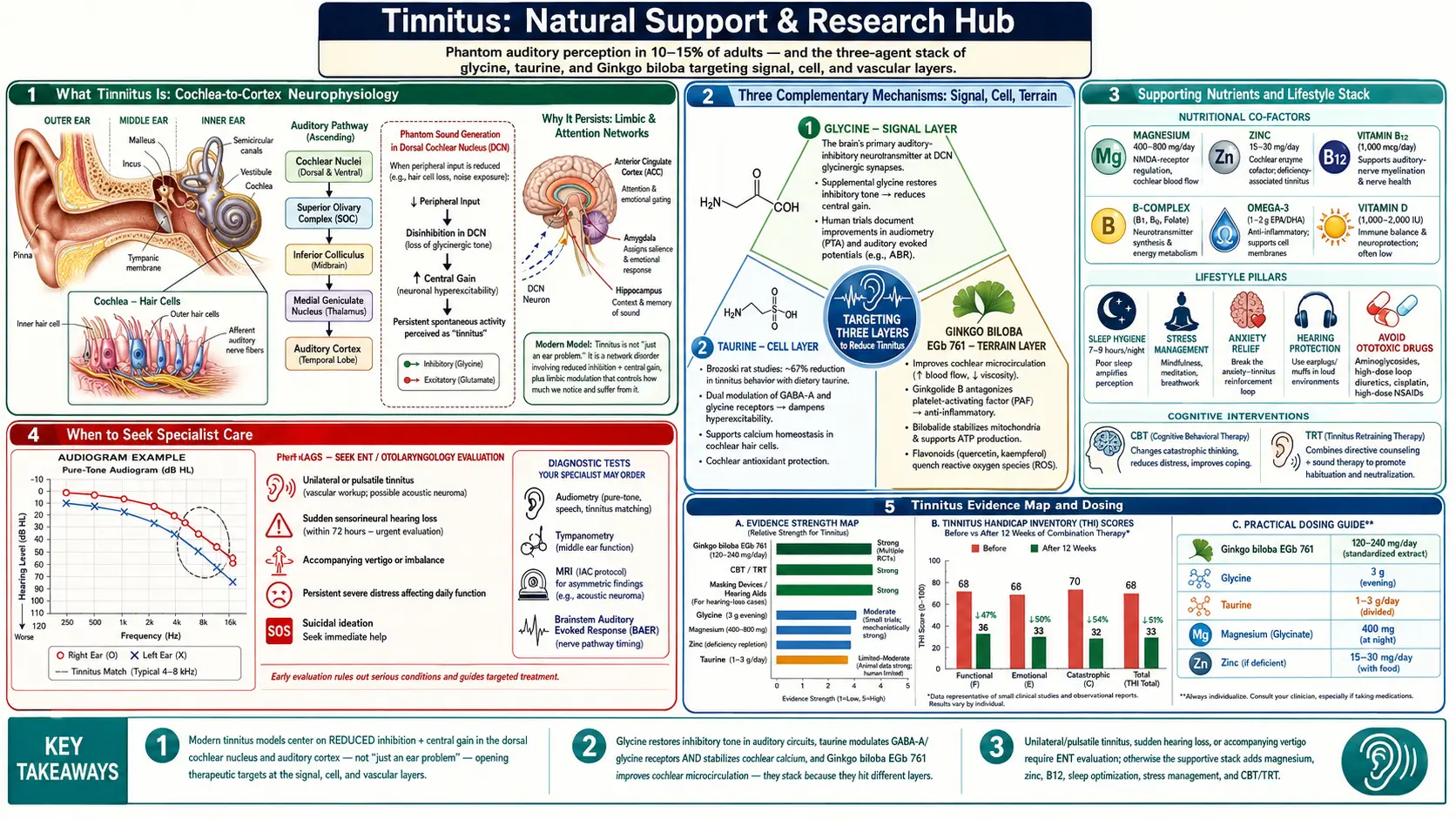

Tinnitus — the perception of ringing, buzzing, hissing, or humming sounds in the ears without an external source — affects an estimated 10–15% of adults worldwide, with roughly 50 million people in the United States alone experiencing some form of it. For many, tinnitus is intermittent and mild; for others, it is a persistent presence that affects sleep, concentration, mood, and quality of life. The modern scientific understanding of tinnitus has moved far beyond the old notion of a simple "ear problem." It is now recognized as a complex neurophysiological phenomenon rooted in the interaction between the cochlea, the auditory brainstem, and higher brain regions — and this expanded model has opened the door to a rich landscape of nutritional, herbal, and lifestyle strategies that support the ear-brain axis.
This hub collects in-depth, research-driven articles on three of the most promising, well-studied natural agents for tinnitus support: glycine, taurine, and Ginkgo biloba. Each targets a different slice of the tinnitus puzzle — glycine restores inhibitory signaling in auditory circuits, taurine stabilizes calcium balance and modulates GABA/glycine receptors in cochlear and brainstem neurons, and Ginkgo biloba (standardized as EGb 761) improves microcirculation and protects inner-ear and neural tissue from oxidative stress. Used thoughtfully, these three work through complementary mechanisms, making them natural partners in a comprehensive tinnitus-support protocol.
Research Topics
Glycine Benefits for Tinnitus
Glycine is one of the brain's primary inhibitory neurotransmitters, and it is especially active in the auditory pathways. Contemporary tinnitus research has converged on a model in which the phantom sound arises from reduced inhibition — too much neural noise in hearing circuits. Because glycine provides much of that inhibition (particularly in the dorsal cochlear nucleus), boosting glycinergic signaling is now one of the most actively researched therapeutic avenues. Human studies have documented measurable improvements in hearing sensitivity and auditory evoked potentials with glycine supplementation, and glycine receptors (GlyR) have been explicitly described in peer-reviewed journals as a "unique target for tinnitus pharmacotherapy."
- Glycine as the auditory system's main "calming" molecule
- Human trials: improvements in audiometry and auditory evoked potentials
- Dorsal cochlear nucleus (DCN) plasticity and glycinergic synapses
- Glycine's contribution to glutathione synthesis and inner-ear antioxidant defense
- Dietary sources, supplementation doses, and evening-dose/sleep benefits
Taurine Benefits for Tinnitus
Taurine is one of the most abundant free amino acids in the brain, heart, and inner ear, where it plays a central role in calcium homeostasis, membrane stability, osmoregulation, and antioxidant defense. Landmark animal studies from Brozoski and colleagues demonstrated that dietary taurine supplementation produced a striking reduction — on the order of 60–70% — in tinnitus-related behavior in rats, without impairing normal hearing. Taurine modulates both GABA-A and glycine receptors in the auditory brainstem and inferior colliculus, helping restore the inhibition/excitation balance that goes awry in tinnitus.
- Brozoski et al. rat studies: ~67% reduction in tinnitus behavior with dietary taurine
- Dual GABA-A and glycine receptor modulation in auditory brainstem neurons
- Calcium homeostasis in cochlear hair cells and synaptic ribbon function
- Antioxidant protection of the cochlea against noise and oxidative stress
- Dietary sources (seafood, shellfish, organ meats) and supplementation ranges
Ginkgo Biloba Benefits for Tinnitus
Ginkgo biloba is the single most studied herbal therapy for tinnitus. The standardized extract EGb 761 — containing 24% flavone glycosides and 6% terpene lactones (ginkgolides A/B/C and bilobalide) — has been used in European clinical practice for decades and is the subject of dozens of clinical trials. Its mechanisms are multi-layered: ginkgolide B antagonizes platelet-activating factor (PAF), flavonoids provide potent antioxidant protection, bilobalide stabilizes mitochondria, and the extract as a whole improves microcirculation in the cochlea and brain. Positive trial data at doses of 120–240 mg/day EGb 761 make Ginkgo a cornerstone of herbal tinnitus support.
- EGb 761: the standardized extract behind the strongest positive trial data
- Flavonoids, ginkgolides, and bilobalide — what each constituent does
- Improved cochlear and cerebral microcirculation
- Platelet-activating factor (PAF) antagonism by ginkgolide B
- Clinical trials: Morgenstern & Biermann, Spiegel, von Boetticher meta-analysis
Why These Three Work Together
Glycine, taurine, and Ginkgo biloba are not redundant — they act on different layers of the tinnitus picture, which is precisely why they stack so well.
- Glycine restores inhibitory neurotransmission in central auditory circuits, quieting the overactive firing that the brain interprets as phantom sound.
- Taurine stabilizes cellular calcium and membrane function in both hair cells and auditory neurons, while simultaneously modulating GABA-A and glycine receptors.
- Ginkgo biloba addresses the vascular and oxidative layer — improving blood flow to the cochlea and auditory nerve, scavenging free radicals, and protecting mitochondria.
Put differently: glycine and taurine work primarily on the signal (how auditory neurons fire and communicate), while Ginkgo works on the terrain (the blood supply, oxygenation, and oxidative state of the tissue those neurons live in). Many tinnitus-support protocols combine all three, often alongside magnesium, zinc, B-complex vitamins, and sleep/stress interventions.
Supporting Nutrients & Lifestyle Factors
Alongside the three primary agents in this hub, these factors are commonly addressed in comprehensive tinnitus-support protocols:
- Magnesium — supports NMDA-receptor regulation and cochlear blood flow
- Zinc — essential cofactor for cochlear enzymes; deficiency is associated with tinnitus in some populations
- Vitamin B12 — supports myelination of the auditory nerve
- Sleep hygiene — poor sleep amplifies tinnitus perception; restoring sleep reduces distress
- Stress management — the limbic system gates how much attention the brain gives to the phantom sound
- Natural anxiety relief — anxiety and tinnitus reinforce each other; calming the nervous system helps break the loop
Connections
- All Remedies
- Taurine for Tinnitus
- Ginkgo Biloba for Tinnitus
- Glycine for Tinnitus
- Tinnitus (Disease)
- Magnesium
- Zinc
- Taurine
- Glycine
- Ginkgo Biloba
- Vitamin B12
- Natural Anxiety Relief
- Stress Management
- Sleep Hygiene
- Dizziness & Vertigo
- Oxidative Stress
- Calcium
- Aspirin
- Vertigo Menieres Disease