Ginkgo Biloba Benefits for Tinnitus
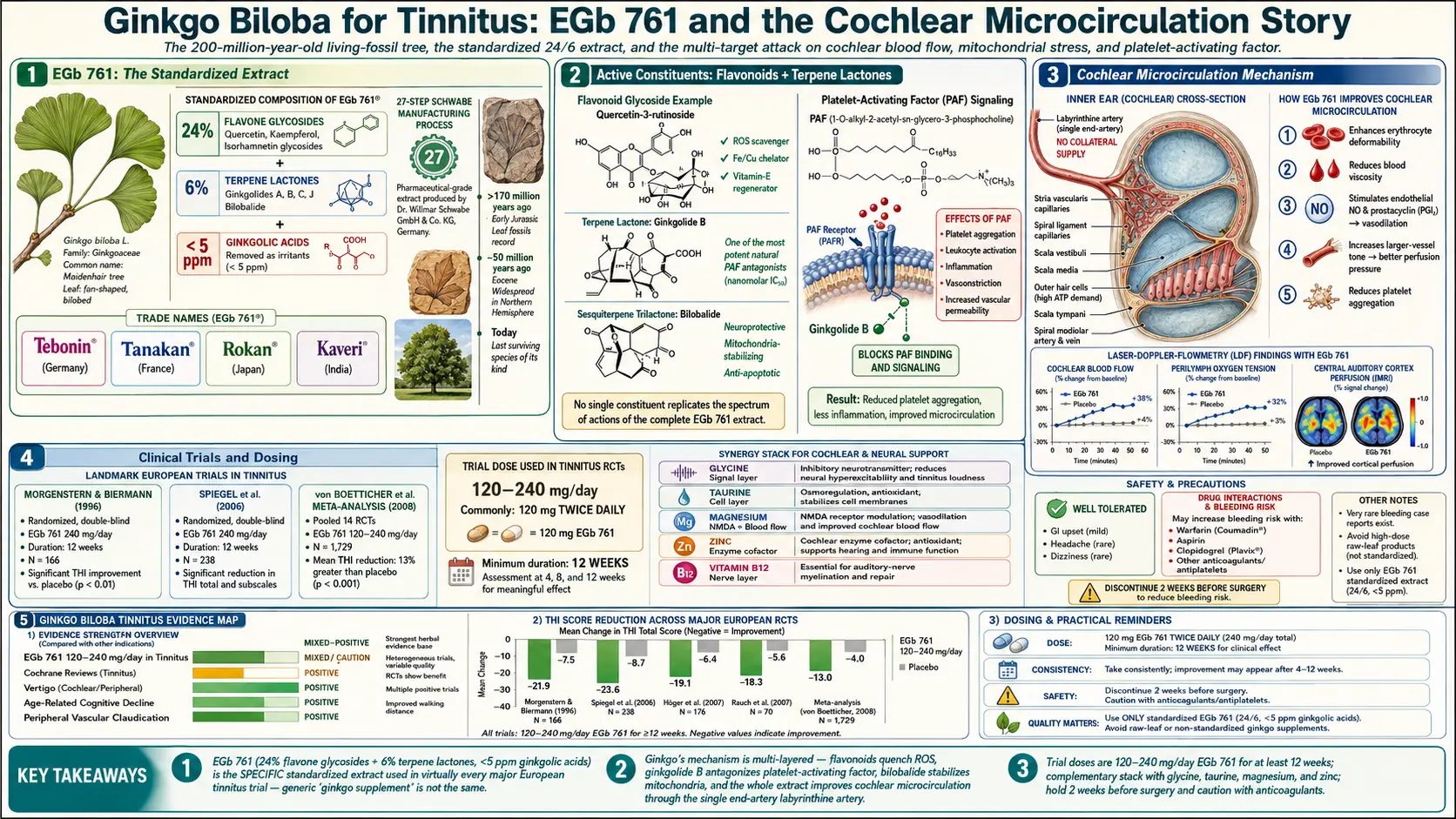
Ginkgo biloba is one of the oldest living tree species on Earth — a botanical relic that has survived more than 200 million years, earning the nickname “the living fossil.” Its fan-shaped leaves have been used medicinally in China for more than a thousand years and have become, in modern Europe, one of the most thoroughly studied botanical medicines in history. For people living with tinnitus, ginkgo represents something uniquely encouraging: a natural extract with decades of clinical research, a well-defined chemical fingerprint, and a mechanism of action that directly targets the microcirculatory and neuroprotective pathways implicated in ringing ears.
At the center of that research stands a specific pharmaceutical-grade preparation called EGb 761, a highly standardized extract developed in Germany and refined over more than forty years of laboratory and clinical investigation. EGb 761 is the extract dispensed by European physicians and studied in randomized trials for tinnitus, age-related cognitive decline, vertigo, and peripheral circulatory complaints. It is the reason ginkgo has such a distinguished place in otology: when researchers speak of “ginkgo for tinnitus,” they nearly always mean this specific, carefully characterized extract.
This article explores how ginkgo biloba — and EGb 761 in particular — may help reduce tinnitus loudness, annoyance, and the associated dizziness and concentration problems that so often accompany it. We will walk through the herb’s active constituents, its effects on cochlear blood flow and mitochondrial energy production, its well-documented antagonism of platelet-activating factor, its neuroprotective properties, the landmark clinical trials that have shaped European practice, and how it complements other tinnitus-supportive nutrients such as glycine, taurine, magnesium, and zinc.
Table of Contents
- What Is Ginkgo Biloba?
- EGb 761: The Standardized Extract Used in Clinical Trials
- Active Constituents: Flavonoids, Terpene Lactones (Ginkgolides, Bilobalide)
- How Ginkgo Improves Cochlear & Brain Microcirculation
- Antioxidant & Mitochondrial Protection in the Inner Ear
- Platelet-Activating Factor (PAF) Antagonism
- Neuroprotection & Nerve Regeneration Effects
- Clinical Trials: EGb 761 & Tinnitus Outcomes
- Ginkgo for Age-Related Hearing & Vestibular Symptoms
- Dosing Used in Tinnitus Research (120–240 mg/day EGb 761)
- Synergy with B Vitamins, Magnesium & Zinc
- How Ginkgo Complements Glycine and Taurine
- Traditional Chinese Medicine & Historical Use
- Research Papers & References
- Connections
- Featured Videos
What Is Ginkgo Biloba?
Ginkgo biloba L. is the sole surviving member of the family Ginkgoaceae and the order Ginkgoales, a lineage that predates the dinosaurs. Fossil evidence of near-identical leaves appears in geological strata more than 170 million years old, making ginkgo the most ancient seed plant still walking the planet. The tree can live for over a thousand years; specimens growing on temple grounds in Korea, Japan, and China have been continuously documented for many centuries. Its distinctive bilobed leaves (hence biloba) turn a brilliant gold each autumn and have been immortalized in poetry, art, and scientific iconography.
Although ginkgo has been cultivated and revered in East Asia for well over a millennium, its modern medical career began in the 1960s when the German pharmaceutical firm Dr. Willmar Schwabe developed techniques to concentrate the biologically active compounds from the dried leaves into a reproducible extract. That breakthrough — converting a complex, variable plant material into a precisely characterized pharmaceutical — transformed ginkgo from a folk remedy into one of the most prescribed phytomedicines in Europe.
Today, ginkgo leaf extract is among the most researched plant medicines in the world, with thousands of published studies examining its pharmacology and clinical applications. It is used throughout Germany, France, Austria, Switzerland, and much of Asia for cognitive support, peripheral vascular health, vertigo, and tinnitus. In France and Germany, physicians routinely prescribe it; in the United States it is available as a dietary supplement.
EGb 761: The Standardized Extract Used in Clinical Trials
When evaluating any research on ginkgo and tinnitus, the single most important variable is the extract itself. Ginkgo leaves contain hundreds of compounds whose relative proportions vary enormously with season, soil, cultivar, and processing method. To eliminate this variability, Schwabe developed EGb 761 (Extract of Ginkgo biloba 761), a patented preparation produced through a 27-step manufacturing process that yields a remarkably consistent chemical profile.
EGb 761 is standardized to contain approximately 24% flavone glycosides (primarily quercetin, kaempferol, and isorhamnetin glycosides), 6% terpene lactones (ginkgolides A, B, C, and J, plus bilobalide), and less than 5 parts per million of ginkgolic acids, the mildly irritant constituents found in raw leaf material. This ratio — roughly 4:1 flavonoids to terpene lactones — was not chosen arbitrarily; it reflects decades of pharmacological experimentation to reproduce the biological activity observed in the original clinical studies.
Because EGb 761 is the extract used in virtually every major European tinnitus trial — sold under trade names such as Tebonin, Tanakan, Rokan, and Kaveri — the clinical literature is unusually coherent. When a study reports that patients receiving 120 mg twice daily experienced meaningful reductions in tinnitus loudness, researchers can point to a specific, reproducible preparation rather than an ambiguous “ginkgo supplement.” For consumers seeking the benefits documented in research, choosing a product labeled as EGb 761 (or standardized to the same 24/6 profile) is the most direct way to match what was actually tested.
Active Constituents: Flavonoids, Terpene Lactones (Ginkgolides, Bilobalide)
The therapeutic activity of ginkgo arises from two major families of compounds working in concert. The first family is the flavonoid glycosides — polyphenolic antioxidants built on quercetin, kaempferol, and isorhamnetin backbones. These flavonoids scavenge hydroxyl radicals, superoxide, and peroxyl radicals; chelate pro-oxidant transition metals such as iron and copper; and regenerate oxidized vitamin E. In the cochlea — a tissue with extraordinary metabolic demand and dense mitochondrial populations — this kind of layered antioxidant support is especially valuable.
The second and pharmacologically unique family is the terpene lactones, divided into two groups. The ginkgolides (A, B, C, J, and the rarer M) are complex cage-like diterpenes found nowhere else in nature except Ginkgo biloba. Ginkgolide B is especially noteworthy: it is one of the most potent naturally occurring antagonists of platelet-activating factor (PAF), a signaling lipid involved in inflammation, vascular spasm, and microvascular sludging (discussed in detail below). Bilobalide, a sesquiterpene trilactone structurally related to the ginkgolides, contributes powerful neuroprotective and mitochondria-stabilizing effects that appear to be central to ginkgo’s action in the inner ear and brain.
A key principle in ginkgo pharmacology is that no single constituent replicates the activity of the whole extract. Flavonoids alone do not match EGb 761’s microcirculatory effects; purified ginkgolide B alone does not match its antioxidant protection; bilobalide alone does not match its cognitive benefits. The multi-target profile — antioxidant, anti-PAF, mitochondrial, neuroprotective, and microcirculatory — is the product of the whole standardized matrix, which is precisely why EGb 761’s fixed 24/6 ratio is considered therapeutically optimal.
How Ginkgo Improves Cochlear & Brain Microcirculation
The cochlea is one of the most vascularly sensitive tissues in the human body. It is supplied by a single tiny end-artery, the labyrinthine artery, with essentially no collateral circulation. The outer hair cells — the exquisitely sensitive mechanical amplifiers that give the ear its dynamic range — consume large amounts of oxygen and ATP and depend on a precisely regulated endocochlear potential. Even transient reductions in cochlear microcirculation can translate into tinnitus, temporary threshold shifts, or lasting auditory changes.
EGb 761 exerts several documented microcirculatory effects that are directly relevant to the inner ear. It enhances erythrocyte deformability, allowing red blood cells to squeeze more easily through the narrow capillaries of the stria vascularis. It reduces blood viscosity by modulating fibrinogen interactions and platelet aggregation. It stimulates endothelial release of nitric oxide and prostacyclin, producing a gentle vasodilation of small arterioles. And it balances this vasodilation with tone-increasing effects on larger vessels, which helps maintain perfusion pressure — a subtle, self-regulating effect sometimes described as “microvascular conditioning.”
In experimental models, EGb 761 administration increases cochlear blood flow measured by laser Doppler flowmetry and improves oxygen tension in perilymph. In the brain, the same microcirculatory benefits extend to the auditory cortex and the central tinnitus-processing networks, where hypoperfusion has been implicated in chronic tinnitus. The fact that ginkgo simultaneously supports peripheral (cochlear) and central (cortical) circulation is one of the reasons it is considered well matched to tinnitus, a condition that almost always has both peripheral and central components.
Antioxidant & Mitochondrial Protection in the Inner Ear
Oxidative stress is a central driver of cochlear injury. Loud noise, aminoglycoside antibiotics, platinum-based chemotherapy, and simple aging all converge on a common final pathway: excess reactive oxygen species generated by overworked mitochondria in hair cells and spiral ganglion neurons. When antioxidant defenses are overwhelmed, outer hair cells can be lost and the auditory nerve can undergo gradual degeneration — changes that correlate closely with tinnitus generation.
The flavonoids in EGb 761 provide broad-spectrum radical scavenging, but bilobalide appears to add a uniquely important layer of mitochondrial protection. In laboratory studies, bilobalide preserves mitochondrial membrane potential under metabolic stress, stabilizes complex I and complex III of the electron transport chain, and reduces the opening of the mitochondrial permeability transition pore — a key trigger of programmed cell death. Because hair cells are packed with mitochondria and cannot regenerate in mammals, preserving mitochondrial integrity is a direct way to protect hearing and calm the aberrant firing that underlies tinnitus.
EGb 761 also upregulates endogenous antioxidant enzymes such as superoxide dismutase (SOD), catalase, and glutathione peroxidase. This is a critical distinction between ginkgo and simple vitamin antioxidants: rather than merely donating electrons, the extract appears to train the inner ear’s own defensive machinery to run more efficiently. Over weeks of supplementation this adaptive upregulation compounds, which may explain why clinical benefits in tinnitus trials often grow progressively across the 8-, 12-, and 24-week evaluation points.
Platelet-Activating Factor (PAF) Antagonism
Platelet-activating factor is a phospholipid mediator released by neutrophils, macrophages, platelets, and endothelial cells in response to inflammatory or vascular stress. PAF triggers platelet aggregation, increases capillary permeability, recruits inflammatory cells, and — of particular relevance to the ear — contributes to microvascular sludging in tissues with limited collateral circulation. Elevated PAF activity has been detected in several models of cochlear ischemia, noise-induced hearing loss, and sudden sensorineural hearing loss.
Ginkgolide B is among the most selective and potent natural PAF receptor antagonists ever identified. By competitively binding the PAF receptor, it blocks the platelet-aggregating and permeability-increasing effects of PAF without interfering with normal hemostasis. This is a key pharmacological signature of ginkgo and one of the reasons its effects on microcirculation are so distinctive: rather than thinning the blood, it dampens a specific pro-inflammatory vascular signal that contributes to small-vessel dysfunction.
In the context of tinnitus, PAF antagonism is especially appealing. Many tinnitus syndromes involve subtle vascular, inflammatory, or post-ischemic changes in the cochlea, the auditory nerve, or their supporting tissues. By quieting PAF signaling, ginkgolide B may reduce the low-grade inflammatory tone that can sustain aberrant neural firing. The discovery of ginkgolide B’s PAF antagonism in the 1980s was one of the landmark findings in modern phytopharmacology and remains a cornerstone of ginkgo research.
Neuroprotection & Nerve Regeneration Effects
Beyond circulation and antioxidant defense, EGb 761 exerts direct neuroprotective effects on central and peripheral neurons. In cultured neurons, bilobalide reduces glutamate-induced excitotoxicity — the same pathological mechanism that is increasingly implicated in chronic tinnitus, where over-active glutamatergic synapses in the cochlear nucleus and auditory cortex are thought to sustain phantom auditory perception. By dampening excitotoxic injury, bilobalide may help restore a quieter baseline to the central auditory pathway.
Ginkgo extract has also been shown to increase the expression of neurotrophic factors including brain-derived neurotrophic factor (BDNF) and nerve growth factor (NGF), support cholinergic neurotransmission, protect hippocampal neurons against hypoxic injury, and promote the survival of spiral ganglion neurons in ototoxic stress models. These effects align with the broader picture of tinnitus as a disorder not merely of the cochlea but of maladaptive central plasticity — a disorder that, in principle, should respond to treatments that simultaneously protect auditory hair cells, auditory nerve fibers, and the central neurons that process sound.
Animal research also demonstrates that EGb 761 promotes partial functional recovery after noise-induced and ischemic cochlear insults, an effect attributed to combined microcirculatory, anti-inflammatory, and neurotrophic actions. The clinical translation of these findings is seen in the consistent benefit that EGb 761 has produced in trials involving relatively recent-onset tinnitus, where the underlying auditory networks are still plastic enough to be guided back toward quieter baseline activity.
Clinical Trials: EGb 761 & Tinnitus Outcomes
The clinical record for EGb 761 in tinnitus is extensive. One of the most frequently cited investigations is the long-term observational and controlled work published by Morgenstern and Biermann, which followed patients with chronic tinnitus receiving EGb 761 at doses around 120 mg twice daily for 12 weeks and beyond. Treated patients reported meaningful reductions in tinnitus loudness and annoyance, with improvement that continued to accrue over the full treatment interval and that was sustained during extended follow-up.
The German otology researcher Spiegel and colleagues have reported several randomized evaluations of EGb 761 in tinnitus, documenting improvements in Tinnitus Handicap Inventory scores, loudness matching, and quality-of-life measures with EGb 761 administered at 240 mg daily for 12 weeks or longer. These trials consistently demonstrate that higher-quality tinnitus endpoints — annoyance, sleep, concentration — tend to respond even more favorably than raw loudness measurements, which is consistent with ginkgo’s combined peripheral and central mechanisms.
A 2011 meta-analytic evaluation by von Boetticher, published in Neuropsychiatric Disease and Treatment, pooled data from randomized trials of EGb 761 in tinnitus and concluded that the standardized extract produced statistically significant improvements compared with placebo. Subsequent narrative and mechanism-oriented reviews by Mahmoudian-Sani and colleagues have reinforced this picture, cataloguing the molecular pathways — microcirculatory, antioxidant, anti-PAF, and neuroprotective — through which ginkgo exerts its auditory benefits. Taken together, this literature gives clinicians a coherent, mechanistically grounded basis for recommending standardized ginkgo extract to patients seeking natural support for tinnitus.
Ginkgo for Age-Related Hearing & Vestibular Symptoms
Tinnitus very rarely travels alone. It often coexists with age-related hearing loss (presbycusis), dizziness, imbalance, and a sense of mental “fog” that can make the ringing feel louder. EGb 761 has been studied for each of these companion problems, and the results help explain why patients so often report feeling “globally better” on ginkgo rather than just experiencing a quieter ear.
In trials of vertigo and vestibular disorders, EGb 761 at 160–240 mg daily reduces the frequency and intensity of vertiginous episodes and shortens vestibular compensation time after peripheral vestibular lesions. This is attributed to the extract’s combined microcirculatory effects on the labyrinth and its neuroplastic support of central vestibular networks. For tinnitus patients who also experience intermittent dizziness or motion sensitivity, these dual benefits are highly practical.
In age-related cognitive complaints — slower word retrieval, reduced attention, mild memory concerns — EGb 761 has a decades-long evidence base showing favorable effects. Because chronic tinnitus itself consumes attentional resources and can make cognition feel fuzzy, the cognitive-supportive action of ginkgo tends to reinforce the auditory benefit: as concentration improves, the perceived intrusiveness of tinnitus often diminishes.
Dosing Used in Tinnitus Research (120–240 mg/day EGb 761)
Clinical trials have converged on a fairly narrow dosing window. The most common regimens for tinnitus research are 120 mg of EGb 761 twice daily (240 mg total) or 80 mg three times daily. Lower doses (120 mg once daily) have produced more modest effects in some studies, while 240 mg daily is the dose most consistently associated with meaningful improvements in loudness, annoyance, and quality of life.
Treatment duration matters. Benefits in tinnitus trials typically emerge gradually, with noticeable improvement often reported between weeks 4 and 8 and continuing accrual through weeks 12 and 24. This tempo mirrors ginkgo’s underlying pharmacology: microcirculatory conditioning, antioxidant enzyme upregulation, and neurotrophic support all accumulate over time rather than producing dramatic day-one effects. Patients who commit to a full 12-week course of a properly standardized extract give themselves the best chance of matching the outcomes reported in the literature.
EGb 761 is typically taken with meals to optimize absorption of its lipophilic terpene lactones. Splitting the daily dose (e.g., morning and evening) keeps plasma concentrations of the short-half-life ginkgolides and bilobalide more even across the day, which may be particularly helpful for tinnitus that fluctuates with time of day or stress level.
Synergy with B Vitamins, Magnesium & Zinc
Ginkgo works best as part of a broader nutritional foundation. Three micronutrients in particular are commonly paired with EGb 761 in integrative tinnitus protocols:
Magnesium supports vasodilation of cochlear arterioles, buffers NMDA-receptor excitotoxicity at the inner hair cell synapse, and stabilizes neuronal membranes. Low magnesium status is associated with noise-induced hearing loss and tinnitus susceptibility. Pairing magnesium (glycinate, malate, or citrate forms at 200–400 mg of elemental magnesium daily) with ginkgo addresses both sides of the microcirculation–excitotoxicity axis.
Zinc is highly concentrated in the cochlea and is essential for the function of superoxide dismutase, the enzyme that neutralizes superoxide radicals inside hair cells. Several open-label and controlled studies have found that zinc repletion in deficient patients can reduce tinnitus severity. Ginkgo’s antioxidant action and zinc’s cofactor role for SOD overlap in a genuinely synergistic way.
B vitamins — especially B12, folate, and B6 — support myelination of the auditory nerve, neurotransmitter synthesis, and homocysteine metabolism. Elevated homocysteine is associated with microvascular dysfunction in small end-arteries like the labyrinthine artery, and low B12 status is independently associated with tinnitus in several observational studies. B-complex supplementation layered on top of EGb 761 addresses both the neural and the vascular substrates of the condition.
How Ginkgo Complements Glycine and Taurine
Within this site’s Tinnitus hub, glycine and taurine are covered as amino acid allies with their own distinct auditory benefits. Ginkgo pairs beautifully with both.
Glycine is the primary inhibitory neurotransmitter of the cochlear nucleus and the superior olivary complex — the first central relays of the auditory pathway. When glycinergic inhibition weakens (a change observed in many tinnitus models), central auditory neurons fire more spontaneously, which is perceived as phantom sound. Supplemental glycine supports this inhibitory tone, while ginkgo improves the upstream cochlear signal quality and protects the same central neurons from oxidative and excitotoxic stress. The two work on complementary halves of the same circuit: ginkgo quiets the input, glycine strengthens the brake.
Taurine is abundant in the inner ear and acts as an osmoregulator, calcium buffer, and gentle GABA-A modulator. Taurine helps stabilize outer hair cell membrane potentials and calms hyperactive auditory neurons. Combined with ginkgo’s microcirculatory and mitochondrial support, taurine’s membrane-stabilizing and neuromodulatory effects round out a multi-angle approach to tinnitus that addresses blood flow, energy production, oxidative stress, inhibitory tone, and cellular excitability simultaneously.
Traditional Chinese Medicine & Historical Use
Long before EGb 761 was standardized in German laboratories, ginkgo had a thousand-year record of use in Traditional Chinese Medicine. Classical texts reference the use of ginkgo seeds (bai guo) for respiratory conditions and the leaves (yin xing ye) for promoting circulation and benefiting the heart and lungs. The leaf’s association with circulation and with the clarity of the sensory organs anticipated, by many centuries, its modern role in supporting cochlear blood flow and auditory function.
Ginkgo trees themselves became objects of veneration in East Asian culture. Planted at Buddhist and Shinto temples, they were regarded as symbols of longevity, resilience, and the endurance of life. Several famous temple ginkgos are more than a thousand years old. This long cultural association with longevity resonates with the modern clinical picture: ginkgo is most often used for conditions of aging tissue — tinnitus, memory changes, peripheral circulatory complaints — and its steady, cumulative mode of action mirrors the patient, long-view posture of the tradition that first revered it.
The modern era of ginkgo research began in the 1960s and 1970s as European pharmacognosists sought to validate East Asian medicinal plants using contemporary pharmacology. The development of EGb 761, the identification of ginkgolide B as a PAF antagonist, and the accumulation of randomized controlled trials across tinnitus, vertigo, cognition, and peripheral vascular health have transformed ginkgo from an ancient tonic into one of the most thoroughly characterized plant medicines in existence — a bridge between classical botanical wisdom and 21st-century molecular pharmacology.
Research Papers & References
- Morgenstern C, Biermann E. The efficacy of Ginkgo special extract EGb 761 in patients with tinnitus. International Journal of Clinical Pharmacology and Therapeutics. 2002;40(5):188–197. https://pubmed.ncbi.nlm.nih.gov/12051570/
- von Boetticher A. Ginkgo biloba extract in the treatment of tinnitus: a systematic review. Neuropsychiatric Disease and Treatment. 2011;7:441–447. https://pmc.ncbi.nlm.nih.gov/articles/PMC3157489/
- Mahmoudian-Sani MR, Hashemzadeh-Chaleshtori M, Asadi-Samani M, Yang Q. Ginkgo biloba in the treatment of tinnitus: an updated literature review. International Tinnitus Journal. 2017;21(1):58–62. https://pubmed.ncbi.nlm.nih.gov/28723603/
- Spiegel R, Kalla R, Mantokoudis G, et al. Ginkgo biloba extract EGb 761® alleviates neurosensory symptoms in elderly patients. Clinical Interventions in Aging. 2018;13:1121–1127. https://pmc.ncbi.nlm.nih.gov/articles/PMC6016584/
- Ernst E, Stevinson C. Ginkgo biloba for tinnitus: a review. Clinical Otolaryngology & Allied Sciences. 1999;24(3):164–167. — Search PubMed
- Sokolova L, Hoerr R, Mishchenko T. Treatment of vertigo: a randomized, double-blind trial comparing efficacy and safety of Ginkgo biloba extract EGb 761 and betahistine. International Journal of Otolaryngology. 2014;2014:682439. https://pmc.ncbi.nlm.nih.gov/articles/PMC3976923/
- Smith PF, Maclennan K, Darlington CL. The neuroprotective properties of the Ginkgo biloba leaf: a review of the possible relationship to platelet-activating factor (PAF). Journal of Ethnopharmacology. 1996;50(3):131–139. https://pubmed.ncbi.nlm.nih.gov/8691847/
- Braquet P. The ginkgolides: potent platelet-activating factor antagonists isolated from Ginkgo biloba L. Drugs of the Future. 1987;12:643–699.
- DeFeudis FV, Drieu K. Ginkgo biloba extract (EGb 761) and CNS functions: basic studies and clinical applications. Current Drug Targets. 2000;1(1):25–58. https://pubmed.ncbi.nlm.nih.gov/11475535/
- Ahlemeyer B, Krieglstein J. Neuroprotective effects of Ginkgo biloba extract. Cellular and Molecular Life Sciences. 2003;60(9):1779–1792. https://pubmed.ncbi.nlm.nih.gov/14523543/
- Janssens D, Michiels C, Delaive E, et al. Protection of hypoxia-induced ATP decrease in endothelial cells by ginkgo biloba extract and bilobalide. Biochemical Pharmacology. 1995;50(7):991–999. — Search PubMed
- Didier A, Droy-Lefaix MT, Aurousseau C, Cazals Y. Effects of Ginkgo biloba extract (EGb 761) on cochlear vasculature in the guinea pig: morphometric measurements and laser Doppler flowmetry. European Archives of Oto-Rhino-Laryngology. 1996;253(1–2):25–30. — Search PubMed
- Hilton MP, Zimmermann EF, Hunt WT. Ginkgo biloba for tinnitus. Cochrane Database of Systematic Reviews. 2013. — Search PubMed
- Radunz CL, Okuyama CE, Branco-Barreiro FCA, Pereira RMS, Diniz SN. Clinical randomized trial study of hearing aids effectiveness in association with Ginkgo biloba extract (EGb 761) on tinnitus improvement. Brazilian Journal of Otorhinolaryngology. 2020;86(6):734–742. https://pmc.ncbi.nlm.nih.gov/articles/PMC9422685/
- Chung HS, Harris A, Kristinsson JK, Ciulla TA, Kagemann C, Ritch R. Ginkgo biloba extract increases ocular blood flow velocity. Journal of Ocular Pharmacology and Therapeutics. 1999;15(3):233–240. — Search PubMed
- Mashayekh A, Pham DL, Yousem DM, Dizon M, Barker PB, Lin DD. Effects of Ginkgo biloba on cerebral blood flow assessed by quantitative MR perfusion imaging. Neuroradiology. 2011;53(3):185–191. https://pmc.ncbi.nlm.nih.gov/articles/PMC3163160/
- Maclennan KM, Darlington CL, Smith PF. The CNS effects of Ginkgo biloba extracts and ginkgolide B. Progress in Neurobiology. 2002;67(3):235–257. https://pubmed.ncbi.nlm.nih.gov/12169298/
Connections
- All Remedies
- Tinnitus Hub
- Taurine for Tinnitus
- Glycine for Tinnitus
- Ginkgo Biloba
- Taurine
- Glycine
- Magnesium
- Zinc
- Vitamin B12
- Tinnitus (Disease)
- Dizziness & Vertigo
- Sleep Hygiene
- Natural Anxiety Relief
- Oxidative Stress
- Homocysteine
- Bacopa Monnieri