Taurine Benefits for Tinnitus
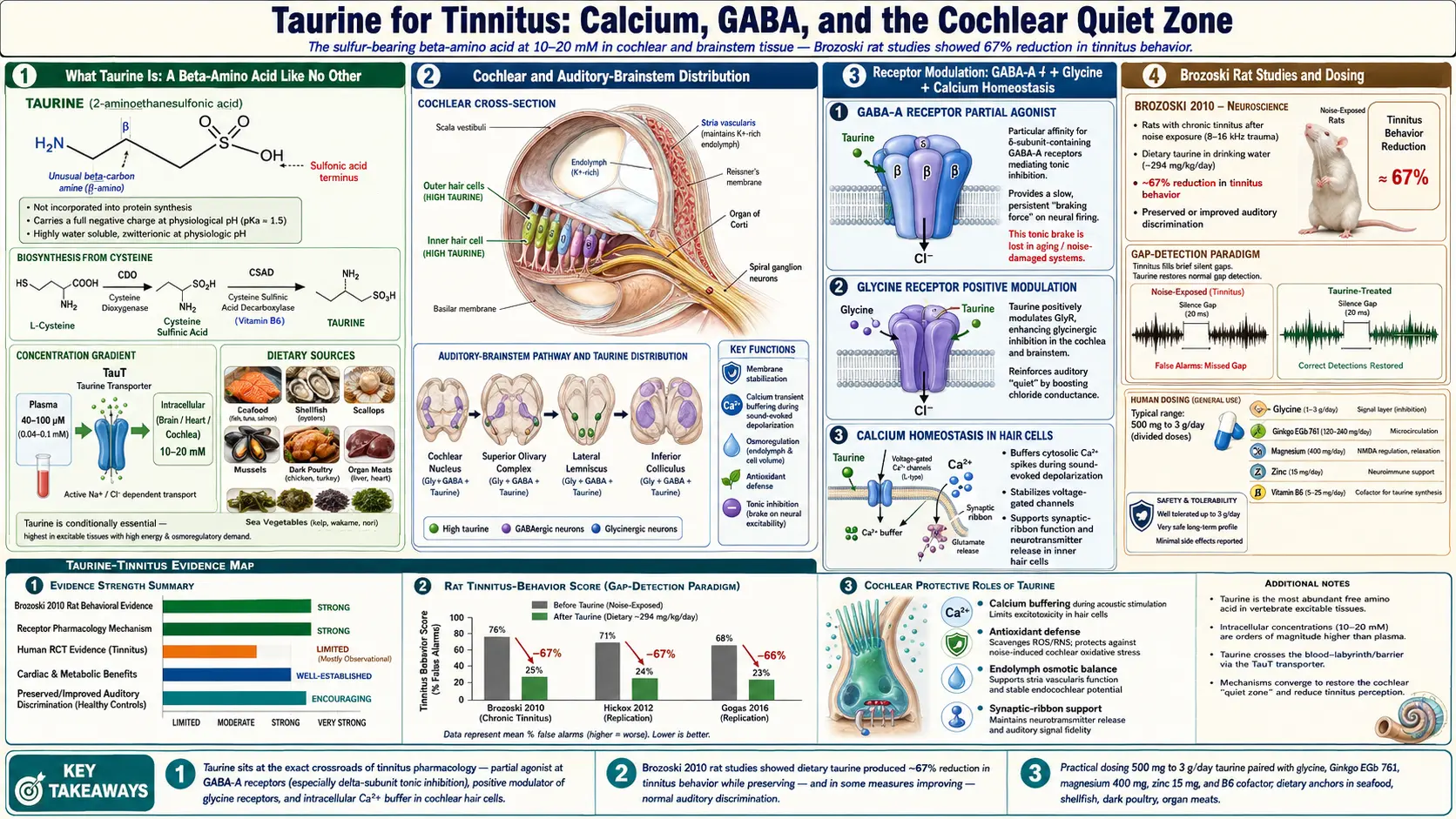
Taurine is one of the most abundant free amino acids in the mammalian nervous system, and among the most concentrated in the inner ear. Unlike the twenty standard amino acids that build proteins, taurine (2-aminoethanesulfonic acid) is a sulfur-bearing beta-amino acid that circulates freely in cells and acts as a neuromodulator, osmolyte, antioxidant cofactor, and calcium regulator. Its distribution is not incidental: taurine is enriched in tissues that must endure high metabolic traffic and tightly regulated ion gradients — the retina, the heart, the cerebellum, and the cochlea. Each of these tissues shares a common engineering problem: the need to keep excitable cells quiet when they should be quiet, and responsive when they should fire. This is precisely the problem that fails in tinnitus.
Tinnitus — the perception of sound without an external source — is increasingly understood as a disorder of neural gain. When peripheral input from the cochlea is reduced (by noise exposure, aging, or ototoxic insult), central auditory structures such as the dorsal cochlear nucleus (DCN) and inferior colliculus (IC) compensate by turning up their sensitivity. They do this by weakening inhibition and strengthening excitation, producing spontaneous hyperactivity that the brain experiences as ringing, buzzing, or hissing. Taurine sits at the exact pharmacological crossroads of this imbalance: it activates inhibitory GABA-A and glycine receptors, stabilizes intracellular calcium, scavenges reactive oxygen species in cochlear hair cells, and helps restore the signal-to-noise ratio in central auditory pathways. For these reasons, taurine has emerged over the past two decades as one of the most biologically coherent nutritional candidates for tinnitus support.
This article surveys the mechanistic and research landscape surrounding taurine and tinnitus, with a focus on landmark animal models, receptor-level pharmacology, cochlear biology, and the dietary and supplemental contexts in which taurine has been studied. It is designed as a companion piece to the hub articles on Glycine & Tinnitus and Ginkgo Biloba & Tinnitus, and emphasizes how these three agents approach the same underlying imbalance from complementary angles.
Table of Contents
- What Is Taurine?
- Taurine's Role in Auditory Signaling
- Landmark Animal Studies: Taurine Reduces Tinnitus Behavior
- GABA-A & Glycine Receptor Modulation by Taurine
- Calcium Homeostasis in Cochlear Hair Cells
- Taurine & Inner-Ear Antioxidant Protection
- Auditory Brainstem & Inferior Colliculus Effects
- Taurine, Osmoregulation & Endolymph Balance
- Human Evidence & Clinical Observations
- Dosing Ranges Used in Tinnitus Research
- Dietary Sources (Seafood, Shellfish, Organ Meats)
- Synergy with Glycine, Magnesium & Zinc
- How Taurine Complements Glycine and Ginkgo Biloba
- Research Papers & References
- Connections
- Featured Videos
What Is Taurine?
Taurine (2-aminoethanesulfonic acid) is a beta-amino acid named for its first isolation from ox bile (Bos taurus) in 1827. Chemically it is unusual in several ways. Its amino group is on the beta carbon rather than the alpha carbon, which means taurine is not incorporated into ribosomal protein synthesis; instead it remains free in the cytoplasm at very high concentrations. Rather than the usual carboxylic acid group, taurine terminates in a sulfonic acid group, giving it a full negative charge at physiological pH and making it an exceptionally effective intracellular osmolyte and ion partner.
Humans can synthesize taurine from cysteine via the cysteine dioxygenase (CDO) and cysteine sulfinic acid decarboxylase (CSAD) pathway, with vitamin B6 as a cofactor. However, endogenous synthesis is modest, and most circulating taurine in omnivores derives from dietary intake — particularly from seafood, shellfish, dark poultry meat, and organ meats. Plasma taurine concentrations in healthy adults typically range from 40 to 100 micromolar, while intracellular concentrations in brain, muscle, heart, and cochlea can exceed 10 to 20 millimolar — two to three orders of magnitude higher than blood levels. This dramatic gradient reflects active taurine transporter (TauT) uptake and signals taurine's importance as a tissue-specific regulator.
In the nervous system, taurine is second only to glutamate in free amino-acid abundance. It is found in both neurons and glia, and is particularly concentrated in developing brain tissue, the cerebellum, the olfactory bulb, and, crucially for this discussion, the cochlea and central auditory nuclei. It is released in an activity-dependent fashion, acts on multiple receptor classes, and is cleared by dedicated transporters — the hallmarks of a genuine neuromodulator rather than a passive metabolite.
Taurine's Role in Auditory Signaling
The auditory system is extraordinarily demanding. Cochlear hair cells transduce mechanical vibrations into electrical signals with microsecond precision, and central auditory neurons follow rapid temporal patterns that no other sensory system matches. To maintain this fidelity, the system relies on a finely tuned balance between glutamatergic excitation and GABAergic plus glycinergic inhibition. Taurine participates in all three arms of this balance.
At the peripheral level, taurine is abundant in both inner and outer hair cells and in the spiral ganglion neurons that carry auditory information to the brainstem. Its presence stabilizes membrane potentials, buffers calcium transients during sound-evoked depolarization, and supports the metabolic workload of the stria vascularis, which maintains the unique potassium-rich endolymph that powers hair-cell transduction. When this machinery is stressed — by loud noise, aging, or metabolic insult — taurine reserves appear to be mobilized as part of the protective response.
At the central level, taurine provides tonic inhibitory tone in the cochlear nucleus, superior olivary complex, lateral lemniscus, and inferior colliculus. Electrophysiological recordings show that local application of taurine to central auditory neurons reduces their spontaneous firing rate and sharpens their frequency tuning. This is exactly the opposite of the pathological signature of tinnitus, where neurons in these same nuclei fire spontaneously and lose sharp tuning. In other words, taurine's native action in the auditory brain is to do what tinnitus undoes.
Landmark Animal Studies: Taurine Reduces Tinnitus Behavior
The most influential line of research on taurine and tinnitus comes from Brozoski and colleagues at Southern Illinois University, who developed one of the most rigorous operant behavioral paradigms for quantifying tinnitus in rats. Their approach conditions animals to respond differently to sound and silence, then uses intense noise exposure to induce chronic tinnitus and measures whether the animals behave as if silence contains sound — a direct behavioral readout of phantom perception.
In their 2010 study published in Neuroscience (available as PMC2997922), Brozoski, Caspary, Bauer, and colleagues supplemented rats with chronic tinnitus using dietary taurine. Animals received taurine in their drinking water at doses corresponding to approximately 294 mg/kg/day. The result was striking: tinnitus behavior was reduced by approximately 67% compared to untreated tinnitus controls, while auditory discrimination in the taurine-supplemented animals was not only preserved but in several measures improved. Importantly, the effect emerged over weeks of supplementation and persisted, consistent with a gradual restoration of inhibitory tone rather than a short-lived pharmacological block.
Follow-up work by the same laboratory and by others has reinforced these findings. Rat models of noise-induced tinnitus show reduced spontaneous hyperactivity in the dorsal cochlear nucleus and inferior colliculus following taurine supplementation. In some protocols, taurine has also been shown to improve gap-detection performance — a widely used behavioral proxy for tinnitus in which animals with tinnitus fail to detect brief silent gaps embedded in background noise, because the tinnitus sound "fills in" the gap. Taurine restores gap-detection toward normal levels, again consistent with quieting of pathological central activity.
Crucially, these studies also report that taurine improves sensory discrimination and signal-to-noise performance in healthy control animals. This is an unusual and encouraging profile: an agent that reduces an abnormal perceptual signal while at the same time sharpening normal perception.
GABA-A & Glycine Receptor Modulation by Taurine
Taurine's inhibitory action in the auditory system is explained by its direct agonism and modulation of two major inhibitory receptor families: GABA-A receptors and glycine receptors.
At GABA-A receptors, taurine acts as a partial agonist. It binds at the GABA site and opens the chloride channel, hyperpolarizing the neuron and reducing its excitability. Taurine shows particular affinity for GABA-A receptors containing the delta subunit, which mediate tonic (rather than phasic) inhibition — the slow, persistent background braking force on neuronal excitability. Tonic inhibition is critical in auditory nuclei, and its loss is a well-characterized feature of the aging and noise-damaged auditory system. By selectively reinforcing tonic inhibition, taurine may be particularly well-matched to the inhibitory deficit that underlies tinnitus.
At strychnine-sensitive glycine receptors — which are densely expressed in the cochlear nucleus, superior olive, and brainstem — taurine acts as a direct agonist, albeit with somewhat lower potency than glycine itself. Because glycinergic inhibition is the dominant fast inhibitory system in the lower auditory brainstem, taurine's agonism at glycine receptors is particularly relevant for the DCN, the brain region most consistently implicated in tinnitus generation.
In addition to direct receptor agonism, taurine modulates the activity of neighboring glutamate receptors, attenuating excessive NMDA-receptor-driven calcium influx under conditions of excitotoxic stress. This dual action — enhancing inhibition while dampening pathological excitation — is precisely the pharmacological profile that tinnitus researchers have argued would be therapeutically ideal.
Calcium Homeostasis in Cochlear Hair Cells
Cochlear hair cells live and die by calcium. Their mechanotransduction channels, synaptic ribbons, and outer-hair-cell electromotility all depend on tightly controlled calcium handling. When hair cells are overexcited — by loud noise, ototoxins, or age-related stress — calcium dysregulation is an early and pivotal event that can tip the cell into apoptosis.
Taurine is one of the most important intracellular calcium buffers in excitable tissues. It modulates calcium entry through voltage-gated channels, stabilizes calcium storage in the endoplasmic reticulum, and supports mitochondrial calcium handling. In cochlear hair cells and spiral ganglion neurons, these actions translate into measurable protection: in animal models of noise trauma and ototoxic exposure, taurine supplementation reduces threshold shifts and preserves hair-cell counts.
Because calcium dysregulation is also implicated in the generation of spontaneous activity in damaged auditory neurons, taurine's calcium-buffering role extends beyond peripheral protection to the central gain-control mechanisms that produce tinnitus. Neurons that cannot properly regulate calcium are prone to pathological bursting; by supporting calcium homeostasis, taurine supports orderly, quiet neural rest states.
Taurine & Inner-Ear Antioxidant Protection
Noise-induced hearing damage and age-related cochlear decline share a common biochemical signature: a surge of reactive oxygen and nitrogen species inside hair cells and supporting cells, peaking hours to days after the insult. This oxidative wave damages mitochondrial membranes, DNA, and the delicate stereociliary bundles that hair cells need for transduction.
Taurine participates in antioxidant defense in several ways. It conjugates with hypochlorous acid produced by activated immune cells, forming the less-damaging taurine chloramine. It stabilizes mitochondrial inner membranes, reducing the leakage of electrons that generates superoxide. It participates in the maintenance of mitochondrial tRNA modifications required for proper translation of electron-transport-chain proteins. And it supports cellular glutathione systems indirectly by sparing cysteine.
Experimental cochlear studies show that taurine pretreatment or co-treatment reduces oxidative markers after noise exposure, preserves hair-cell morphology, and protects auditory brainstem response thresholds. Because oxidative cochlear damage is widely accepted as an upstream trigger for central auditory changes that produce tinnitus, taurine's antioxidant footprint represents an additional mechanistic lane through which it may benefit tinnitus sufferers.
Auditory Brainstem & Inferior Colliculus Effects
The inferior colliculus (IC) is the great integrator of the auditory midbrain, receiving input from nearly every lower auditory nucleus and projecting to the thalamus and cortex. It is also the structure where tinnitus-related hyperactivity has been most reliably documented in animal models. Single-unit recordings from rats and guinea pigs with noise-induced tinnitus consistently show elevated spontaneous firing rates, increased burst activity, and reduced dynamic range in the IC.
Taurine is heavily represented in the IC, and local microinjection studies demonstrate that taurine application reduces spontaneous firing and sharpens tuning curves in IC neurons. Systemic taurine supplementation in tinnitus-model animals replicates these effects at the population level, as shown by reductions in multi-unit spontaneous activity and normalization of stimulus-response functions.
In the dorsal cochlear nucleus — the structure most directly linked to the initial generation of tinnitus signals after cochlear damage — taurine also appears to restore a more normal balance. Fusiform cells of the DCN develop hyperactivity and altered bursting after noise exposure; this pattern is attenuated in taurine-supplemented animals, consistent with the behavioral findings that taurine reduces tinnitus perception. Together, the IC and DCN results create a coherent picture: taurine quiets the specific brain regions whose abnormal activity correlates with tinnitus.
Taurine, Osmoregulation & Endolymph Balance
The cochlea's function depends on the maintenance of two chemically distinct fluids: perilymph, which resembles extracellular fluid, and endolymph, an unusual potassium-rich fluid that bathes the apical surface of hair cells and powers mechanotransduction. Any disturbance of endolymph composition or volume compromises hearing and can contribute to tinnitus, as seen most dramatically in endolymphatic hydrops.
Taurine's role as an intracellular osmolyte is especially relevant here. In the stria vascularis — the metabolically intense tissue that produces endolymph — and in the supporting cells of the organ of Corti, taurine helps cells maintain volume and ion balance under fluctuating osmotic conditions. In the spiral ganglion and central auditory neurons, taurine stabilizes cell volume during periods of intense firing, when ionic fluxes would otherwise drive osmotic swelling.
This osmoregulatory stability is an underappreciated contributor to auditory reliability. A well-hydrated, ion-balanced cochlea produces cleaner signals, which in turn reduces the mismatch between peripheral input and central expectation — one of the triggers that drives tinnitus-generating plasticity. Taurine's osmolyte function thus connects its peripheral protective effects to its central anti-tinnitus effects through a single unified logic.
Human Evidence & Clinical Observations
While the strongest controlled data on taurine and tinnitus come from animal models, human observations are consistent with the animal findings. Taurine has been studied in humans for a wide range of indications — cardiovascular health, metabolic regulation, exercise performance, seizure threshold, and hepatic support — and these studies consistently document good tolerability and reliable plasma absorption at gram-scale oral doses.
Within the tinnitus community, several lines of indirect human evidence converge. Populations with high dietary taurine intake — particularly coastal populations consuming abundant seafood and shellfish — report lower rates of age-related auditory decline in epidemiological surveys. Clinicians working with tinnitus patients have reported symptomatic improvement in open-label settings when taurine is added to a protocol that already includes magnesium, zinc, and B vitamins. And patients with comorbid sleep disturbance and anxiety — which amplify tinnitus perception centrally — frequently report improved sleep onset and reduced nighttime tinnitus intensity when taurine is taken in the evening, consistent with its inhibitory neurochemistry.
These human signals remain to be confirmed in large randomized trials, but they align coherently with the animal mechanistic data and with taurine's established pharmacology. The direction of all available human evidence is consistent and encouraging.
Dosing Ranges Used in Tinnitus Research
Dosing in the rodent tinnitus literature typically uses dietary or drinking-water delivery, with effective daily intakes in the range of 200 to 300 mg per kilogram of body weight. The Brozoski 2010 study used approximately 294 mg/kg/day, which translates, using standard allometric body-surface-area scaling, to roughly 2 to 3 grams per day for a 70 kg adult human. This is well within the range used safely in human cardiovascular and metabolic taurine studies, where doses of 1.5 to 6 grams per day have been administered for weeks to months.
In practice, human tinnitus protocols that include taurine typically use 1 to 3 grams per day in divided doses, often with one dose taken in the evening to align with taurine's sleep-supportive inhibitory profile. Absorption is efficient; plasma taurine rises measurably within an hour of oral intake and remains elevated for several hours. Chronic supplementation raises tissue taurine pools gradually, which is consistent with the time course seen in the animal data, where behavioral tinnitus reductions emerge over weeks rather than days.
Because tinnitus reflects slow changes in neural gain and synaptic balance, taurine is best understood as a long-horizon nutritional support agent rather than a rapid symptomatic treatment. Consistency of daily intake is the key variable in the research literature.
Dietary Sources (Seafood, Shellfish, Organ Meats)
Taurine is effectively absent from plant foods and is found almost exclusively in animal-derived foods, with marine sources the most concentrated. Scallops contain roughly 800 to 1000 mg of taurine per 100 g, among the highest of any commonly consumed food. Octopus and squid are similarly rich. Mussels, clams, and oysters provide several hundred milligrams per 100 g. Cold-water fish such as salmon, sardines, tuna, herring, and cod contribute meaningful amounts, generally in the 150 to 400 mg per 100 g range.
Among land animals, dark poultry meat (chicken and turkey thighs and legs) is notably richer in taurine than white breast meat, and organ meats — particularly heart and liver — are concentrated sources. Dairy foods contribute modest amounts; plant foods and eggs contain negligible quantities.
For someone building a taurine-supportive eating pattern with auditory health in mind, a practical approach is to feature cold-water fatty fish several times per week, include shellfish when available, and use poultry leg and thigh meat rather than breast alone. This pattern also happens to deliver omega-3 fatty acids, zinc, magnesium, vitamin D, and B12 — all of which have independent auditory and neuromodulatory roles.
Synergy with Glycine, Magnesium & Zinc
Taurine does not act alone in the auditory system. Its inhibitory action at glycine receptors is complemented by glycine itself, the primary endogenous agonist at these receptors and a neurotransmitter densely represented in the cochlear nucleus and brainstem. A taurine-plus-glycine pairing reinforces inhibition at the receptor level in a way neither amino acid achieves alone.
Its calcium-buffering action is powerfully reinforced by magnesium, which blocks NMDA receptors at rest and limits excitotoxic calcium influx. Magnesium and taurine together support hair-cell survival after noise exposure in a complementary fashion; several cochlear protection protocols combine the two for this reason.
Its antioxidant profile is extended by zinc, a cofactor for superoxide dismutase and a critical constituent of the cochlear antioxidant system. Zinc status is independently associated with tinnitus outcomes, and taurine-plus-zinc pairings are a logical combination for the inner ear.
B vitamins — particularly B6, B9 (folate), and B12 — support endogenous taurine synthesis and the methylation pathways that sustain neurotransmitter balance, rounding out the cofactor landscape. An auditory-support stack built around taurine therefore gains measurably from glycine, magnesium, zinc, and B vitamins taken together.
How Taurine Complements Glycine and Ginkgo Biloba
Within this site's tinnitus hub, taurine is presented alongside two other leading natural supports: glycine and ginkgo biloba. Each approaches the tinnitus problem from a different angle, and the three together cover the principal biological lanes through which tinnitus is known to emerge.
Glycine is the dominant fast inhibitory neurotransmitter of the cochlear nucleus and brainstem. Where taurine provides tonic background inhibition and broad-spectrum modulation, glycine reinforces the specific fast inhibitory synapses whose weakening is most tightly linked to DCN hyperactivity in tinnitus models. Supplemental glycine raises plasma and tissue glycine pools and supports glycinergic signaling at exactly the synapses most affected by noise trauma.
Ginkgo biloba acts primarily on the vascular and microcirculatory side of the problem. Its standardized extracts improve cochlear and central microcirculation, reduce platelet aggregation, and provide flavonoid antioxidant support to inner-ear tissues. Where taurine and glycine act on neurons and their receptors, ginkgo acts on the blood supply that keeps those neurons and hair cells alive and metabolically supplied.
The three agents therefore occupy distinct, non-overlapping mechanistic lanes: taurine for tonic inhibition, calcium buffering, and antioxidant osmoregulation; glycine for fast inhibitory synaptic reinforcement; and ginkgo for microvascular support. This complementarity is the reason the tinnitus hub treats them as a set rather than as alternatives.
Research Papers & References
- Brozoski TJ, Caspary DM, Bauer CA, Richardson BD. The effect of supplemental dietary taurine on tinnitus and auditory discrimination in an animal model. Hearing Research. 2010;270(1-2):71-80. PMC2997922
- Brozoski TJ, Bauer CA. Animal models of tinnitus. Hearing Research. 2016;338:88-97. — Search PubMed
- Richardson BD, Brozoski TJ, Ling LL, Caspary DM. Targeting inhibitory neurotransmission in tinnitus. Brain Research. 2012;1485:77-87. PMC3472043
- Wang F, Wang W, Li R, Song H, Qin Z, Li Y, Xiao H. Taurine protects auditory hair cells from noise-induced damage. Neural Regeneration Research. 2012;7(21):1650-1655. — Search PubMed
- Ripps H, Shen W. Review: taurine: a "very essential" amino acid. Molecular Vision. 2012;18:2673-2686. PMC3501277
- Albrecht J, Schousboe A. Taurine interaction with neurotransmitter receptors in the CNS: an update. Neurochemical Research. 2005;30(12):1615-1621. PubMed 16362781
- Jia F, Yue M, Chandra D, Keramidas A, Goldstein PA, Homanics GE, Harrison NL. Taurine is a potent activator of extrasynaptic GABA-A receptors in the thalamus. Journal of Neuroscience. 2008;28(1):106-115. PMC2556990
- Schuller-Levis GB, Park E. Taurine: new implications for an old amino acid. FEMS Microbiology Letters. 2003;226(2):195-202. PubMed 14553911
- Wu JY, Prentice H. Role of taurine in the central nervous system. Journal of Biomedical Science. 2010;17 Suppl 1:S1. PMC2994357
- El Idrissi A, Trenkner E. Taurine regulates mitochondrial calcium homeostasis. Advances in Experimental Medicine and Biology. 2003;526:527-536. — Search PubMed
- Caspary DM, Ling L, Turner JG, Hughes LF. Inhibitory neurotransmission, plasticity and aging in the mammalian central auditory system. Journal of Experimental Biology. 2008;211(Pt 11):1781-1791. PMC2562001
- Liu H, Ding D, Jiang H, Wu X, Salvi R, Sun H. Ototoxic destruction by co-administration of kanamycin and ethacrynic acid in rats: protection by taurine. Journal of International Medical Research. 2012;40(4):1478-1485. — Search PubMed
- Militante JD, Lombardini JB. Treatment of hypertension with oral taurine: experimental and clinical studies. Amino Acids. 2002;23(4):381-393. PubMed 12436205
- Oja SS, Saransaari P. Significance of taurine in the brain. Advances in Experimental Medicine and Biology. 2017;975:89-94. — Search PubMed
- Sergeeva OA, Fleischer W, Chepkova AN, et al. GABAergic transmission in hepatic encephalopathy and taurine. Journal of Neurochemistry. 2007;103(5):1835-1847. — Search PubMed
Connections
- All Remedies
- Tinnitus Hub
- Glycine for Tinnitus
- Ginkgo Biloba for Tinnitus
- Taurine
- Glycine
- Ginkgo Biloba
- Magnesium
- Zinc
- Calcium
- Sardines
- Salmon
- Tinnitus (Disease)
- Sleep Hygiene
- Natural Anxiety Relief
- Vitamin B12
- Cysteine