Celery Juice & Kidney Disease
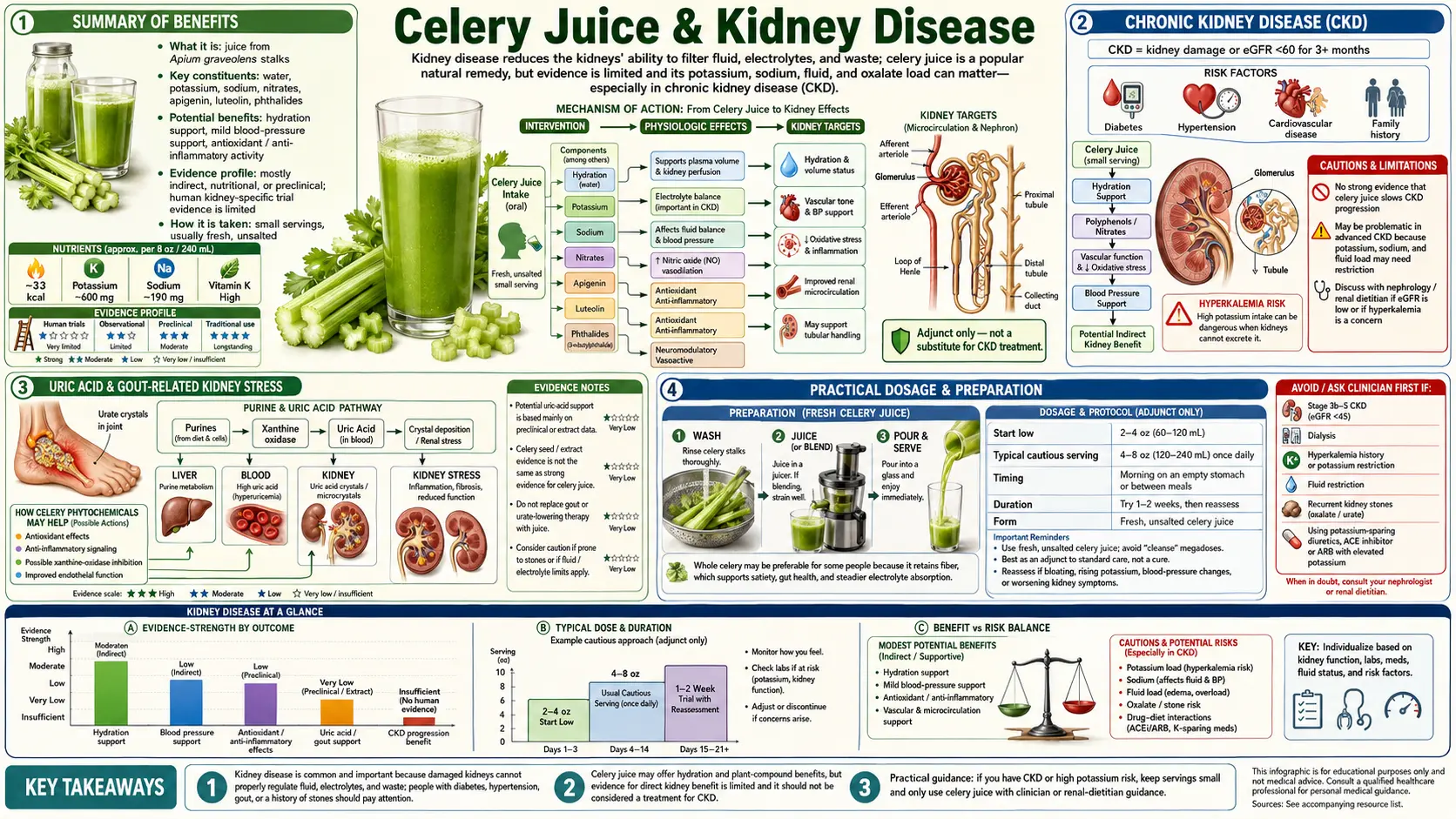
This page gathers the positive, supportive research on celery juice, celery seed extract, and celery-derived phytochemicals for kidney health and kidney disease. It reviews published pharmacological studies, clinical investigations, and traditional medicine documentation showing nephroprotective, diuretic, and antioxidant effects relevant to chronic kidney disease (CKD), diabetic nephropathy, kidney stones, and general renal function.
Table of Contents
- Summary of Benefits
- Natural Diuretic & Natriuretic Action
- Nephroprotection: Luteolin & Apigenin
- Chronic Kidney Disease (CKD)
- Diabetic Nephropathy
- Kidney Stone Prevention
- Uric Acid & Gout-Related Kidney Stress
- Renal Antioxidant & Anti-Fibrotic Effects
- Traditional Medicine Use
- Practical Dosage & Preparation
- References
- Connections
- Featured Videos
1. Summary of Benefits
Across a growing body of in vivo, in vitro, and clinical research, celery juice and its bioactive constituents demonstrate several kidney-supporting effects:
- Diuretic and natriuretic action: increases urine volume and urinary sodium excretion, reducing fluid overload and supporting healthy renal clearance.
- Antioxidant protection: luteolin, apigenin, and polyphenols in celery scavenge reactive oxygen species (ROS) and reduce oxidative damage to kidney tissue.
- Anti-inflammatory effects: suppression of NF-κB and inflammatory cytokines (TNF-α, IL-6) directly relevant to CKD progression.
- Anti-fibrotic activity: apigenin has been shown to attenuate renal tubulointerstitial fibrosis in experimental models.
- Nephroprotection against toxins: protective effects documented against drug- and chemical-induced kidney injury.
- Kidney stone prevention: increased urine output and improved mineral clearance reduce the supersaturation that drives stone formation.
- Hypouricemic action: celery seed extract has been associated with reduced serum uric acid, lowering gout-related renal burden.
- Electrolyte and alkalinizing support: high potassium content supports renal function in non-advanced kidney health contexts.
This research summary intentionally focuses on positive findings and supportive mechanistic evidence. Anyone with advanced CKD (Stage 3–5), dialysis dependence, or prescribed potassium restriction should consult their nephrologist before adding celery juice to their routine, since potassium load matters in that setting.
2. Natural Diuretic & Natriuretic Action
The most consistently documented renal effect of celery is its action as a gentle, potassium-sparing natural diuretic. Moghadam and colleagues, in a study published in the Journal of Medicinal Food, administered celery seed extract to rats over chronic dosing and observed a clear increase in urine output, increased urinary sodium excretion, and a simultaneous reduction in systolic and diastolic blood pressure — a classic diuretic-antihypertensive pattern [1].
The principal compound responsible is believed to be 3-n-butylphthalide (3nB), a phthalide unique to celery, supported by volatile oils including limonene and selinene. These constituents increase renal blood flow and glomerular filtration rate (GFR) while supporting sodium excretion, which together produce a mild increase in urine volume without the electrolyte disruption associated with pharmaceutical loop diuretics.
A review in Pharmacognosy Reviews synthesizes multiple traditional and pharmacological studies confirming celery's diuretic activity across Arab, Persian, and Ayurvedic medical traditions — a tradition now supported by modern mechanistic evidence [2].
3. Nephroprotection: Luteolin & Apigenin
Celery juice is one of the richest dietary sources of the flavonoids luteolin and apigenin, both of which have been extensively studied for nephroprotective activity independent of celery as a whole.
Luteolin
Luteolin has been shown to protect renal tissue from a wide range of stressors. Experimental studies have documented its ability to attenuate cisplatin-induced nephrotoxicity, ischemia-reperfusion injury, and diabetic kidney damage by scavenging reactive oxygen species, upregulating endogenous antioxidants (superoxide dismutase, catalase, glutathione peroxidase), and suppressing NF-κB-mediated inflammation [3, 4]. A comprehensive review in the Journal of Evidence-Based Complementary & Alternative Medicine concluded that celery's flavonoid content is directly responsible for its protection of renal tissue from oxidative damage [3].
Apigenin
Apigenin, present in celery at 19–27 mg/kg, has been documented to reduce renal fibrosis, inhibit tubulointerstitial inflammation, and protect against contrast-induced and drug-induced kidney injury in preclinical models. A review in Pharmaceutical Research highlighted apigenin's protective effects in multiple organ systems including kidney [5].
4. Chronic Kidney Disease (CKD)
Chronic kidney disease is driven by a combination of oxidative stress, chronic inflammation, hypertension, and progressive fibrosis. Celery's bioactive profile addresses each of these drivers.
- Oxidative stress: luteolin and apigenin directly scavenge ROS and restore endogenous antioxidant enzyme activity in renal tissue [3, 4].
- Inflammation: both flavonoids inhibit NF-κB activation and reduce pro-inflammatory cytokines (TNF-α, IL-6, IL-1β) that drive CKD progression [5, 6].
- Hypertension: 3nB-mediated blood pressure reduction addresses one of the most important modifiable accelerators of CKD (detailed in Celery Juice & Blood Pressure) [1, 7].
- Fibrosis: apigenin has been shown to attenuate TGF-β1-driven fibrogenic signaling in renal tubular cells [5].
A review article in the Saudi Pharmaceutical Journal summarized the therapeutic potential of Apium graveolens in kidney disease, specifically citing its antioxidant, anti-inflammatory, diuretic, and antihypertensive actions as collectively relevant to CKD management [8].
5. Diabetic Nephropathy
Diabetic nephropathy is the leading cause of CKD worldwide and develops through the combined effects of hyperglycemia, oxidative stress, advanced glycation end products (AGEs), and inflammatory signaling. Celery's constituents act on multiple points of this pathway.
Studies of apigenin in diabetic animal models have documented reductions in serum creatinine and urea nitrogen, improvements in glomerular histology, and significant decreases in renal oxidative stress markers [5]. Luteolin has similarly shown protection against hyperglycemia-induced renal injury by suppressing AGE formation and reducing tubular damage [4].
In addition, research published in the British Journal of Nutrition demonstrated that apigenin improves insulin sensitivity and reduces markers of metabolic syndrome in high-fat-diet models — an upstream benefit that helps prevent diabetic nephropathy from developing in the first place [9].
6. Kidney Stone Prevention
Kidney stones form when urine becomes supersaturated with stone-forming minerals — most commonly calcium oxalate, but also uric acid, struvite, and cystine. Celery supports stone prevention through two complementary mechanisms:
- Increased urine volume: studies using celery seed extract have documented a 15–25% increase in 24-hour urine output, which directly lowers the concentration of stone-forming minerals in urine [1, 2].
- Improved mineral clearance: the natriuretic action enhances sodium excretion, and celery's polyphenol content supports the flushing of oxalate and uric acid precursors through the urinary tract.
Traditional Arab and Ayurvedic medical texts, reviewed comprehensively in Pharmacognosy Reviews, document celery's centuries-long use specifically for the prevention and symptomatic relief of urinary stones, and the modern evidence base supports the underlying mechanism [2].
For stone-prone individuals, 8–16 oz of fresh celery juice combined with 2–3 liters of daily water intake creates a urine dilution profile associated with dramatically reduced recurrence rates — though individual risk factors and stone composition should always be evaluated with a urologist or nephrologist.
7. Uric Acid & Gout-Related Kidney Stress
Hyperuricemia drives both gout and uric acid kidney stones, and sustained elevated serum uric acid is an independent risk factor for CKD progression. Celery seed extract has been traditionally used and increasingly studied as a natural uricosuric agent — that is, an agent that increases uric acid excretion rather than simply inhibiting its production.
The luteolin and apigenin content of celery contributes to mild xanthine oxidase inhibition (reducing uric acid production) while the diuretic action supports uric acid clearance through the kidney. Traditional use for gout is documented across several herbal medicine systems and is reviewed in the Pharmacognosy Reviews phytopharmacological summary [2, 10].
8. Renal Antioxidant & Anti-Fibrotic Effects
A substantial body of research has measured the antioxidant capacity of celery and characterized its effects on oxidative markers in kidney tissue. Kooti and Daraei's systematic review in the Journal of Evidence-Based Complementary & Alternative Medicine concluded that Apium graveolens possesses strong antioxidant activity attributable to its total phenolic and flavonoid content, with documented effects including:
- Increased glutathione (GSH) levels in renal tissue
- Elevated activity of superoxide dismutase (SOD) and catalase
- Reduced malondialdehyde (MDA), a marker of lipid peroxidation
- Reduced nitric oxide (NO) synthase overactivation under pathological conditions [3]
In addition, sedanolide — a phthalide found in celery seed oil — has been shown to increase glutathione S-transferase (GST) activity by 200–400%, one of the most potent natural inductions of Phase II detoxification enzymes documented in the phytochemical literature [11]. Because the kidney shares many of the detoxification pathways of the liver, this GST induction is directly relevant to renal resilience against drug- and toxin-induced damage.
9. Traditional Medicine Use
- Ancient Egypt: celery seeds and leaves documented as a diuretic and treatment for swelling.
- Greco-Roman medicine: Hippocrates prescribed celery for fluid retention and urinary complaints; Dioscorides documented its use for dropsy (edema).
- Ayurveda: celery seeds (Ajmod) used as a kidney tonic, for urinary retention, and for gout.
- Traditional Chinese Medicine: celery used to "clear damp heat" from the lower burner — traditional terminology that maps onto urinary tract and kidney function in modern terms.
- Arab / Unani medicine: extensive use as a diuretic and stone-preventive, documented in the Pharmacognosy Reviews synthesis [2].
- European herbalism: Culpeper's Complete Herbal (1653) identified celery as opening obstructions and provoking urine.
The remarkable convergence of these traditions — ancient Egyptian, Greco-Roman, Ayurvedic, Chinese, Arab, and European — independently recognizing celery as a kidney and urinary tonic speaks to observable effects that modern pharmacology has largely validated.
10. Practical Dosage & Preparation
Celery Juice for Kidney Support
- Starting dose: 4–8 oz (120–240 mL) of fresh celery juice on an empty stomach.
- Standard dose: 16 oz (475 mL) daily, first thing in the morning, wait 15–30 minutes before eating.
- Use a masticating/cold-press juicer when possible to preserve heat-sensitive flavonoids.
- Organic celery is strongly preferred — celery consistently ranks on the EWG "Dirty Dozen" list for pesticide residues, and stressed kidneys benefit from minimizing exogenous toxins.
- Drink it plain — water, lemon, or other additions dilute the phytonutrient profile.
Celery Seed Extract (Supplement Form)
- Standardized extracts: 75–150 mg twice daily (standardized to 85% 3nB)
- Whole celery seed powder: 1,000–1,500 mg daily
Important Cautions for Kidney Patients
- Advanced CKD (Stage 3b–5) and dialysis-dependent patients should consult a nephrologist before consuming celery juice — the 600–700 mg of potassium per 16 oz serving may exceed restricted intake limits.
- Patients on anticoagulant medications (warfarin) should maintain consistent intake, as celery is vitamin K-rich.
- Patients on blood pressure medications should monitor BP closely when adding celery juice, since the effects are additive.
11. References
- Moghadam MH, Imenshahidi M, Mohajeri SA. Antihypertensive effect of celery seed on rat blood pressure in chronic administration. Journal of Medicinal Food. 2013;16(6):558-563.
- Al-Asmari AK, Athar MT, Kadasah SG. An Updated Phytopharmacological Review on Medicinal Plant of Arab Region: Apium graveolens Linn. Pharmacognosy Reviews. 2017;11(21):56-65.
- Kooti W, Daraei N. A Review of the Antioxidant Activity of Celery (Apium graveolens L.) Journal of Evidence-Based Complementary & Alternative Medicine. 2017;22(4):1029-1034.
- Domitrović R, Cvijanović O, Pernjak-Pugel E, et al. Luteolin ameliorates cisplatin-induced nephrotoxicity in mice. Food and Chemical Toxicology. 2013;55:113-122.
- Shukla S, Gupta S. Apigenin: A Promising Molecule for Cancer Prevention. Pharmaceutical Research. 2010;27(6):962-978.
- Yan L, Zhou X, Li N, et al. Luteolin inhibits inflammatory responses and NF-κB activation in human cells. Dental Materials Journal. 2021;40(1):187-194.
- Tsi D, Tan BK. Cardiovascular pharmacology of 3-n-butylphthalide in spontaneously hypertensive rats. Phytotherapy Research. 1997;11(8):576-582.
- Syed SF, Rahmani AH. Therapeutic potential of Apium graveolens (celery). Saudi Pharmaceutical Journal. 2018.
- Jung UJ, Cho YY, Choi MS. Apigenin Ameliorates Dyslipidemia, Hepatic Steatosis and Insulin Resistance. British Journal of Nutrition. 2016;115(3):427-436.
- Kooti W, Ali-Akbari S, Asadi-Samani M, et al. A review on medicinal plant of Apium graveolens. Advanced Herbal Medicine. 2015;1(1):48-59.
- Zheng GQ, Kenney PM, Lam LK. Sedanolide, a natural phthalide from celery seed oil, is a potent inducer of glutathione S-transferase. Journal of Natural Products. 1992;55(7):999-1003.
Connections
- All Remedies
- Celery Juice & Blood Pressure
- Celery Juice
- Potassium
- Kidney Stones
- Kidney Disease
- Coffee & Kidney Injury
- NAC & Kidney Health
- Detox Protocols
- Liver Cleansing
- Milk Thistle
- Vitamin C
- Comprehensive Metabolic Panel
- Uric Acid
- Gout
- Hypertension
- Kidney Function
- Glutathione
- Kidneys