Breathwork: Science-Based Techniques for Stress, Sleep, Focus, and Autonomic Balance
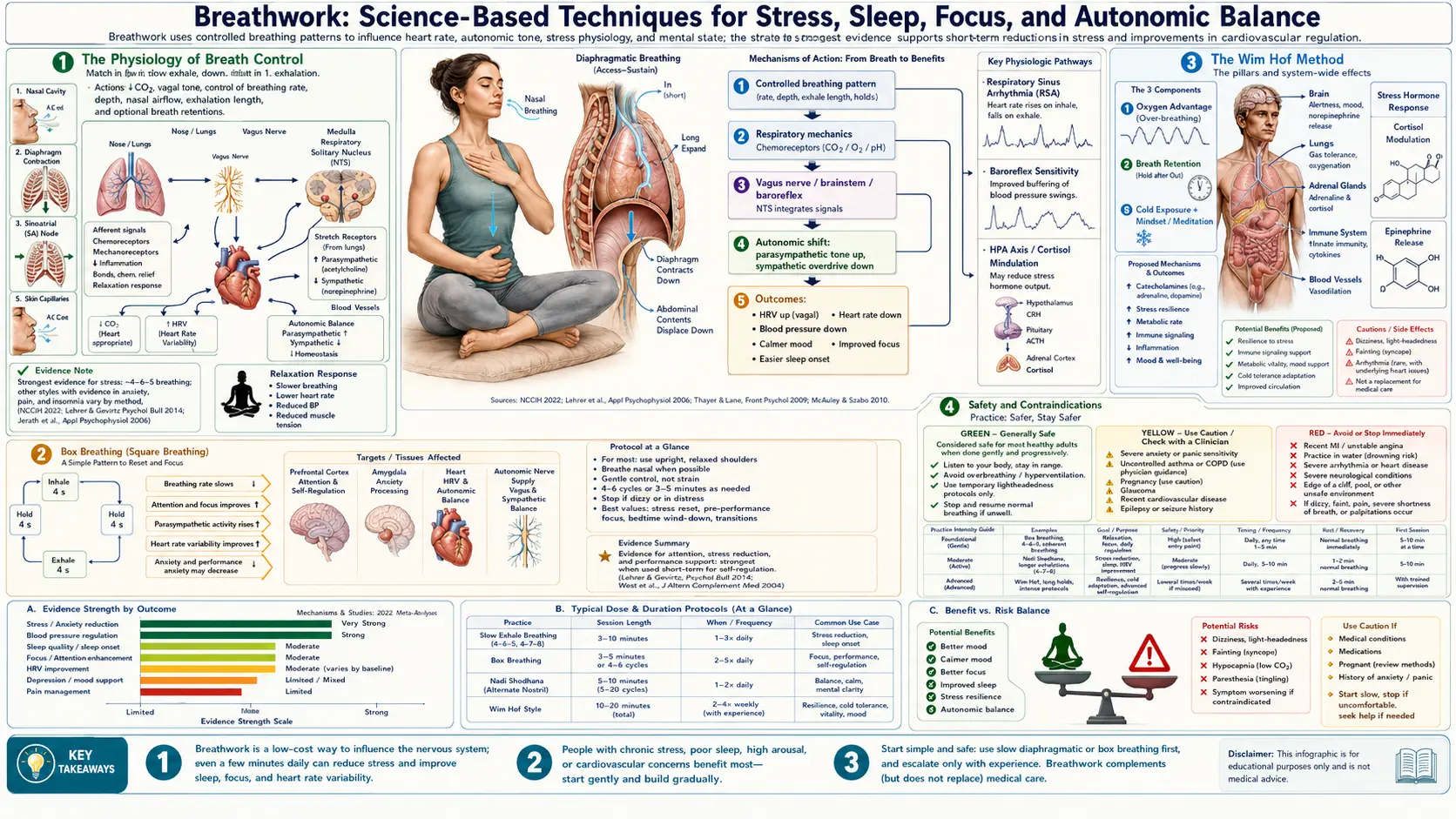


Voluntary control of the breath is one of the few levers by which humans can directly influence the autonomic nervous system. Neurons in the brainstem’s pre-Bötzinger complex set respiratory rhythm, and these neurons communicate bidirectionally with the locus coeruleus, the principal noradrenergic arousal center. Breathing fast activates the locus coeruleus and sympathetic tone; breathing slowly quiets it. This simple fact underlies an explosion of research into breathwork as a tool for stress management, sleep, focus, and emotional regulation.
This article covers the major evidence-backed techniques — box breathing, the physiological sigh, slow coherent breathing, the Wim Hof method, and Buteyko-style nasal training — along with practical protocols and safety considerations.
Table of Contents
- The Physiology of Breath Control
- Nasal vs Mouth Breathing
- The Physiological Sigh
- Box Breathing
- Slow Coherent Breathing (5.5 Breaths per Minute)
- The Wim Hof Method
- Buteyko and CO2 Tolerance
- Holotropic and Rebirthing Breathwork
- Safety and Contraindications
- Connections
- Featured Videos
The Physiology of Breath Control
During each breath, inhalation modestly accelerates heart rate and exhalation slows it — the phenomenon known as respiratory sinus arrhythmia, the dominant driver of heart-rate variability (HRV). By manipulating the ratio of inhale to exhale, you can bias the autonomic nervous system: longer exhales promote parasympathetic activity, while longer inhales (or short, sharp breathing) activate the sympathetic system. Longer-term breath practices alter baseline CO2 tolerance, vascular tone, and even cortisol response to stress.
Nasal vs Mouth Breathing
Nasal breathing produces nitric oxide in the paranasal sinuses, which is then inhaled into the lungs where it improves ventilation-perfusion matching and has antimicrobial effects. Nasal breathing also filters, humidifies, and warms air, engages the diaphragm more fully, and — because the nose has smaller aperture than the mouth — produces higher CO2 retention and improved oxygen uptake. Mouth breathing is appropriate under high metabolic demand (vigorous exercise) but is associated in chronic form with dental caries, gum disease, malocclusion in children, sleep-disordered breathing, and daytime fatigue.
The Physiological Sigh
Popularized by neuroscientist Andrew Huberman, the physiological sigh is a spontaneous pattern the body uses to reinflate collapsed alveoli: a deep inhale through the nose, followed by a second shorter inhale, then a long exhale through the mouth. A 2023 Stanford trial led by David Spiegel showed that five minutes daily of cyclic sighing reduced anxiety more effectively than equivalent-duration mindfulness meditation in the same study. One or two physiological sighs can interrupt acute stress in seconds.
Box Breathing
Used by U.S. Navy SEALs and performance psychologists, box breathing cycles four seconds of inhale, four of breath hold, four of exhale, four of breath hold. The equal ratio balances sympathetic and parasympathetic tone, calming without sedating. It is particularly useful before high-performance tasks where alertness must be preserved.
Slow Coherent Breathing (5.5 Breaths per Minute)
Breathing at approximately 5.5 to 6 breaths per minute — roughly five seconds in and five seconds out — maximally synchronizes heart-rate variability with respiration and has been shown to reduce blood pressure, improve emotional regulation, and increase HRV in numerous randomized trials. This is the core practice of biofeedback-based protocols such as those developed by the HeartMath Institute.
The Wim Hof Method
A structured practice combining 30–40 forceful cyclic breaths, a breath hold after exhalation, and a recovery breath, repeated for three rounds. It produces transient respiratory alkalosis, measurable increases in adrenaline, and subjective euphoria. Research by Kox and colleagues showed trained practitioners could voluntarily attenuate inflammatory response to an injected endotoxin, an extraordinary demonstration of top-down immune modulation. The practice should be done seated or lying down and never in or near water because of the risk of shallow-water blackout.
Buteyko and CO2 Tolerance
Developed in the 1950s by Ukrainian physician Konstantin Buteyko, this approach treats chronic over-breathing as the driver of many symptoms. Core exercises focus on nasal-only breathing, reduced breathing volume, and small comfortable breath holds to raise CO2 tolerance. Strongest evidence is in asthma, where Buteyko-style training has reduced reliever-inhaler use in multiple trials.
Holotropic and Rebirthing Breathwork
These are intensive sessions — typically 60–120 minutes of connected rapid breathing — that produce altered states of consciousness through respiratory alkalosis and cerebral vasoconstriction. Popular in trauma-release and psychotherapeutic contexts. The experiences can be powerful; contraindications include cardiovascular disease, pregnancy, history of aneurysm, glaucoma, recent surgery, and bipolar disorder. Facilitation by a trained practitioner is essential.
Safety and Contraindications
- Never practice intensive breathwork in or near water — shallow-water blackout has killed practitioners.
- Cardiovascular disease, aneurysms, uncontrolled hypertension: avoid rapid hyperventilating styles.
- Pregnancy, glaucoma, epilepsy: consult a clinician before intensive techniques.
- Anxiety and panic disorder: slow, exhale-emphasized styles first; rapid styles can provoke panic.
Connections
- All Remedies
- Anxiety
- Asthma
- Stress Management
- Natural Anxiety Relief
- Mouth Taping
- Sleep Hygiene
- Obstructive Sleep Apnea
- PTSD
- Cardiovascular Disease
- Hypertension
- Arrhythmia
- Glaucoma
- Fatigue
- Bipolar Disorder
- COPD
- Oral Microbiome
- Burnout
- Nicotinic Acetylcholine Receptors
- Conditions on this site that reference this page: Grief · Loneliness · Panic Disorder · Somatic Symptom Disorder
Research Papers
- Clinical trials on breathwork — PubMed search
- Systematic reviews of breathwork — PubMed search
- Meta-analyses on breathwork — PubMed search
- Treatment research on breathwork — PubMed search
- Mechanism studies of breathwork — PubMed search
- Epidemiology of breathwork — PubMed search