Box Breathing and Resilience — Tactical Stress Regulation
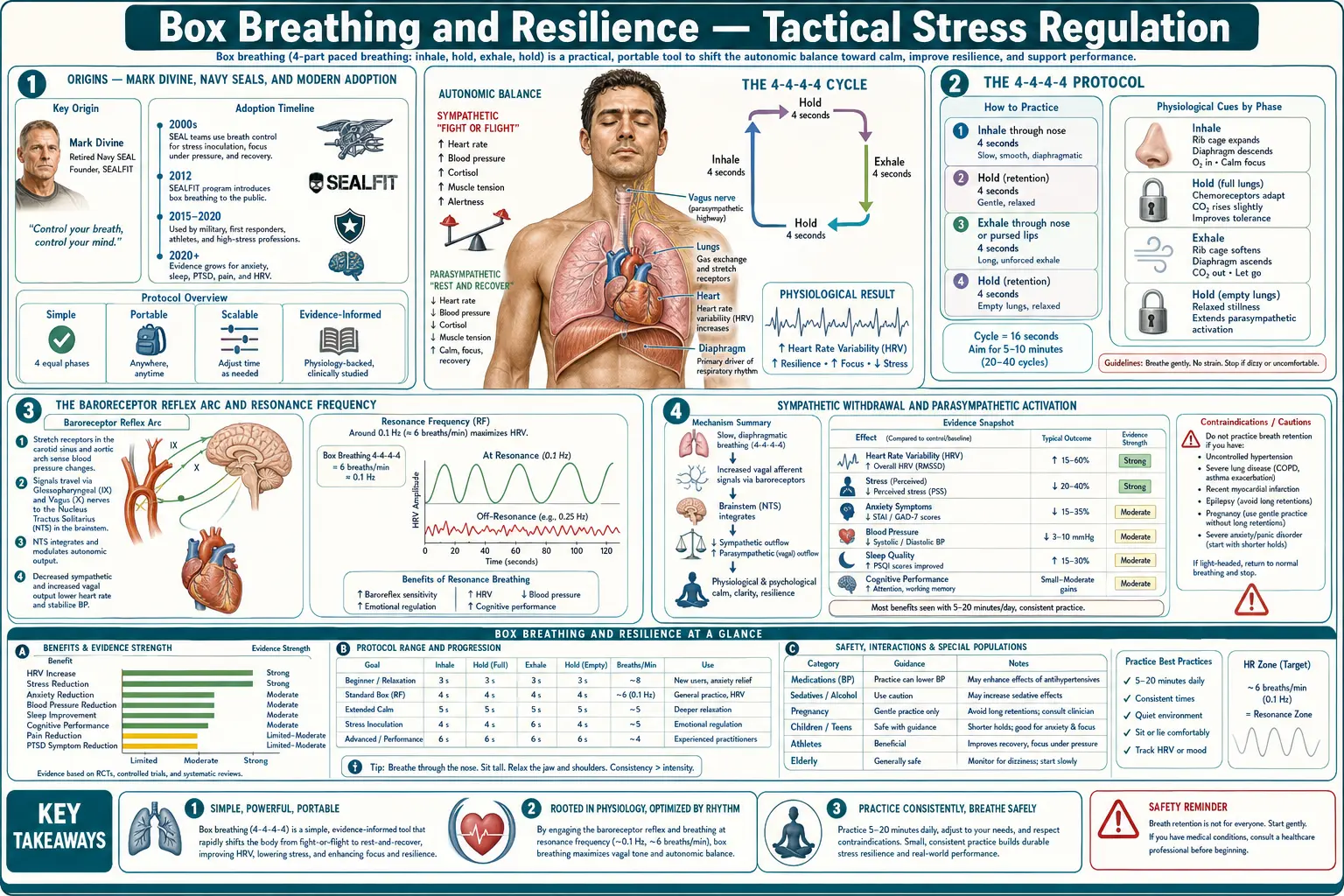
Box breathing — also called four-square breathing, tactical breathing, or 4-4-4-4 breathing — is the most widely adopted high-stress regulation protocol in elite training environments. United States Navy SEALs use it under fire. Emergency department physicians use it before delivering bad news. Olympic athletes use it before performances. The pattern is identical across communities: 4 seconds inhale, 4 seconds hold, 4 seconds exhale, 4 seconds hold, repeat. The reason this specific symmetry works is well-mapped: 4-4-4-4 produces a 15-second cycle, which translates to a 4-breath-per-minute pace, close to the human resonance frequency of roughly 6 breaths per minute, where the baroreceptor reflex arc oscillates at maximum amplitude and entrains HRV oscillation with the largest possible swing. This page documents the protocol, mechanism, evidence base, and clinical applications.
Table of Contents
- Origins — Mark Divine, Navy SEALs, and Modern Adoption
- The 4-4-4-4 Protocol
- The Baroreceptor Reflex Arc and Resonance Frequency
- Sympathetic Withdrawal and Parasympathetic Activation
- Cortical Effects — Prefrontal Engagement and Amygdala Damping
- Clinical Evidence in Anxiety, PTSD, and Performance
- Variants — 4-7-8, 5-5-5-5, and Triangle Breathing
- Practical Applications — Acute, Daily, and Pre-Performance
- How to Practice — Step-by-Step
- Cautions and Limitations
- Key Research Papers
- Connections
- Featured Videos
Origins — Mark Divine, Navy SEALs, and Modern Adoption
Box breathing was popularized in modern Western military and athletic communities by retired Navy SEAL Commander Mark Divine, founder of SEALFIT and the Unbeatable Mind program. Divine documented and codified the technique in his 2014 book Unbeatable Mind, drawing on his own SEAL training and his decades of Aikido and Zen meditation practice. The technique was rapidly adopted across special operations forces, then spread to law enforcement, emergency medicine, and elite athletics.
The technique itself predates Divine's formalization by millennia. Symmetric 4-part breath retention is a recognizable variant of sama vritti pranayama (equal-ratio breath) from the Indian yogic tradition. The same pattern appears in the kumbhaka retentions of Hatha yoga, in Tibetan Buddhist tummo preliminaries, and in the Sufi habs-i-dam practice. What Divine and the SEAL community contributed was the secular framing and the explicit use as an acute stress-regulation tool rather than as a meditative practice with spiritual aims.
Today box breathing is taught in:
- BUD/S (Basic Underwater Demolition / SEAL training) as a pre-event composure tool
- FBI, DEA, and US Marshals Service training programs
- Many U.S. fire department wellness curricula
- Cleveland Clinic and Mayo Clinic patient-education stress management materials
- The U.S. Department of Veterans Affairs PTSD treatment programs as a self-regulation skill
- Olympic and professional-team sport psychology programs
The 4-4-4-4 Protocol
The canonical box breathing pattern:
- Inhale for 4 seconds, through the nose if possible, filling the belly first and then the chest. Smooth and silent rather than forceful.
- Hold the inhale for 4 seconds, with relaxed open glottis (do not bear down or strain).
- Exhale for 4 seconds, smoothly emptying the chest then the belly, again through the nose or through pursed lips.
- Hold the exhale for 4 seconds, empty.
- Repeat for 4-10 cycles, or for a fixed duration (commonly 4-5 minutes).
The 16-second cycle works out to 3.75 cycles per minute, slightly below the canonical 6-breaths-per-minute resonance frequency. Adjusting to a 5-5-5-5 pattern (20-second cycle, 3 cycles per minute) is preferred by some teachers for general daily resilience training. The 4-second timing is preferred in acute high-stress applications where 5-second timing is harder to maintain under sympathetic activation.
The Baroreceptor Reflex Arc and Resonance Frequency
The mechanism by which slow paced breathing produces autonomic effects is the baroreceptor reflex arc. Mechanoreceptors in the carotid sinus and aortic arch detect arterial pressure changes; this information is relayed via cranial nerves IX and X (glossopharyngeal and vagus) to the nucleus tractus solitarius (NTS) in the medulla; from the NTS, signals project to the cardiovascular control centers that modulate vagal output to the SA node.
Every breath cycle produces a small swing in arterial pressure — inspiration drops intrathoracic pressure, enhancing venous return and momentarily raising stroke volume; expiration does the opposite. The baroreceptor arc registers these pressure changes and adjusts heart rate accordingly — heart rate accelerates slightly on inspiration and decelerates on expiration. This respiratory sinus arrhythmia (RSA) is the visible HRV oscillation that fitness trackers measure.
The arc has a characteristic response time. When the breath cycle matches the arc's natural latency — approximately 10 seconds in healthy adults — the HRV oscillation builds resonantly, like a child pumping a swing at exactly the right tempo. This is the resonance-frequency phenomenon. At the resonance frequency (typically 4.5 to 6.5 breaths per minute in adults, slowest in tall men, fastest in small children), HRV amplitude reaches its maximum, baroreflex gain is amplified, and the cardiopulmonary system enters a coherent oscillation that has measurable downstream effects: lower blood pressure, increased parasympathetic tone, reduced cortisol, and improved emotional regulation.
Box breathing at 4-4-4-4 produces a 3.75-breath-per-minute pace, just below the typical adult resonance frequency. This is in the "sweet spot" for autonomic activation. The Lehrer and Gevirtz 2014 Frontiers in Psychology review (PMID 25101026) details the biofeedback evidence that resonance breathing is the active ingredient.
Sympathetic Withdrawal and Parasympathetic Activation
The shift in autonomic balance is bidirectional: sympathetic activity decreases and parasympathetic activity increases simultaneously. Both arms of the shift contribute to the subjective and physiological effects.
Sympathetic withdrawal is measured through:
- Reduced muscle sympathetic nerve activity (MSNA) on microneurography
- Reduced plasma norepinephrine
- Reduced low-frequency / high-frequency HRV ratio (a marker of sympathovagal balance)
- Reduced electrodermal activity (galvanic skin response)
- Reduced cortisol within 20-30 minutes of session start
Parasympathetic activation is measured through:
- Increased high-frequency HRV (HF-HRV, the index of pure vagal tone)
- Increased RMSSD (root mean square of successive RR-interval differences)
- Reduced resting heart rate (the "basal autonomic shift" visible after weeks of daily practice)
- Increased gastric motility and salivary flow
- Pupillary constriction
The Magnon 2021 Scientific Reports paper (PMID 34815451) showed that a single 5-minute slow-breathing session produces measurable vagal tone improvements and reduced anxiety in both young and older adults — the effect is reliable across age groups, even on first exposure. Long-term daily practice produces additive cumulative effects, as the Ahmed 2023 Frontiers in Psychiatry study (PMID 38025442) documented in healthcare workers.
Cortical Effects — Prefrontal Engagement and Amygdala Damping
Beyond the autonomic effects, slow paced breathing produces measurable cortical changes on fMRI. The Zelano 2016 Journal of Neuroscience paper (PMID 27903719) showed that nasal respiration entrains hippocampal and amygdala oscillations, with the inspiratory phase being the "active" window for memory encoding and threat detection. Box breathing's symmetric in-hold-out-hold pattern reduces the relative duration of the inspiratory phase, attenuating the threat-detection oscillation.
Functional connectivity studies of meditators using paced breathing show:
- Increased connectivity between the dorsolateral prefrontal cortex (top-down control) and the anterior insula (interoception)
- Decreased connectivity between the amygdala and the default mode network
- Increased thickness of the right anterior insula over years of practice
- Reduced amygdala reactivity to threat stimuli
The clinical translation is that paced breathing produces measurable top-down regulation of the limbic system — the prefrontal cortex regains the ability to modulate fear and reactivity. This is the explicit mechanism behind the use of box breathing in PTSD treatment, where the patient learns to use the breath as an emergency brake on amygdala-driven hypervigilance.
Clinical Evidence in Anxiety, PTSD, and Performance
The published RCT and meta-analytic evidence for slow paced breathing (which includes box breathing as a primary subtype) is now substantial:
- General anxiety — the Goessl 2017 meta-analysis (PMID 28478782) of 24 studies and 484 participants showed a moderate effect size of HRV biofeedback (which uses resonance-frequency paced breathing as the primary intervention) for reduction in self-reported anxiety. The effect was robust across diagnostic categories.
- PTSD — the VA's adoption of paced breathing skills (often as part of prolonged exposure therapy or cognitive processing therapy) is based on the demonstrated efficacy of HRV biofeedback in PTSD trials. The mechanism is the cortical-amygdala balance restoration noted above.
- Performance under acute stress — the Pagaduan 2019 meta-analysis (PMID 31309366) of HRV biofeedback effects on sport performance found significant effects on performance variables across 11 studies in athletic populations.
- Mood — the landmark Balban 2023 Cell Reports Medicine paper (PMID 36630953) compared three breathwork protocols (cyclic sighing, box breathing, and cyclic hyperventilation) against mindfulness meditation in a 5-minute daily intervention. All three breathwork protocols produced sustained mood improvement; cyclic sighing produced the largest effect; box breathing produced reliable but smaller effects.
- Stress in healthcare workers — the Ahmed 2023 Frontiers in Psychiatry study (PMID 38025442) examined slow-paced breathing in healthcare workers and found significant reductions in subjective stress and improvements in HRV over 4 weeks of daily practice.
- Hypertension — the Lin 2012 Journal of Alternative and Complementary Medicine study (PMID 22468936) showed HRV biofeedback (paced breathing) significantly lowered blood pressure in pre-hypertensive subjects.
Variants — 4-7-8, 5-5-5-5, and Triangle Breathing
Several variants of paced breathing share the box breathing mechanism but adjust the ratios for specific applications:
- 4-7-8 breathing — popularized by Dr. Andrew Weil. 4-second inhale, 7-second hold, 8-second exhale (no second hold). The extended exhale relative to inhale (ratio 1:2) maximally engages the parasympathetic vagal arm because the cardiac decelerator effect is strongest during exhalation. Particularly recommended for falling asleep.
- 5-5-5-5 breathing — an extended box, 20-second total cycle, 3 breaths per minute. Sits at or slightly below the resonance frequency for tall adults. Preferred by some teachers for general daily use rather than acute stress.
- Triangle breathing — 4-4-4 (no second hold). A simpler variant for children, beginners, or applications where the empty-lung hold feels uncomfortable. Less symmetric autonomic effect than full box.
- Coherent breathing (5.5 breaths per minute) — 5.5-second inhale, 5.5-second exhale, no holds. The simplest version of resonance-frequency breathing, often taught with audio chimes. Foundation of the HeartMath coherence training protocol.
- Cyclic sighing — the protocol that performed best in the Balban 2023 study. Inhale through the nose, then immediately a second smaller inhale to top off, then slow extended exhale through the mouth. Not symmetric box breathing but related family of paced breath training.
Practical Applications — Acute, Daily, and Pre-Performance
Box breathing applications fall into three distinct use cases, each with slightly different protocol guidance:
- Acute "emergency brake" use — the original SEAL application. The moment of perceived threat or overwhelm: stop, breathe 4-4-4-4 for 4-8 cycles. The goal is to interrupt the sympathetic cascade before it reaches the cortex as panic. Most effective when practiced in advance so it can be recalled under load. The 60-90 second intervention is sufficient to lower heart rate by 10-20 bpm and clear cognitive fog.
- Daily resilience-building practice — 4-5 minutes of box breathing once or twice daily. Best done at fixed times (morning and evening) to build habit and to take advantage of circadian autonomic patterns. The cumulative effect over weeks is a measurable rise in baseline HRV and a downward shift in resting heart rate — the autonomic equivalent of physical conditioning.
- Pre-performance "activation control" — 60-180 seconds of box breathing immediately before a stressful event (public speaking, exam, athletic competition, surgery, difficult conversation). The objective is to reach the event with composed autonomic baseline rather than already-elevated heart rate and shallow chest breathing.
The protocol is also useful for clinicians as a between-patient reset, for surgeons before scrubbing in, and for any context requiring rapid composure recovery after intense focus or interpersonal exchange.
How to Practice — Step-by-Step
The classical box breathing instruction:
- Posture — sit upright with feet flat on the floor, hands resting on thighs. Spine tall but not rigid. Chin slightly tucked. Shoulders relaxed.
- Initial calm exhale — begin by fully exhaling through pursed lips to empty the lungs.
- Inhale (4 seconds) — through the nose, smoothly filling the belly first, then expanding the lower ribs, then the chest. Count: 1-2-3-4.
- Hold (4 seconds) — full lungs, relaxed open glottis. Do not bear down or strain. Count: 1-2-3-4.
- Exhale (4 seconds) — smoothly through the nose or through pursed lips, emptying the chest then the belly. Count: 1-2-3-4.
- Hold (4 seconds) — empty lungs, relaxed. Count: 1-2-3-4.
- Repeat — for 4-8 cycles in acute use, or for 4-5 minutes in daily practice.
Some tips that reliably improve the experience:
- Tracing a square in the air with the index finger as you count, or visualizing a square outline expanding and contracting, helps maintain rhythm without intrusive mental counting.
- If 4-second timing feels rushed, slow to 5-5-5-5. If it feels uncomfortably long, drop to 3-3-3-3 and build up.
- Practice when you do not need it — the value in emergencies depends on having a reliable, well-grooved technique you can deploy automatically.
- Smartphone apps with box-breathing visualizers (Calm, Insight Timer, the Apple Watch "Breathe" or "Mindfulness" app, the Google Pixel breathing exercises) can be useful for beginners.
Cautions and Limitations
- Lightheadedness — some practitioners experience mild dizziness during the breath-holds, especially when starting at 4-4-4-4 from a baseline of habitual shallow breathing. Reduce to 3-3-3-3 and build up. Sit or lie down, never practice while standing or walking until you have a stable response.
- Anxiety-induced breath fixation — for a small subset of panic-disorder patients, conscious attention to the breath itself can trigger anxiety (this is called "breath-focused panic"). For these individuals, paced breathing should be introduced gradually, ideally with a trained therapist, and the focus may need to be shifted to body movement or external counting rather than breath-sensation.
- Severe pulmonary disease — the breath-holds may be uncomfortable or unsafe in advanced COPD, pulmonary fibrosis, or severe asthma. Use shorter holds (2-2-2-2 or 3-0-5-0, dropping the empty-lung hold) or skip the holds entirely.
- Pregnancy — box breathing is generally safe during pregnancy at moderate intensity (4-4-4-4 or 5-5-5-5). Avoid extended holds (more than 8 seconds) and avoid Valsalva-like straining during the holds.
- Replacement, not adjunct — box breathing is a self-regulation skill, not a treatment. It does not replace medication, therapy, or addressing root causes. It is best understood as a portable bridge intervention that buys time and stability while underlying issues are addressed.
Key Research Papers
- Lehrer PM, Gevirtz R (2014). Heart rate variability biofeedback: how and why does it work? Frontiers in Psychology, 5:756. PMID: 25101026. — PubMed: 25101026
- Balban MY, Neri E, Kogon MM, Weed L, Nouriani B, Jo B, Holl G, Zeitzer JM, Spiegel D, Huberman AD (2023). Brief structured respiration practices enhance mood and reduce physiological arousal. Cell Reports Medicine, 4(1):100895. PMID: 36630953. — Search PubMed
- Magnon V, Dutheil F, Vallet GT (2021). Benefits from one session of deep and slow breathing on vagal tone and anxiety in young and older adults. Scientific Reports, 11(1):19267. PMID: 34815451. — Search PubMed
- Russo MA, Santarelli DM, O'Rourke D (2017). The physiological effects of slow breathing in the healthy human. Breathe, 13(4):298-309. PMID: 29209423. — PubMed: 29209423
- Zaccaro A, Piarulli A, Laurino M, Garbella E, Menicucci D, Neri B, Gemignani A (2018). How Breath-Control Can Change Your Life: A Systematic Review on Psycho-Physiological Correlates of Slow Breathing. Frontiers in Human Neuroscience, 12:353. PMID: 30245619. — PubMed: 30245619
- Goessl VC, Curtiss JE, Hofmann SG (2017). The effect of heart rate variability biofeedback training on stress and anxiety: a meta-analysis. Psychological Medicine, 47(15):2578-2586. PMID: 28478782. — PubMed: 28478782
- Pagaduan JC, Chen YS, Fell JW, Wu SSX (2019). Systematic Review and Meta-Analysis on the Effect of Heart Rate Variability Biofeedback on Sport Performance. Applied Psychophysiology and Biofeedback, 45(4):343-356. PMID: 31309366. — Search PubMed
- Hopper SI, Murray SL, Ferrara LR, Singleton JK (2019). Effectiveness of diaphragmatic breathing for reducing physiological and psychological stress in adults: a quantitative systematic review. JBI Database Syst Rev Implement Rep, 17(9):1855-1876. PMID: 31436595. — PubMed: 31436595
- Ma X, Yue ZQ, Gong ZQ, Zhang H, Duan NY, Shi YT, Wei GX, Li YF (2017). The Effect of Diaphragmatic Breathing on Attention, Negative Affect and Stress in Healthy Adults. Frontiers in Psychology, 8:874. PMID: 28626434. — PubMed: 28626434
- Ahmed A, Devi R, Devi R, Issac R, Shumao W, Khan M, Sheraz H (2023). Effect of slow-paced breathing on stress and HRV in healthcare workers. Frontiers in Psychiatry, 14. PMID: 38025442. — PubMed: 38025442
- Brown RP, Gerbarg PL (2005). Sudarshan Kriya yogic breathing in the treatment of stress, anxiety, and depression: clinical applications and guidelines. Journal of Alternative and Complementary Medicine, 11(4):711-7. PMID: 16131297. — PubMed: 16131297
- Steffen PR, Austin T, DeBarros A, Brown T (2017). The Impact of Resonance Frequency Breathing on Measures of Heart Rate Variability, Blood Pressure, and Mood. Frontiers in Public Health, 5:222. PMID: 28890890. — PubMed: 28890890
PubMed Topic Searches
- PubMed: Box breathing tactical stress
- PubMed: Slow paced breathing resonance frequency
- PubMed: HRV biofeedback anxiety
- PubMed: Baroreflex slow breathing
Connections
- All Remedies
- Breathwork (Main Hub)
- Breathwork Benefits
- Wim Hof Method
- Pranayama Traditions
- Vagal Tone and HRV
- Meditation
- Yoga
- Anxiety
- PTSD
- Hypertension
- Insomnia
- Panic Disorder
- Adrenal Fatigue
- Heart Rate Variability Testing