Wim Hof Method — Breathwork, Cold, and the Immune System
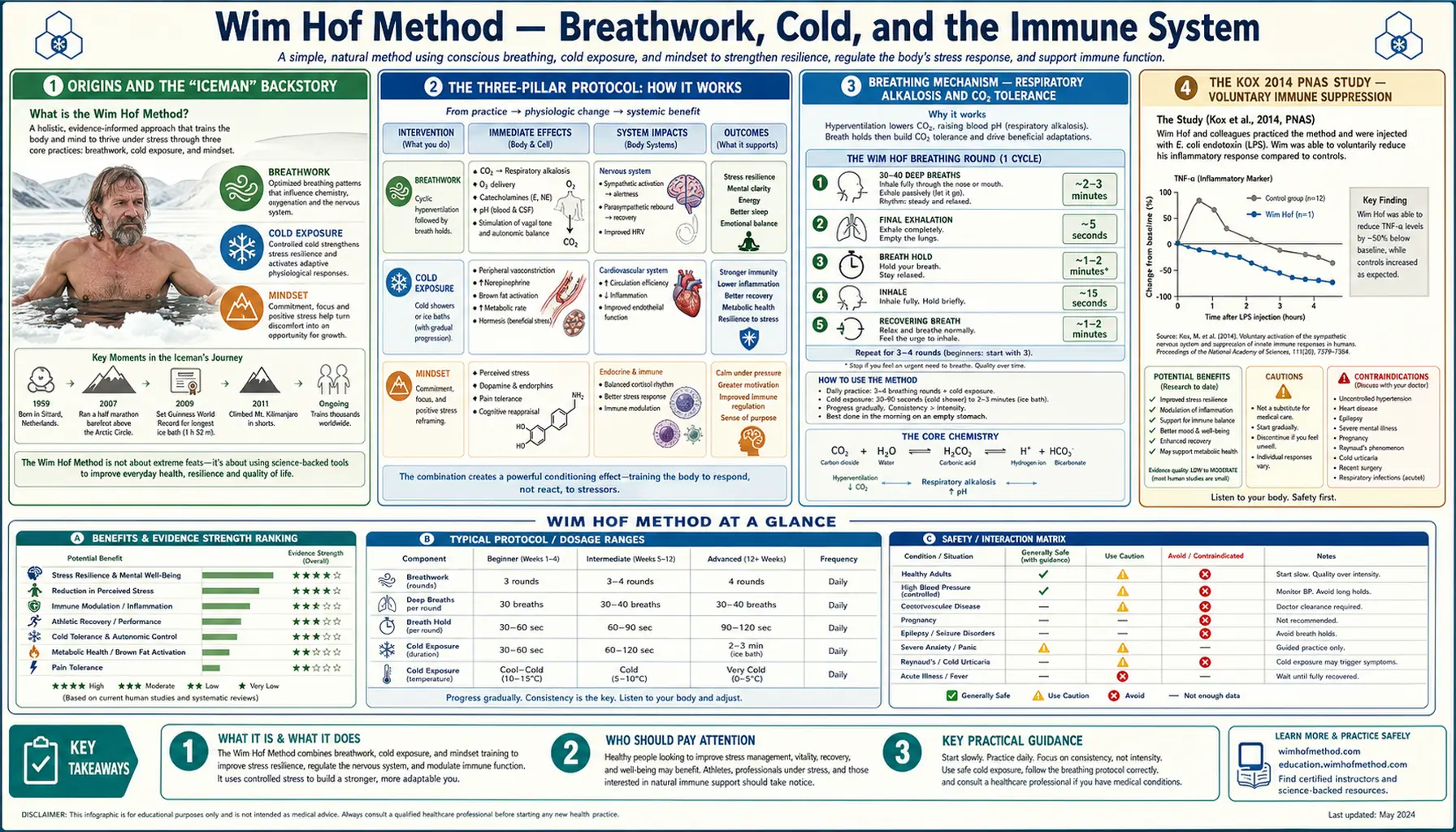
The Wim Hof Method is the first breathwork protocol whose physiological effects have been independently replicated in mainstream peer-reviewed laboratories. The 2014 Kox PNAS study demonstrated that trained practitioners can voluntarily increase circulating epinephrine, suppress pro-inflammatory cytokine response to bacterial endotoxin, and increase IL-10 secretion — the first published evidence that the human innate immune response is under any voluntary control. Subsequent fMRI work at Wayne State showed cortical and brainstem activation patterns absent in untrained controls. The protocol combines three elements: cyclic hyperventilation, breath retention after exhale, and graduated cold exposure. This page documents the protocol, the mechanism, the published evidence, and the explicit safety constraints — the same hyperventilation that produces benefit on dry land kills practitioners who attempt it in water.
Table of Contents
- Origins and the "Iceman" Backstory
- The Three-Pillar Protocol
- Breathing Mechanism — Respiratory Alkalosis and CO2 Tolerance
- The Kox 2014 PNAS Study — Voluntary Immune Suppression
- Brain Imaging Evidence (Muzik 2018 "Brain Over Body")
- Cold Exposure Mechanism — Brown Adipose, Norepinephrine, Hardening
- Clinical Applications and Practical Indications
- How to Practice (Step-by-Step Protocol)
- Safety — Why Hyperventilation Kills in Water
- Cautions and Contraindications
- Key Research Papers
- Connections
- Featured Videos
Origins and the "Iceman" Backstory
Wim Hof is a Dutch extreme-cold-exposure athlete born in 1959 in Sittard, Netherlands, who holds 26 Guinness World Records, including the longest ice bath (1 hour 53 minutes 12 seconds), a barefoot half-marathon on snow and ice in Lapland, and a Mount Kilimanjaro summit attempt in shorts. His method coalesced in the 1980s and 1990s from his own self-experimentation with cold-water immersion in Amsterdam canals and his independent rediscovery of breathing patterns resembling Tibetan Tummo and yogic Bhastrika.
The transition from extreme-athlete curiosity to mainstream physiological research began in 2011 when Wim Hof and his then-26-year-old brother Andre Hof were injected with E. coli endotoxin at Radboud University Medical Center in Nijmegen, Netherlands, under the supervision of intensive-care physician Peter Pickkers. The case report (Kox 2012, Psychosomatic Medicine) documented that Wim Hof's inflammatory cytokine response was approximately half that of historical control subjects. This was suggestive but not definitive — a single individual under intensive coaching may simply have been an unusual responder.
The definitive replication came three years later. In the 2014 Kox PNAS study, Wim Hof personally trained 12 healthy male volunteers for 10 days in his method, then both the trained group and a 12-person untrained control group were injected with endotoxin under identical conditions. The results were striking and have not been credibly refuted.
The Three-Pillar Protocol
The Wim Hof Method is structured around three pillars that are designed to work synergistically. Practiced together, the protocol produces measurable autonomic, immune, and psychological effects. Practiced separately, the effects are smaller and less reproducible.
- Breathing — 30 to 40 cycles of deep, full-belly inhalation through the mouth or nose followed by passive exhalation ("in fully, let out, don't force"), followed by an extended breath-hold on exhale (typically 60 to 180 seconds for trained practitioners, sometimes longer), followed by a recovery inhalation held for 15 seconds. Three rounds are standard. The cycle is repeated daily, ideally morning, on an empty stomach.
- Cold exposure — graduated progression from cold showers (start with the last 30 seconds, build to 2-3 minutes) to ice baths (50°F / 10°C or lower, 1-5 minutes, with no breathing protocol during immersion). The point is hardening of the autonomic response, not endurance heroics.
- Commitment / mindset — the third pillar, emphasized by Wim Hof himself, is consistent practice and the cultivation of focused intention. In neuroscience terms, this is the cortical-control element that distinguishes the method from reflexive cold-shock or panic-driven hyperventilation.
The breathing alone, practiced daily for 30 days, produces a measurable reduction in CO2 sensitivity and an increase in baseline parasympathetic tone. Combined with cold exposure, the protocol produces the most documented immune effect (the Kox study used the full combined protocol, not breathing alone).
Breathing Mechanism — Respiratory Alkalosis and CO2 Tolerance
The 30 to 40 cycles of voluntary hyperventilation lower arterial CO2 (hypocapnia) and raise blood pH (respiratory alkalosis). Arterial pH can rise from the normal 7.40 to as high as 7.75 during a typical Wim Hof round — values that would be considered medical emergencies if produced by an underlying disease, but which are transient and self-correcting during voluntary breathwork.
The acute physiological consequences of this respiratory alkalosis include:
- Cerebral vasoconstriction — CO2 is a potent cerebral vasodilator; lowering it constricts cerebral arteries and reduces cerebral blood flow by 30-50%. This produces the characteristic light-headedness, tingling in the extremities and face (paresthesia), and visual changes some practitioners experience.
- Bohr effect shift — the oxygen-hemoglobin dissociation curve shifts left, meaning hemoglobin holds onto oxygen more tightly and releases less to tissues. This is part of why the subsequent breath-hold tolerance is so extended — you have lower CO2 stimulating the urge to breathe, despite normal-to-elevated O2 at the start of the hold.
- Calcium binding to albumin — alkalosis shifts ionized calcium to its protein-bound form, producing the muscle tetany and Trousseau-sign-like cramping in hands and feet that some practitioners feel as transient stiffening of the fingers ("lobster claws").
- Sympathetic activation — circulating epinephrine increases. In the Kox 2014 study, plasma epinephrine in trained practitioners rose to levels higher than what is typically measured in healthy individuals jumping from a 197-foot bungee tower for the first time.
The training effect over weeks of regular practice is increased CO2 tolerance — the chemoreceptors in the carotid and aortic bodies and in the medullary central chemoreceptors reset to require a higher CO2 level before triggering the urge to breathe. This is the same adaptation seen in elite free divers and is responsible for the steady extension of breath-hold times across weeks of daily practice.
The Kox 2014 PNAS Study — Voluntary Immune Suppression
The Kox 2014 study (PMID 24799686) is the foundational peer-reviewed evidence for the Wim Hof Method. Design and results:
- Design — 24 healthy male volunteers, randomized to either a 10-day Wim Hof training intervention (in Poland, including cold-water immersion, mountain ascents in shorts, and full daily breathwork) or no intervention. After return, both groups were injected with intravenous E. coli endotoxin (2 ng/kg LPS) at Radboud UMC under identical conditions.
- During the endotoxin challenge, the trained group practiced their full breathwork protocol; the control group breathed normally. Blood samples were drawn at baseline and at intervals over the following 8 hours.
- Pro-inflammatory cytokine response — the trained group's peak TNF-alpha was approximately 50% lower than controls. IL-6 and IL-8 were similarly attenuated.
- Anti-inflammatory IL-10 — the trained group's IL-10 response was approximately 200% higher than controls, peaking before the pro-inflammatory cytokines.
- Clinical symptom score — the trained group experienced fewer and milder flu-like symptoms (chills, headache, muscle aches) than controls, consistent with the reduced cytokine response.
- Catecholamines — during the breathwork preceding the endotoxin challenge, the trained group's plasma epinephrine spiked to levels approximately 2.5-fold higher than the highest values previously recorded in volunteers responding to first-time bungee jumping. This epinephrine surge is the proximate cause of the IL-10 increase, which in turn suppresses the pro-inflammatory cascade.
The interpretation is that voluntary hyperventilation produces a catecholamine surge that mimics the acute stress response, and this catecholamine release activates the cholinergic anti-inflammatory pathway (vagal-acetylcholine-alpha7 nicotinic acetylcholine receptor on macrophages) that suppresses NF-kappaB-driven inflammation. The result is a state where the practitioner can functionally "turn down" the innate immune response on demand — a finding that was previously considered impossible.
The 2024 PLOS ONE systematic review (Almahayni & Hammond, PMID 38446777) examined 9 studies including the Kox work, with cautious overall conclusions: the immune effect is real but the field needs longer-term studies in clinical populations rather than only short-term challenges in healthy volunteers.
Brain Imaging Evidence (Muzik 2018 "Brain Over Body")
The 2018 Muzik et al. NeuroImage study (PMID 29438845) examined Wim Hof himself under fMRI and PET scanning during a controlled cold-suit challenge. The findings:
- Wim Hof exhibited activation of the right anterior insula and primary sensorimotor cortex during cold exposure, with increased glucose metabolism in the bilateral periaqueductal gray (PAG) — brainstem region involved in pain modulation and opioid release.
- The PAG activation pattern was consistent with endogenous opioid-mediated analgesia and may explain the resistance to cold-induced pain reported by trained practitioners.
- Increased brown adipose tissue (BAT) thermogenesis was measured via PET, suggesting some component of cold tolerance is metabolic non-shivering thermogenesis rather than purely cortical pain suppression.
- The activation pattern in trained Wim Hof was distinct from typical responses to noxious cold in untrained controls, supporting the "brain over body" conceptual framework.
This study is a single-subject case and does not generalize to all practitioners, but it provides mechanistic plausibility for the cortical-control element of the method and is consistent with reports from intermediate-level practitioners of reduced cold-discomfort over months of training.
Cold Exposure Mechanism — Brown Adipose, Norepinephrine, Hardening
The cold-exposure pillar of the method operates through three documented physiological mechanisms:
- Brown adipose tissue (BAT) activation — chronic cold exposure recruits and activates brown adipose tissue, which expresses uncoupling protein 1 (UCP1) in the mitochondrial inner membrane and dissipates the proton gradient as heat rather than ATP. Studies of Wim Hof Method practitioners (Soeberg 2021 and others) and of habitual winter swimmers show measurable BAT volume and activity increases over months. This produces a modest improvement in metabolic flexibility and insulin sensitivity.
- Norepinephrine surge — cold-water immersion at 14°C for 1 hour produces approximately a 530% increase in plasma norepinephrine, far larger than any pharmacologic agent could safely produce. This catecholamine surge has antidepressant effects (similar mechanism to SNRI medications, but endogenous) and is the proximate driver of post-cold-exposure mood elevation reported by virtually all practitioners.
- Autonomic "hardening" — the term used by Hof for the adaptive reduction in cold-shock response over weeks of practice. The initial gasp reflex, hyperventilation, and panic response to cold immersion all attenuate with repeated controlled exposure. This is classical autonomic conditioning, similar to the adaptation seen in commercial divers and military cold-water swimmers.
For more on the standalone effects of cold exposure (cold showers, ice baths, contrast hydrotherapy), see our Cold Therapy page.
Clinical Applications and Practical Indications
The published clinical applications of the Wim Hof Method — or of its component breathwork and cold exposure — include:
- Autoimmune and inflammatory conditions — the Kox study's mechanism implies potential benefit in rheumatoid arthritis, ankylosing spondylitis, inflammatory bowel disease, and other Th1/Th17-driven inflammatory conditions. Anecdotal reports and small open-label studies suggest benefit in these populations; rigorous RCTs are still needed.
- Depression and treatment-resistant anxiety — the catecholamine surge produces an acute mood-elevating effect comparable to a single ketamine infusion in subjective terms, though without the dissociative profile or the specific NMDA-receptor mechanism. The 2023 Cell Reports Medicine study by Balban (a cyclic-sighing protocol, not the full Wim Hof method) showed sustained mood improvement and reduced anxiety with daily breathwork.
- Performance anxiety and pre-competition arousal — the predictable epinephrine surge during the breathwork can be used as a pre-performance "activation," analogous to a controlled cup of coffee. The Citherlet 2022 study (PMID 35283816) examined the acute effect of Wim Hof breathing on repeated-sprint performance.
- Chronic fatigue and post-viral syndromes — the activation of the sympathetic nervous system in patients with autonomic dysfunction is double-edged. Some patients (especially with deconditioning-driven fatigue) report benefit; others (with autonomic instability, POTS, ME/CFS with post-exertional malaise) report worsening. Individual titration is required.
- Antarctic and high-altitude expedition tolerance — the Petraskova Touskova 2022 study (PMID 35225054) examined a novel Wim Hof psychophysiological training program in an Antarctic expedition context.
How to Practice (Step-by-Step Protocol)
The classical morning protocol, as taught by the Wim Hof Method instructor training:
- Setup — sit or lie down comfortably. Empty stomach. No caffeine yet. Quiet environment. Practice never in water, never while driving, never standing.
- Round 1 — 30 deep breaths — inhale fully through the nose or mouth, filling the belly first, then the chest. Exhale by letting go (do not force the exhale; passive release). The rhythm is roughly 1.5-2 seconds per cycle. You will feel light-headed and tingly — this is normal.
- Retention — after the 30th breath, exhale fully and stop breathing. Hold this empty-lung retention as long as comfortable. First-time practitioners commonly reach 60-90 seconds; experienced practitioners 2-4 minutes; advanced 5+ minutes. Do not force.
- Recovery breath — when you feel the strong urge to breathe, inhale deeply, hold for 15 seconds, then release.
- Repeat rounds 2 and 3 — identical structure. Retention times typically extend with each round as CO2 chemoreceptor sensitivity adapts within the session.
- Conclude — sit quietly for 2-3 minutes. Notice the deepened body sensation, mental clarity, and warmth. Optionally proceed to cold exposure (cold shower or ice bath) within the next 15 minutes.
The official Wim Hof Method app and the free guided audio at wimhofmethod.com are excellent starting points. Beginners should never attempt the protocol without first watching the free fundamentals video course.
Safety — Why Hyperventilation Kills in Water
The single most important safety rule of the Wim Hof Method is: never practice the breathing in water or while driving. This is not a precautionary disclaimer; it is the physiologically necessary boundary derived from the actual mechanism.
Hyperventilation lowers arterial CO2. The urge to breathe is driven primarily by rising CO2, not by falling O2. When a practitioner hyperventilates and then submerges, the urge to surface is suppressed because CO2 takes longer to rise back to the breakpoint threshold. Meanwhile, O2 is being consumed normally. Eventually, O2 falls below the threshold required to maintain consciousness, but because CO2 has not yet risen to trigger an urgent urge to breathe, the practitioner loses consciousness without warning — this is the "shallow water blackout" phenomenon that kills experienced free divers every year.
The same physiology applies to the post-breathwork retention. If a practitioner does the 30 cycles, then attempts a breath-hold while floating in a hot tub, swimming pool, or bathtub, loss of consciousness during the retention results in immediate drowning. There are documented deaths of Wim Hof Method practitioners from this exact mechanism, including a fatal case in 2015 documented in the Belgian press.
The driving prohibition follows the same logic: the cerebral vasoconstriction and transient cognitive cloudiness during peak hyperventilation are incompatible with safe vehicle operation. Practice at a stop; do not practice in motion.
Additional safety rules:
- Never combine the breathing with cannabis, alcohol, or other CNS depressants — the additive risk of loss of consciousness is real.
- Never combine the breathing with sympathomimetic stimulants (high-dose caffeine, ADHD medications) at first practice — the catecholamine surge plus a stimulant can produce palpitations and unpleasant arrhythmias.
- Skip the breathwork during pregnancy.
- Skip the breathwork after recent eye surgery, retinal detachment, or recent head injury.
Cautions and Contraindications
- Pregnancy — the maternal hyperventilation acutely reduces placental perfusion. Avoid.
- Epilepsy or seizure history — voluntary hyperventilation is a standard EEG provocation test for seizure activity, precisely because it can trigger seizures in susceptible individuals. Avoid the breathwork; cold exposure alone is generally safe.
- Recent cardiovascular event — uncontrolled atrial fibrillation, recent myocardial infarction (within 6 months), unstable angina, or moderate-to-severe aortic stenosis are contraindications to both the catecholamine surge from breathwork and the cold-pressor effect from cold exposure.
- Severe asthma or COPD with hypercapnia — the chemoreceptor recalibration could theoretically blunt the protective hypercapnic respiratory drive.
- Raynaud's phenomenon, cryoglobulinemia, cold urticaria — cold exposure is contraindicated.
- Acute mental health crisis — active psychosis, severe panic disorder, or acute trauma response can be intensified by the dissociative experience some practitioners have during deep retention. Establish a stable baseline and ideally work with a trained instructor.
- Children under 16 — the protocol is not designed for or studied in children. Cold showers in moderation are reasonable; the breathwork is not for kids.
- Practice without a buddy at home is acceptable for the breathwork on dry land, but never for first cold-immersion attempts in an ice bath.
Key Research Papers
- Kox M, van Eijk LT, Zwaag J, van den Wildenberg J, Sweep FC, van der Hoeven JG, Pickkers P (2014). Voluntary activation of the sympathetic nervous system and attenuation of the innate immune response in humans. Proceedings of the National Academy of Sciences, 111(20):7379-7384. PMID: 24799686. — PubMed: 24799686
- Kox M, Stoffels M, Smeekens SP, van Alfen N, Gomes M, Eijsvogels TM, Hopman MT, van der Hoeven JG, Netea MG, Pickkers P (2012). The influence of concentration/meditation on autonomic nervous system activity and the innate immune response: a case study. Psychosomatic Medicine, 74(5):489-94. PMID: 22685240. — Search PubMed
- Muzik O, Reilly KT, Diwadkar VA (2018). "Brain over body" — A study on the willful regulation of autonomic function during cold exposure. NeuroImage, 172:632-641. PMID: 29438845. — PubMed: 29438845
- Almahayni O, Hammond L (2024). Does the Wim Hof Method have a beneficial impact on physiological and psychological outcomes in healthy and non-healthy participants? A systematic review. PLOS ONE, 19(3):e0286933. PMID: 38446777. — Search PubMed
- Citherlet T, Crettaz von Roten F, Kayser B, Guex K (2022). Acute Effects of the Wim Hof Breathing Method on Repeated Sprint Ability. Frontiers in Physiology, 13:843643. PMID: 35283816. — Search PubMed
- Petraskova Touskova T, Bob P, Bares Z, Vanickova Z, Nyvlt D, Raboch J (2022). A novel Wim Hof psychophysiological training program to reduce stress responses during an Antarctic expedition. Journal of International Medical Research, 50(4). PMID: 35225054. — Search PubMed
- Zwaag J, Naaktgeboren R, van Herwaarden AE, Pickkers P, Kox M (2022). The Effects of Cold Exposure Training and a Breathing Exercise on the Inflammatory Response in Humans. Psychosomatic Medicine, 84(4):457-467. PMID: 35980777. — Search PubMed
- Buijze GA, Hopman MT (2014). Controlled hyperventilation after training may accelerate altitude acclimatization. Wilderness & Environmental Medicine, 25(4):484-486. PMID: 25443755. — Search PubMed
- Marko D, Bahenský P, Bunc V, et al. (2023). The effect of Wim Hof Method on autonomic and cardiovascular function. Frontiers in Psychology, 14. PMID: 37663332. — Search PubMed
- Buijze GA, De Jong HMY, Kox M, et al. (2019). An add-on training program involving breathing exercises, cold exposure, and meditation attenuates inflammation and disease activity in axial spondyloarthritis — A proof of concept trial. PLOS ONE, 14(12):e0225749. PMID: 31794549. — Search PubMed
PubMed Topic Searches
- PubMed: Wim Hof Method
- PubMed: Hyperventilation and endotoxin immune response
- PubMed: Cold exposure and brown adipose tissue
- PubMed: Cholinergic anti-inflammatory pathway
Connections
- All Remedies
- Breathwork (Main Hub)
- Breathwork Benefits
- Box Breathing and Resilience
- Pranayama Traditions
- Vagal Tone and HRV
- Cold Therapy
- Meditation
- Ankylosing Spondylitis
- Rheumatoid Arthritis
- Depression
- Anxiety
- Metabolic Syndrome
- Sauna
- Meditation