Selenium Deficiency: Symptoms, Causes, and Recovery
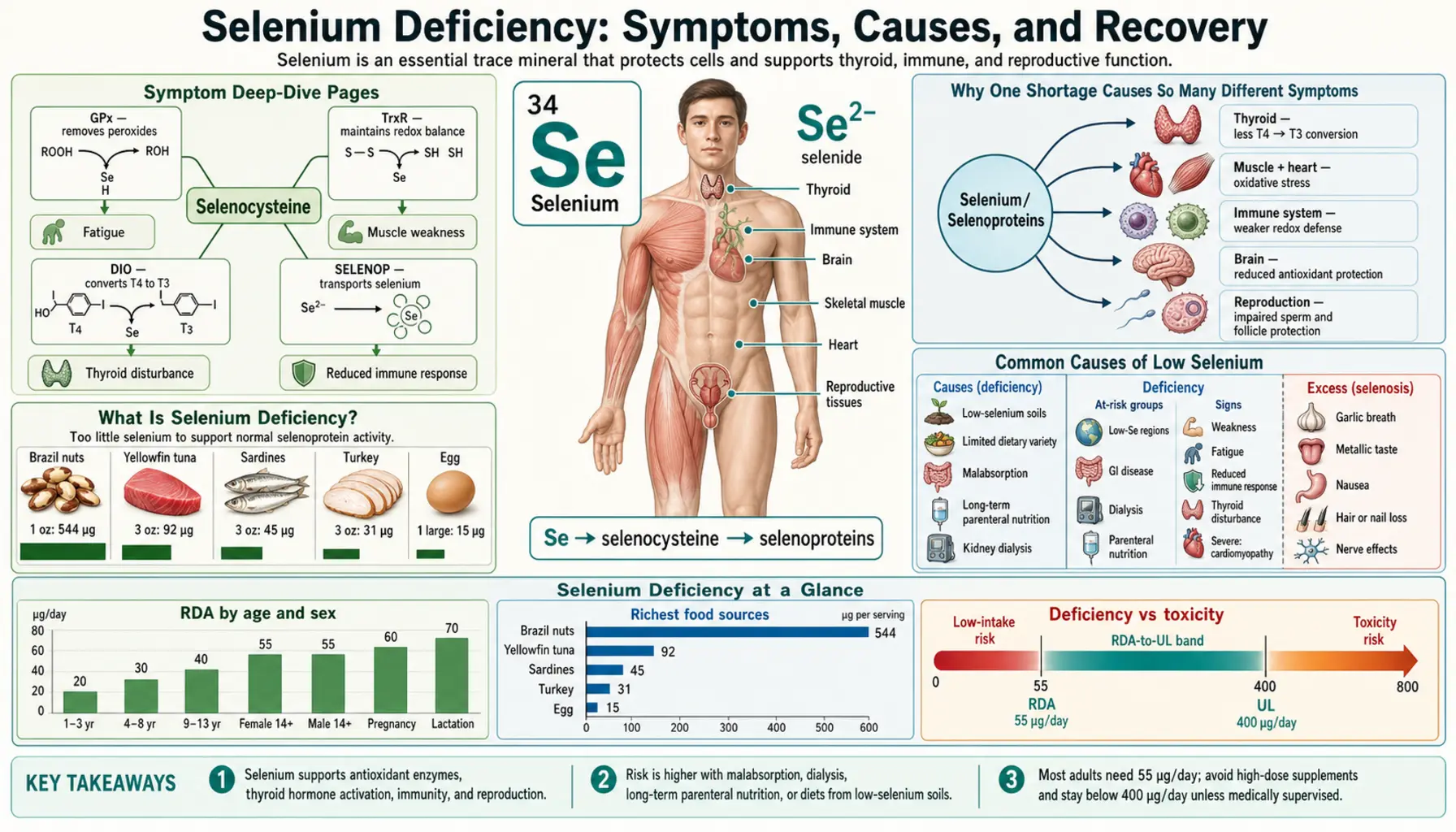
Selenium deficiency means your body does not have enough of this trace mineral to build the small family of proteins that depend on it — the selenoproteins. You need only a tiny amount of selenium, measured in micrographs (millionths of a gram) rather than the milligrams most minerals are dosed in, but that tiny amount does outsized work: it powers your most important antioxidant enzymes, switches thyroid hormone into its active form, and helps the immune system fight infection. Severe deficiency is uncommon in most of the world and is tied to a few specific places where the soil is naturally low in selenium — most famously parts of China, where it caused a heart disease called Keshan disease. But milder low-selenium status is more common and tends to show up quietly: a struggling thyroid, more frequent infections, and tired, weak muscles. The reassuring news is that selenium status is straightforward to raise — often with food alone, since a single serving of certain nuts, fish, eggs, or organ meats can cover a full day's need, and because the body is good at holding on to selenium once it is replenished. This hub explains what selenium deficiency is, why one shortage ripples into the heart, thyroid, immune system, and muscles, what commonly causes it, and exactly how it is diagnosed and corrected — with deep-dive pages for each of the major symptoms.
Symptom Deep-Dive Pages
Heart (Keshan Disease)
The selenium-deficiency cardiomyopathy first described in Keshan County, China — how a low-selenium diet weakens the heart muscle, who is at risk today, and why prevention with selenium worked so dramatically.
Thyroid Problems
Why the thyroid is the most selenium-dense organ in the body, how low selenium impairs the conversion of thyroid hormone to its active form, and the link to Hashimoto's thyroiditis.
Weakened Immunity
How selenium-dependent antioxidant enzymes protect immune cells, why low selenium can blunt the response to infection and vaccination, and what the evidence does — and does not — show.
Muscle Weakness
The muscle aches, weakness, and (rarely) myopathy that can accompany severe selenium deficiency — what it feels like, why muscle tissue is vulnerable, and the honest limits of blaming weakness on selenium alone.
Table of Contents
- Symptom Deep-Dive Pages
- What Is Selenium Deficiency?
- Why One Shortage Causes So Many Different Symptoms
- Common Causes of Low Selenium
- Related Nutrients: Iodine, Iron, Zinc & Vitamin E
- How Selenium Deficiency Is Diagnosed
- How Low Selenium Is Corrected
- When to Seek Care / Red Flags
- Key Research Papers
- Connections
- Featured Videos
What Is Selenium Deficiency?
Selenium is an essential trace mineral — "essential" because your body cannot make it and must get it from food, and "trace" because the amount you need is genuinely tiny. The recommended intake for adults is about 55 micrograms per day (a microgram is one-millionth of a gram), and most people in selenium-rich regions take in more than that without trying. Selenium deficiency is the state in which intake has been too low for too long to keep the body's selenium-dependent machinery running normally.
What makes selenium unusual is that it does not act as a free-floating mineral the way calcium or potassium do. Instead, almost all of selenium's work is done through about 25 specialized proteins called selenoproteins, each of which has a selenium atom built into its core. When selenium runs short, the body cannot manufacture enough of these proteins, and it prioritizes the most vital ones — meaning the symptoms of deficiency reflect which selenoproteins are starved first.
There is no single universally-agreed "deficiency number" the way there is for many vitamins, but researchers commonly describe selenium status using the blood level and the activity of selenoproteins:
- Adequate status — In most studies, a plasma or serum selenium of roughly 70–90 micrograms per liter (µg/L) or higher is enough to fully saturate the body's key antioxidant enzyme, glutathione peroxidase. Above this, more selenium does not buy more enzyme activity.
- Suboptimal / low status — Levels below about 70 µg/L are associated with not-yet-maxed selenoprotein activity. People in this range often feel completely well, but their thyroid and immune defenses may be operating with less reserve. This milder shortfall is far more common than outright deficiency.
- Severe deficiency — Truly low intake over months to years, typically below 10–15 micrograms per day, depletes selenoproteins enough to cause recognizable disease. This is rare globally and is concentrated in specific low-selenium regions, or in people fed for long periods without selenium (for example, older intravenous-nutrition formulas).
Two facts are worth holding together. First, frank, disease-causing selenium deficiency is uncommon in much of the world, because the modern food supply moves grain and meat across regions and averages out the soil differences. Second, the soil a population's food grows in matters enormously: where soil selenium is naturally low — parts of China, some areas of Europe, New Zealand — average intakes can sit at the bottom of the healthy range, and certain people slip below it. So selenium deficiency is best thought of less as a vitamin you forgot to take and more as a geography-and-circumstance problem.
Why One Shortage Causes So Many Different Symptoms
The puzzle of selenium deficiency is how one trace mineral can affect organs as different as the heart, the thyroid, the immune system, and skeletal muscle. The answer is the same one that runs through this whole hub: selenium's jobs are concentrated in a small set of selenoproteins, and several of those proteins sit at the controls of important systems. Lose the raw material and several systems lose function at once. Restore it and they tend to recover together.
Here is the core idea in everyday language. Think of selenium as a rare ingredient that a handful of critical machines cannot run without. The machines do completely different jobs, but they share this one part. When the part is in short supply, the body keeps the most essential machines running and lets the others idle — so the pattern of symptoms tells you which selenoproteins ran dry first. The most important machines are:
- Antioxidant enzymes (glutathione peroxidases). These are the body's frontline defense against oxidative stress — the constant cellular "rusting" caused by reactive oxygen molecules produced as a byproduct of using oxygen. Selenium-dependent glutathione peroxidases neutralize peroxides before they damage cell membranes and DNA. This was selenium's first known role, discovered in 1973 (Rotruck and colleagues). When selenium is low, tissues that burn a lot of oxygen — like heart muscle — take more oxidative damage. This is central to Keshan disease.
- Thyroid hormone activators (deiodinases). The thyroid gland makes mostly an inactive, "storage" form of thyroid hormone called T4. Selenium-containing enzymes called deiodinases snip an iodine atom off T4 to make the active hormone, T3, which actually drives metabolism. The thyroid holds more selenium per gram than any other organ. When selenium is low, this conversion falters, which is why deficiency shows up as thyroid problems. See also Selenium and Thyroid Function.
- Immune-cell protection and signaling. Immune cells generate bursts of reactive molecules to kill microbes, and they rely on selenoproteins to survive that self-made oxidative storm and to coordinate the response. Low selenium can leave immune defenses sluggish, which is the theme of the Weakened Immunity page and is explored on Selenium and Immune Function.
- Muscle tissue maintenance. Heart and skeletal muscle are oxygen-hungry and contain selenoproteins (including selenoprotein N, which is needed for normal muscle function). Severe deficiency can therefore produce muscle pain and weakness — covered on the Muscle Weakness page.
This is the unifying theme to carry into the symptom pages: selenium deficiency is not a single disease with one symptom but a shortage of a shared part that several important machines depend on. One low number is felt in several places — and which places, and how badly, depends on how low the level falls and on what else (iodine status, viral infection, other illness) is happening at the same time.
Common Causes of Low Selenium
Selenium status comes down to one simple input — how much selenium reaches you through food — and a few situations that increase loss or demand. Because the kidney does not waste selenium the way it wastes potassium, low selenium is almost always a story of low intake rather than excess loss. Here are the causes worth knowing.
- Low-selenium soil (the dominant cause worldwide). Plants take up selenium from soil, and animals get it from plants, so the selenium content of any given diet ultimately traces back to the ground the food grew in. Soil selenium varies enormously by region. In low-selenium belts — classically parts of central and northeastern China, but also areas of Europe (including parts of the UK and Scandinavia) and New Zealand — locally-grown food simply contains less selenium, and people who eat mostly local produce can fall short.
- Diets built around low-selenium foods. Even outside low-selenium regions, a diet heavy in foods that are naturally low in selenium — for example, mostly fruits, vegetables, and refined grains with little fish, meat, eggs, or whole grains — can supply less selenium. The mineral is most concentrated in animal foods, certain seafood, nuts, and whole grains.
- Severe malabsorption. Conditions that damage the gut's ability to absorb nutrients — such as Crohn's disease, untreated celiac disease, short-bowel syndrome after surgery, or chronic severe diarrhea — reduce selenium uptake along with many other nutrients.
- Long-term intravenous (parenteral) nutrition without selenium. People fed entirely through a vein for weeks or months can become deficient if the formula lacks selenium. This was a recognized problem with older formulas and is now prevented by adding selenium — it is also one of the few causes of severe deficiency outside low-selenium regions.
- Dialysis and advanced kidney disease. People on long-term hemodialysis frequently have low selenium levels, partly from dietary restrictions and partly from losses during dialysis.
- Phenylketonuria (PKU) and other restrictive medical diets. The very low-protein, specialized formula diets used for certain inherited metabolic disorders can be low in selenium unless it is deliberately supplemented.
- Heavy alcohol use and severe general malnutrition. As with most micronutrients, chronic alcohol use and severe undernutrition deplete selenium along with other trace minerals.
A practical note: outside the low-selenium regions and these specific medical situations, an otherwise healthy person eating a varied diet that includes some seafood, eggs, meat, or whole grains is unlikely to become truly selenium-deficient. When a clinician suspects deficiency in someone without one of the causes above, they will usually look hard for a malabsorption problem or a restrictive diet rather than assume the food supply alone is to blame.
Related Nutrients: Iodine, Iron, Zinc & Vitamin E
Selenium does not work in isolation, and several of its effects only make sense alongside a few partner nutrients. Understanding these relationships explains some otherwise confusing situations — for example, why correcting selenium without checking iodine can occasionally backfire for the thyroid.
- Iodine — the closest partner. Iodine and selenium are the two minerals the thyroid most depends on. Iodine is the raw material the thyroid uses to build thyroid hormone; selenium-containing deiodinases then activate it and selenoproteins protect the gland from the oxidative byproducts of making hormone. Because their roles are linked, the two deficiencies interact: severe combined iodine-and-selenium deficiency produces the worst thyroid outcomes, and there is a well-known caution that giving selenium to someone who is also severely iodine-deficient can, in theory, accelerate hormone breakdown and worsen hypothyroidism if iodine is not addressed first. The practical lesson is that the thyroid is best supported by getting both right. See Iodine.
- Iron. The thyroid enzyme that uses iodine to make hormone (thyroid peroxidase) is iron-dependent, so iron deficiency — common in menstruating women — can blunt thyroid function alongside any selenium or iodine shortfall. When the thyroid is struggling, iron is worth checking too. See Iron.
- Zinc. Zinc, like selenium, is a trace mineral central to immune function and to the enzymes that handle thyroid hormone signaling. Diets low in one trace mineral are often low in others, and zinc and selenium deficiencies can coexist, compounding immune weakness. See Zinc.
- Vitamin E. Selenium-dependent glutathione peroxidase and vitamin E work as complementary parts of the same antioxidant system: vitamin E protects fats in cell membranes directly, while glutathione peroxidase mops up the peroxides that form. A shortage of one places more strain on the other, which is why early animal studies of selenium deficiency often involved vitamin E too, and why the two were studied together in the prostate-cancer prevention trials.
The takeaway is not to chase a long supplement list, but to recognize that the thyroid and the antioxidant defenses depend on a small team of nutrients. When selenium is low, a thoughtful work-up considers iodine and iron in particular — especially when the main problem is thyroid-related.
How Selenium Deficiency Is Diagnosed
Unlike potassium or sodium, selenium is not on the routine blood panels most people get at a check-up — a basic or comprehensive metabolic panel does not measure it. (For what those standard panels do cover, see the Comprehensive Metabolic Panel page.) Selenium has to be ordered specifically, which is one reason mild deficiency often goes unrecognized: no one is looking unless there is a reason to.
When deficiency is suspected, a clinician can measure selenium status in several ways, each capturing a different time window:
- Serum or plasma selenium — the most common test. It reflects relatively recent intake (the past weeks). A typical reference range is roughly 70–150 µg/L, though labs differ. It is a reasonable snapshot but can be temporarily lowered by acute illness and inflammation, so a single low value during an infection should be interpreted cautiously.
- Glutathione peroxidase activity — rather than measuring selenium itself, this measures how well one of the key selenoenzymes is working, which is arguably a better gauge of whether selenium is functionally sufficient. Because enzyme activity plateaus once selenium is adequate, it is most useful for detecting deficiency rather than excess.
- Selenoprotein P — a transport selenoprotein made by the liver that many researchers consider the best single marker of selenium status, because it responds across a wider range of intakes than glutathione peroxidase. It is more available in research and specialized settings than in routine practice.
- Whole-blood selenium and toenail selenium — these reflect longer-term, average intake over months. Toenail clippings are a clever, non-invasive way researchers estimate someone's selenium status over the prior year, and they have been used in large nutrition studies.
In practice, the most useful clue is often the context: a person from or living in a known low-selenium region, on long-term intravenous nutrition, on dialysis, or with a serious malabsorption condition, who develops unexplained heart, thyroid, or muscle symptoms, is the person in whom selenium is worth measuring. When the thyroid is the concern, selenium is usually checked alongside thyroid hormone levels, thyroid antibodies, iodine status, and iron.
How Low Selenium Is Corrected
The reassuring theme of selenium deficiency is how readily it responds to food. Because the daily requirement is so small and a few foods are extraordinarily rich in selenium, most people can correct a mild shortfall at the dinner table. The guiding principles are: food first, supplement modestly and only when needed, and never assume that more is better — the safe range for selenium is genuinely narrow.
- Mild or borderline status — food first. Selenium is concentrated in a short list of foods, and adding them reliably raises status. Brazil nuts are the most famous example — so rich that one or two nuts can supply a full day's selenium, and a controlled trial showed Brazil nuts raised selenium status as effectively as a supplement (Thomson and colleagues, 2008). Other excellent sources include seafood such as tuna, sardines, cod, and salmon; eggs; beef and other meats, especially organ meats; poultry; and whole grains. For a fuller breakdown of food amounts, see the Selenium food sources page.
- A word of caution on Brazil nuts. Their selenium content is so high and so variable (depending on where they were grown) that eating a large handful every day can push intake into the excessive range over time. A couple of nuts a few times a week is plenty — this is a case where a "more is better" instinct can genuinely cause harm.
- When supplements are appropriate. For confirmed deficiency that diet cannot fix (for example, in malabsorption, dialysis, or supervised correction of a documented low level), selenium supplements are used. Common forms include selenomethionine (an organic form, well absorbed and stored) and sodium selenite/selenate (inorganic forms). Typical replacement and study doses fall in the range of about 50–200 micrograms per day. This should be guided by a clinician, ideally with a baseline level, rather than self-prescribed indefinitely.
- Thyroid-specific use. In people with autoimmune (Hashimoto's) thyroiditis, selenium supplementation has been studied as a way to lower thyroid antibody levels; a systematic review and meta-analysis (Toulis and colleagues, 2010) found it can reduce antibodies, though the effect on how people actually feel and on long-term thyroid function is less certain. If selenium is used for the thyroid, iodine status should be addressed too. See Hashimoto's Thyroiditis.
- Respect the ceiling. The tolerable upper intake level for adults is 400 micrograms per day from all sources combined — a low ceiling compared with most minerals. Chronic intake above this can cause selenosis (hair and nail brittleness or loss, garlic-smelling breath, gastrointestinal upset, and nerve problems). Large trials such as the SELECT prostate-cancer study (Lippman and colleagues, 2009) found no benefit — and signals of possible harm — from selenium supplementation in already-replete men, underscoring that selenium supplements are for documented or likely deficiency, not for healthy, well-nourished people. The companion Selenium Toxicity hub covers excess in detail.
For most people with genuinely low selenium, the outlook is excellent: because the body holds on to selenium and the requirement is small, correcting intake restores selenoprotein activity over a matter of weeks, and the associated symptoms tend to improve as they do.
When to Seek Care / Red Flags
Most low-selenium situations are mild and not urgent — a non-emergency conversation with your doctor about diet and testing is the right step if you live in or come from a known low-selenium region, have a malabsorption condition, are on dialysis or long-term intravenous nutrition, and you have unexplained fatigue, thyroid symptoms, or muscle aches. But because the most serious form of selenium deficiency affects the heart, certain symptoms deserve prompt medical attention rather than a wait-and-see approach. Seek urgent care if you have any of the following:
- Shortness of breath, especially on exertion or when lying flat — together with leg swelling or rapid weight gain from fluid, this can signal a weakening heart muscle (cardiomyopathy) and needs evaluation. This is the danger that makes severe selenium deficiency more than a nuisance — see Keshan Disease.
- Palpitations, fainting, or near-fainting — a racing, pounding, or irregular heartbeat, or passing out, can reflect a heart-rhythm problem and should be assessed. See Arrhythmia.
- Rapidly progressive or severe muscle weakness — especially weakness that interferes with breathing, swallowing, or walking, which warrants prompt evaluation regardless of the suspected cause.
- New or worsening thyroid symptoms — persistent fatigue, weight change, cold intolerance, or a swelling in the neck (goiter) deserves a thyroid work-up, which can identify whether selenium, iodine, or an autoimmune process is involved.
- Signs you may be getting too much selenium — if you have been taking selenium supplements or eating many Brazil nuts daily and develop brittle or shedding hair and nails, a garlic or metallic taste, or unexplained nausea, stop and seek advice; this points toward selenosis, covered on the Selenium Toxicity hub.
People in the specific high-risk groups — residents of low-selenium areas, those on dialysis or parenteral nutrition, and people with serious malabsorption — should have a lower threshold for getting selenium status checked, because in these settings deficiency is genuinely possible and, in the case of the heart, potentially serious. For most other people, selenium deficiency is uncommon, and a varied diet is both the prevention and the cure.
Key Research Papers
- Rayman MP (2012). Selenium and human health. The Lancet;379(9822):1256-1268. — DOI: 10.1016/S0140-6736(11)61452-9
- Fairweather-Tait SJ, Bao Y, Broadley MR, Collings R, Ford D, et al. (2011). Selenium in Human Health and Disease. Antioxidants & Redox Signaling;14(7):1337-1383. — DOI: 10.1089/ars.2010.3275
- Rotruck JT, Pope AL, Ganther HE, Swanson AB, Hafeman DG, Hoekstra WG (1973). Selenium: Biochemical Role as a Component of Glutathione Peroxidase. Science;179(4073):588-590. — DOI: 10.1126/science.179.4073.588
- Labunskyy VM, Hatfield DL, Gladyshev VN (2014). Selenoproteins: Molecular Pathways and Physiological Roles. Physiological Reviews;94(3):739-777. — DOI: 10.1152/physrev.00039.2013
- Burk RF, Hill KE (2009). Selenoprotein P — Expression, functions, and roles in mammals. Biochimica et Biophysica Acta (BBA) — General Subjects;1790(11):1441-1447. — DOI: 10.1016/j.bbagen.2009.03.026
- Köhrle J, Jakob F, Contempré B, Dumont JE (2005). Selenium, the Thyroid, and the Endocrine System. Endocrine Reviews;26(7):944-984. — DOI: 10.1210/er.2001-0034
- Huang Z, Rose AH, Hoffmann PR (2012). The Role of Selenium in Inflammation and Immunity: From Molecular Mechanisms to Therapeutic Opportunities. Antioxidants & Redox Signaling;16(7):705-743. — DOI: 10.1089/ars.2011.4145
- Toulis KA, Anastasilakis AD, Tzellos TG, Goulis DG, Kouvelas D (2010). Selenium Supplementation in the Treatment of Hashimoto's Thyroiditis: A Systematic Review and a Meta-analysis. Thyroid;20(10):1163-1173. — DOI: 10.1089/thy.2009.0351
- Thomson CD, Chisholm A, McLachlan SK, Campbell JM (2008). Brazil nuts: an effective way to improve selenium status. The American Journal of Clinical Nutrition;87(2):379-384. — DOI: 10.1093/ajcn/87.2.379
- Lippman SM, Klein EA, Goodman PJ, Lucia MS, Thompson IM, et al. (2009). Effect of Selenium and Vitamin E on Risk of Prostate Cancer and Other Cancers (SELECT). JAMA;301(1):39-51. — DOI: 10.1001/jama.2008.864
- Longnecker MP, Taylor PR, Levander OA, Howe M, Veillon C, et al. (1991). Selenium in diet, blood, and toenails in relation to human health in a seleniferous area. The American Journal of Clinical Nutrition;53(5):1288-1294. — DOI: 10.1093/ajcn/53.5.1288
- Loscalzo J (2014). Keshan Disease, Selenium Deficiency, and the Selenoproteome. New England Journal of Medicine. — PubMed
PubMed Topic Searches
- PubMed — Selenium deficiency and human health
- PubMed — Keshan disease, selenium, and cardiomyopathy
- PubMed — Selenium, thyroid, deiodinases, and autoimmune thyroiditis
- PubMed — Selenium, immune function, and infection
- PubMed — Selenium status biomarkers and selenoprotein P
Connections
- All Minerals
- Selenium Deficiency: Heart (Keshan Disease)
- Selenium Deficiency: Thyroid Problems
- Selenium Deficiency: Weakened Immunity
- Selenium Deficiency: Muscle Weakness
- Selenium Overview
- Selenium Toxicity Hub
- Selenium Benefits Hub
- Selenium and Thyroid Function
- Selenium and Immune Function
- Selenium and Antioxidant Defense
- Selenium Food Sources
- History of Selenium
- Iodine
- Iron
- Zinc
- Comprehensive Metabolic Panel
- Hashimoto's Thyroiditis
- Hypothyroidism
- Endocrinology
- Cardiomyopathy
- Arrhythmia
- Tuna
- Sardines
- Eggs
- Cod
- Beef