Selenium Deficiency: Muscle Weakness
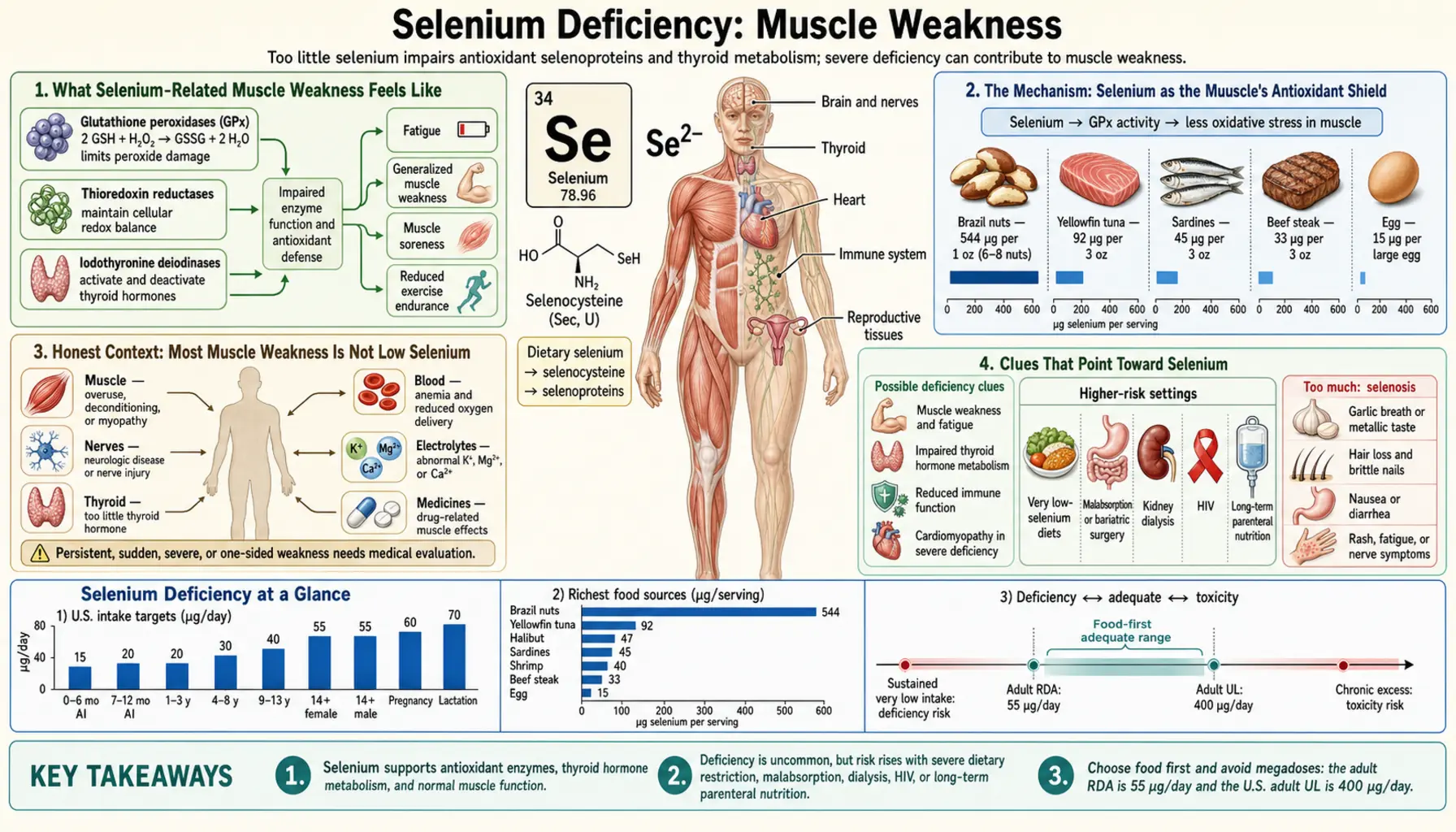
Selenium is a trace mineral most people have never thought about — the body holds only about 13–20 milligrams of it in total — yet when it runs deeply low, one of the things that can suffer is the muscle itself. People describe aching, tender thighs and upper arms, legs that tire and give out on stairs, and a heavy, weak feeling that rest doesn't fix. This is a real but uncommon problem: in most of the world ordinary diets supply enough selenium, and true selenium-deficiency myopathy shows up mainly in very specific situations — long-term intravenous feeding without selenium, severe gut-absorption disease, or (historically) entire regions where the soil is almost devoid of the mineral. This page explains how selenium protects muscle, why a deficit can weaken it, the far more common reasons muscles feel weak, and how the genuine cases are spotted and corrected.
Table of Contents
- What Selenium-Related Muscle Weakness Feels Like
- The Mechanism: Selenium as the Muscle's Antioxidant Shield
- Honest Context: Most Muscle Weakness Is Not Low Selenium
- Clues That Point Toward Selenium
- What Actually Causes Selenium to Fall This Low
- A Related Story: Selenoprotein N and Inherited Myopathy
- Getting Tested
- Correcting Low Selenium Safely
- When to Seek Care / Red Flags
- Key Research Papers
- Connections
- Featured Videos
What Selenium-Related Muscle Weakness Feels Like
When selenium deficiency does reach the muscles, the complaint that brings people to a doctor is usually a combination of weakness and discomfort in the large muscles — the thighs, hips, calves, and upper arms. Unlike the painless weakness of low potassium, selenium-related myopathy is often described as sore:
- Tender, aching thighs and upper arms — the muscle is uncomfortable to press, and the ache is worse with use. In the best-documented human cases, muscle tenderness and pain were the leading symptoms, not just loss of strength.
- Legs that tire and weaken on stairs or hills — because the big proximal muscles closest to the trunk are affected, climbing stairs, rising from a low chair, and walking uphill feel disproportionately hard.
- A heavy, “done” feeling that rest doesn't fully fix — people describe legs that feel leaden after ordinary activity and don't bounce back the way they used to.
- Sometimes whitening of the nail beds or thinning hair — long-standing selenium deficiency can show up in the nails and hair too, which, alongside muscle symptoms, can hint at the underlying cause.
A laboratory clue often travels with these symptoms: a blood enzyme called creatine kinase (CK), which leaks out of injured muscle, is frequently elevated. A raised CK alongside aching, weak proximal muscles is the picture clinicians have repeatedly described in genuine selenium-deficiency myopathy, and it is one of the features that separates it from simple tiredness.
It is worth being plain from the start: this is a slow, smouldering problem, not a sudden one. Selenium deficiency myopathy develops over months in someone whose intake has been very low for a long time — it is not the kind of thing that appears overnight in an otherwise well-fed person.
The Mechanism: Selenium as the Muscle's Antioxidant Shield
Selenium does almost nothing on its own. Its job in the body is to sit at the active core of a small family of proteins called selenoproteins, where it is built into a special amino acid — selenocysteine — that acts as the business end of the enzyme. Humans make about 25 selenoproteins, and several of them matter directly to muscle. The most important for this page are the glutathione peroxidases and a muscle-enriched protein called selenoprotein N.
Working muscle is a furnace. Every contraction burns fuel and oxygen, and a normal by-product of that metabolism is a steady trickle of reactive oxygen species — unstable, corrosive molecules often called free radicals or oxidants. In healthy amounts these are managed and even useful as signals; in excess they damage the delicate machinery of the muscle fiber: its membranes, its proteins, and the calcium-handling system it uses to contract and relax. The job of selenium-dependent glutathione peroxidase is to neutralise that oxidant load — it uses glutathione to convert harmful peroxides into harmless water before they can do damage. (For more on this system, see Selenium for Antioxidant Defense.)
When selenium is severely depleted, the supply of these protective enzymes falls, and the muscle's antioxidant shield thins. Oxidative damage accumulates in the fibers that work hardest — the large postural and locomotor muscles — injuring them, spilling CK into the blood, and leaving the muscle weak and sore.
An analogy. Picture a busy kitchen with a stove running all day. Oxidants are the grease and smoke that working flames inevitably throw off, and the selenium-powered enzymes are the exhaust hood and fire blanket that keep the mess from building up and the flames from catching the curtains. Run the kitchen with the hood switched off — which is what severe selenium deficiency does — and at first you notice nothing. But over weeks the walls blacken, the surfaces degrade, and eventually a small flare-up that the hood would have shrugged off does real harm. The stove still has fuel; the problem is that nothing is clearing the by-products of using it. Restore the “exhaust system” — the selenoproteins — and the muscle can recover.
Selenoprotein N adds a second layer to the story. It is concentrated in muscle, is especially important early in muscle development, and helps regulate calcium release and the muscle's response to oxidative stress. As described below, when the gene for selenoprotein N is mutated, the result is a well-defined inherited muscle disease — powerful evidence that selenium-built proteins are genuinely structural to healthy muscle, not a fringe curiosity.
Honest Context: Most Muscle Weakness Is Not Low Selenium
Here is the part that has to be said clearly, because it is easy to read about a deficiency and conclude it explains your symptoms. In a well-nourished person, selenium deficiency is a rare cause of muscle weakness. Across most of North America and Europe, ordinary diets — through bread, meat, fish, eggs, and especially nuts — supply enough selenium to keep these enzymes stocked. Weak, aching muscles are a very common complaint with a long list of far more likely explanations, and selenium sits near the bottom of that list for most people.
Far more common causes of muscle weakness include:
- Deconditioning and age-related muscle loss (sarcopenia) — loss of strength from inactivity, illness, or simply ageing is the single most common reason muscles feel weaker than they used to.
- Thyroid disease — both an underactive and an overactive thyroid cause genuine proximal muscle weakness. (Selenium also matters to the thyroid, so the two can intertwine — see the sibling page on Selenium and Thyroid Problems.)
- Other electrolyte problems — low potassium, low magnesium, low calcium, or low phosphate all weaken muscle, and they are checked long before selenium.
- Vitamin D deficiency — a classic and very common cause of proximal weakness and aching, especially difficulty rising from a chair or climbing stairs.
- Statin-associated muscle symptoms — cholesterol-lowering statins can cause muscle aching and weakness; see CoQ10 and Statin Myopathy.
- Primary muscle and nerve diseases — inflammatory myopathies (such as polymyositis), muscular dystrophies, and neurological conditions all present with weakness and need specialist evaluation.
- Anaemia, depression, poor sleep, and chronic illness — which often produce a sense of weakness that is really exhaustion.
The honest bottom line: muscle weakness should send you to a clinician for a sensible workup — not to a selenium bottle. Selenium becomes a serious suspect only when the right risk factors are present and the common causes have been considered.
Clues That Point Toward Selenium
Given how uncommon it is, what would actually raise selenium deficiency as a real possibility behind aching, weak muscles? A handful of specific clues, almost always involving a reason the person can't get or absorb normal dietary selenium:
- Long-term intravenous (parenteral) nutrition — anyone fed for months through a vein, especially if the feeding solution was not supplemented with selenium. This is the single most classic setting, and the muscle symptoms were what first alerted doctors to the deficiency decades ago.
- Severe malabsorption or major gut surgery — advanced Crohn's disease, short-bowel syndrome after bowel resection, or other conditions that drastically reduce nutrient absorption.
- Origin in a known selenium-poor region with a restricted local diet — historically, parts of China and Siberia with extremely selenium-deficient soil produced endemic disease, including the heart-muscle condition discussed on the Keshan disease page.
- Very restrictive long-term diets or feeding regimens — certain extreme elimination diets, or specialised formula diets used for medical reasons, if they are not selenium-replete.
- Muscle symptoms accompanied by an unexplained raised CK and sometimes whitened nail beds — the combination, in someone with the above risk factors, is what tips a clinician toward checking selenium.
Notice the pattern: this is almost never a problem of a normal person eating a normal diet. It is a problem of access — the mineral can't get in. If none of these apply to you, selenium is very unlikely to be the answer, and the sibling pages on thyroid problems and weakened immunity describe the other ways selenium status can show itself.
What Actually Causes Selenium to Fall This Low
Selenium reaches us through food, and how much is in that food depends heavily on how much was in the soil where the plants grew or the animals grazed. That single fact explains most of the geography of selenium deficiency. The principal causes of a deficit deep enough to threaten muscle are:
- Intravenous feeding without added selenium. Before selenium was routinely included in parenteral-nutrition solutions, patients fed this way for months could become profoundly depleted — the landmark 1979 case report described a woman on long-term intravenous nutrition who developed muscle pain and tenderness that resolved after selenium was given. This recognition is exactly why modern feeding solutions now include it.
- Malabsorption. Diseases and surgeries that strip the gut of its ability to absorb nutrients can deplete selenium along with much else, particularly when the small intestine is extensively affected or removed.
- Selenium-poor soil with a locally sourced diet. In a handful of geographically isolated regions, the soil is so low in selenium that people eating only locally grown food fell into severe deficiency — the historical setting for endemic disease.
- Severe, prolonged undernutrition. Generalised starvation or extreme restriction lowers selenium along with every other nutrient.
Two things this list does not include are worth stating: it does not include eating a varied ordinary diet, and it does not include skipping a selenium supplement. People sometimes worry that not taking a supplement will starve their muscles of selenium; for the great majority eating mixed food — especially anyone who eats nuts, seafood, eggs, meat, or whole grains — that simply isn't how it works.
A Related Story: Selenoprotein N and Inherited Myopathy
One of the most compelling pieces of evidence that selenium genuinely matters to muscle comes not from diet but from genetics. The gene SELENON (also written SEPN1) carries the instructions for selenoprotein N — one of the muscle-enriched selenoproteins described above. In 2001, researchers discovered that mutations in this gene cause a group of inherited muscle diseases, now grouped together as SELENON-related myopathy (historically called rigid spine muscular dystrophy and multiminicore disease).
Children with these conditions develop muscle weakness, a stiff spine, and — importantly — weakness of the breathing muscles, so that breathing problems can dominate the picture even when the limbs are only mildly affected. The discovery established that a single selenium-built protein is structurally essential to healthy muscle, which strongly supports the idea that the antioxidant and calcium-handling roles of selenoproteins are not incidental to muscle health.
Two important caveats keep this in proportion. First, SELENON-related myopathy is a genetic disease, not a dietary one — it is caused by an inherited fault in the gene, and it cannot be caused or cured by selenium intake. Second, it is rare. We include it here because it illuminates why selenium matters to muscle, not because it is something a selenium supplement could prevent or treat. If a child has progressive weakness and a rigid spine, the path is to a neuromuscular specialist and genetic testing, not to the supplement aisle.
Getting Tested
If the risk factors and symptoms genuinely raise selenium deficiency, confirming it is straightforward, though it usually starts by ruling the common causes out first. A sensible workup typically includes:
- The common causes, checked first. A Comprehensive Metabolic Panel looks at potassium, calcium, kidney and liver function and glucose; thyroid function (TSH), vitamin D, and magnesium are usually added because they are common, treatable causes of weakness. A creatine kinase (CK) level checks for actual muscle injury.
- A blood selenium level. Selenium can be measured directly in serum or plasma. It reflects recent intake. A clearly low level in someone with the right risk factors supports the diagnosis.
- Glutathione peroxidase activity. Because selenium works through enzymes, the activity of the selenium-dependent enzyme glutathione peroxidase can be measured as a functional marker of how well the body's selenium is actually being used — it reflects longer-term status than a single blood level.
- Specialist evaluation when needed. If weakness is significant or the cause is unclear, a clinician may pursue further muscle and nerve testing (and, where an inherited myopathy is suspected, genetic testing) to reach a firm diagnosis.
The practical message: a few inexpensive blood tests both screen for the far more common culprits and, where warranted, confirm or exclude selenium itself. You should not be diagnosing — or self-treating — a selenium deficiency on a hunch.
Correcting Low Selenium Safely
When a genuine deficiency is confirmed, correcting it is usually effective — in the documented muscle cases, symptoms improved once selenium was restored. The approach is layered, and it comes with an unusually important safety caveat because selenium has a narrow margin between enough and too much.
- Food first, for prevention and mild needs. Selenium-rich whole foods are remarkably effective. Brazil nuts are the single richest common source — just one or two can cover a day's needs, so they are eaten in small, occasional amounts rather than by the handful. Seafood such as tuna and sardines, plus eggs, poultry, meat, and whole grains, all contribute. See Selenium Food Sources & Daily Intake for the full picture.
- Supplements, when diet can't do the job. When a true deficiency exists and food isn't enough — or when the gut can't absorb — supplemental selenium (commonly as selenomethionine or sodium selenite) is used under medical guidance. The adult Recommended Dietary Allowance is only about 55 micrograms a day, which puts how little is needed into perspective.
- Intravenous selenium — for people on parenteral nutrition or who cannot absorb it, selenium is added to the feeding solution. This is precisely the lesson learned from the early case reports, and it is now standard practice.
- Fix the underlying cause. Treating the malabsorptive disease, or ensuring a feeding regimen is selenium-replete, is what makes the correction last.
The crucial caution — more is not better. Selenium is genuinely toxic in excess. The tolerable upper intake for adults is about 400 micrograms a day, and routinely exceeding it causes selenosis: brittle, breaking nails, hair loss, a garlic odour on the breath, a metallic taste, digestive upset, and — with severe overdose — nerve damage. Because the gap between a helpful dose and a harmful one is small, high-dose selenium supplements taken “just in case” can do real harm. The selenium overview page covers status, intake, and the toxicity end of the range in more detail.
When to Seek Care / Red Flags
Selenium deficiency myopathy itself is slow and treatable, but muscle weakness as a symptom can sometimes signal something urgent that has nothing to do with selenium. Seek medical care — and treat the following as emergencies, by emergency services rather than a routine appointment:
- Trouble breathing or shortness of breath — weakness involving the breathing muscles is dangerous in any myopathy and needs immediate help.
- Weakness that is severe, spreading rapidly, or accompanied by trouble swallowing.
- Dark (tea-, cola-, or rust-coloured) urine with muscle pain — a possible sign of muscle breakdown (rhabdomyolysis), which can injure the kidneys.
- Chest pain, palpitations, fainting, or breathlessness on exertion — because severe selenium deficiency can also affect the heart muscle (see cardiomyopathy and Keshan disease).
- New weakness with numbness, vision or speech changes, or a drooping face — this points away from a slow nutritional cause toward a neurological emergency.
Short of those emergencies, any persistent, unexplained muscle weakness deserves a non-urgent medical evaluation — not a self-prescribed supplement. A clinician can run the inexpensive panel that sorts the common causes from the rare ones, and can decide whether selenium genuinely belongs in the picture. Given selenium's narrow safety margin, this is one mineral where guessing and self-dosing carry real downside.
Key Research Papers
- van Rij AM, Thomson CD, McKenzie JM, Robinson MF (1979). Selenium deficiency in total parenteral nutrition. The American Journal of Clinical Nutrition;32(10):2076-2085. — DOI: 10.1093/ajcn/32.10.2076
- Rayman MP (2000). The importance of selenium to human health. The Lancet;356(9225):233-241. — DOI: 10.1016/S0140-6736(00)02490-9
- Lescure A, Rederstorff M, Krol A, Guicheney P, Allamand V (2009). Selenoprotein function and muscle disease. Biochimica et Biophysica Acta (BBA) – General Subjects;1790(11):1569-1574. — DOI: 10.1016/j.bbagen.2009.03.002
- Moghadaszadeh B, Petit N, Jaillard C, et al. (2001). Mutations in SEPN1 cause congenital muscular dystrophy with spinal rigidity and restrictive respiratory syndrome. Nature Genetics;29(1):17-18. — DOI: 10.1038/ng713
- Ferreiro A, Quijano-Roy S, Pichereau C, et al. (2002). Mutations of the Selenoprotein N Gene, Which Is Implicated in Rigid Spine Muscular Dystrophy, Cause the Classical Phenotype of Multiminicore Disease. The American Journal of Human Genetics;71(4):739-749. — DOI: 10.1086/342719
- Gu QP, Sun Y, Ream LW, Whanger PD (2000). Selenoprotein W accumulates primarily in primate skeletal muscle, heart, brain and tongue. Molecular and Cellular Biochemistry;204(1-2):49-56. — DOI: 10.1023/a:1007065829068
- Li GS, Wang F, Kang D, Li C (1985). Keshan disease: an endemic cardiomyopathy in China. Human Pathology;16(6):602-609. — DOI: 10.1016/s0046-8177(85)80110-6
- Shi Y, Yang W, Tang X, et al. (2021). Keshan Disease: A Potentially Fatal Endemic Cardiomyopathy in Remote Mountains of China. Frontiers in Pediatrics;9:576916. — DOI: 10.3389/fped.2021.576916
- Labunskyy VM, Hatfield DL, Gladyshev VN (2014). Selenoproteins: Molecular Pathways and Physiological Roles. Physiological Reviews;94(3):739-777. — DOI: 10.1152/physrev.00039.2013
- Fairweather-Tait SJ, Bao Y, Broadley MR, et al. (2011). Selenium in Human Health and Disease. Antioxidants & Redox Signaling;14(7):1337-1383. — DOI: 10.1089/ars.2010.3275
PubMed Topic Searches
- PubMed — Selenium deficiency and myopathy
- PubMed — Selenium deficiency in parenteral nutrition
- PubMed — SELENON (SEPN1)-related myopathy
- PubMed — Selenoproteins and skeletal muscle oxidative stress
- PubMed — Selenium, creatine kinase, and muscle weakness
Connections
- All Minerals
- Selenium Deficiency Hub
- Selenium Deficiency and the Heart (Keshan Disease)
- Selenium Deficiency and Thyroid Problems
- Selenium Deficiency and Weakened Immunity
- Selenium Overview
- Selenium for Antioxidant Defense
- Selenium for Thyroid Function
- Selenium Food Sources & Daily Intake
- Potassium Deficiency and Muscle Weakness
- Magnesium
- CoQ10 and Statin Myopathy
- Cardiomyopathy
- Hypothyroidism
- Comprehensive Metabolic Panel
- Tuna
- Eggs