Copper Deficiency: Bone and Connective Tissue
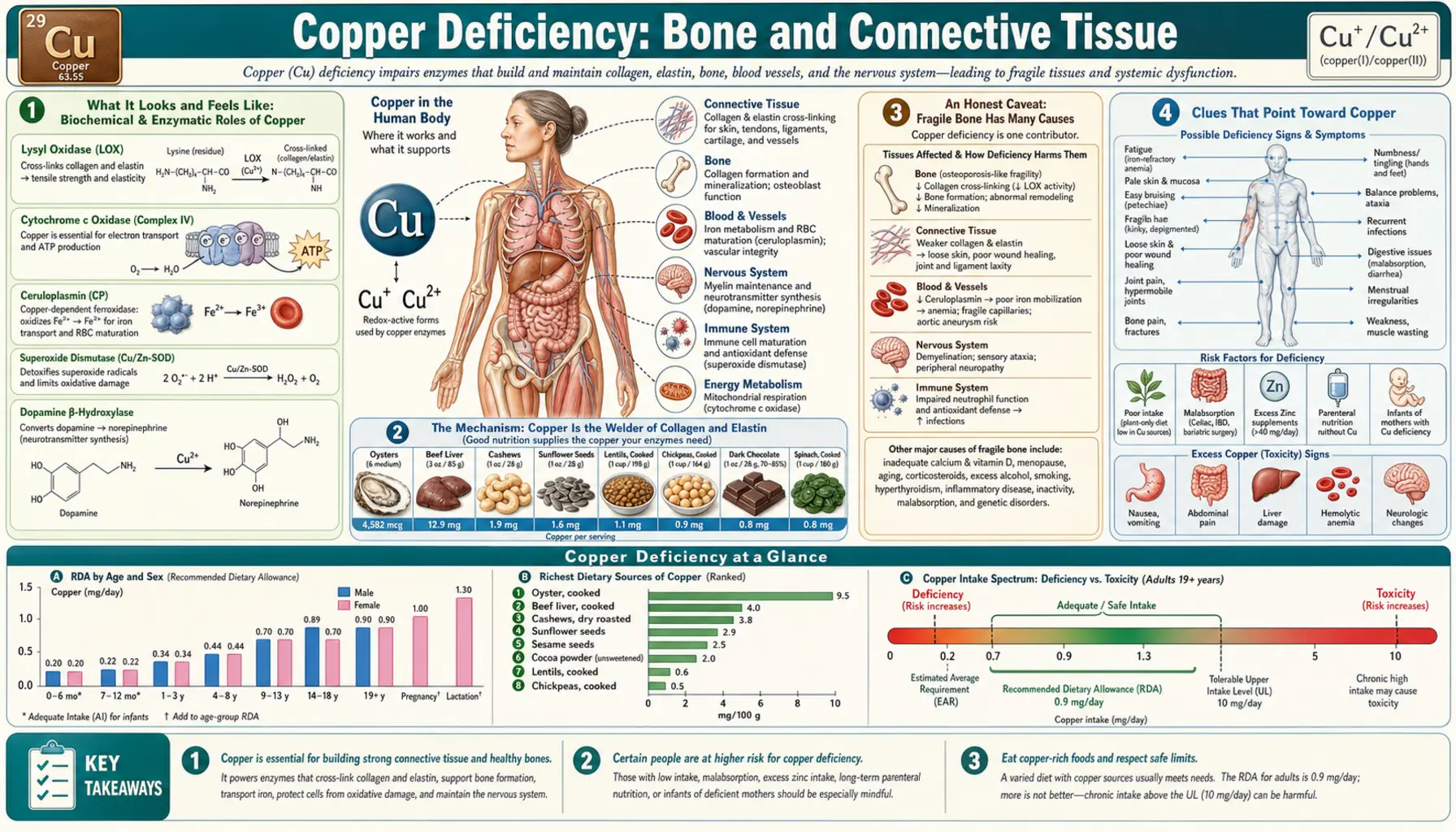
Copper is famous for blood and nerves, but one of its quietest jobs is structural: it is the spark that lets your body weld collagen and elastin into strong, springy tissue. Without enough copper, the molecular welds never set — and the things made from collagen and elastin (bone, blood vessels, skin, tendons, ligaments) become weaker and more fragile than they should be. In children this can mean unexplained fractures and flared, fraying bone on X‑ray; in adults the bone effects are subtler and harder to pin on copper alone. This page explains exactly why low copper weakens the body's scaffolding, why fragile bone is almost never a reliable sign of copper deficiency by itself, when copper truly deserves a look, and how the problem is found and fixed.
Table of Contents
- What It Looks and Feels Like
- The Mechanism: Copper Is the Welder of Collagen and Elastin
- An Honest Caveat: Fragile Bone Has Many Causes
- Clues That Point Toward Copper
- What Drives Copper This Low
- The Inherited Extreme: Menkes and Occipital Horn Syndrome
- Getting Tested
- Correcting Low Copper Safely
- When to Seek Care / Red Flags
- Key Research Papers
- Connections
- Featured Videos
What It Looks and Feels Like
Unlike a muscle cramp or a wave of fatigue, the bone-and-connective-tissue effects of copper deficiency are mostly things you see on imaging or feel only after something has already gone wrong. They build silently and then announce themselves through fragility. The classic picture differs sharply between infants and adults.
In infants and young children — the group in whom copper-deficiency bone disease is best documented — the signs are skeletal and striking:
- Fractures from little or no trauma — including rib fractures and breaks at the ends of the long bones, sometimes discovered by accident on an X‑ray taken for another reason.
- Flared, fraying, “spurred” bone ends — on X‑ray the growing ends of bones (the metaphyses) look cupped, frayed, and spiky, with thin outer bone (osteoporosis on film) and little bony spurs at the edges.
- Soft-skull and rib changes that can superficially resemble rickets or even scurvy, which is one reason copper deficiency is sometimes missed or mistaken.
In adults, the bone story is far quieter and far less certain. Most adults with proven copper deficiency come to attention because of anemia and low white cells or nerve and balance problems — not because of a fracture. When bone is affected, it tends to show up as low bone density (osteopenia or osteoporosis) on a DEXA scan rather than as dramatic breaks. The connective-tissue side — skin that bruises or tears easily, joints that feel loose, slow wound healing — is biologically plausible from the same mechanism, but in everyday adults it is mild, non-specific, and very hard to attribute to copper with confidence.
The honest summary, which the rest of this page unpacks, is this: copper deficiency genuinely can weaken bone and connective tissue, the effect is real and dramatic at the extremes (severe deficiency, infancy, the inherited disorders), but fragile bone in an ordinary adult is almost never caused by low copper, and copper should be considered only when the company it keeps points that way.
The Mechanism: Copper Is the Welder of Collagen and Elastin
Bone is not just mineral. Picture it as reinforced concrete: the hard mineral (calcium and phosphate) is the concrete, and a dense mesh of collagen fibers is the steel rebar that gives the concrete its tensile strength and keeps it from shattering. Blood-vessel walls, skin, tendons, and ligaments lean even more heavily on collagen and on its stretchy cousin, elastin. Laying down those fibers is only half the job. To be strong, the freshly made collagen and elastin strands have to be locked to one another by chemical bridges called cross-links. Cross-links are what turn a loose bundle of threads into a load-bearing cable.
The enzyme that forges those bridges is lysyl oxidase — and lysyl oxidase cannot work without copper. It is a copper-dependent enzyme: a copper ion sits in its active site and does the chemistry that starts the cross-linking reaction. When copper is scarce, lysyl oxidase loses activity, the cross-links don't form, and collagen and elastin stay in their weak, un-welded state. The fibers are present but soft, like rebar that was laid in place and never welded at the joints. Animal and biochemical studies have shown this directly: lysyl oxidase activity and connective-tissue cross-linking fall when copper is restricted, and the affected tissue is structurally weaker.
An analogy. Imagine a welder assembling a steel frame. The steel beams are the collagen fibers; copper is the spark that lights the welding torch. With plenty of copper, every joint gets welded and the frame can carry weight. Starve the welder of his spark and the beams still get stacked into roughly the right shape — but none of the joints are fused. The structure looks finished from across the room, yet it flexes, sags, and gives way under load that a properly welded frame would shrug off. That is what copper deficiency does to bone (fractures, frayed growing ends), to arteries (a known cause of aneurysms in the severe inherited form), and to skin and joints (laxity, easy bruising, poor healing).
Copper also feeds the body's antioxidant defenses through an enzyme called copper‑zinc superoxide dismutase, which is one more reason copper-starved tissue tends to age and fail faster — but the cross-linking failure is the headline event for bone and connective tissue. (The flip side of this same biology — what copper builds when it is plentiful — is covered on Copper and Connective Tissue.)
An Honest Caveat: Fragile Bone Has Many Causes
This is the most important section on the page, and it cuts against the temptation to blame copper for every weak bone. Fragile bone, easy fractures, and lax connective tissue are extremely common and have many causes — the overwhelming majority of which have nothing to do with copper. If you have been told your bones are thin or you have broken a bone easily, copper deficiency is far down the list of likely explanations.
By far the more common reasons for weak or fragile bone include:
- Age-related and postmenopausal osteoporosis — the dominant cause of fragile bone in adults, driven mainly by aging and the drop in estrogen after menopause.
- Vitamin D deficiency and low calcium intake — the classic, treatable mineral problems behind soft bone (and rickets in children); these are checked long before copper.
- Steroid medications, thyroid and parathyroid disorders, low sex hormones, and immobility — common secondary drivers of bone loss.
- Smoking, heavy alcohol use, and low body weight.
- Genetic connective-tissue and bone disorders — for example Ehlers–Danlos syndrome (loose, fragile connective tissue) and osteogenesis imperfecta (brittle bone disease), which are inherited and unrelated to your copper intake.
There is also a crucial caution specific to children: the X‑ray changes of copper deficiency — multiple fractures, frayed and spurred bone ends — can closely mimic the appearance of inflicted injury (child abuse), and the reverse is also true. This overlap is well recognized, and it is precisely why the diagnosis must rest on the whole picture — copper and ceruloplasmin levels, risk factors, the pattern of findings — rather than on the bone appearance alone. Copper deficiency is an uncommon explanation; it should neither be invented to explain away injury nor overlooked in a genuinely at-risk infant.
The takeaway: a weak bone is a clue, not a verdict. On its own it points to the common causes above, not to copper. Copper earns a place in the workup only when other features line up, which is the subject of the next section.
Clues That Point Toward Copper
So when should bone or connective-tissue fragility raise the question of copper? The strongest clue is almost never the bone itself — it is the company the bone problem keeps. Copper deficiency rarely attacks bone in isolation. Suspect it when fragile bone or poor healing appears alongside:
- Unexplained anemia plus a low white-cell count — this combination is the single most characteristic fingerprint of copper deficiency and is covered on Anemia & Low White Cells. Anemia that doesn't respond to iron, paired with low neutrophils, is a classic prompt to check copper.
- Numbness, tingling, or a wobbly, unsteady gait — the copper-deficiency nerve syndrome (a myelopathy that mimics vitamin B12 deficiency), detailed on Nerve Damage & Balance.
- A high-risk back-story (see the next section) — especially previous stomach or weight-loss surgery, long-term high-dose zinc, or long-term tube/IV feeding.
- In an infant: the specific X‑ray pattern of frayed, spurred, cupped bone ends with rib fractures, particularly in a premature or low-birthweight baby fed unsupplemented for a long time.
Conversely, fragile bone with a perfectly normal blood count, normal nerves, no risk factors, and a typical postmenopausal or age-related profile points firmly away from copper and toward the common causes. Copper is a supporting actor in bone fragility; it steps forward only when the rest of the cast (low blood counts, neurological signs, the right history) appears with it.
What Drives Copper This Low
Dietary copper deficiency is uncommon in otherwise healthy adults eating a varied diet, because copper is widespread in food. When deficiency does occur, it almost always traces to a specific, identifiable reason that either blocks absorption or drains copper away. The common culprits:
- Excess zinc — the most common reversible cause. High-dose zinc (from supplements, some cold remedies, or, classically, zinc-containing denture creams used heavily for years) blocks copper absorption in the gut. Zinc switches on a protein in intestinal cells (metallothionein) that grabs copper and carries it out of the body in shed cells, so copper never reaches the bloodstream. This is a well-documented cause of severe copper deficiency and is discussed further under Zinc Toxicity. Crucially, copper and zinc compete — so “more zinc is better” can quietly create a copper problem.
- Stomach and weight-loss (bariatric) surgery — gastric bypass and similar operations remove or bypass the part of the upper gut where copper is best absorbed. Copper deficiency can appear years later, often well after the surgery is forgotten as a possible cause, and is an increasingly recognized reason for unexplained anemia, neurological signs, and bone loss in this group.
- Malabsorption — celiac disease, inflammatory bowel disease, and other conditions that injure the small intestine reduce copper uptake.
- Long-term tube or intravenous (IV/TPN) feeding without adequate copper — a hospital-era cause that, in premature infants especially, has produced the full bone-disease picture. Modern feeds are usually copper-supplemented, but gaps still occur.
- Premature and low-birthweight infants — babies build most of their copper stores in the last weeks of pregnancy, so those born early start with little reserve and are vulnerable if intake is low.
Because the cause is so often a treatable one — stop the excess zinc, supplement after bariatric surgery, fortify a feed — identifying it is half the cure. Replacing copper without removing the cause (for instance, continuing high-dose zinc) tends to fail.
The Inherited Extreme: Menkes and Occipital Horn Syndrome
The clearest proof that copper builds connective tissue comes from two rare inherited disorders in which the body cannot move copper to where it is needed. Both are caused by faults in a copper-transport gene called ATP7A, and both show, in vivid form, what happens to the body's scaffolding when copper-dependent enzymes fail.
Menkes disease is a severe, X‑linked disorder (affecting mainly boys) in which copper is absorbed into gut cells but cannot be exported into the bloodstream, so the rest of the body is starved of it. The result is a devastating combination of failing nerves, distinctive sparse and kinky hair (“steely” hair, from the same loss of copper-dependent enzymes that affects hair and skin pigment), loose skin and joints, bone changes, and fragile, tortuous arteries that can rupture or form aneurysms — a direct consequence of elastin that was never properly cross-linked.
Occipital horn syndrome is a milder disorder caused by less severe faults in the same ATP7A gene. Its hallmark is connective-tissue weakness: lax, sagging skin, hyperflexible joints, hernias, bladder problems, and the curious bony spurs at the back of the skull (the “occipital horns”) that give the syndrome its name. It overlaps in appearance with the inherited connective-tissue disorders and is essentially a window onto chronic, lifelong shortage of copper at the tissues.
These conditions are rare and are not what is happening in an adult with thin bones. They matter here because they are nature's experiment: knock out the body's ability to deliver copper, and the predictable casualties are bone, blood vessels, skin, and joints — exactly the tissues that depend on copper-powered cross-linking. They confirm the mechanism even though they are not the everyday problem.
Getting Tested
If copper deficiency is genuinely suspected — usually because of the accompanying blood or nerve findings, not the bone alone — the workup is a simple, inexpensive set of blood tests:
- Serum copper — the total copper level in the blood, which is low in deficiency.
- Ceruloplasmin — the main copper-carrying protein in blood. It usually falls alongside copper and helps confirm the picture. (One caveat: ceruloplasmin is an “acute-phase” protein that rises with inflammation, infection, pregnancy, and estrogen, which can mask a true deficiency — so results are read in context.)
- A complete blood count (CBC) — to look for the characteristic anemia and low neutrophils that so often travel with copper deficiency and that strengthen the case considerably.
- A zinc level — because high zinc is the most common reversible cause; a high zinc with a low copper essentially makes the diagnosis.
Note that a routine Comprehensive Metabolic Panel does not include copper, ceruloplasmin, or zinc — these must be ordered specifically. For the bone side of the question, low bone density is measured with a DEXA scan, and a clinician evaluating fragile bone will first check the common, treatable causes — nutrient status, vitamin D, calcium, thyroid and parathyroid hormones, sex hormones — reserving copper testing for cases where the rest of the picture points that way. In an infant with the suspicious X‑ray pattern, copper and ceruloplasmin are checked promptly as part of a careful, whole-picture evaluation.
Correcting Low Copper Safely
The good news is that when copper deficiency is the real problem, it is very treatable, and the blood abnormalities often recover within weeks once copper is restored and the cause is removed. Bone changes in children can also heal with treatment. The approach, in order:
- Find and remove the cause first. If high-dose zinc is the culprit, stopping it is essential — copper will not normalize while zinc keeps blocking its absorption. If the cause is bariatric surgery or malabsorption, ongoing supplementation is planned for the long term.
- Food first, for mild cases and prevention. Copper is abundant in a number of everyday foods: shellfish (oysters are especially rich), organ meats such as beef liver, nuts and seeds such as almonds and cashews, and — a pleasant surprise — dark chocolate and cocoa. A varied diet that includes these usually supplies plenty. More detail on dietary sources lives on the Copper food sources page.
- Oral copper supplements — copper (as copper gluconate or sulfate) is prescribed and monitored when diet alone isn't enough or when an ongoing cause keeps draining copper. Levels are rechecked to confirm recovery and to avoid over-correction.
- Intravenous copper — reserved for severe deficiency, poor absorption, or when oral copper isn't working, and given under medical supervision.
- Mind the copper–zinc balance. Because the two minerals compete, sensible supplementation respects both: very high zinc creates copper deficiency, while large unbalanced copper doses are not the goal either. The aim is to restore copper to a normal level, not to overshoot.
For an ordinary adult worried about bone strength with normal copper status, the evidence does not support taking copper to protect bone. General bone health — adequate calcium and vitamin D, weight-bearing exercise, not smoking, moderate alcohol — matters far more than copper for the vast majority of people. Copper repletion is a fix for a copper deficiency, not a routine bone supplement.
When to Seek Care / Red Flags
Most questions about bone strength and copper are answered calmly with a clinician and a few blood tests. But some situations deserve prompt medical attention rather than watchful waiting:
- A fracture from little or no trauma — a broken bone after a minor bump or fall (a “fragility fracture”) should always be evaluated for the underlying cause of weak bone.
- An infant or young child with unexplained fractures — this always needs urgent, careful medical evaluation. The cause must be sorted out properly; do not attempt to self-diagnose copper deficiency at home.
- Fragile bone together with unexplained anemia, easy bruising or bleeding, frequent infections, or new numbness, tingling, or unsteadiness — this cluster is the pattern that genuinely raises the possibility of copper deficiency and should be checked without delay.
- A history of stomach or weight-loss surgery, long-term high-dose zinc, or long-term tube/IV feeding with any of the above — tell your clinician, because copper is easy to overlook and these are exactly the people in whom it is missed.
- Sudden, severe chest, back, or abdominal pain in someone known to have a severe copper-handling disorder (such as Menkes or occipital horn syndrome), which can signal a vascular emergency — call for help immediately.
The recurring theme is that bone fragility is a reason to look for a cause, not a reason to start copper. When fragile bone keeps company with low blood counts or nerve symptoms, copper moves up the list — and confirming or excluding it takes only a simple blood draw.
Key Research Papers
- Uauy R, Olivares M, Gonzalez M (1998). Essentiality of copper in humans. American Journal of Clinical Nutrition;67(5 Suppl):952S-959S. — DOI: 10.1093/ajcn/67.5.952S
- Lucero HA, Kagan HM (2006). Lysyl oxidase: an oxidative enzyme and effector of cell function. Cellular and Molecular Life Sciences;63(19-20):2304-2316. — DOI: 10.1007/s00018-006-6149-9
- Siegel RC, Pinnell SR, Martin GR (1970). Cross-linking of collagen and elastin. Properties of lysyl oxidase. Biochemistry;9(21):4486-4492. — DOI: 10.1021/bi00825a004
- Werman MJ, Bhathena SJ, Turnlund JR (1996). Lysyl oxidase activity, collagen cross-links and connective tissue ultrastructure. The Journal of Nutritional Biochemistry;7(8):437-444. — DOI: 10.1016/0955-2863(96)00076-9
- Soskel NT, Watanabe S, Sandberg LB (1985). Lysyl Oxidase Activity in Lungs of Copper-Deficient Hamsters. Connective Tissue Research;14(1):41-50. — DOI: 10.3109/03008208509152391
- Tümer Z, Møller LB (2013). An Overview and Update of ATP7A Mutations Leading to Menkes Disease and Occipital Horn Syndrome. Human Mutation;34(3):417-429. — DOI: 10.1002/humu.22266
- Kumar N (2006). Copper Deficiency Myelopathy (Human Swayback). Mayo Clinic Proceedings;81(10):1371-1384. — DOI: 10.4065/81.10.1371
- Lazarchick J (2012). Update on anemia and neutropenia in copper deficiency. Current Opinion in Hematology;19(1):58-60. — DOI: 10.1097/MOH.0b013e32834da9d2
- Fan Y, Ni S, Zhang H (2022). Associations of Copper Intake with Bone Mineral Density and Osteoporosis in Adults: Data from the National Health and Nutrition Examination Survey. Biological Trace Element Research;200(5):2062-2068. — DOI: 10.1007/s12011-021-02845-5
- Chaudhri MA, Kemmler W, Harsch I, Watling RJ (2009). Plasma Copper and Bone Mineral Density in Osteopenia: An Indicator of Bone Mineral Density in Osteopenic Females. Biological Trace Element Research;129(1-3):94-98. — DOI: 10.1007/s12011-008-8299-0
- National Institutes of Health, Office of Dietary Supplements (2022). Copper — Health Professional Fact Sheet. NIH ODS. — ods.od.nih.gov
- Copper deficiency and connective-tissue / skeletal fragility (occipital-horn and infantile presentations). PubMed literature search. — PubMed
PubMed Topic Searches
- PubMed — Copper, lysyl oxidase, and collagen cross-linking
- PubMed — Copper-deficiency bone changes and fractures in infants
- PubMed — Zinc-induced copper deficiency
- PubMed — Copper intake and bone mineral density
- PubMed — Menkes disease and occipital horn syndrome (ATP7A)
Connections
- All Minerals
- Copper Deficiency Symptom Hub
- Copper Deficiency: Anemia & Low White Cells
- Copper Deficiency: Nerve Damage & Balance
- Copper Deficiency: Hair & Skin Pigment
- Copper Toxicity Hub
- Copper Overview
- Copper and Connective Tissue
- Copper Food Sources
- Zinc
- Zinc Toxicity
- Iron
- Calcium
- Vitamin C
- Osteoporosis
- Ehlers–Danlos Syndrome
- Aortic Aneurysm
- Anemia
- Comprehensive Metabolic Panel
- Beef Liver
- Dark Chocolate