Boron for Cognitive Function
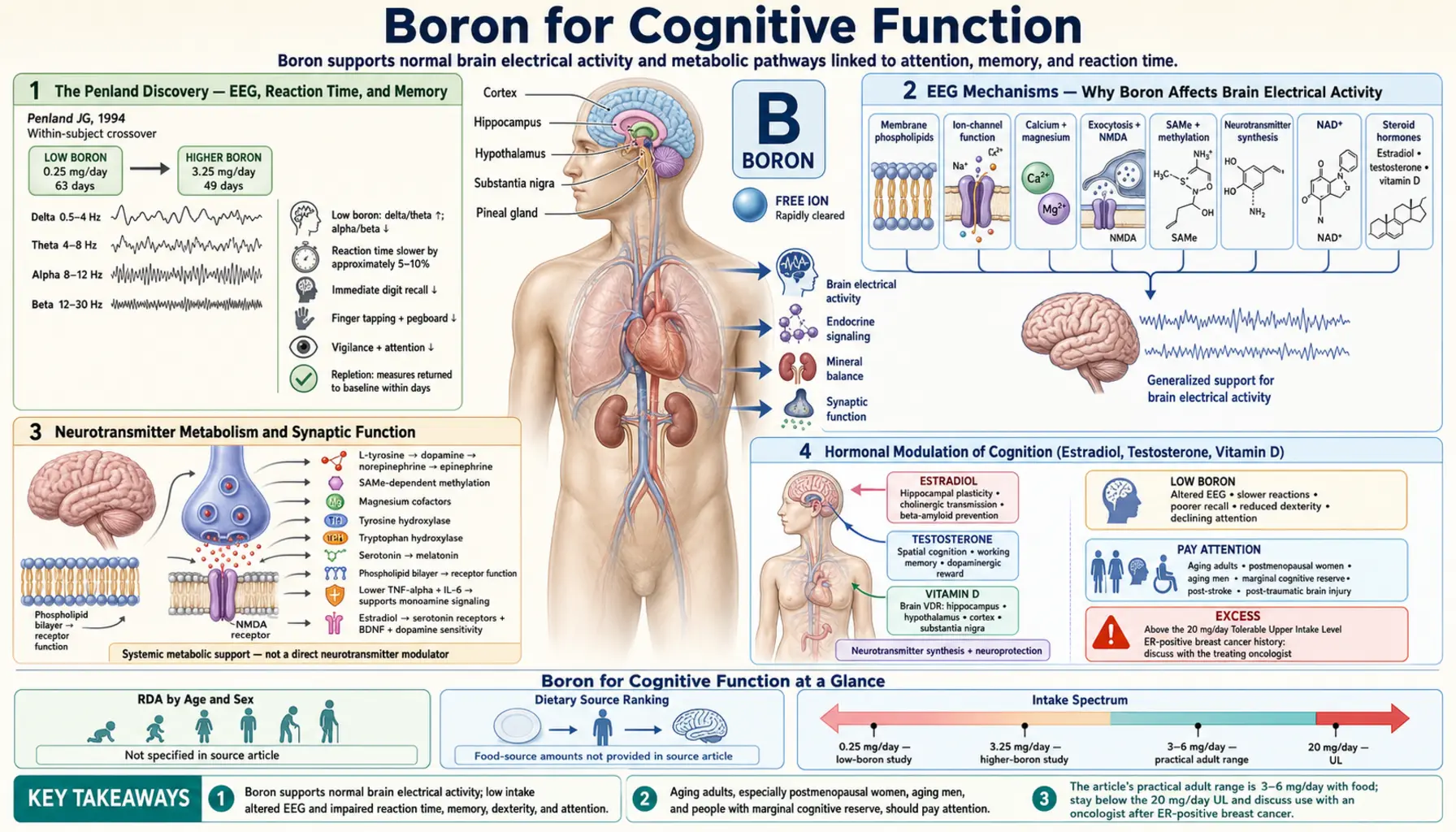
The connection between boron and brain function was almost entirely unsuspected until James G. Penland at the USDA Grand Forks Human Nutrition Research Center conducted a series of controlled-diet studies in the early 1990s. Penland fed adult subjects low-boron diets (0.25 mg/day) for prolonged periods and compared their EEG patterns, reaction times, short-term memory performance, manual dexterity, and attention metrics against the same subjects after boron repletion (3 mg/day). The boron-deprived state was associated with EEG patterns resembling early-stage encephalopathy — increased low-frequency activity, decreased alpha-wave activity, and impaired performance on cognitive tasks. Within days of repletion, all measures returned to baseline. This deep-dive walks through the Penland EEG studies, the proposed neural mechanisms, the implications for aging cognition and neurodegenerative disease prevention, and the practical role of boron in a brain-health nutritional protocol.
Table of Contents
- The Penland Discovery — EEG, Reaction Time, and Memory
- EEG Mechanisms — Why Boron Affects Brain Electrical Activity
- Neurotransmitter Metabolism and Synaptic Function
- Hormonal Modulation of Cognition (Estradiol, Testosterone, Vitamin D)
- Neuroinflammation Reduction
- Oxidative Stress and Neuroprotection
- Boron-Mediated Mineral Balance and Brain Function
- Aging Cognition and Mild Cognitive Impairment
- Alzheimer's Disease — Hypothesized Boron Connection
- Practical Brain-Health Protocol with Boron
- Cautions for Cognitive Use
- Key Research Papers
- Connections
- Featured Videos
The Penland Discovery — EEG, Reaction Time, and Memory
James G. Penland published the seminal paper on dietary boron and brain function in Environmental Health Perspectives in 1994. The study design was a within-subject crossover with rigorous dietary control. Adult subjects (men and women, mostly post-menopausal women) lived in a metabolic research unit and were fed a low-boron diet (0.25 mg/day, the natural background level after stripping boron-rich foods from a normal diet) for 63 days, then a higher-boron diet (3.25 mg/day, achieved by adding boron supplementation back to the same base diet) for 49 days.
During each diet period, subjects underwent regular cognitive and electrophysiological testing:
- EEG recording — resting-state electroencephalography with quantitative analysis of frequency bands (delta 0.5–4 Hz, theta 4–8 Hz, alpha 8–12 Hz, beta 12–30 Hz)
- Reaction time — simple and choice reaction time tasks
- Short-term memory — immediate digit recall, spatial memory tasks
- Manual dexterity — finger-tapping rates, pegboard tasks
- Vigilance and attention — sustained-attention tasks of 10–30 minute duration
- Psychomotor performance — coordinated hand-eye tasks
The key findings:
- EEG changes — the low-boron diet was associated with increased proportion of low-frequency (delta and theta) activity and reduced proportion of high-frequency (alpha and beta) activity. This pattern resembles the EEG of drowsy or mildly encephalopathic states. Boron repletion shifted the EEG back toward higher alpha and beta activity, the pattern of alert, attentive cognition
- Reaction time slowing — both simple and choice reaction times were slower during the low-boron period. The magnitude of slowing was approximately 5–10%, equivalent in size to the slowing produced by mild sleep deprivation or moderate alcohol consumption
- Short-term memory impairment — immediate recall of digit sequences was reduced during low-boron, with restoration on repletion
- Manual dexterity reduction — finger-tapping rates and pegboard performance were impaired
- Vigilance/attention impairment — longer-duration tasks showed declining performance more rapidly in the low-boron state
The pattern of effects is consistent with a mild but generalized impairment of cognitive performance, mediated through changes in brain electrical activity rather than through any specific localized cognitive deficit. The implication is that boron supports baseline brain electrical function in a relatively non-specific way, with detectable behavioral consequences when boron is deficient.
Penland's findings have been confirmed and extended in subsequent studies. The general conclusion: boron is required for normal brain electrical activity, and low boron intake produces measurable cognitive impairment that is reversed by repletion within days. The effect is subtle in healthy adults with normal cognitive baseline, but it may be more clinically significant in populations with marginal cognitive reserve (aging adults, post-stroke, post-traumatic brain injury).
EEG Mechanisms — Why Boron Affects Brain Electrical Activity
The proposed mechanisms for boron's effect on EEG are several and overlapping:
- Membrane phospholipid stabilization — boron binds to phosphatidylinositol and other inositol-containing membrane lipids, modulating membrane fluidity and the function of membrane-bound ion channels that govern neuronal excitability. The voltage-gated sodium, potassium, and calcium channels that generate action potentials and synaptic potentials are all membrane-protein complexes whose function depends on the surrounding lipid environment
- Calcium and magnesium homeostasis — boron-supported mineral balance keeps intracellular and extracellular calcium and magnesium concentrations stable, which is critical for normal neurotransmitter release (calcium-triggered exocytosis at synaptic terminals) and for NMDA-receptor function (magnesium blocks the NMDA channel at resting potential and is displaced by depolarization)
- SAMe and methylation — boron is required for normal S-adenosylmethionine (SAMe) metabolism, and SAMe is the universal methyl donor for hundreds of biochemical reactions including neurotransmitter synthesis (dopamine, norepinephrine, serotonin), membrane phospholipid methylation, and DNA methylation
- NAD+ and energy metabolism — boron influences NAD+ availability through interactions with the nicotinamide riboside metabolic pathway. NAD+ is required for oxidative phosphorylation, sirtuin function, and DNA-repair enzyme activity — all critical for normal neuronal function and longevity
- Steroid hormone effects on brain — the boron-mediated elevation of estradiol, testosterone, and vitamin D (see the Hormone Balance deep-dive) has independent effects on brain function. Estradiol supports synaptic plasticity, neurotransmitter receptor expression, and BDNF (brain-derived neurotrophic factor) production. Testosterone supports dopaminergic function and spatial cognition. Vitamin D acts at the brain VDR to influence neurotransmitter synthesis and neuroprotection
The convergence of these mechanisms is why boron-induced EEG changes are generalized rather than localized to a single brain region or a single cognitive domain. Boron operates at the metabolic substrate level (membrane lipids, methylation, NAD+, mineral balance, steroid hormones) that supports brain function as a whole.
Neurotransmitter Metabolism and Synaptic Function
Boron influences neurotransmitter metabolism through several indirect routes:
- SAMe-dependent methylation — the synthesis of dopamine, norepinephrine, and epinephrine from L-tyrosine requires SAMe-mediated methylation at multiple steps. Boron-supported SAMe metabolism therefore supports catecholamine synthesis. Similarly, serotonin metabolism (the conversion of serotonin to melatonin in the pineal gland, the catabolism of serotonin by COMT-mediated O-methylation) requires SAMe
- Cofactor availability — magnesium is required as a cofactor for tyrosine hydroxylase (the rate-limiting enzyme for dopamine synthesis) and tryptophan hydroxylase (the rate-limiting enzyme for serotonin synthesis). Boron-supported magnesium retention supports both
- Membrane lipid composition — the function of every neurotransmitter receptor (which are transmembrane proteins) depends on the surrounding lipid bilayer composition. Boron-stabilized phospholipids support normal receptor function
- Inflammatory cytokine suppression — chronic neuroinflammation impairs neurotransmitter function (TNF-alpha and IL-6 disrupt monoamine signaling). Boron's anti-inflammatory effect indirectly supports normal neurotransmitter biology
- Steroid-mediated effects on receptor expression — estradiol increases serotonin receptor density in multiple brain regions, supports BDNF production, and modulates dopamine receptor sensitivity. Boron-elevated estradiol in postmenopausal women therefore has downstream neurotransmitter consequences
The composite effect is that boron supplementation provides metabolic support for normal neurotransmitter function without being a direct neurotransmitter modulator itself. It does not cross the blood-brain barrier in significant concentrations as a free ion (boron is rapidly cleared) but its effects on systemic mineral balance, methylation status, and hormone concentrations translate into brain effects.
Hormonal Modulation of Cognition (Estradiol, Testosterone, Vitamin D)
The hormonal effects of boron documented in detail on the Hormone Balance page have direct cognitive consequences:
- Estradiol in postmenopausal women — estradiol supports hippocampal neuroplasticity, cholinergic neurotransmission, and prevention of beta-amyloid accumulation. Postmenopausal estradiol decline is implicated in the increased dementia risk in women relative to men of the same age. Boron-induced partial estradiol restoration may provide modest cognitive support, particularly for verbal memory and processing speed
- Testosterone in aging men — testosterone supports spatial cognition, working memory, and dopaminergic reward function. Age-related testosterone decline is associated with mild cognitive impairment risk. Boron-elevated free testosterone may provide modest cognitive support
- Vitamin D at the brain VDR — vitamin D receptors are widely expressed in the brain (hippocampus, hypothalamus, cortex, substantia nigra) and vitamin D-deficient individuals have measurably worse cognitive performance and higher dementia risk. Boron-supported vitamin D activation amplifies the cognitive-protective effect of vitamin D supplementation
- DHEA and adrenal steroids — DHEA has direct neurosteroid effects on GABA-A and NMDA receptors, supports mood and energy. Boron-supported DHEA may contribute to general cognitive wellbeing
- Cortisol reduction — the modest cortisol-lowering effect of boron documented in the Naghii trial is potentially neuroprotective because chronically elevated cortisol is hippocampal-toxic and associated with cognitive impairment
The integrated hormonal effects of boron are particularly relevant for aging populations whose cognitive decline is partly driven by hormonal changes. For aging women in particular, the combination of bone-protective and cognition-protective effects of boron supplementation provides a compelling rationale for adoption.
Neuroinflammation Reduction
Chronic low-grade neuroinflammation is increasingly recognized as a central feature of aging brain dysfunction and a contributor to neurodegenerative diseases including Alzheimer's disease, Parkinson's disease, and vascular cognitive impairment. The activated microglia and astrocytes that produce pro-inflammatory cytokines (IL-1-beta, IL-6, TNF-alpha) in chronic neuroinflammation impair synaptic plasticity, neurotransmitter function, and (in extreme cases) drive neuronal death.
The systemic anti-inflammatory effect of boron documented in the Naghii trial (CRP reduced by 50%, TNF-alpha by 30%, IL-6 by 35%) translates to reduced central inflammation through several mechanisms:
- Reduced peripheral cytokine exposure — the brain is partially exposed to circulating cytokines through the circumventricular organs, where the blood-brain barrier is incomplete. Lower peripheral inflammation means less central exposure
- Reduced gut inflammation — the gut-brain axis transmits inflammatory signals from intestinal dysbiosis and leaky gut to the brain via vagal afferents and circulating mediators. Boron's general anti-inflammatory effect reduces this signaling
- Direct microglial effects — in vitro evidence suggests boron compounds can directly suppress microglial activation through NF-kB pathway inhibition
- Improved endothelial function — cerebrovascular endothelial inflammation contributes to blood-brain-barrier disruption and to vascular cognitive impairment. Reduced systemic inflammation supports endothelial integrity
The combination of anti-inflammatory and hormone-supportive effects positions boron as a foundational nutritional intervention for cognitive aging, alongside other established neuroprotective nutrients (omega-3 fatty acids, vitamin D, B-vitamins for homocysteine management, magnesium, lithium orotate in low dose).
Oxidative Stress and Neuroprotection
The brain is uniquely vulnerable to oxidative stress because of its high oxygen consumption (20% of resting energy expenditure for 2% of body mass), its high content of oxidation-prone polyunsaturated fatty acids in membrane phospholipids, and its limited regenerative capacity (most neurons are postmitotic and cannot be replaced). Antioxidant defenses are correspondingly important for long-term brain health.
Boron does not function as a direct antioxidant (it does not have a redox-active electron) but supports the endogenous antioxidant systems through several pathways:
- Glutathione metabolism — boron-supported magnesium retention supports glutamate-cysteine ligase (the rate-limiting enzyme for glutathione synthesis). Glutathione is the brain's dominant intracellular antioxidant
- Vitamin D and antioxidant gene expression — vitamin D upregulates antioxidant enzyme expression (superoxide dismutase, glutathione peroxidase, catalase). Boron-supported vitamin D activation amplifies this effect
- Sex steroid neuroprotection — estradiol and testosterone both have neuroprotective effects against oxidative stress, partly through direct antioxidant chemistry and partly through antioxidant gene expression
- Membrane stabilization — boron-stabilized membrane phospholipids are less susceptible to lipid peroxidation, reducing the propagation of oxidative damage through the membrane
The neuroprotective effects of boron are subtle compared to dedicated antioxidant nutrients (alpha-lipoic acid, NAC, vitamin E, vitamin C). Boron should be thought of as a supportive nutrient that amplifies the effect of dedicated antioxidants, not as an antioxidant in its own right.
For dedicated antioxidant approaches, see our Alpha Lipoic Acid page and NAC page.
Boron-Mediated Mineral Balance and Brain Function
The mineral-balance effects of boron documented in detail on the Bone Density page have direct brain implications:
- Magnesium retention — magnesium deficiency is associated with increased anxiety, depression, headache, and cognitive impairment. Boron-supported magnesium retention preserves the calming, NMDA-modulating effects of adequate brain magnesium
- Calcium balance — both hypercalcemia and hypocalcemia produce neurological symptoms. Boron-mediated calcium balance helps maintain the narrow normal range required for normal neuronal excitability
- Phosphorus balance — phosphate is required for ATP, phospholipids, and DNA. Boron-supported phosphorus retention contributes to brain energy metabolism
- Sodium and potassium — the resting membrane potential of neurons depends on the sodium-potassium ATPase pump (which requires magnesium as cofactor) and on potassium gradients (which are influenced by acid-base balance, itself affected by mineral homeostasis)
The composite picture: boron acts as a metabolic regulator that keeps the brain's mineral and hormonal milieu in a state that supports optimal function. The effect is not dramatic in any single dimension but is real across many dimensions simultaneously.
Aging Cognition and Mild Cognitive Impairment
Cognitive decline with normal aging is multifactorial. Synaptic loss, neurotransmitter receptor decline, reduced cerebral blood flow, accumulated oxidative damage, declining hormonal milieu (estradiol in women, testosterone in men, DHEA in both, vitamin D in both), and increasing neuroinflammation all contribute. Mild cognitive impairment (MCI) is the clinical syndrome characterized by measurable cognitive decline beyond normal aging but not yet meeting dementia criteria; approximately 15% of MCI patients progress to dementia annually.
Boron supplementation in aging populations has not been specifically tested as an MCI intervention in any large trial, but the mechanistic rationale is strong:
- Improved EEG patterns documented by Penland in adults, presumably also operative in older adults
- Modest hormonal restoration in postmenopausal women and aging men
- Anti-inflammatory effects consistent with reduced neuroinflammation
- Vitamin D activation support with downstream cognitive consequences
- Bone-cognitive protection (the same supplementation that protects bone also protects cognition, addressing the two leading aging concerns simultaneously)
The intervention is low-cost (a year of 3–6 mg/day boron costs $10–30), low-risk (well below the 20 mg/day Tolerable Upper Intake Level), and produces measurable changes in objective biomarkers within weeks. The clinical case for boron supplementation in aging populations is strong even in the absence of dedicated MCI trial data.
For comprehensive cognitive aging approaches, see the mild cognitive impairment section above, our Dementia page, and our Brain Health page.
Alzheimer's Disease — Hypothesized Boron Connection
The role of boron in Alzheimer's disease prevention or treatment is speculative but rests on a coherent hypothesis. The proposed pathways are:
- Beta-amyloid clearance — estradiol supports the activity of insulin-degrading enzyme and neprilysin, the proteases that catabolize beta-amyloid. Boron-induced estradiol restoration in postmenopausal women may modestly improve beta-amyloid clearance
- Tau phosphorylation — glycogen synthase kinase-3-beta (GSK-3-beta), the enzyme primarily responsible for pathological tau hyperphosphorylation, is inhibited by lithium and may be modulated by other trace elements including boron
- Neuroinflammation — the central role of microglial activation in Alzheimer's pathogenesis means that any anti-inflammatory intervention is theoretically relevant. The Naghii data on systemic CRP, TNF-alpha, and IL-6 reduction are encouraging
- Vitamin D status — vitamin D deficiency is consistently associated with higher Alzheimer's risk in observational studies. Boron-supported vitamin D activation amplifies the protective effect of vitamin D supplementation
- Insulin sensitivity — type 2 diabetes and insulin resistance are major risk factors for Alzheimer's disease (sometimes called "type 3 diabetes"). Boron's effects on insulin sensitivity (modest but real) may be protective
- SAMe and methylation — impaired methylation is implicated in Alzheimer's pathogenesis, and SAMe supplementation has shown modest cognitive benefit in some studies. Boron-supported SAMe metabolism is potentially relevant
No randomized controlled trial has yet tested boron supplementation as Alzheimer's prevention. The intervention is sufficiently low-risk and inexpensive that adoption in at-risk populations (positive family history, ApoE4 carriers, individuals with MCI) does not require trial-level evidence. The supplementation should be combined with other established Alzheimer's-protective nutritional approaches: Mediterranean diet, omega-3 fatty acids, B-vitamins for homocysteine management, vitamin D, magnesium, and regular exercise.
For comprehensive Alzheimer's information, see our Alzheimer's Disease page.
Practical Brain-Health Protocol with Boron
Boron does not function as a stand-alone cognitive intervention but as one component of a comprehensive brain-health nutritional protocol. A reasonable protocol for adults with cognitive aging concerns:
- Boron citrate or glycinate 3–6 mg/day with food
- Vitamin D3 2000–5000 IU/day to a serum 25(OH)D level of 40–80 ng/mL
- Magnesium glycinate or L-threonate 300–400 mg/day (L-threonate has documented brain penetration)
- Omega-3 fatty acids (EPA + DHA) 2–3 g/day, particularly DHA for brain structure
- B-vitamin complex with adequate B12 (1000 mcg methylcobalamin), folate (400–800 mcg methylfolate), B6 (50 mg pyridoxal-5-phosphate) to keep homocysteine below 8 micromoles/L
- Vitamin K2 MK-7 180–360 mcg/day for cerebrovascular calcium handling
- Vitamin E 400 IU/day as mixed tocopherols
- Curcumin 500–1500 mg/day (BCM-95 or Meriva form for absorption) for anti-inflammatory effect
- Alpha-lipoic acid 600 mg/day or NAC 600–1200 mg/day for antioxidant support
- Lion's Mane mushroom 1–3 g/day for NGF-mimetic effect
The full protocol addresses multiple cognitive-aging pathways simultaneously. Boron at 3–6 mg/day is one foundational element among many. Combined with regular aerobic exercise (which independently supports BDNF, vascular function, and cognitive performance), Mediterranean-style diet, social engagement, and cognitive challenge (the "use it or lose it" principle of cognitive reserve), the regimen represents a comprehensive approach to cognitive aging.
Cautions for Cognitive Use
- Not a treatment for established dementia — once Alzheimer's or other dementia is clinically established, boron supplementation is unlikely to produce noticeable functional improvement. The intervention is best framed as prevention or as adjunct to early-stage management
- Drug interactions — boron has minimal interaction with cognitive-enhancing pharmaceuticals (donepezil, memantine, rivastigmine). Generally compatible
- Hormone-dependent cancers — for postmenopausal women with estrogen-receptor-positive breast cancer history, the modest estradiol-elevating effect of boron requires discussion with the treating oncologist
- Other cognition-related cautions — as covered in the Hormone Balance Cautions section and the Bone Density Cautions section, the general boron supplementation safety profile is excellent at typical doses
Key Research Papers
- Penland JG (1994). Dietary boron, brain function, and cognitive performance. Environmental Health Perspectives. — PubMed
- Penland JG (1998). The importance of boron nutrition for brain and psychological function. Biological Trace Element Research. — PubMed
- Nielsen FH, Penland JG (1999). Boron supplementation of peri-menopausal women affects boron metabolism and indices associated with macromineral metabolism, hormonal status and immune function. Journal of Trace Elements in Experimental Medicine. — PubMed
- Nielsen FH (2008). Is boron nutritionally relevant? Nutrition Reviews. — PubMed
- Pizzorno L (2015). Nothing boring about boron. Integrative Medicine (Encinitas). — PubMed
- Boysen G et al. (2011). Effects of boron compounds on neurons and microglia in models of neuroinflammation. — PubMed
- Kim DH et al. (2014). Boron compounds reduce inflammation in microglia via the NF-kB pathway. — PubMed
- Eyles DW, Burne TH, McGrath JJ (2013). Vitamin D, effects on brain development, adult brain function and the links between low levels of vitamin D and neuropsychiatric disease. Frontiers in Neuroendocrinology. — PubMed
- Henderson VW (2014). Alzheimer's disease: review of hormone therapy trials and implications for treatment and prevention after menopause. Journal of Steroid Biochemistry and Molecular Biology. — PubMed
- Slutsky I et al. (2010). Enhancement of learning and memory by elevating brain magnesium. Neuron. — PubMed
- Cherbuin N et al. (2014). Higher normal fasting plasma glucose is associated with hippocampal atrophy: the PATH Study. Neurology. — PubMed
- Smith AD et al. (2010). Homocysteine-lowering by B vitamins slows the rate of accelerated brain atrophy in mild cognitive impairment. PLoS ONE. — PubMed
PubMed Topic Searches
- PubMed: Boron, brain function, cognitive performance
- PubMed: Boron and EEG
- PubMed: Boron and SAMe methylation
- PubMed: Boron neuroprotection
- PubMed: Estradiol, hippocampus, cognition
Connections
- All Minerals
- Boron Overview
- Boron Benefits Hub
- Boron for Bone Density
- Boron for Hormone Balance
- Boron for Arthritis & Joints
- Alzheimer's Disease
- Dementia
- Magnesium
- Vitamin D3
- Vitamin B12
- Folate
- NAC
- Alpha Lipoic Acid
- Omega-3 Fatty Acids
- Estradiol
- Testosterone
- Vitamin D Test
- Homocysteine
- Lion's Mane Mushroom