Boron: History and Discovery
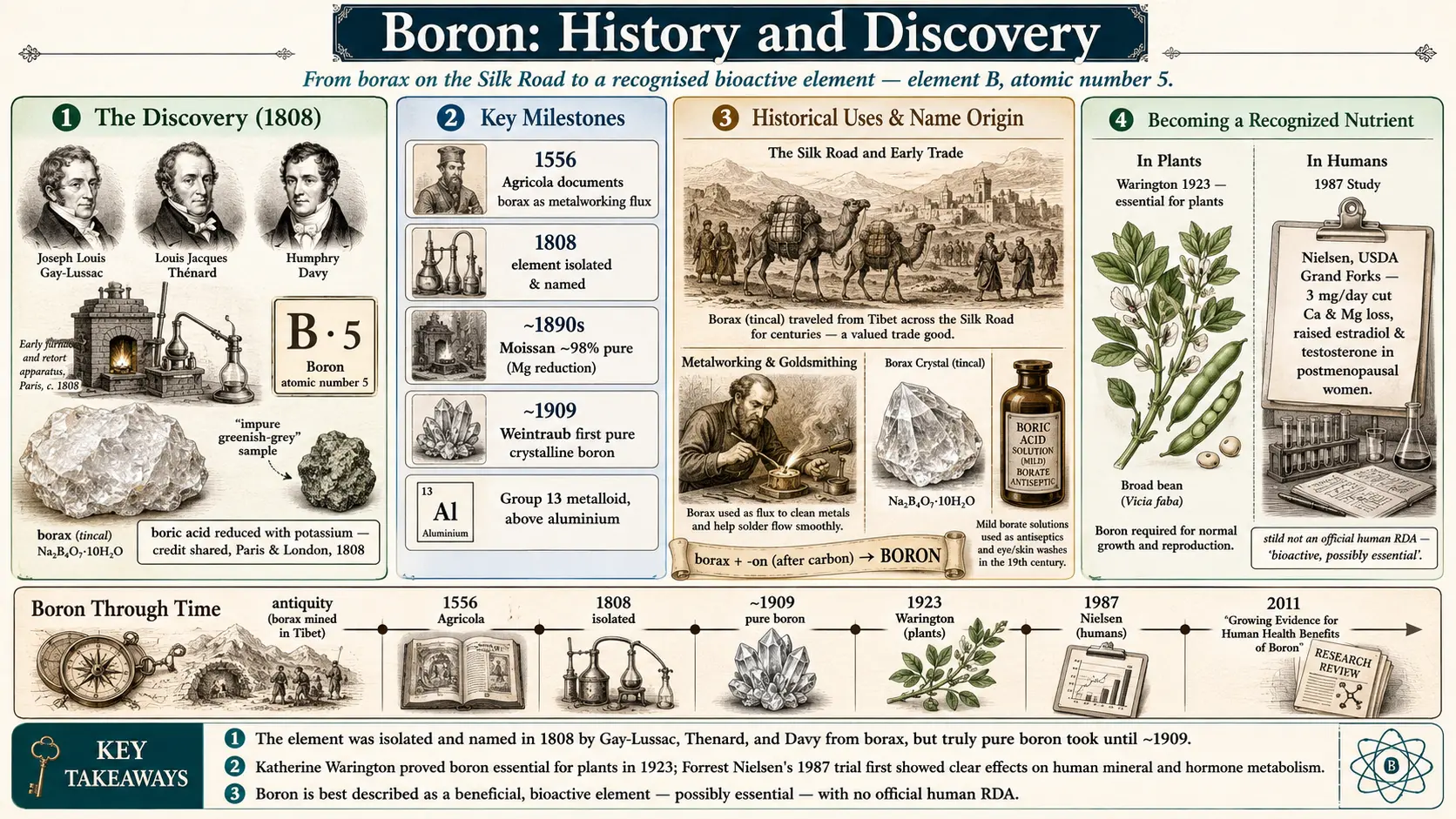
Boron has a longer human story than almost anyone realises. People were mining and trading its main mineral — borax — for well over a thousand years before they had any idea there was a hidden element inside it. Caravans carried it out of the dry lake beds of Tibet along the Silk Road; goldsmiths and glassmakers prized it; and not until 1808 did chemists finally pull the new element loose from its compounds — a feat achieved almost simultaneously in Paris and London, leaving boron with a small but genuine priority dispute attached to its birth. The story has two distinct chapters. The first is the chemistry: who first isolated and named the element. The second, far more recent, is the biology: who showed that this same element matters to living things, first to plants in the 1920s and then, in a landmark 1987 study, to people. This article tells both chapters, and marks clearly where the record is firm and where it is still argued over.
Table of Contents
- Before the Element: Borax on the Silk Road
- The Discovery of 1808: Paris and London
- Naming the Element: From Borax to Boron
- The Long Road to Pure Boron
- A Metalloid in Group 13
- Boron the Plant Nutrient: Warington, 1923
- Boron and People: The 1987 Breakthrough
- From Curiosity to Recognised Bioactive Element
- Research Papers and References
- Connections
- Featured Videos
Before the Element: Borax on the Silk Road
The history of boron begins not with a chemist but with a salt. Borax — a soft, white, crystalline borate mineral — was gathered from the dried beds of seasonal lakes, most famously on the high plateau of Tibet, and traded westward across Asia. In its raw mined form it was long known as tincal (or tincar), a name that traces back through Malay, Urdu, Persian, and Arabic to the Sanskrit ṭā̋ka̋a. From at least the early medieval period this Tibetan tincal moved along the Silk Road trade routes toward Persia and the Arab world.
What made borax valuable was not anything anyone understood about its chemistry — that lay a thousand years in the future — but what it could do. As a flux, it lowers the melting point of metal oxides and helps clean metal surfaces, which made it indispensable to goldsmiths and metalworkers for soldering and refining precious metals. It was also used as a glaze and in early glassmaking. The German scholar Georgius Agricola, in his great sixteenth-century treatise on mining and metallurgy De re metallica (published 1556), documented borax in this metalworking role, by which time it was a well-established material of the European workshop.
A familiar piece of the story — that the explorer Marco Polo brought borax (or borax glazes) back to Europe from Asia in the thirteenth century — is widely repeated and broadly consistent with the trade record, though like much surrounding the Polo narratives it is best treated as traditional history rather than firmly documented fact. The secure point is simpler and not in doubt: for many centuries borax was a prized article of long-distance trade, used by craftsmen who had no notion that it concealed a chemical element no one had yet seen.
The Discovery of 1808: Paris and London
The element hidden inside borax was finally isolated in 1808, and the story comes with a genuine priority dispute baked in — because it happened in two countries at nearly the same moment. In Paris, the French chemists Joseph Louis Gay-Lussac and Louis Jacques Thénard heated boric acid with the reactive metal potassium, which stripped away the oxygen and left behind an impure greenish-grey or brown substance — the first elemental boron. Across the English Channel in London, Sir Humphry Davy — fresh from using the new tool of electrolysis to isolate sodium and potassium the year before — obtained boron from boric acid by a closely related approach, also reported in 1808.
Because the two laboratories announced their results within a very short span — sources place the French announcement in late June 1808 and Davy's within days of it — credit for the discovery is conventionally shared among Gay-Lussac, Thénard, and Davy. This is the honest way to state it: rather than a single discoverer, boron has three, working independently and essentially simultaneously, and reference sources differ on the precise day-by-day ordering. What all accounts agree on is the year, 1808, and the method in principle — chemical reduction of a boron–oxygen compound (boric acid, itself derived from borax) to free the element.
One important caveat belongs here. The material these chemists produced in 1808 was far from pure; by modern estimates it was only a fraction boron, heavily contaminated with other elements. In a real sense, then, 1808 marks the date boron was first recognised and isolated as a new element, not the date anyone held pure boron in their hand — a distinction that takes us to the next two sections.
Naming the Element: From Borax to Boron
The element's name is a small fossil of its own history. It was built from borax — the mineral it came out of — with the ending “-on” borrowed by analogy from carbon, because the newly isolated substance reminded chemists of carbon in some of its properties. So “bor-” (from borax) plus “-on” (from carbon) gives boron. The root of borax itself is older still, passing through Arabic and Persian (often given as būraq or burah) before entering the European languages.
It is worth noting that Davy initially favoured a different name — boracium — following the pattern he had used for the metallic elements he isolated, such as sodium and potassium. The name that endured, however, was boron, which correctly signalled that this element behaves less like a metal and more like its neighbour carbon. The naming therefore carries a real scientific judgement inside it: even at the moment of discovery, chemists sensed that boron sat on the borderline between metals and non-metals — the very property that defines it today.
The Long Road to Pure Boron
Isolating boron and purifying it turned out to be two very different problems. The 1808 product was impure, and getting to genuinely pure elemental boron took most of another century, because boron is stubborn: it forms extremely stable compounds and reacts readily with the contaminants around it. Through the nineteenth century chemists steadily improved the purity. The French chemist Henri Moissan — later a Nobel laureate — is reported to have produced boron in the range of roughly 98 percent pure in the 1890s by reducing boron oxide with magnesium, a notable advance though still not the pure element.
Credit for the first genuinely pure, crystalline boron is commonly given to the American chemist Ezekiel Weintraub, who around 1909 obtained high-purity boron, reportedly by reducing a boron halide vapour with hydrogen in an electric arc. Sources are not perfectly uniform on these purity milestones — different accounts emphasise Moissan or Weintraub and quote slightly different figures — so the responsible summary is this: the element was discovered in 1808, but obtaining boron in a truly pure state was a hard, drawn-out achievement not reached until around the turn of the twentieth century. Even today, producing very high-purity boron remains technically demanding.
A Metalloid in Group 13
Modern chemistry placed boron precisely. It is the element with atomic number 5 and the chemical symbol B, sitting at the top of group 13 in the second period of the periodic table, directly above aluminium. Crucially, boron is classed as a metalloid — an element that straddles the line between metals and non-metals, sharing some features of each. This is exactly the in-between character that the early chemists glimpsed when they named it after carbon rather than after a metal.
That borderline nature explains a great deal about boron's behaviour, including why it is so hard to purify and why it forms the remarkable cage-like and chain-like compounds that fascinate chemists. For the purposes of human health, the most relevant fact is that boron does not circulate in the body as a free metal ion the way iron or zinc do; in water and in living tissue it exists almost entirely as boric acid and borate — gentle, weakly acidic forms — which is the chemistry behind both its biological roles and its long use as a mild antiseptic. The next sections turn from the element's chemistry to the slow discovery that it is also a substance living things actually use.
Boron the Plant Nutrient: Warington, 1923
For more than a century after its discovery, boron was treated as an industrial curiosity with no known role in life. That changed in the 1920s, and the pivotal figure was the British scientist Katherine Warington, working at the Rothamsted Experimental Station in England. In her landmark 1923 paper, “The effect of boric acid and borax on the broad bean and certain other plants,” published in Annals of Botany, she demonstrated that the broad bean (Vicia faba) and other plants could not grow normally without a small amount of boron, and that resupplying it restored healthy growth.
Warington's work is generally credited as the proof that boron is an essential micronutrient for higher plants — one of the genuine landmarks of plant-nutrition science. Its consequence for the human story is double-edged and a little ironic. On one hand, it established beyond doubt that boron is biologically active, not inert. On the other, it created a long-standing teaching that boron was a peculiar element — essential for plants but, so the textbooks said for decades, of no proven importance to animals or people. That assumption would not be seriously challenged until the 1980s.
Boron and People: The 1987 Breakthrough
The case that boron matters to human health came together in the 1980s, and two strands deserve naming. The first was clinical and epidemiological: from the 1960s onward the researcher Rex E. Newnham argued that boron supplementation eased his own arthritis and, more broadly, that populations with higher dietary boron seemed to have markedly lower rates of arthritis — observations he later summarised in a 1994 paper, “Essentiality of boron for healthy bones and joints,” in Environmental Health Perspectives. These were suggestive rather than conclusive, and Newnham presented them as a hypothesis worth testing.
The decisive experimental evidence came from Forrest H. Nielsen and colleagues at the United States Department of Agriculture's Grand Forks Human Nutrition Research Center in North Dakota. Their 1987 study, “Effect of dietary boron on mineral, estrogen, and testosterone metabolism in postmenopausal women,” published in The FASEB Journal, was the first controlled nutritional trial of boron in humans. Postmenopausal women were first depleted of boron and then given a 3 mg/day supplement; the boron markedly reduced urinary loss of calcium and magnesium and raised blood levels of 17β-estradiol and testosterone. For the first time, boron had been shown to exert clear, measurable effects on human mineral and hormone metabolism.
This 1987 result is the true turning point in boron's nutritional story — the equivalent, for boron, of the deficiency-disease discoveries that established other trace elements as essential. It directly motivated a wave of further human work, including Nielsen's own follow-up studies on boron deprivation (reported in Environmental Health Perspectives in 1994), which found that low boron intake altered brain electrical activity and cognitive performance as well as mineral handling. One honest qualification remains, and it persists to this day: despite this evidence, boron has never been formally classified as an essential nutrient for humans, and there is no official Recommended Dietary Allowance for it. It is best described, in the careful language researchers now use, as a bioactive and beneficial element — possibly essential, but not yet officially declared so.
From Curiosity to Recognised Bioactive Element
The modern phase of boron's history is the gradual gathering of scattered findings into a coherent, if still incomplete, picture. A widely cited 2011 review by Forrest H. Nielsen and Susan L. Meacham in the Journal of Evidence-Based Complementary & Alternative Medicine, titled “Growing Evidence for Human Health Benefits of Boron,” pulled this work together and argued that boron intakes below about 1 mg per day — which many people fall short of — should be regarded as a genuine health concern, readily remedied by a diet rich in fruit, vegetables, nuts, and pulses.
So boron's history runs in two long arcs that only met recently. The first arc is the element itself: mined as borax for over a millennium, isolated and named in 1808 by Gay-Lussac, Thénard, and Davy, and finally purified around the turn of the twentieth century. The second arc is its biology: proven essential to plants by Katherine Warington in 1923, then — after decades of being dismissed for animals — shown to affect human bone, hormone, and brain function by Forrest Nielsen and colleagues from 1987 onward. The detailed evidence on bone, joints, hormones, and cognition, together with dosing and cautions, is covered in the companion Boron Benefits articles and on the main Boron page; this history is concerned only with how a salt from a Tibetan lake bed became a recognised element and, much later, a question in human nutrition.
Research Papers and References
The list below combines key peer-reviewed papers marking the milestones in boron's nutritional history with curated PubMed topic-search links into the wider literature. Historical and chemical events (the 1808 isolation, the naming of the element, and the early borax trade) are documented in the article from standard reference sources rather than as modern citations. Author names, titles, and journals are given as plain text; only the stable DOI, PMID, or archive link is hyperlinked, and each opens in a new tab.
- Warington K. The effect of boric acid and borax on the broad bean and certain other plants. Annals of Botany. 1923;os-37(4):629-672. — doi:10.1093/oxfordjournals.aob.a089871
- Nielsen FH, Hunt CD, Mullen LM, Hunt JR. Effect of dietary boron on mineral, estrogen, and testosterone metabolism in postmenopausal women. The FASEB Journal. 1987;1(5):394-397. — doi:10.1096/fasebj.1.5.3678698 · PMID: 3678698
- Newnham RE. Essentiality of boron for healthy bones and joints. Environmental Health Perspectives. 1994;102(Suppl 7):83-85. — doi:10.1289/ehp.94102s783 · PMID: 7889887
- Nielsen FH. Biochemical and physiologic consequences of boron deprivation in humans. Environmental Health Perspectives. 1994;102(Suppl 7):59-63. — doi:10.1289/ehp.94102s759 · PMID: 7889883
- Nielsen FH, Meacham SL. Growing evidence for human health benefits of boron. Journal of Evidence-Based Complementary & Alternative Medicine. 2011;16(3):169-180. — doi:10.1177/2156587211407638
- Boron — element discovery and history — PubMed: boron nutrition history and essentiality
- Boron — bone, hormone, and metabolic research — PubMed: dietary boron, bone, and hormone metabolism
External Authoritative Resources
- NIH Office of Dietary Supplements — Boron
- Encyclopedic overview — Boron (element history)
- PubMed — All research on boron in human nutrition