Tart Cherry for Antioxidant & Brain Health
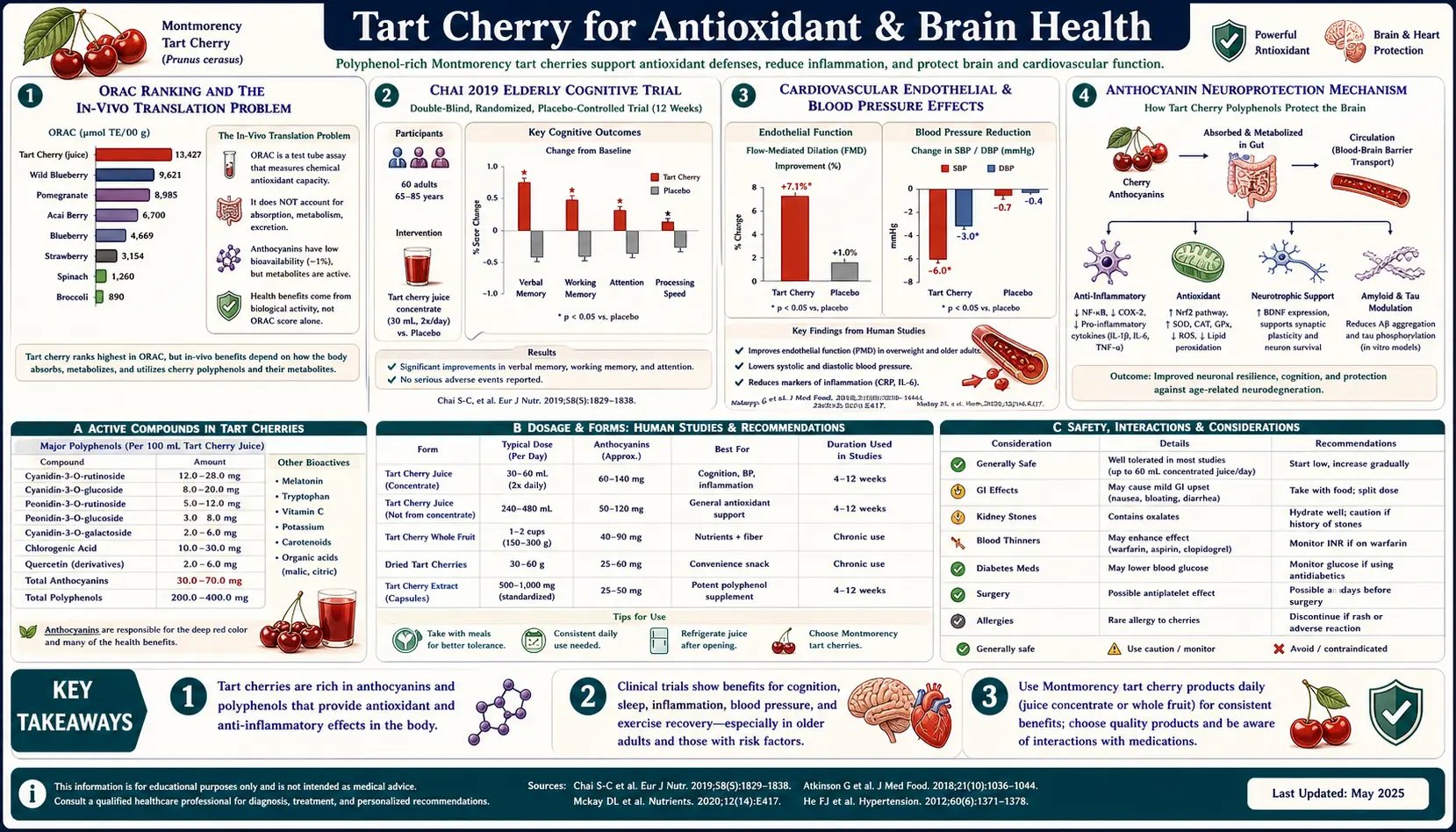
Tart cherry consistently ranks among the top three foods on standard oxygen radical absorbance capacity (ORAC) panels — alongside wild blueberry and pomegranate — reflecting its exceptional density of cyanidin-3-glucoside and related anthocyanin polyphenols. The clinical translation of "high ORAC" into "improved health outcomes" has historically been overhyped (the USDA officially withdrew its ORAC database in 2012 because of weak in-vivo correlation), but for tart cherry specifically the antioxidant capacity does translate to measurable systemic effects. The most clinically interpretable evidence comes from the Chai 2019 trial published in Food & Function, a 12-week randomized double-blind trial in adults 65-80 in which Montmorency tart cherry juice improved subjective memory scales, reduced systolic blood pressure, and lowered LDL cholesterol versus placebo. The underlying mechanism includes anthocyanin neuroprotection (the molecules cross the blood-brain barrier in measurable amounts, modulate microglial activation, and support BDNF signaling), endothelial nitric oxide preservation, and the same systemic anti-inflammatory effect detailed in the Inflammation deep-dive. This article walks through the ORAC ranking and its limitations, the Chai 2019 cognitive trial, the cardiovascular endothelial effects, the neuroprotective mechanism, and head-to-head comparisons with wild blueberry (Wild Blueberry Health study) and pomegranate punicalagins as the principal alternative anti-aging brain-health interventions.
Table of Contents
- ORAC Ranking and the In-Vivo Translation Problem
- The Chai 2019 Elderly Cognitive Trial
- Cardiovascular Endothelial & Blood Pressure Effects
- Anthocyanin Neuroprotection Mechanism
- Blood-Brain Barrier Crossing and CNS Bioavailability
- Microglial Modulation and Neuroinflammation
- BDNF and Adult Neurogenesis
- Comparison: Tart Cherry vs Wild Blueberry
- Comparison: Tart Cherry vs Pomegranate Punicalagins
- Stacking with Mediterranean and MIND Dietary Patterns
- Cautions, Interactions, Patient Selection
- Key Research Papers
- Connections
- Featured Videos
ORAC Ranking and the In-Vivo Translation Problem
The Oxygen Radical Absorbance Capacity (ORAC) assay was developed in the early 1990s as an in-vitro test of a food's total capacity to neutralize peroxyl radicals. The USDA published an ORAC database that ranked thousands of foods, and the assay became the basis for a wave of "high-ORAC" marketing in the antioxidant supplement and superfood industries. Tart cherries scored extraordinarily well on the ORAC panel — among the top three foods alongside wild blueberry and pomegranate, with values around 6,800 ORAC units per 100 g for fresh tart cherries.
The translation from in-vitro ORAC to in-vivo health outcomes proved disappointing for most foods. The USDA officially withdrew the ORAC database in 2012, citing inadequate evidence that "the antioxidant capacity values estimated by the ORAC method have a direct connection to health benefits in vivo." Most high-ORAC foods do not measurably alter plasma antioxidant status when consumed in normal dietary amounts, and isolated antioxidant supplements (high-dose vitamin E and beta-carotene in particular) have a checkered safety record (ATBC, CARET, HOPE-TOO trials).
Tart cherry is one of the partial exceptions. Multiple human trials have documented that tart cherry consumption does measurably raise plasma antioxidant capacity (Howatson 2010, Bell 2014, Kelley 2018), reduce markers of in-vivo oxidative damage (F2-isoprostanes, protein carbonyls, oxidized LDL), and produce downstream clinical effects across the inflammatory, cardiovascular, and cognitive outcomes covered in this and the other Tart Cherry Benefits deep-dives. The reason cherry succeeds where many high-ORAC foods fail seems to be the combination of high anthocyanin concentration, favorable food-matrix bioavailability, and the multi-mechanism effect that extends beyond direct radical scavenging into Nrf2-mediated endogenous antioxidant defense and NF-kB inhibition.
The practical takeaway: ORAC is an unreliable predictor of food health benefit in general, but for tart cherry specifically the high ORAC reflects a real cyanidin-3-glucoside content that does produce measurable in-vivo effects.
The Chai 2019 Elderly Cognitive Trial
The most clinically interpretable randomized trial of tart cherry for cognitive health was Sheau C. Chai and colleagues at the University of Delaware, published in Food & Function in 2019. The design was a 12-week randomized double-blind parallel-group trial in 37 community-dwelling adults aged 65-80 without dementia. Participants consumed either 480 ml (16 oz) of Montmorency tart cherry juice daily (split into 8 oz twice daily) or a calorie- and macronutrient-matched placebo beverage.
Outcomes were measured at baseline and 12 weeks across cognitive function (validated subjective scales plus selected objective tests), blood pressure, lipid panel, and inflammatory markers:
- Cognitive function — subjective memory scales (Memory Functioning Questionnaire) improved significantly in the cherry group, with smaller improvements on objective tests of verbal fluency and information processing speed. The objective test improvements were modest in magnitude but consistent in direction
- Systolic blood pressure — decreased by approximately 5 mmHg in the cherry group vs no change in placebo. This is a clinically meaningful magnitude for cardiovascular event risk over the long term
- LDL cholesterol — reduced by approximately 10% in the cherry group vs no change in placebo
- Inflammatory markers — hs-CRP, IL-6, and TNF-alpha showed modest reductions in the cherry group
- Tolerability — no significant adverse events; the 16 oz daily juice volume was generally well-tolerated though some participants noted glycemic excursions
The Chai 2019 trial is the most clinically relevant cognitive trial because it studied the population most concerned with brain-health interventions — healthy older adults at risk for mild cognitive impairment progressing to dementia — and used a 12-week duration adequate to capture vascular and inflammatory mechanism effects. The improvement in subjective memory plus the reduction in vascular risk factors (BP, LDL, inflammation) makes mechanistic sense: a substantial portion of cognitive decline with aging is vascular in origin, and reducing the vascular risk burden plausibly preserves cognitive function. The relatively small sample size and reliance on subjective scales for the primary cognitive outcome are the principal methodologic limitations — larger trials would be valuable.
Cardiovascular Endothelial & Blood Pressure Effects
The vascular effects documented in the Chai 2019 trial — 5 mmHg systolic BP reduction, 10% LDL reduction — are mechanistically supported by smaller studies of endothelial function. Keane et al. (2016) in American Journal of Clinical Nutrition demonstrated that a single 60 ml acute dose of Montmorency tart cherry juice concentrate produced a measurable improvement in flow-mediated dilation (FMD) of the brachial artery within 2 hours of consumption. FMD is a standard non-invasive measure of endothelial function and a validated surrogate for cardiovascular event risk.
The proposed mechanism involves anthocyanin-mediated preservation of endothelial nitric oxide (NO) bioavailability. NO is produced by endothelial NO synthase (eNOS) and serves as the principal vasodilator signal in healthy arteries. With aging and oxidative stress, NO is increasingly scavenged by superoxide to form peroxynitrite — reducing NO bioavailability and producing endothelial dysfunction, which precedes clinically apparent vascular disease by years to decades. Cherry anthocyanins reduce the superoxide burden that depletes NO, indirectly preserving vascular function.
The blood-pressure-lowering effect of about 5 mmHg systolic is small per individual but cumulatively important at the population level. The MRFIT and Prospective Studies Collaboration data indicate that each 2 mmHg sustained systolic reduction reduces stroke mortality by approximately 10% over the long term — a 5 mmHg cherry effect, sustained, would correspond to roughly a 25% long-term stroke risk reduction (with all the standard caveats about extrapolating short trial effects to lifetime benefit). For more on cardiovascular risk modification, see our Lipid Panel page.
The LDL reduction observed in Chai 2019 (~10%) is similar in magnitude to a low-intensity statin, although the mechanism is different (likely reduced hepatic cholesterol synthesis via polyphenol effects on HMG-CoA reductase and possibly enhanced bile acid binding rather than direct enzyme inhibition). The cherry intervention is not a substitute for statin therapy in patients with established ASCVD or high 10-year risk, but as a dietary adjunct it offers a meaningful incremental benefit.
Anthocyanin Neuroprotection Mechanism
The neuroprotective mechanism of anthocyanins (cyanidin-3-glucoside in particular) operates through several distinct pathways relevant to age-related cognitive decline:
- Direct radical scavenging in brain tissue — anthocyanins crossing the blood-brain barrier scavenge reactive oxygen species generated by mitochondrial leak in neurons. The brain is uniquely vulnerable to oxidative damage because of its high lipid content (the omega-3-rich neuronal membranes are particularly susceptible to lipid peroxidation), high oxygen consumption, and limited antioxidant capacity
- Mitochondrial preservation — anthocyanins support mitochondrial membrane integrity, reduce cytochrome c release, and may modestly enhance complex I and complex IV activity. Mitochondrial dysfunction is a unifying feature of multiple neurodegenerative diseases (Parkinson's, Alzheimer's, ALS)
- Amyloid and tau aggregation inhibition — in vitro and animal-model evidence suggests anthocyanins can modestly disrupt amyloid-beta aggregation and tau hyperphosphorylation, the two pathologic hallmarks of Alzheimer's disease. Human translation remains uncertain but is mechanistically consistent
- Cerebral vascular protection — the same endothelial-NO-preservation mechanism that helps systemic blood pressure also applies to cerebral arterioles. Vascular cognitive impairment is one of the major contributors to age-related cognitive decline, particularly the subcortical small-vessel disease that produces white-matter hyperintensities on MRI
- Microglial modulation — see next section on neuroinflammation
- BDNF support — see following section on adult neurogenesis
The convergence of these mechanisms is what gives anthocyanin-rich foods their broad neuroprotective profile in observational epidemiology — the Devore 2012 prospective cohort study (Nurses' Health Study) and the Rabassa 2015 InCHIANTI cohort both showed inverse associations between dietary anthocyanin intake and rate of cognitive decline in older adults, with effect sizes in the range of 2-3 years of preserved cognitive age over follow-up.
Blood-Brain Barrier Crossing and CNS Bioavailability
For an oral antioxidant to produce neuroprotective effects, it must measurably reach brain tissue. Many candidate compounds (vitamin E, vitamin C, resveratrol at oral doses) achieve only modest CNS penetration. Anthocyanins do measurably cross the blood-brain barrier in animal models — Talavera et al. (2005) and Andres-Lacueva et al. (2005) detected anthocyanin metabolites in rat brain tissue 1-2 hours after oral cyanidin-3-glucoside loading, with concentrations highest in hippocampus, striatum, and cortex (the regions most relevant to cognitive function).
In humans, direct measurement of brain anthocyanin is impractical, but plasma pharmacokinetics combined with the demonstrable cognitive and cerebrovascular effects in trials like Chai 2019 support the inference that meaningful CNS exposure occurs. The plasma half-life of intact cyanidin-3-glucoside is short (~2 hours), but the deglycosylated and methylated metabolites (peonidin, protocatechuic acid, ferulic acid derivatives) have longer half-lives and are themselves bioactive antioxidants. The cumulative pharmacokinetics support twice-daily dosing.
The bioavailability of anthocyanins from tart cherry is enhanced by the natural food matrix — the co-occurring fats, sugars, vitamin C, and other polyphenols stabilize the anthocyanins against gastric degradation and enhance intestinal absorption. Isolated cyanidin-3-glucoside supplements have lower bioavailability than the same molar dose delivered as cherry juice or freeze-dried cherry powder. This is one of the recurring findings in polyphenol pharmacology and an argument for whole-food rather than isolated-compound supplementation strategies.
Microglial Modulation and Neuroinflammation
Chronic activation of microglia — the brain's resident innate immune cells — is increasingly recognized as a central driver of neurodegenerative disease progression. Microglia exist in a continuum of activation states from "resting" / surveillance through M1-like pro-inflammatory through M2-like phagocytic / repair. Chronic M1-skewed activation produces sustained release of IL-1-beta, TNF-alpha, and reactive oxygen species into the neural environment, damaging neurons and amplifying further microglial activation in a self-reinforcing cycle.
Anthocyanins shift microglial polarization away from the chronic M1 state and toward the more homeostatic M2 / surveillance state. This has been demonstrated in cell-culture models (BV-2 microglial cells exposed to LPS) and in animal models of LPS-induced neuroinflammation, traumatic brain injury, and amyloid-beta-driven Alzheimer's pathology. The translational implication is that chronic anthocyanin intake may dampen the chronic neuroinflammatory component of multiple neurodegenerative conditions.
The same mechanism is implicated in the "sickness behavior" / depression / fatigue that often accompanies chronic systemic inflammation (autoimmune disease, chronic infection, post-viral fatigue syndromes). Anthocyanin intake may modestly attenuate the central sickness-behavior signal by reducing the microglial amplification of peripheral inflammatory cytokines crossing the blood-brain barrier.
BDNF and Adult Neurogenesis
Brain-derived neurotrophic factor (BDNF) is the principal molecular signal supporting hippocampal adult neurogenesis — the ongoing generation of new neurons in the dentate gyrus that contributes to learning, memory, and mood regulation. BDNF levels decline with age, and reduced BDNF signaling is implicated in major depression, anxiety, and cognitive decline.
Several dietary and lifestyle interventions reliably raise BDNF: exercise (the dominant non-pharmacologic BDNF enhancer), caloric restriction, omega-3 fatty acid intake, certain polyphenols (including the anthocyanin family), and (perhaps surprisingly) intermittent fasting. The polyphenol-BDNF connection has been demonstrated for blueberry anthocyanins (Wang et al. 2010), grape skin polyphenols (resveratrol), and green tea EGCG. Cherry anthocyanins fit the same chemical class and likely produce a similar effect, although direct cherry-on-BDNF human studies are limited.
The clinical implication is that regular anthocyanin intake from cherry, blueberry, or pomegranate may produce modest but cumulatively important support for adult neurogenesis, hippocampal volume preservation, and the cognitive and mood regulation those structures support. The effect is not dramatic per dose, but over years of consistent intake the cumulative impact may be meaningful — consistent with the observational epidemiology showing slower cognitive decline in habitual anthocyanin consumers.
For a broader treatment of BDNF and its modulators (including exercise, sleep, and fasting), see our Gut-Brain Axis page and the Fasting page.
Comparison: Tart Cherry vs Wild Blueberry
Wild lowbush blueberry (Vaccinium angustifolium) is the other dominant cherry-class anthocyanin food in the brain-health literature. The two are often compared head-to-head and frequently used interchangeably in practice. Comparing on the relevant dimensions:
- Anthocyanin content per serving — wild blueberry slightly higher (~600 mg total anthocyanins per cup) than tart cherry (~500 mg per cup); both are dramatically higher than cultivated highbush blueberry (which is the supermarket variety)
- Anthocyanin profile — cherry dominated by cyanidin-3-glucoside; blueberry dominated by malvidin and delphinidin glycosides. Modest differences in pharmacokinetics and bioactivity, but broadly overlapping mechanisms
- Sleep / melatonin effect — tart cherry only (blueberry has negligible melatonin content)
- Anti-inflammatory / DOMS effect — tart cherry better-documented in athletic-recovery trials
- Cognitive / cardiovascular outcomes — comparable evidence base; blueberry has the Krikorian 2010 (older adults memory), Whyte 2015 (children attention), and the larger NHS / NHS-II prospective cohorts showing slower cognitive decline. Cherry has Chai 2019
- Uric acid / gout effect — tart cherry only (blueberry has not been shown to lower uric acid)
- Practical availability — wild blueberry is harder to source outside of New England and Quebec; "blueberry" in most stores is the milder cultivated highbush variety. Tart cherry concentrate is widely available year-round
- Cost — comparable per anthocyanin-equivalent dose
The reasonable summary: tart cherry has the broader documented benefit profile (sleep, gout, athletic recovery, plus the cardiovascular and cognitive effects shared with blueberry); wild blueberry has slightly higher anthocyanin density and longer prospective epidemiologic support for cognitive outcomes. There is no need to choose — consuming both regularly (or alternating) is a defensible strategy. For more on blueberry specifically, see our Blueberries page.
Comparison: Tart Cherry vs Pomegranate Punicalagins
Pomegranate (Punica granatum) is the third major contender for highest-density antioxidant fruit. Pomegranate's active polyphenols are different — the dominant compounds are punicalagins (large ellagitannins, ~2 g per liter of pomegranate juice) and their gut-microbiome-converted metabolites called urolithins.
Comparing tart cherry vs pomegranate:
- Polyphenol class — cherry: anthocyanins (cyanidin glycosides); pomegranate: ellagitannins (punicalagins) and urolithins. Different chemistry, different pharmacokinetics
- Bioavailability — pomegranate punicalagins themselves have poor systemic bioavailability, but the gut-microbiome-derived urolithins (urolithin A in particular) are well-absorbed and have a longer half-life than anthocyanins. The catch: urolithin production requires a specific gut microbiome composition (an Akkermansia- and Gordonibacter-rich profile), and an estimated 40% of adults are "non-converters" who derive less benefit from pomegranate
- Mitochondrial mitophagy effect — urolithin A specifically has been shown to enhance mitophagy (autophagy of damaged mitochondria), with putative anti-aging implications. This is a unique mechanism not shared by cherry anthocyanins. Direct synthetic urolithin A supplements are commercially available (Mitopure / Timeline Nutrition)
- Cardiovascular evidence — pomegranate has stronger evidence for carotid intima-media thickness reduction (Aviram 2004) than cherry; both reduce blood pressure
- Sleep / melatonin effect — cherry only
- Uric acid effect — cherry only
- Anti-inflammatory athletic recovery — cherry has broader trial base; pomegranate has supporting evidence but less specific
The reasonable summary: cherry and pomegranate are complementary rather than redundant. Cherry covers a broader range of acute and short-term applications; pomegranate (via urolithins) may offer unique long-term mitochondrial / aging benefits. Both can be consumed regularly; both are reasonable substitutes for the more processed antioxidant supplements that dominate the consumer market.
Stacking with Mediterranean and MIND Dietary Patterns
Tart cherry fits naturally into the Mediterranean diet and MIND diet (Mediterranean-DASH Intervention for Neurodegenerative Delay) frameworks, both of which are evidence-supported anti-aging dietary patterns:
- Mediterranean diet — the PREDIMED trial (Estruch et al. 2013, 2018) demonstrated approximately 30% reduction in cardiovascular events with a Mediterranean diet supplemented with extra-virgin olive oil or nuts. Cherry, like other deep-pigmented fruits, fits naturally into the "abundant fruit and vegetable" principle of this dietary pattern
- MIND diet — the Morris 2015 prospective cohort study identified 10 brain-healthy and 5 brain-unhealthy foods; the brain-healthy list specifically includes berries (which the original protocol defines as blueberries and strawberries, but the underlying mechanism would extend to tart cherry by reasonable extrapolation). The MIND diet was associated with approximately 53% slower cognitive decline in highest- vs lowest-adherence quintiles over 9-year follow-up
- DASH diet — the original cardiovascular dietary intervention that established the 5-9 mmHg systolic BP reduction achievable with dietary modification alone. Cherry's blood-pressure-lowering effect adds incrementally to the broader DASH framework
A practical anti-aging dietary template that incorporates the cherry findings:
- Daily breakfast with mixed berries (blueberry + tart cherry + pomegranate seeds) for the synergistic polyphenol load
- Fatty fish (salmon, sardines, mackerel) two or more servings per week for marine omega-3
- Leafy greens daily; cruciferous vegetables three or more times per week
- Extra-virgin olive oil as the primary cooking and dressing fat
- Nuts (walnuts in particular for the alpha-linolenic acid) daily
- Whole grains over refined grains
- Beans / legumes several times per week
- Limited red meat, no processed meat, limited refined sugar and sweetened beverages
- Tart cherry juice concentrate (30 ml) or freeze-dried cherry capsule (480 mg) daily for the targeted sleep / inflammation / cardiovascular benefit beyond whole-fruit consumption
Cautions, Interactions, Patient Selection
- Glycemic load — the 16 oz daily juice dose used in Chai 2019 contains substantial sugar. Diabetic patients should use freeze-dried capsule forms; consider continuous glucose monitor data to inform individual decision
- Anticoagulant interaction — modest platelet-modulating effect of cherry anthocyanins; standard INR monitoring is sufficient for warfarin users. Caution with combined antiplatelet + anticoagulant regimens
- Hypotensive medications — the 5 mmHg BP reduction is additive to ACE inhibitors, ARBs, calcium channel blockers, and diuretics. Generally well-tolerated but monitor for symptomatic hypotension in patients on multiple BP medications
- Statin interaction — no direct interaction; the modest LDL reduction from cherry is additive to statin effect without specific interaction concerns
- Dementia diagnostic considerations — cherry juice has not been demonstrated to reverse established dementia. For patients with cognitive complaints, a comprehensive workup (TSH, B12, folate, vitamin D, metabolic panel, MRI brain, neuropsychological testing) should not be deferred for a dietary trial
- Depression and anxiety — small open-label evidence suggests possible adjunctive benefit; cherry is not a substitute for psychotherapy or evidence-based pharmacotherapy for major depression
- Parkinson's disease — the anthocyanin neuroprotection mechanism is theoretically relevant but no clinical evidence supports cherry as Parkinson's therapy; the focus in PD management should remain on levodopa, dopamine agonists, deep brain stimulation, and disease-modifying clinical-trial candidates
- Iron absorption — cherry anthocyanins modestly chelate non-heme iron; separate iron supplements by 2 hours
- Pregnancy — whole-food cherry is safe; juice concentrate at high doses has not been formally studied in pregnancy; default to whole-food consumption
Key Research Papers
- Chai SC et al. (2019). Effects of tart cherry juice on biomarkers of inflammation and oxidative stress in older adults. Nutrients, 11(2):228. — PubMed
- Chai SC et al. (2019). Effects of tart cherry juice on cognitive performance in older adults. Food & Function, 10(7):4423-4431. — PubMed
- Keane KM et al. (2016). Effects of Montmorency tart cherry (Prunus cerasus) on vascular function in men with early hypertension. American Journal of Clinical Nutrition, 103(6):1531-1539. — PubMed
- Devore EE et al. (2012). Dietary intakes of berries and flavonoids in relation to cognitive decline. Annals of Neurology, 72(1):135-143. — PubMed
- Rabassa M et al. (2015). Low levels of a urinary biomarker of dietary polyphenol are associated with substantial cognitive decline over a 3-year period in older adults: the Invecchiare in Chianti study. Journal of the American Geriatrics Society. — PubMed
- Wang Y et al. (2010). Blueberry treatment attenuates beta-amyloid-induced microglial inflammation. Nutritional Neuroscience. — PubMed
- Andres-Lacueva C et al. (2005). Anthocyanins in aged blueberry-fed rats are found centrally and may enhance memory. Nutritional Neuroscience, 8(2):111-120. — PubMed
- Talavera S et al. (2005). Anthocyanin metabolism in rats and their distribution to digestive area, kidney, and brain. Journal of Agricultural & Food Chemistry, 53(10):3902-3908. — PubMed
- Morris MC et al. (2015). MIND diet associated with reduced incidence of Alzheimer's disease. Alzheimer's & Dementia, 11(9):1007-1014. — PubMed
- Estruch R et al. (2018). Primary prevention of cardiovascular disease with a Mediterranean diet supplemented with extra-virgin olive oil or nuts. NEJM, 378:e34. — PubMed
- Aviram M et al. (2004). Pomegranate juice consumption for 3 years by patients with carotid artery stenosis reduces common carotid intima-media thickness, blood pressure and LDL oxidation. Clinical Nutrition. — PubMed
- Kelley DS et al. (2018). A review of the health benefits of cherries. Nutrients, 10(3):368. — PubMed
PubMed Topic Searches
- PubMed: Tart cherry cognitive function
- PubMed: Anthocyanin blood-brain barrier
- PubMed: Cyanidin-3-glucoside neuroprotection
- PubMed: Anthocyanin blood pressure / endothelial
- PubMed: ORAC assay limitations
Connections
- All Herbs
- Tart Cherry Overview
- Tart Cherry Benefits Hub
- Tart Cherry for Sleep & Melatonin
- Tart Cherry for Inflammation
- Tart Cherry for Uric Acid & Gout
- Blueberries (Wild)
- Quercetin
- Lipid Panel
- Inflammatory Markers
- Anti-Inflammatory Diet
- Gut-Brain Axis (BDNF)
- Fasting (BDNF)
- Vitamin C
- Vitamin E
- Turmeric / Curcumin