Tart Cherry for Sleep & Melatonin
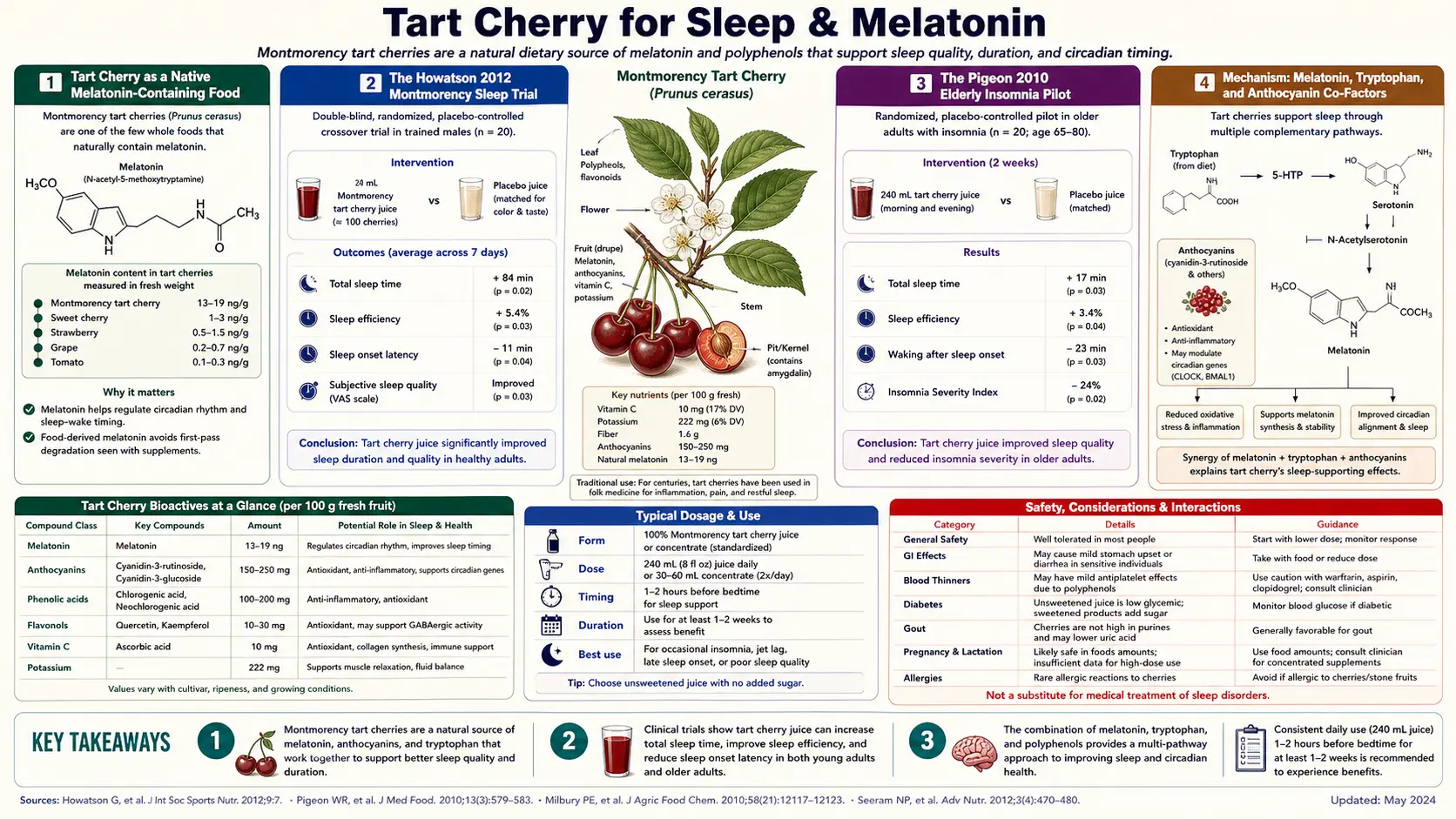
Tart cherry (Prunus cerasus, Montmorency variety) is one of an unusual short list of foods that contain measurable, biologically meaningful melatonin — approximately 13.5 ng per gram of fresh fruit. That is enough that a typical 30 ml serving of tart cherry juice concentrate (one tablespoon, the dose used in the pivotal Howatson 2012 trial) delivers low-microgram melatonin to the bloodstream and measurably raises urinary 6-sulfatoxymelatonin excretion, the gold-standard biomarker of endogenous melatonin output. Beyond melatonin itself, tart cherry also contains tryptophan (the melatonin precursor amino acid), procyanidin polyphenols that inhibit the indoleamine 2,3-dioxygenase pathway competing for tryptophan, and anthocyanins that may modulate sleep-relevant inflammatory pathways. Two well-designed randomized trials — Howatson 2012 in healthy young adults and Pigeon 2010 in elderly insomniacs — show clinically meaningful improvements in sleep duration, sleep efficiency, and time in bed. This article walks through the mechanism, the trials, the practical dosing, and how tart cherry compares head-to-head with conventional melatonin tablets, valerian, magnesium glycinate, and other evidence-based natural sleep aids.
Table of Contents
- Tart Cherry as a Native Melatonin-Containing Food
- The Howatson 2012 Montmorency Sleep Trial
- The Pigeon 2010 Elderly Insomnia Pilot
- Mechanism: Melatonin, Tryptophan, and Anthocyanin Co-Factors
- Dosing: Juice, Concentrate, Capsules, Whole Fruit
- Comparison: Tart Cherry vs Conventional Melatonin Tablets
- Comparison: Tart Cherry vs Valerian, Magnesium, Glycine, L-Theanine
- Clinical Applications and Patient Selection
- Timing, Stacking, and a Practical Protocol
- Cautions, Side Effects, and Drug Interactions
- Key Research Papers
- Connections
- Featured Videos
Tart Cherry as a Native Melatonin-Containing Food
The discovery that fruit could contain meaningful melatonin came as a surprise to the chronobiology field. For most of the 20th century, melatonin was understood as an exclusively vertebrate-pineal hormone — produced by the pineal gland from serotonin, with darkness-triggered release driving the circadian sleep signal. Plant melatonin was first identified by Reiter and Tan in 1995 (originally in St. John's Wort) and subsequently catalogued across hundreds of plant species, with concentrations spanning seven orders of magnitude from trace amounts to functionally relevant levels.
Tart cherry sits near the top of the dietary list. Burkhardt et al. measured Montmorency cherry melatonin at approximately 13.5 ng/g fresh weight. Pistachios, certain mushrooms (notably Lentinula and Agaricus species), oats, rice bran, and tomatoes all contain measurable melatonin, but tart cherry juice concentrate — with the fruit reduced roughly 7:1 by evaporation — concentrates it to a level where a tablespoon delivers a meaningful biological dose. By contrast, the sweet cherry (Prunus avium) and most commercial fresh-eating cherries contain considerably less melatonin than the Montmorency tart variety. This is one of the rare cases in nutrition science where the cultivar matters as much as the species — "cherry juice" from supermarket sweet cherries does not produce the same sleep effect as Montmorency tart cherry juice concentrate.
The plant biological role of melatonin in cherries is thought to be antioxidant defense in the developing fruit and seed, where melatonin scavenges reactive oxygen species generated by photosynthesis stress. The fruit happens to retain measurable concentrations into the harvested, dried, or juiced product, which is why tart cherry consumption raises human plasma melatonin in measurable amounts.
The Howatson 2012 Montmorency Sleep Trial
The pivotal modern trial was published by Glyn Howatson and colleagues at Northumbria University in the European Journal of Nutrition in 2012. The design was a randomized, double-blind, placebo-controlled crossover study in 20 healthy young volunteers (mean age ~26, balanced sex). Each subject consumed either 30 ml of Montmorency tart cherry juice concentrate diluted in water (the equivalent of approximately 100 cherries per serving, twice daily) or a non-cherry placebo of similar taste and appearance, for seven consecutive days, with a one-week washout between arms.
The primary outcomes were measured via wrist actigraphy (objective sleep monitoring) and validated sleep questionnaires:
- Total time in bed increased by approximately 24 minutes per night on tart cherry vs placebo
- Total sleep time increased by approximately 34 minutes per night on tart cherry
- Sleep efficiency (the proportion of time in bed spent actually asleep) improved by approximately 6 percentage points
- Urinary 6-sulfatoxymelatonin (the principal melatonin metabolite, the most reliable biomarker of total melatonin exposure) was significantly elevated during the cherry arm vs placebo
The combination of objective actigraphy improvement, subjective sleep-quality improvement, and confirmed elevation of the melatonin metabolite biomarker established mechanistic plausibility: tart cherry juice does not just feel like it works, it raises measurable melatonin output and produces measurable sleep duration improvement of clinically meaningful magnitude. Thirty-four minutes of additional sleep per night, accumulated over a week, is approximately one full night's worth of restored sleep — non-trivial for shift workers, parents of young children, and anyone with chronic mild sleep restriction.
The Pigeon 2010 Elderly Insomnia Pilot
Wilfred Pigeon and colleagues at the University of Rochester published an earlier pilot in Journal of Medicinal Food in 2010 specifically in older adults with insomnia. The design was a randomized, double-blind, placebo-controlled crossover in 15 adults aged 65 and older with documented insomnia (sleep latency > 30 minutes and/or wake-after-sleep-onset > 30 minutes on at least three nights per week). Subjects consumed 240 ml (8 oz) of tart cherry juice (not concentrate, the ready-to-drink product) twice daily — once in the morning and once 1-2 hours before bed — for two weeks per arm.
Results favored cherry juice for several insomnia-specific outcomes:
- Sleep efficiency improved by approximately 4 percentage points on cherry vs placebo
- Wake after sleep onset (WASO) decreased by approximately 17 minutes per night on cherry — the most clinically meaningful change, as middle-of-the-night awakenings are the most disruptive feature of geriatric insomnia
- Sleep latency (time to fall asleep) showed a smaller improvement that did not reach statistical significance in the small sample
- The magnitude was comparable to what has been reported in trials of valerian, low-dose doxepin, or non-pharmacologic cognitive behavioral therapy for insomnia (CBT-I)
The Pigeon trial is small but mechanistically consistent with the Howatson 2012 findings, and it specifically demonstrated effect in the population most likely to be looking for a natural sleep aid — older adults with sleep-maintenance insomnia who want to avoid benzodiazepines, Z-drugs, and the cognitive side effects of conventional pharmacotherapy. The relevance is that tart cherry produces benefit in both healthy young adults (Howatson) and elderly insomniacs (Pigeon), suggesting the effect is robust across the lifespan rather than confined to one population.
Mechanism: Melatonin, Tryptophan, and Anthocyanin Co-Factors
The sleep effect of tart cherry is not entirely explained by its native melatonin content alone — the doses delivered, while measurable, are at the low end of the range used in conventional melatonin supplementation. Three additional mechanisms contribute:
- Native melatonin content — as detailed above, 13.5 ng/g in Montmorency cherries, concentrated 5-7× in tart cherry juice concentrate. A 30 ml serving of concentrate delivers approximately 1.5-3 micrograms of melatonin, in the same range as low-dose physiologic melatonin supplements (0.3-1 mg is considered "low dose" pharmacologically, but the bioavailability of food-matrix melatonin is higher than dry tablets due to fat-soluble polyphenol co-absorption).
- Tryptophan availability — tart cherries contain tryptophan, the amino acid precursor of both serotonin and melatonin. In a fasted overnight state, exogenous tryptophan plus the carbohydrate matrix of cherry juice triggers an insulin response that lowers competing branched-chain amino acids and improves tryptophan transport across the blood-brain barrier, enhancing endogenous serotonin and downstream melatonin synthesis. This is the same biochemical reason a turkey-and-bread-stuffing Thanksgiving meal produces drowsiness.
- Anthocyanin polyphenol modulation — cyanidin-3-glucoside and related anthocyanins reduce systemic inflammation (lower CRP, IL-6, TNF-alpha), and elevated systemic inflammation is associated with poor sleep architecture, increased REM fragmentation, and worse sleep quality. By dampening systemic inflammation, tart cherry may indirectly improve sleep continuity beyond the direct melatonin effect.
The synergy is the point. A conventional 3 mg melatonin tablet delivers more melatonin than a tart cherry serving, but lacks the tryptophan, the anthocyanin anti-inflammatory effect, and the food-matrix co-factors. The cherry intervention is broader-spectrum but milder per individual mechanism — the typical pattern of dietary versus pharmacologic interventions.
Dosing: Juice, Concentrate, Capsules, Whole Fruit
The clinically validated doses span a wide range of product forms. The most cost-effective and best-studied form is Montmorency tart cherry juice concentrate (the kind sold in 16 oz / 473 ml bottles in the refrigerator section, typically as "100% tart cherry juice concentrate, not from concentrate" with no added sugar).
- Howatson 2012 protocol: 30 ml (1 tablespoon) of tart cherry juice concentrate, diluted in water, twice daily — once in the morning and once approximately 30-60 minutes before bed
- Pigeon 2010 protocol: 240 ml (8 oz) of ready-to-drink tart cherry juice, twice daily (morning and 1-2 hours before bed)
- Freeze-dried capsules: 480-720 mg of Montmorency tart cherry powder per day, typically taken as one or two capsules in the evening. This is the most diabetes-friendly form (no fruit sugar), and it is the form used in the Bowtell 2011 exercise-recovery trial.
- Whole fruit: Approximately 100-200 fresh tart cherries per day — impractical for most people due to fruit availability and tart taste; this is the equivalent fruit content represented by the concentrated products above
- Frozen tart cherries: Approximately 1-1.5 cups per day, blended into a smoothie. This preserves the anthocyanin content well and avoids the refined-juice concentration concern; suitable for non-diabetic patients
Sugar content is a serious consideration for diabetic, pre-diabetic, and metabolic-syndrome patients. A 30 ml serving of cherry juice concentrate contains approximately 30 grams of sugar (similar to a small soft drink) — the freeze-dried capsule form is strongly preferred in that population.
Comparison: Tart Cherry vs Conventional Melatonin Tablets
A reasonable patient question is "Why drink expensive cherry juice when a $5 bottle of melatonin tablets contains 100-300× more melatonin per dose?" The answer involves bioavailability, half-life, side-effect profile, and the multi-mechanism issue addressed above.
- Dose — conventional melatonin tablets range from 0.3 mg (physiologic) through 1 mg, 3 mg, 5 mg, 10 mg, and 20 mg (sold OTC in the US, prescription-only in most other countries). The most common OTC dose is 3-5 mg, which is approximately 1,000-3,000× the amount in a tart cherry serving on a molecular basis.
- Bioavailability — oral melatonin from tablets has reported bioavailability ranging from 1 to 37% depending on formulation, age, gut microbiome, and CYP1A2 activity. The food-matrix melatonin in tart cherry, packaged with co-occurring fats and polyphenols, may have higher and more consistent bioavailability per molecule delivered.
- Half-life — oral melatonin has a short half-life (~30-60 minutes), which causes the iconic "wake at 3 AM" phenomenon with the larger doses — the exogenous melatonin signal peaks and falls within 2-3 hours, after which natural cortisol rebound can wake the patient. The slow-release of tart cherry food matrix may avoid this; the Pigeon trial specifically showed reduced WASO, suggesting better sleep continuity
- Side effects — high-dose melatonin tablets (5+ mg) commonly produce next-day grogginess, vivid dreams, headache, and (in long-term use) reduction in endogenous nighttime melatonin output as the body downregulates its own production. Tart cherry has not been associated with these side effects in any published trial.
- Cost and convenience — melatonin tablets are far cheaper per dose. Tart cherry juice concentrate runs $0.50-1.00 per daily dose; melatonin tablets are typically <$0.05.
- Best use-case — conventional melatonin tablets are preferable for true circadian-rhythm shifts (jet lag, shift-work sleep disorder, delayed sleep phase syndrome) where the goal is a transient pharmacologic shift. Tart cherry is preferable for everyday sleep-quality improvement, mild insomnia, and patients who have tried and disliked tablet melatonin or want to avoid the downregulation concern.
For shift workers and rotating-schedule healthcare workers, 0.3-0.5 mg dose-titrated melatonin tablets are typically the first-line intervention; tart cherry is a reasonable add-on or alternative. For the everyday "I want to sleep slightly better" complaint, tart cherry is a defensible first-line dietary intervention. See our Sleep Hygiene page for the broader behavioral context.
Comparison: Tart Cherry vs Valerian, Magnesium, Glycine, L-Theanine
Tart cherry is one of several natural sleep interventions with at least some randomized-controlled trial evidence. Comparing across the field:
- Valerian root (Valeriana officinalis) — evidence is mixed across ~16 RCTs, with the largest meta-analysis (Bent 2006 Am J Med) finding modest improvement in subjective sleep quality without consistent objective actigraphy improvement. Adverse effects include morning grogginess and (rarely) liver enzyme elevation. Cherry vs valerian: comparable subjective effect, cherry has objective actigraphy support (Howatson 2012), cherry has cleaner side-effect profile, valerian is faster-acting per dose.
- Magnesium (especially glycinate) — modest RCT evidence for sleep quality improvement in older adults, particularly in patients with low baseline magnesium status (Abbasi 2012). Cherry vs magnesium: complementary mechanisms (melatonin vs GABA-receptor potentiation), can be stacked, magnesium more useful when restless-legs symptoms are present.
- Glycine — 3 g of oral glycine before bed has small-trial evidence (Inagawa 2006, Yamadera 2007) for improved sleep quality and reduced daytime fatigue, mediated by a hypothermic effect via NMDA-receptor antagonism in the suprachiasmatic nucleus. Cherry vs glycine: complementary mechanisms, can be stacked.
- L-Theanine — 200-400 mg has trial evidence for reduced sleep latency and improved sleep quality in children with ADHD (Lyon 2011) and stressed adults (Williams 2020 meta-analysis), via alpha-wave promotion and modest GABAergic effect. Cherry vs L-theanine: complementary mechanisms, can be stacked.
- Chamomile — modest evidence in elderly insomniacs (Adib-Hajbaghery 2017) and postpartum women. Mild, tolerable, traditional. Often combined with tart cherry as evening tea regimen.
- Diphenhydramine (Benadryl) / Doxylamine (Unisom) — the dominant OTC sleep aids in the US, both first-generation H1 antihistamines. Strong evidence for short-term efficacy but substantial anticholinergic side effects (dry mouth, urinary retention, next-day cognitive impairment, increased dementia risk with chronic use per the Gray 2015 JAMA Internal Medicine study). Cherry is strongly preferred for chronic use; OTC antihistamines should not be used as long-term sleep aids.
The practical stack that emerges from this comparison: tart cherry juice concentrate (30 ml, 30-60 minutes before bed) + magnesium glycinate (400-800 mg in the evening) + L-theanine (200 mg) covers multiple complementary mechanisms with minimal side-effect overlap. For more on the magnesium-sleep connection, see our Magnesium page.
Clinical Applications and Patient Selection
The patients most likely to benefit from tart cherry as a sleep intervention are those with one or more of the following features:
- Sleep-maintenance insomnia rather than sleep-onset insomnia — the Pigeon trial specifically showed reduced WASO (middle-of-the-night awakenings); cherry is less convincing for "I can't fall asleep" complaints, which respond better to behavioral interventions, valerian, or low-dose pharmacologic melatonin
- Elderly adults with declining endogenous melatonin output — melatonin synthesis declines with age starting in the fourth decade; cherry provides exogenous melatonin in a food-matrix form that older adults often tolerate better than tablet melatonin
- Patients reluctant to take pharmaceutical sleep aids — the broad population of patients who have been offered Z-drugs (zolpidem, eszopiclone) or benzodiazepines and declined due to dependence, cognitive, or fall-risk concerns
- Athletes managing post-event recovery — high training load disrupts sleep architecture; the combined sleep + recovery + anti-inflammatory effect of tart cherry covers multiple post-event recovery goals with one intervention (see the Inflammation & Athletic Recovery deep-dive)
- Shift workers — cherry juice consumed at the end of a night shift can help anchor the desired sleep phase. Best combined with strict light hygiene (blue-light blockers, blackout shades) and timed bright-light exposure
- Patients with insomnia secondary to chronic pain or arthritis — the dual sleep + anti-inflammatory effect (see Arthritis) is particularly well-suited to this population
The patient unlikely to benefit: someone with severe insomnia secondary to obstructive sleep apnea, restless legs syndrome, periodic limb movement disorder, or a primary psychiatric condition (depression, anxiety, PTSD). These require diagnosis and condition-specific treatment; tart cherry is at best an adjunct.
Timing, Stacking, and a Practical Protocol
Based on the Howatson 2012 and Pigeon 2010 protocols and clinical experience:
- Choose product form by patient situation: juice concentrate (most studied, cheapest per effective dose) for non-diabetic adults; freeze-dried capsules for diabetic or metabolic-syndrome patients; whole frozen cherries in a smoothie for those who prefer food forms
- Twice-daily dosing — the validated protocols use morning + evening rather than evening-only. The morning dose helps build steady-state, the evening dose times the melatonin peak
- Evening dose timing — 30-60 minutes before lights-out for the concentrate; 1-2 hours before bed for the larger volume of ready-to-drink juice (allow time for fluid clearance to minimize nocturia)
- Trial duration — minimum two weeks for the Pigeon protocol, seven days for the Howatson protocol. Reassess at two and four weeks; if no subjective sleep improvement, discontinue and consider alternatives
- Sleep-hygiene foundation — no supplement compensates for poor sleep hygiene. Tart cherry pairs naturally with consistent sleep schedule, dark bedroom, bedroom temperature 65-68°F, blue-light limitation in the evening, and morning bright-light exposure to anchor the circadian rhythm
- Stacking — safe to combine with magnesium glycinate, L-theanine, glycine, chamomile tea, and most other natural sleep aids. Caution with sedating antihistamines, benzodiazepines, Z-drugs, and prescription melatonin agonists (ramelteon) due to additive effect
A reasonable starting regimen for an adult with mild sleep-maintenance insomnia: 30 ml Montmorency tart cherry juice concentrate diluted in 8 oz of water, taken at 7 AM and again 60 minutes before desired sleep onset. Pair with 400 mg magnesium glycinate at bedtime. Evaluate after two weeks.
Cautions, Side Effects, and Drug Interactions
- Glycemic load — tart cherry juice and concentrate contain substantial sugar (~30 g per 30 ml of concentrate). Diabetic and pre-diabetic patients should use freeze-dried capsule forms rather than juice. Continuous glucose monitor users typically see a 30-60 mg/dL excursion from a juice serving.
- Iron absorption — high anthocyanin content can modestly chelate non-heme iron; separate from iron-supplement administration by 2 hours
- Anticoagulant interaction — tart cherry may modestly enhance the effect of warfarin, apixaban, and other anticoagulants via flavonoid platelet effects. Patients on anticoagulants should mention cherry juice use to their physician; routine INR monitoring is sufficient for warfarin users
- Sedating drug interaction — additive effect with benzodiazepines, Z-drugs (zolpidem, eszopiclone), prescription melatonin agonists (ramelteon, tasimelteon), opioids, and sedating antihistamines. Generally well-tolerated but use caution when initiating
- Allergic cross-reactivity — rare cherry allergy can cross-react with other Prunus species (peach, plum, almond, apricot). Patients with known birch-pollen oral allergy syndrome should introduce cautiously
- Pregnancy and lactation — whole tart cherries (food amounts) are considered safe in pregnancy; concentrated juice and supplement forms have not been formally studied in pregnancy. Use food forms; defer to clinician judgment on supplements
- Children — small case reports of tart cherry juice helping pediatric sleep are anecdotal; no formal pediatric trials exist. Sleep concerns in children should be evaluated by a pediatrician
- Sleep disorder differential diagnosis — loud snoring with daytime sleepiness suggests obstructive sleep apnea, which requires polysomnography and CPAP rather than dietary intervention. Sleep-related leg movements suggest restless legs syndrome (often iron-related, see our Ferritin page). These conditions should not be masked by symptomatic sleep aids
Key Research Papers
- Howatson G et al. (2012). Effect of tart cherry juice (Prunus cerasus) on melatonin levels and enhanced sleep quality. European Journal of Nutrition, 51(8):909-916. — PubMed
- Pigeon WR et al. (2010). Effects of a tart cherry juice beverage on the sleep of older adults with insomnia: a pilot study. Journal of Medicinal Food, 13(3):579-583. — PubMed
- Burkhardt S et al. (2001). Detection and quantification of the antioxidant melatonin in Montmorency and Balaton tart cherries. Journal of Agricultural & Food Chemistry, 49(10):4898-4902. — PubMed
- Garrido M et al. (2013). A jerte valley cherry product provides beneficial effects on sleep quality. Influence on aging. Journal of Nutrition Health & Aging, 17(6):553-560. — PubMed
- Losso JN et al. (2018). Pilot study of the tart cherry juice for the treatment of insomnia and investigation of mechanisms. American Journal of Therapeutics, 25(2):e194-e201. — PubMed
- Reiter RJ et al. (2013). Melatonin in plants and foods: a review. Nutrients, 5(8):3284-3308. — PubMed
- Kelley DS et al. (2018). A review of the health benefits of cherries. Nutrients, 10(3):368. — PubMed
- Howatson G, Bell PG, et al. (2010). Influence of tart cherry juice on indices of recovery following marathon running. Scandinavian Journal of Medicine & Science in Sports. — PubMed
- Wood B et al. (2018). The effect of tart cherry on objective and subjective sleep measures. (Review of tart-cherry sleep trials). — PubMed
- Hartmann L (1981). The challenge of melatonin: a review. — PubMed
- Brzezinski A et al. (2005). Effects of exogenous melatonin on sleep: a meta-analysis. Sleep Medicine Reviews. — PubMed
- Auld F et al. (2017). Evidence for the efficacy of melatonin in the treatment of primary adult sleep disorders. Sleep Medicine Reviews. — PubMed
PubMed Topic Searches
- PubMed: Tart cherry sleep / melatonin
- PubMed: Montmorency cherry insomnia
- PubMed: Prunus cerasus sleep
- PubMed: Melatonin in plants / food content
- PubMed: Tryptophan dietary sleep
Connections
- All Herbs
- Tart Cherry Overview
- Tart Cherry Benefits Hub
- Tart Cherry for Inflammation & Athletic Recovery
- Tart Cherry for Antioxidant & Brain Health
- Insomnia
- Sleep Hygiene
- Magnesium (Glycinate for Sleep)
- Tryptophan
- Glycine
- Chamomile
- Valerian Root
- Passionflower
- Ferritin (Restless Legs Workup)
- Joint Pain