Tart Cherry for Inflammation & Athletic Recovery
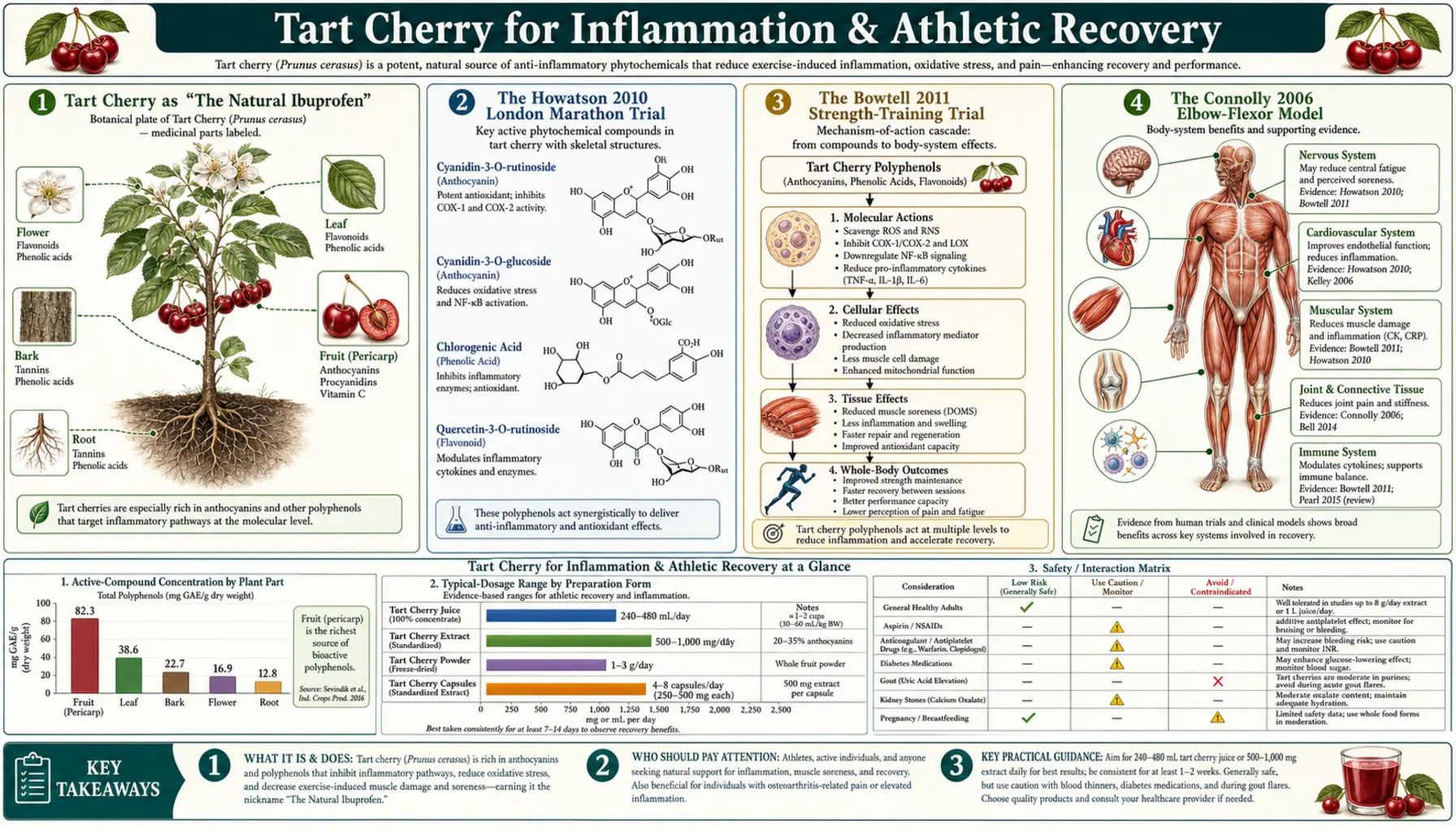
Tart cherry has earned the nickname "the natural ibuprofen" among sports-medicine researchers. The evidence behind that name is real but narrower than the nickname suggests: it sits almost entirely in short recovery trials after a single hard bout, and several trials of resting inflammation in ordinary adults have been flatly negative. A series of well-designed randomized trials between 2006 and 2015 documented that Montmorency tart cherry juice or freeze-dried capsule supplementation around endurance and resistance exercise reduces post-event delayed-onset muscle soreness (DOMS), preserves isometric strength recovery, lowers post-event serum CRP and IL-6, blunts oxidative-stress markers, and accelerates the return to baseline performance metrics. The Howatson 2010 London Marathon trial and the Bowtell 2011 strength-training trial are the most cited, but the body of evidence now includes elbow-flexor models, cycling protocols, and team-sport recovery trials. The clinical translation matters because the conventional alternative — NSAIDs (ibuprofen, naproxen, aspirin) taken around exercise — carries underappreciated downsides: GI bleeding risk, renal dysfunction in dehydrated athletes, and a now-replicated inhibition of the anabolic muscle-adaptation signaling that exercise is supposed to produce. Tart cherry delivers comparable DOMS reduction without those liabilities. This article walks through the trials, the molecular mechanism (anthocyanin-mediated COX modulation and antioxidant defense), the practical loading and maintenance protocols used by professional athletes, and the head-to-head comparison with NSAID strategies.
Table of Contents
- Tart Cherry as "The Natural Ibuprofen"
- The Howatson 2010 London Marathon Trial
- The Bowtell 2011 Strength-Training Trial
- The Connolly 2006 Elbow-Flexor Model
- Mechanism: Anthocyanins, COX-2, and Oxidative Stress
- CRP, IL-6, and TNF-Alpha Reduction
- Comparison: Tart Cherry vs Ibuprofen / Naproxen / Aspirin
- The NSAID Anti-Adaptive Muscle-Recovery Problem
- Loading, Maintenance, and Post-Event Protocols
- Beyond Sports: Chronic Inflammatory Conditions
- Cautions, Interactions, and Patient Selection
- Key Research Papers
- Connections
- Featured Videos
Tart Cherry as "The Natural Ibuprofen"
The phrase "natural ibuprofen" is informal but apt. Like ibuprofen, tart cherry anthocyanins inhibit cyclooxygenase (COX) enzymes, reducing prostaglandin production at the site of tissue injury and inflammation. Unlike ibuprofen, the inhibition is modest, broad-spectrum across COX-1 and COX-2, and accompanied by direct antioxidant scavenging of reactive oxygen species, plus a separate set of anti-inflammatory effects on NF-kB signaling, IL-6 transcription, and TNF-alpha release.
The earliest mechanistic demonstration was Wang et al. (1999) at Michigan State University, who isolated cyanidin-3-glucoside and related anthocyanins from tart cherries and showed in vitro IC50 values for COX-1 and COX-2 inhibition comparable to (though weaker than) several NSAIDs at the molecular level. This established that the molecular machinery was at least theoretically capable of producing an NSAID-like effect, and motivated the human trials that followed.
The translational question was always whether a dietary dose of cherries or cherry juice would deliver enough anthocyanin to the bloodstream and the relevant tissues to produce a clinically meaningful effect. The answer, established by the trials below, is yes — for the specific clinical context of post-exercise muscle damage and inflammation, where the cumulative effect of dietary anthocyanin loading produces measurable reductions in markers of muscle damage, inflammation, and subjective soreness.
The Howatson 2010 London Marathon Trial
The most cited and most clinically interpretable tart cherry sports-medicine trial is Howatson, McHugh, and colleagues published in Scandinavian Journal of Medicine & Science in Sports in 2010. The design was a parallel-group randomized trial in 20 recreational marathon runners (10 cherry, 10 placebo) preparing for and running the 2008 London Marathon. The intervention was 8 oz of Montmorency tart cherry juice twice daily for 5 days before the race, on race day, and for 48 hours after — total 8 days of loading.
Outcomes were measured at baseline, immediately post-race, 24 hours, and 48 hours post-race:
- Isometric strength recovery — the cherry group recovered isometric quadriceps strength significantly faster than placebo, returning to near-baseline values by 48 hours while the placebo group was still substantially impaired
- Inflammation markers — serum interleukin-6 (IL-6) and high-sensitivity C-reactive protein (CRP) were lower in the cherry group at 24 and 48 hours post-race
- Oxidative stress — total antioxidant status was elevated and protein carbonyl content (an oxidative-damage marker) was reduced in the cherry group
- Muscle damage — creatine kinase tended lower in the cherry group, though the difference did not reach significance
- Subjective soreness — the cherry group reported less perceived muscle soreness on visual analog scales
The Howatson 2010 trial was the first to show that a dietary intervention could meaningfully shift the marathon-recovery time course. The magnitude of the strength-recovery effect was large enough to be relevant to professional athletes with tight competition calendars where 24-48 hours faster recovery has direct competitive implications.
The Bowtell 2011 Strength-Training Trial
Bowtell and colleagues at the University of Brighton published the complementary strength-training trial in Medicine & Science in Sports & Exercise in 2011. The design was a randomized double-blind crossover in 10 well-trained men (mean age 27, regular strength trainers) performing a knee-extension/flexion eccentric exercise protocol designed to induce DOMS. Subjects consumed 30 ml Montmorency tart cherry juice concentrate (diluted in 100 ml water) twice daily for 7 days before exercise, on the day of exercise, and for 48 hours after — or a non-cherry placebo of similar appearance.
The principal outcome was recovery of maximal voluntary isometric contraction (MVIC), a sensitive measure of muscle-damage recovery, alongside markers of inflammation and oxidative stress:
- MVIC recovery — the cherry group recovered to 90% of baseline strength by 24 hours post-exercise, while the placebo group was at 73%. By 48 hours, cherry was at 95%, placebo at 80%.
- Inflammation — total inflammatory marker burden was reduced in the cherry group at 24 and 48 hours
- Oxidative stress — lipid peroxidation was reduced (lower thiobarbituric acid reactive substances)
- Muscle soreness — subjective DOMS scores were significantly lower at 24 and 48 hours in the cherry group
The Bowtell trial extended the Howatson finding from the endurance-exercise context (marathon) to the strength-training context (eccentric resistance exercise). The same intervention, in roughly the same protocol, produced the same pattern of measurable benefit. The convergence across two different exercise paradigms strengthens the evidence base substantially — this is not a quirk of one specific protocol.
The Connolly 2006 Elbow-Flexor Model
The earliest of the modern tart cherry exercise trials was Connolly and colleagues, published in the British Journal of Sports Medicine in 2006. The design used the classic eccentric elbow-flexor (biceps) protocol that has been a workhorse model in DOMS research for decades — subjects perform 2 sets of 20 maximal eccentric elbow flexions on a Cybex isokinetic dynamometer, which reliably produces measurable strength loss, swelling, soreness, and recovery curves over 4-5 days. The subjects were 14 college-age males. The intervention was 12 oz of tart cherry juice blend twice daily for 8 days (4 days before exercise, 4 days after) on one arm versus placebo on the contralateral arm.
Key results:
- Pain scores — subjects reported significantly less elbow-flexor pain on the cherry arm at days 3 and 4 post-exercise
- Strength loss — isometric elbow-flexor strength loss peaked at 22% on placebo vs 4% on cherry (a six-fold reduction in the strength deficit)
- Within-subject design — because each subject served as their own control with one arm assigned to cherry and the other to placebo, the protocol was particularly rigorous against between-subject variability confounders
The Connolly trial was the original proof of principle that motivated the larger Howatson and Bowtell trials that followed. Its within-subject design remains a methodologic strength in a literature otherwise dominated by parallel-group trials.
Mechanism: Anthocyanins, COX-2, and Oxidative Stress
The molecular mechanism of tart cherry's anti-inflammatory effect operates through at least four distinct pathways:
- Direct antioxidant scavenging — the cyanidin-3-glucoside structure has a catechol B-ring that donates hydrogen to peroxyl, hydroxyl, and superoxide radicals, neutralizing them before they can damage cell membranes (lipid peroxidation), proteins (carbonyl formation), or DNA (8-oxoguanine adducts). In exercise contexts, the principal source of oxidative damage is mitochondrial ROS leak during high-intensity contraction; anthocyanins reach concentrations in plasma sufficient to provide measurable scavenging
- COX-1 and COX-2 inhibition — the Wang 1999 in vitro work demonstrated direct inhibition of both cyclooxygenase isoforms by tart cherry anthocyanins. The effect is modest per molecule (IC50 in the micromolar range, weaker than ibuprofen) but the cumulative anthocyanin load from concentrated supplementation produces measurable downstream prostaglandin reduction
- NF-kB transcription factor inhibition — anthocyanins reduce nuclear translocation of the NF-kB heterodimer, which is the master regulator of inflammatory gene expression. Downstream consequences include reduced transcription of IL-1, IL-6, IL-8, TNF-alpha, COX-2, and inducible nitric oxide synthase (iNOS)
- Nrf2 antioxidant defense activation — anthocyanins (and related polyphenols) activate the Nrf2 / Keap1 / ARE pathway, the master regulator of endogenous antioxidant defense. Activation upregulates glutathione synthesis enzymes, superoxide dismutase, catalase, and a suite of phase-II detoxification enzymes — producing a longer-lasting "indirect antioxidant" effect that outlasts the direct scavenging by hours to days
The multi-mechanism profile is what distinguishes tart cherry from a single-pathway pharmacologic intervention. NSAIDs hit one mechanism hard (COX inhibition) but produce no Nrf2 activation, no direct radical scavenging, and no transcriptional anti-inflammatory effect. Tart cherry hits multiple mechanisms modestly — the dietary intervention pattern.
CRP, IL-6, and TNF-Alpha Reduction
The serum inflammatory marker reductions documented across the tart cherry trials are clinically meaningful in their own right, beyond the sports-medicine context. The Howatson 2010 marathon trial reported approximately 30% lower hs-CRP at 48 hours post-race in the cherry group versus placebo. IL-6, the most exercise-responsive cytokine, was similarly reduced. TNF-alpha showed a smaller but consistent reduction.
These changes are mechanistically relevant to chronic disease prevention. Elevated hs-CRP is an independent risk factor for cardiovascular events; elevated IL-6 is implicated in insulin resistance, depression, and accelerated brain aging; TNF-alpha drives a wide range of autoimmune and inflammatory conditions. The fact that a dietary intervention can measurably reduce all three offers a low-risk adjunct for patients with chronically elevated inflammatory markers. For patients with documented elevated hs-CRP on routine lipid screening, see our Inflammatory Markers page for the broader workup.
The magnitude of the cherry effect on chronic inflammatory markers in non-exercise contexts has been studied less extensively. Several short observational and small-trial studies in adults with osteoarthritis or metabolic syndrome have shown modest hs-CRP reduction (typically 15-25%) with 4-12 weeks of tart cherry juice supplementation. The effect appears real but smaller than the acute post-exercise effect, consistent with the underlying biology — the acute exercise stimulus produces a large inflammatory perturbation that the cherry intervention modulates, while chronic baseline inflammation is a smaller, slower target.
Comparison: Tart Cherry vs Ibuprofen / Naproxen / Aspirin
The natural question in any "natural alternative to NSAIDs" discussion is whether the natural intervention is actually competitive with the pharmacologic option in terms of efficacy, safety, and convenience.
| Parameter | Tart Cherry | Ibuprofen / Naproxen |
|---|---|---|
| DOMS / post-exercise pain reduction | Moderate, well-documented across multiple RCTs | Moderate to large for acute pain; mixed for DOMS specifically |
| Onset of action | Hours, with loading days preferable | 30-60 minutes |
| GI bleeding risk | Negligible at dietary doses | Significant, dose-dependent; ~1%/year on chronic NSAID |
| Renal effect in dehydrated athletes | None documented | Acute kidney injury risk; multiple case series in marathon runners |
| Cardiovascular risk | None documented (likely cardioprotective via antioxidant effect) | Elevated MI and stroke risk with chronic use (FDA black box) |
| Anti-anabolic muscle effect | None documented | Documented inhibition of training-induced muscle protein synthesis (see next section) |
| Cost per effective dose | $0.50-1.00 (concentrate) or $0.30-0.60 (capsule) | $0.10-0.20 |
| Drug interactions | Minor (mild platelet effect; check with anticoagulants) | Many (anticoagulants, antiplatelet, ACE-I, lithium, methotrexate) |
The bottom line: NSAIDs are faster-acting and cheaper for acute injury pain (a turned ankle, a tweaked back), where short-duration use carries acceptable risk. Tart cherry is the better choice for chronic / regular post-exercise recovery management, where cumulative NSAID exposure adds up over months and years — and where the anti-adaptive muscle-recovery problem (next section) is most relevant. See also our Aspirin Side Effects page for the longer NSAID-class safety discussion.
The NSAID Anti-Adaptive Muscle-Recovery Problem
The most underappreciated reason that competitive and recreational athletes have been switching from prophylactic NSAIDs to tart cherry juice is the now well-replicated finding that chronic NSAID use around training blunts the muscle-adaptation signal that training is supposed to produce. Trappe et al. (2002, 2011) at Ball State University showed that ibuprofen or acetaminophen administered around resistance training inhibits the post-exercise rise in muscle protein synthesis (specifically the mTOR-driven phase) and reduces the muscle hypertrophy that accumulates over weeks of training. Lilja et al. (2018) extended this in a 6-week strength-training trial: subjects taking high-dose ibuprofen (1200 mg/day) showed approximately half the muscle hypertrophy and one-third the strength gain compared to the low-dose group.
The mechanism is the prostaglandin-mediated signaling that normally couples mechanical loading to muscle protein synthesis. NSAIDs block COX-2-derived PGF2-alpha that activates p38 MAPK and downstream mTOR signaling in muscle satellite cells. Without PGF2-alpha, the muscle does not "know" it was loaded and does not initiate the adaptive hypertrophy program.
Whether tart cherry does the same thing to adaptation has not actually been tested, and this page previously implied otherwise. The trials usually offered in support do not carry a training-adaptation endpoint: Howatson (2010) followed marathon runners for 48 hours, Bowtell (2011) measured recovery from a single bout of strength exercise, and Levers (2015) likewise studied one acute bout. None of them ran a training block and measured hypertrophy or strength gain, so none of them can show that gains “continue normally” on cherry. No trial has.
There is a specific reason not to assume the answer is favourable. The concern with NSAIDs is that suppressing the post-exercise signal suppresses the adaptation it triggers, and the same logic has been demonstrated for antioxidant supplements: Paulsen et al. (2014), in a double-blind randomized trial in The Journal of Physiology, found that vitamin C and E supplementation hampered cellular adaptation to endurance training. Tart cherry is being taken for its antioxidant and anti-inflammatory activity, which is exactly the activity implicated. A 2020 Sports Medicine review of dietary supplements and endurance-training adaptation places polyphenol supplements squarely inside this open question.
The honest position: cherry's COX effect is milder than a therapeutic NSAID dose, which is a reasonable basis for expecting less interference — but expecting is not knowing. If your goal is maximum adaptation from a training block, the cautious approach used by many sports dietitians applies to cherry as it does to other antioxidants: use it around competition and in-season congestion, when recovery speed is what matters, rather than continuously through a hypertrophy or base-building block. That is a judgement call made under uncertainty, and it should be presented as one.
Loading, Maintenance, and Post-Event Protocols
The clinical protocols that emerge from the Howatson, Bowtell, and Connolly trials follow a consistent loading-and-maintenance pattern:
- Loading phase (4-7 days before target event) — 30 ml Montmorency tart cherry juice concentrate twice daily, or 480 mg freeze-dried capsule equivalent twice daily, or 8 oz ready-to-drink tart cherry juice twice daily. This builds plasma anthocyanin levels and Nrf2-mediated antioxidant defense capacity
- Event day — continue twice-daily dose, with one dose 1-2 hours before the event
- Recovery phase (48 hours post-event) — continue twice-daily dose for 48 hours minimum, 5-7 days for high-intensity events with substantial muscle damage
- Chronic maintenance (training season) — 30 ml concentrate once daily (typically with breakfast) provides baseline anti-inflammatory and antioxidant support during heavy training blocks
Specific applications:
- Marathon and ultramarathon runners — load 5-7 days before race, continue 48 hours post; the Howatson protocol is the validated default
- Triathletes — similar to marathon protocol; particularly useful between Olympic-distance races spaced 7-14 days apart in racing-season
- Strength athletes — chronic 30 ml/day during heavy training blocks; full 7-day loading protocol around competition or tested 1RM days
- CrossFit / high-intensity functional training — chronic 30 ml/day; full loading around competition
- Cyclists in stage races — continuous twice-daily dosing throughout the race period to manage cumulative inflammation across consecutive race days
- Football / rugby / contact sports — chronic 30 ml/day during season; particularly relevant given the broader concussion / brain-inflammation literature where antioxidant cherry effect may have value
- Recreational weekend warriors — a single 30 ml dose the evening before and morning of an unaccustomed exercise event (a hike, a basketball game, a ski day) is a reasonable simplified protocol
Beyond Sports: Chronic Inflammatory Conditions
The anti-inflammatory mechanism that helps athletic recovery also has applications in chronic inflammatory disease management:
- Osteoarthritis — Schumacher 2013 and Kuehl 2012 demonstrated modest WOMAC pain-score improvements and reduced joint stiffness in knee osteoarthritis with 6-week tart cherry juice supplementation. Effect size is smaller than NSAIDs but acceptable for patients seeking to minimize chronic NSAID use. See our Arthritis page for the broader management context.
- Inflammatory arthritis (rheumatoid arthritis, psoriatic arthritis) — tart cherry is an adjunct rather than primary therapy; the underlying autoimmune mechanism requires immunomodulatory drugs (methotrexate, biologics). Cherry can be added safely for symptomatic relief.
- Fibromyalgia — small open-label studies suggest improvement in pain and sleep quality (the latter via the melatonin route; see the Sleep deep-dive). Worth a 4-8 week trial as part of a broader management approach.
- Metabolic syndrome / chronic low-grade inflammation — modest hs-CRP and IL-6 reductions have been documented; cherry is one component of a broader anti-inflammatory diet
- Post-surgical recovery — emerging evidence (small trials) suggests that perioperative tart cherry supplementation may reduce postoperative pain scores and opioid requirements. Currently best considered exploratory.
- Chronic tendinopathy (Achilles, patellar, lateral epicondylitis) — the chronic-inflammatory component of tendinopathy is theoretically responsive to anti-inflammatory dietary intervention; evidence is largely mechanistic rather than clinical at this point
Cautions, Interactions, and Patient Selection
- Glycemic load — cherry juice concentrate contains substantial fructose. Diabetic and metabolic-syndrome patients should use freeze-dried capsule forms. CGM monitoring can guide individual decisions
- Anticoagulant interaction — the modest platelet-modulating effect of cherry anthocyanins may add to warfarin, apixaban, rivaroxaban, or dabigatran. Monitor INR for warfarin users; the magnitude is small but should be disclosed to the prescribing physician
- Aspirin interaction — theoretical additive antiplatelet effect; clinically negligible at dietary doses. See our Aspirin page
- Athletes subject to anti-doping testing — tart cherry juice and freeze-dried cherry are not banned substances under WADA or NCAA rules. Cherry supplements should be sourced from third-party-tested manufacturers (NSF Certified for Sport, Informed Sport) to avoid contamination with unlabeled stimulants or anabolic agents
- Iron supplementation — separate by 2 hours due to mild anthocyanin chelation of non-heme iron
- Concurrent NSAID use — safe to combine acutely, but if the goal of cherry is to reduce NSAID exposure, then taper NSAIDs as cherry is loaded rather than continuing both indefinitely
- Pregnancy and lactation — whole-food cherry is safe; supplement-form anti-inflammatory dosing is not formally studied; defer to clinician
- Liver disease — no specific contraindication; cherry has been documented to be hepatoprotective in animal models of chemical liver injury, but no human hepatic dosing data exist
Key Research Papers
- Howatson G et al. (2010). Influence of tart cherry juice on indices of recovery following marathon running. Scandinavian Journal of Medicine & Science in Sports, 20(6):843-852. — PubMed
- Bowtell JL et al. (2011). Montmorency cherry juice reduces muscle damage caused by intensive strength exercise. Medicine & Science in Sports & Exercise, 43(8):1544-1551. — PubMed
- Connolly DA et al. (2006). Efficacy of a tart cherry juice blend in preventing the symptoms of muscle damage. British Journal of Sports Medicine, 40(8):679-683. — PubMed
- Wang H et al. (1999). Antioxidant and antiinflammatory activities of anthocyanins and their aglycon, cyanidin, from tart cherries. Journal of Natural Products 62(2):294-296. In vitro. — PubMed
- Levers K et al. (2015). Effects of powdered Montmorency tart cherry supplementation on an acute bout of intense lower body strength exercise in resistance trained males. Journal of the International Society of Sports Nutrition, 12:41. — PubMed
- Kuehl KS et al. (2010). Efficacy of tart cherry juice in reducing muscle pain during running: a randomized controlled trial. Journal of the International Society of Sports Nutrition, 7:17. — PubMed
- Schumacher HR et al. (2013). Randomized double-blind crossover study of the efficacy of a tart cherry juice blend in treatment of osteoarthritis (OA) of the knee. Osteoarthritis and Cartilage, 21(8):1035-1041. — PubMed
- Kuehl KS (2012). Cherry juice targets antioxidant potential and pain relief. Medicine and Sport Science 59:86-93. — PubMed 23075558 (A 2012 Kuehl osteoarthritis trial is often cited alongside this one; it appeared in a journal PubMed does not index and could not be verified, so it is not relied on here.)
- Trappe TA et al. (2002). Effect of ibuprofen and acetaminophen on postexercise muscle protein synthesis. American Journal of Physiology — Endocrinology and Metabolism. — PubMed
- Lilja M et al. (2018). High doses of anti-inflammatory drugs compromise muscle strength and hypertrophic adaptations to resistance training in young adults. Acta Physiologica, 222(2). — PubMed
- Paulsen G, Cumming KT, Holden G, et al. (2014). Vitamin C and E supplementation hampers cellular adaptation to endurance training in humans: a double-blind, randomised, controlled trial. The Journal of Physiology 592(8):1887-1901. — PubMed 24492839
- Rothschild JA, Bishop DJ (2020). Effects of dietary supplements on adaptations to endurance training. Sports Medicine 50(1):25-53. — PubMed 31531769
- Hillman AR, Uhranowsky K (2021). Acute ingestion of Montmorency tart cherry reduces serum uric acid but has no impact on high-sensitivity C-reactive protein or oxidative capacity. Plant Foods for Human Nutrition 76(1):83-89. Human RCT — null on the inflammatory marker. — PubMed 33506357
- Hillman AR, Chrismas BCR (2021). Thirty days of Montmorency tart cherry supplementation has no effect on gut microbiome composition, inflammation, or glycemic control in healthy adults. Frontiers in Nutrition 8:733057. Human RCT — negative. — PubMed 34604282
- Lear R, O'Leary M, O'Brien Andersen L, et al. (2019). Tart cherry concentrate does not alter the gut microbiome, glycaemic control or systemic inflammation in a middle-aged population. Nutrients 11(5):1063. Human RCT — negative. — PubMed 31085979
- Bell PG, Walshe IH, Davison GW, Stevenson EJ, Howatson G (2015). Recovery facilitation with Montmorency cherries following high-intensity, metabolically challenging exercise. Applied Physiology, Nutrition, and Metabolism 40(4):414-423. — PubMed
PubMed Topic Searches
- PubMed: Tart cherry exercise recovery / DOMS
- PubMed: Montmorency cherry athletic performance
- PubMed: Cyanidin-3-glucoside anti-inflammatory
- PubMed: Anthocyanin COX-2 inhibition
- PubMed: NSAID muscle adaptation inhibition
Connections
- All Herbs
- Tart Cherry Overview
- Tart Cherry Benefits Hub
- Tart Cherry for Sleep & Melatonin
- Tart Cherry for Antioxidant & Brain Health
- Tart Cherry for Uric Acid & Gout
- Arthritis
- Joint Pain
- Fibromyalgia
- Inflammatory Markers (CRP, IL-6)
- Anti-Inflammatory Diet
- Aspirin Side Effects (NSAID Risks)
- Turmeric / Curcumin
- Willow Bark
- Quercetin