Tart Cherry: History and Traditional Use
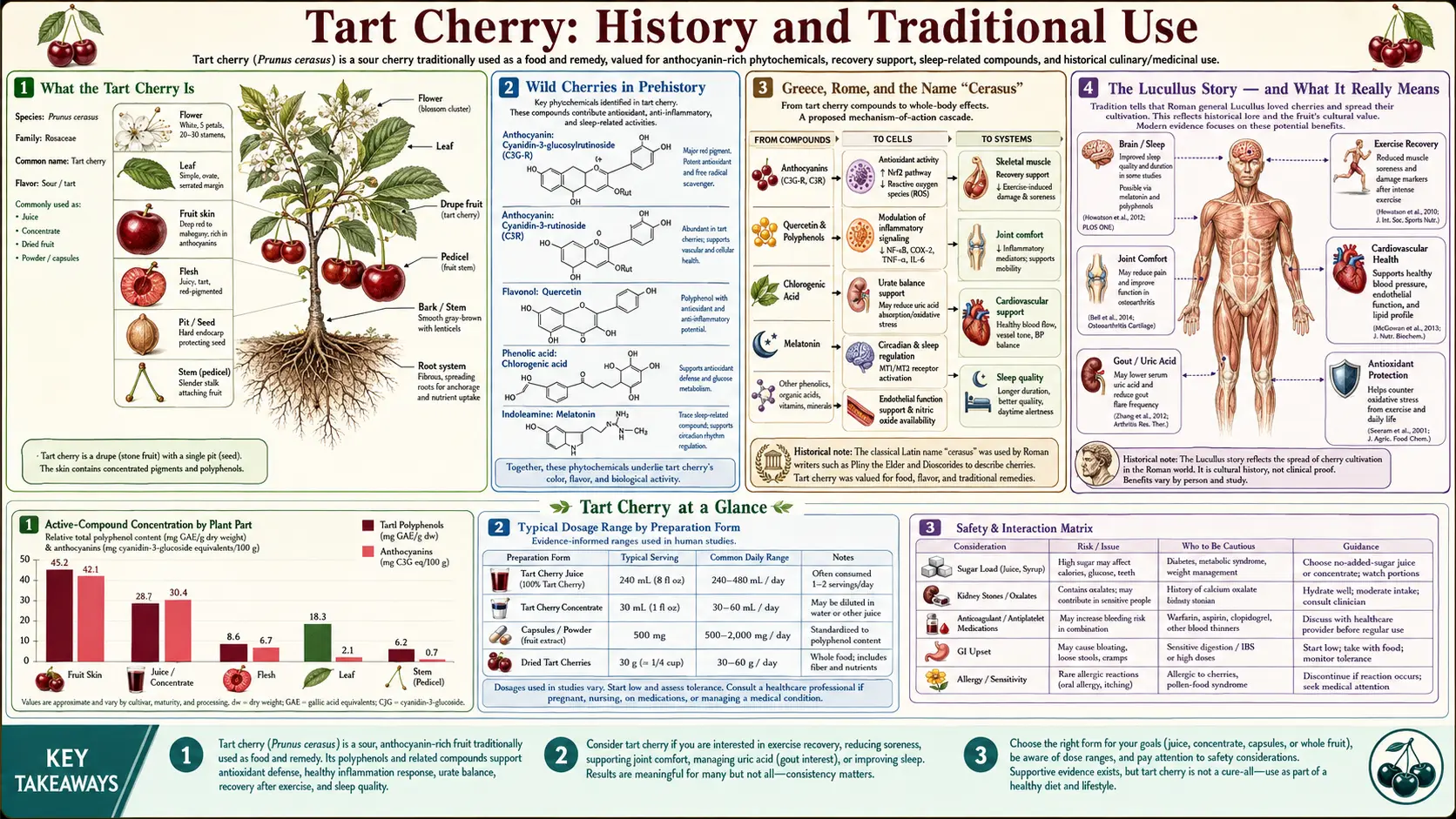
The tart or sour cherry (Prunus cerasus) has fed and treated people around the northern Mediterranean and across Europe for thousands of years. Wild cherries were gathered in prehistory; the Greeks and Romans wrote them into their farm manuals and natural histories; medieval and folk healers used the fruit, stems, and bark for fevers, coughs, and aching joints; and in the last few decades laboratory and clinical science has finally begun to explain why the old "cherries for rheumatism" remedy may have had something to it. This page tells that long story, marking tradition as tradition and naming real people only where the record genuinely supports it.
Table of Contents
- What the Tart Cherry Is
- Wild Cherries in Prehistory
- Greece, Rome, and the Name "Cerasus"
- The Lucullus Story — and What It Really Means
- Medieval and European Folk Medicine
- North America and the "Cherries for Rheumatism" Tradition
- Montmorency, Balaton, and the Rise of the Modern Crop
- From Tradition to Modern Science
- Research Papers and References
- Connections
- Featured Videos
What the Tart Cherry Is
The tart cherry, also called the sour cherry or (for the dark-fleshed kinds) the Morello cherry, is the small, bright, acidic fruit of Prunus cerasus, a deciduous tree in the rose family (Rosaceae). It is a different species from the sweet cherry, Prunus avium, the large dark fruit most people eat fresh out of hand. Botanists generally regard Prunus cerasus as an ancient natural hybrid — arising from a cross between the sweet cherry and the ground cherry, Prunus fruticosa — which is part of why its early history is harder to trace than that of the sweet cherry: the two were not always told apart in old texts, and their stones can be difficult to distinguish in the archaeological record.
This distinction matters for a history page because much of what makes tart cherry interesting today — its very high concentration of red anthocyanin pigments and its small but measurable melatonin content — belongs specifically to the sour species and its cultivars. Where the historical sources clearly mean the sour, cooking, or "tart" cherry, that is noted; where older writers simply say "cherry," this page says so too, rather than reading modern precision back into texts that did not have it.
Wild Cherries in Prehistory
Cherries are among the oldest fruits in the human diet. Archaeobotanists — researchers who study plant remains from excavations — routinely recover cherry stones from waterlogged sites such as old wells, ditches, latrines, and lake-edge settlements across Europe, where the wet, oxygen-poor ground preserves seeds for thousands of years. Wild cherry remains have been reported from Neolithic and Bronze Age contexts in several parts of Europe, showing that people gathered and ate the small wild fruits long before any written record.
An important honest caveat belongs here. Most of these very early finds are of wild cherries, and many cannot be confidently assigned to the sour species Prunus cerasus as opposed to the wild sweet cherry, Prunus avium, or other small wild Prunus. The domestication and spread of the large-fruited cherries is still an active research question, and scholars are careful not to over-claim. What the archaeological record does support is the broad, well-grounded statement that cherries in general have been gathered and eaten in Europe since prehistoric times — not a precise claim that the modern tart cherry as we know it was being cultivated in the Stone Age.
Greece, Rome, and the Name "Cerasus"
Cherries enter the written record in the classical Mediterranean. The Greek botanist Theophrastus, often called the "father of botany," described the cherry tree (using the Greek word kerasos) in his botanical works in the late fourth and early third centuries BCE, distinguishing several kinds. Roman agricultural writers followed: in the first century BCE the agronomist Varro, and a little later Columella in his farm manual De Re Rustica, treated the cherry as a familiar orchard tree and gave instructions for growing and grafting it. These authors are named here as historical primary sources rather than as modern citations.
The most influential classical account is that of Pliny the Elder, whose vast Natural History (completed around 77 CE) devotes a passage to the cherry. Pliny lists several named varieties grown in his day — including sweet, sour or "bitter," and firm-fleshed kinds — which shows that distinct tart and sweet cherries were already recognized in the Roman world. Pliny also records the everyday Roman uses of the fruit: eaten fresh, dried for keeping, and valued as a pleasant and mildly medicinal food.
The very word we use carries this history. Our English "cherry" descends, through French and Latin cerasus, from the Greek kerasos. That word is closely tied to the ancient Black Sea town the Greeks called Kerasous — modern Giresun in northeastern Turkey — a region long famous for its cherries. Scholars debate the direction of the borrowing (whether the fruit was named after the town or the town after the fruit), but the link between the cherry's name and that corner of Anatolia is genuine and old.
The Lucullus Story — and What It Really Means
One of the most widely repeated tales in any history of the cherry is that the Roman general and famous gourmet Lucullus brought the cherry tree to Italy from Pontus, on the southern Black Sea coast, after his victory over King Mithridates in the 70s BCE — carrying it back, by some accounts, in his triumphal procession. The story comes from Pliny's Natural History, and it is charming and frequently quoted.
Accuracy requires a clear caution: this popular origin story is disputed by modern historians and botanists. Cherry stones turn up in Italian archaeological deposits that predate Lucullus, and there is good evidence that cherries — at least wild ones, and probably some cultivated ones via the Etruscans and Greeks — were already known in Italy before his campaigns. The most careful modern reading is that Lucullus did not introduce the cherry to Italy from nothing, but more likely brought back a superior cultivated variety from the famous orchards around Cerasus, and that Pliny's memorable phrasing was later simplified into the tidy "Lucullus invented the cherry in Rome" legend. The genus name Cerasus (still used as a section within Prunus) and the town name preserve the real and undisputed connection to that Black Sea region; the dramatic "general who brought the first cherry to Rome" detail is best treated as tradition rather than established fact.
This page flags the Lucullus story precisely because it is so often presented as plain history when the evidence is more nuanced — a good reminder that a colorful origin tale and a documented fact are not the same thing.
Medieval and European Folk Medicine
After Rome, the cherry remained a common European orchard and dooryard tree, and it accumulated a steady body of folk-medical use. In the medieval and early-modern herbal tradition the fruit was eaten and the other parts of the plant were pressed into service: cherry stalks (the stems) were brewed as a mild diuretic tea for the kidneys and bladder, while the leaves and bark, being astringent, were used in washes and decoctions. These are traditional uses recorded in herbals and folk practice; they describe how people used the plant, not proven cures.
English herbalists of the seventeenth century mention the cherry in this vein. Nicholas Culpeper, in his widely-read herbal of 1652, noted culinary and medicinal uses of cherries and, in keeping with the astringent character of the tree, of the stems and bark; he and other writers of the period grouped such remedies for fevers, "hot" complaints, and urinary irritation. Culpeper is named here as a historical author within the astrological-botanical framework of his age, not as a modern medical authority. Across European folk medicine more broadly, sour cherries and their dried fruit were associated with cooling fevers, easing coughs, settling the stomach, and — the theme that would echo loudest later — soothing painful, inflamed joints.
The cherry-stalk diuretic deserves a special mention because it was unusually persistent: dried cherry stems (stipites cerasorum) were a recognized folk and pharmacy item in parts of Europe well into modern times, sold for brewing as a gentle "water" tea. As with all of these traditional preparations, the honest summary is that they were trusted, gentle, and popular, and that modern evidence for most of them remains limited.
North America and the "Cherries for Rheumatism" Tradition
European colonists carried cherry stones and seedlings to North America, where both sweet and sour cherries were planted in early orchards along the Atlantic seaboard and, later, throughout the Midwest. The sour cherry proved especially well suited to the cold winters and short summers of the northern states, and it became a staple pie and preserving fruit.
It is in nineteenth- and twentieth-century American folk practice that the single most famous traditional claim for tart cherry takes shape: the use of cherries and cherry juice for "rheumatism" — the broad old term covering gout, arthritis, and aching, inflamed joints. The folk remedy of eating cherries (or drinking their juice) to ease gout and joint pain was passed along by word of mouth and in home-remedy collections, and it is the direct ancestor of the modern interest in tart cherry for gout. Historically this is a folk tradition: a popular, widely shared belief rather than a documented scientific discovery, and this page presents it as such.
What is fair to say is that this old "cherries for gout" idea is unusual among folk remedies in that modern research has taken it seriously and partially supported it. A widely cited 2012 study led by Yuqing Zhang and colleagues, published in Arthritis & Rheumatism, followed gout patients and reported that cherry intake over a two-day window was associated with a markedly lower risk of a subsequent gout attack — the kind of finding that turned a kitchen-table tradition into a genuine research question. The traditional claim came first by more than a century; the science came later.
Montmorency, Balaton, and the Rise of the Modern Crop
Most modern research on tart cherry is done not on the fruit in general but on specific named cultivars, and a little history of these varieties explains why. By far the most studied is the Montmorency cherry, a light-red, clear-juice sour cherry whose name traces to the Montmorency region of France, where it has been grown for centuries; it became the dominant commercial sour cherry of North America. The United States tart-cherry crop is centered in Michigan — the Grand Traverse area near Lake Michigan is the heart of it — with significant production in Utah, Washington, New York, Wisconsin, and Oregon, and Montmorency makes up the great majority of that crop.
A second cultivar important to research is the Balaton cherry, a dark-fleshed, dark-juice Morello-type sour cherry of Hungarian origin (linked to the Lake Balaton region and to the variety known there as "Ujfehertoi furtos"). Balaton was introduced to United States growers through Michigan State University's horticulture program in the 1980s and 1990s as a richer-colored, higher-anthocyanin alternative to Montmorency. Because the two cultivars differ in their pigment content, researchers are careful to specify which one they studied — a level of precision that is itself a sign of how the tart cherry moved from generic folk fruit to defined research material.
The practical point for readers is simple: when a sleep, gout, or exercise-recovery study reports a benefit from "tart cherry," it almost always means a concentrate or product made from Montmorency or Balaton cherries, not just any cherry — and not the sweet supermarket cherry, whose anthocyanin and melatonin levels are far lower.
From Tradition to Modern Science
The modern scientific story of tart cherry began in earnest in the late 1990s at Michigan State University, in the heart of America's sour-cherry country. In 1999, Haibo Wang, Muraleedharan G. Nair, and their colleagues published a paper in the Journal of Natural Products reporting that anthocyanins and the pigment cyanidin isolated from tart cherries had measurable antioxidant and anti-inflammatory activity in the laboratory. That work, and the related research from the same group on the cherry pigments' ability to inhibit the cyclooxygenase (COX) enzymes — the same enzymes targeted by common anti-inflammatory drugs — gave the first concrete chemical reason why the old "cherries for inflammation" tradition might not be mere folklore.
Two further strands of research built tart cherry's modern reputation. In sports science, a 2010 trial by Glyn Howatson and colleagues found that Montmorency tart cherry juice helped marathon runners recover muscle strength faster, kindling a large literature on tart cherry for exercise recovery. And in sleep science, a 2012 study by Howatson's group showed that tart cherry juice concentrate raised participants' melatonin levels and modestly improved sleep — consistent with the discovery that tart cherries are one of the few foods to contain measurable amounts of melatonin, the body's sleep-timing hormone. The gout research of Zhang and colleagues, described above, completed the picture by connecting back to the oldest folk use of all.
The arc of this history is worth pausing on. A wild fruit gathered in prehistory, named for a Black Sea town, written about by Theophrastus and Pliny, brewed and poulticed through the medieval and folk centuries, and trusted in American kitchens "for the rheumatism," has in the last few decades been handed to chemists and clinicians — who found real pigments, real enzyme effects, and real (if modest) clinical benefits behind some of the tradition. The detailed evidence for each application is covered in the companion Tart Cherry Benefits deep-dive articles. Tradition raised the questions; modern research is still working through the answers, and the honest verdict is one of cautious, partial confirmation rather than miracle cure.
Research Papers and References
The list below pairs the key peer-reviewed studies that turned tart cherry's traditional reputation into a research subject with curated PubMed topic-search links into the broader literature. Historical primary texts (Theophrastus's botanical works, the Roman farm manuals of Varro and Columella, Pliny's Natural History, and Culpeper's herbal) are named in the article as historical sources rather than as modern citations. Links open in a new tab at the publisher, PubMed, or NCCIH.
- Wang H, Nair MG, Strasburg GM, Chang YC, Booren AM, Gray JI, DeWitt DL. Antioxidant and antiinflammatory activities of anthocyanins and their aglycon, cyanidin, from tart cherries. Journal of Natural Products. 1999;62(2):294-296. — PMID: 10075763; doi:10.1021/np980501m
- Zhang Y, Neogi T, Chen C, Chaisson C, Hunter DJ, Choi HK. Cherry consumption and decreased risk of recurrent gout attacks. Arthritis & Rheumatism. 2012;64(12):4004-4011. — PMID: 23023818; doi:10.1002/art.34677
- Howatson G, McHugh MP, Hill JA, Brouner J, Jewell AP, van Someren KA, Shave RE, Howatson SA. Influence of tart cherry juice on indices of recovery following marathon running. Scandinavian Journal of Medicine & Science in Sports. 2010;20(6):843-852. — Search PubMed; doi:10.1111/j.1600-0838.2009.01005.x
- Howatson G, Bell PG, Tallent J, Middleton B, McHugh MP, Ellis J. Effect of tart cherry juice (Prunus cerasus) on melatonin levels and enhanced sleep quality. European Journal of Nutrition. 2012;51(8):909-916. — PMID: 22038497; doi:10.1007/s00394-011-0263-7
- Cherry (Prunus cerasus) ethnobotany, folk medicine, and history PubMed: Prunus cerasus ethnobotany and traditional use
- Tart cherry, gout, and uric acid — the modern follow-up to the old folk remedy PubMed: tart cherry gout and uric acid
External Authoritative Resources
- NCCIH — Herbs at a Glance
- MedlinePlus — Herbs and Supplements
- PubMed — All research on Prunus cerasus
Connections
- All Herbs
- Tart Cherry Hub
- Tart Cherry Benefits Deep Dive
- Elderberry
- Turmeric
- Willow Bark
- Ginger
- Hawthorn
- Cherries — the cherry as everyday food, including the sweet species that older writers rarely distinguished from the sour one.