Rosemary — Benefits Deep Dive
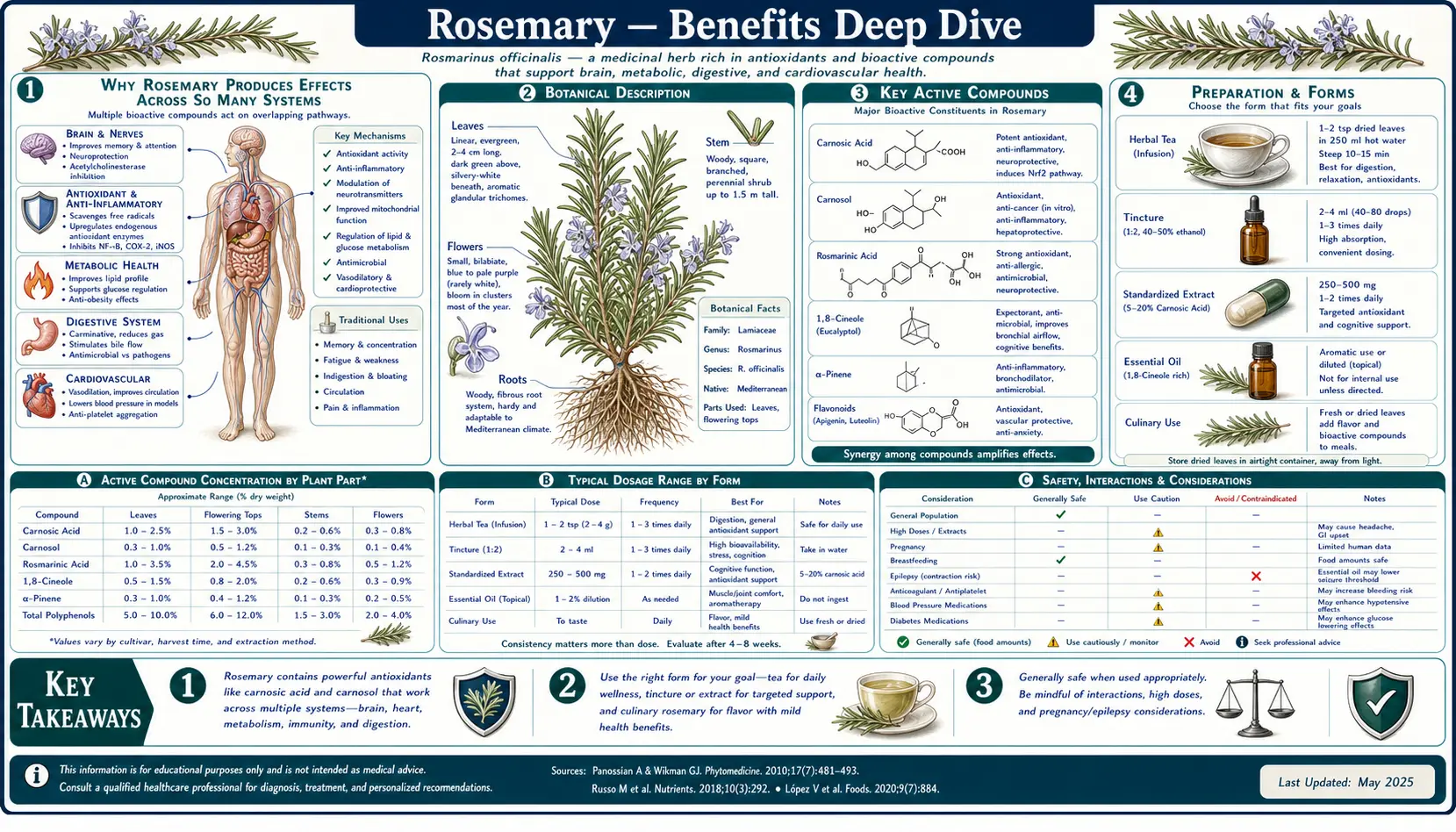
Rosemary (Rosmarinus officinalis, recently reclassified as Salvia rosmarinus) is the Mediterranean evergreen shrub of "remembrance" — immortalized by Ophelia's line "There's rosemary, that's for remembrance" in Hamlet, used in classical Greek and Roman funerary rites, and burned in medieval European sickrooms as an antiseptic fumigant. Its modern scientific profile is built on four extensively studied actives: carnosic acid and carnosol (the principal phenolic diterpenes, potent Nrf2 activators and antioxidants), rosmarinic acid (a polyphenolic ester with strong free-radical scavenging activity), and 1,8-cineole (the volatile monoterpene that gives rosemary its aroma and crosses the blood-brain barrier after inhalation). Rosemary uniquely combines three delivery modes — culinary (the dried leaf in cooking and the carnosic-acid extract as an EU-approved food preservative), aromatherapy (inhaled essential oil for cognitive performance), and topical (essential oil for androgenetic alopecia, with one well-publicized trial showing efficacy comparable to 2% minoxidil). Four benefit pages below explore the conditions where rosemary produces the largest measurable effect.
Deep-Dive Articles
Cognitive Function & Memory
The Moss 2003 and 2018 Northumbria University trials — healthy adults exposed to rosemary essential oil aroma in an enclosed cubicle showed 60-75% improvements in prospective memory recall versus unscented controls. 1,8-cineole is the active inhaled monoterpene, crosses the blood-brain barrier, and inhibits acetylcholinesterase. The Shakespearean "rosemary for remembrance" tradition, the modern cholinergic mechanism, and the practical aromatherapy protocols.
Antioxidant & Anti-Aging
Carnosic acid and carnosol are the principal phenolic diterpenes responsible for rosemary's antioxidant power — among the highest ORAC values of any culinary herb. Mechanism is Nrf2 pathway activation, upregulating endogenous glutathione, superoxide dismutase, and catalase. EU-approved rosemary extract (E392) extends the shelf life of meat, oil, and processed food by inhibiting lipid peroxidation, and the same chemistry underlies the cellular anti-aging effects.
Hair Loss (Androgenetic Alopecia)
The Panahi 2015 SKINmed trial randomized 100 men with androgenetic alopecia to topical rosemary oil or 2% minoxidil, twice daily, for 6 months — both groups showed comparable hair regrowth, with the rosemary group reporting less scalp itching. Mechanism is 5-alpha-reductase inhibition (preventing testosterone-to-DHT conversion) and improved scalp microcirculation. Practical topical AGA protocol, dilution rules, and the carrier-oil considerations.
Digestive & Liver
Traditional carminative (gas-relieving) and cholagogue (bile-stimulating) effects formally recognized by the German Commission E for dyspeptic complaints. The rat hepatoprotective literature (carnosol and rosmarinic acid reducing CCl4-, paracetamol-, and ethanol-induced liver injury), COX-1/COX-2 inhibition contributing to anti-inflammatory action in the gut, and the cautions around rosemary essential oil being too potent for oral use.
Table of Contents
- Deep-Dive Articles
- Why Rosemary Produces Effects Across So Many Systems
- Key Research Papers
- External Authoritative Resources
- Connections
- Featured Videos
Why Rosemary Produces Effects Across So Many Systems
Most culinary herbs operate through one or two principal mechanisms. Rosemary is unusual in that four chemically distinct actives, present in significant concentrations in the same dried leaf or extract, each drive a different category of biological effect. The four mechanisms together explain why a single plant can plausibly support cognition, antioxidant defense, hair regrowth, and digestive function — and why no single isolated compound captures the whole-herb effect.
- Carnosic acid — Nrf2 pathway activation — carnosic acid is an electrophilic diterpene that covalently modifies cysteine residues on KEAP1, the cytoplasmic anchor protein that normally targets the transcription factor Nrf2 for proteasomal degradation. Modification of KEAP1 releases Nrf2 to translocate into the nucleus, where it binds antioxidant response elements (AREs) in the promoters of approximately 200 cytoprotective genes — glutathione synthesis enzymes, superoxide dismutase, catalase, heme oxygenase-1, and NAD(P)H quinone oxidoreductase 1. This is the master mechanism behind rosemary's antioxidant and anti-aging effects and contributes to hepatoprotection.
- 1,8-Cineole — acetylcholinesterase inhibition — the volatile monoterpene that gives rosemary essential oil its characteristic camphoraceous aroma is small, lipophilic, and crosses the blood-brain barrier after inhalation or oral exposure. Once in the CNS, 1,8-cineole acts as a reversible acetylcholinesterase inhibitor — the same enzyme target as donepezil (Aricept) for Alzheimer's disease, although with much lower potency. This is the molecular basis for the Moss aromatherapy cognitive studies at Northumbria University.
- Rosmarinic acid — direct antioxidant and anti-inflammatory — the dominant water-soluble polyphenolic ester in rosemary (also found in lemon balm, sage, and many Lamiaceae herbs). Rosmarinic acid is a potent direct scavenger of peroxyl radicals, peroxynitrite, and singlet oxygen, and also inhibits inflammatory transcription factors NF-kappaB and AP-1. It contributes to the antioxidant effect through a different pathway than the Nrf2-mediated carnosic acid effect, and to the anti-inflammatory and hepatoprotective effects.
- 5-Alpha-reductase inhibition — the hair-loss mechanism — multiple compounds in rosemary extract (carnosol prominently, plus 12-O-methyl carnosic acid and ursolic acid) inhibit the 5-alpha-reductase enzyme that converts testosterone to dihydrotestosterone (DHT). DHT is the androgen responsible for the miniaturization of scalp hair follicles in androgenetic alopecia. This shared mechanism with finasteride and the systemic anti-androgens is what underlies the Panahi 2015 trial showing topical rosemary oil non-inferior to 2% minoxidil at 6 months.
A practical consequence of this multi-mechanism profile is that delivery mode matters. The cognitive and memory effects depend on inhalation of the volatile 1,8-cineole — cooking with dried rosemary leaf or taking a capsule of rosemary extract orally does not deliver enough vapor to the airways to reach therapeutic concentrations in CSF. Conversely, the antioxidant and hepatoprotective effects depend on systemic absorption of carnosic acid, carnosol, and rosmarinic acid — aromatherapy alone will not produce them. The hair-loss application is purely topical and requires sustained scalp contact with diluted essential oil. The four benefit pages explore each delivery mode in detail.
Key Research Papers
- Moss M, Cook J, Wesnes K, Duckett P (2003). Aromas of rosemary and lavender essential oils differentially affect cognition and mood in healthy adults. International Journal of Neuroscience. — PubMed
- Moss M, Oliver L (2012). Plasma 1,8-cineole correlates with cognitive performance following exposure to rosemary essential oil aroma. Therapeutic Advances in Psychopharmacology. — PubMed
- Panahi Y, Taghizadeh M, Marzony ET, Sahebkar A (2015). Rosemary oil vs minoxidil 2% for the treatment of androgenetic alopecia: a randomized comparative trial. SKINmed. — PubMed
- Satoh T, Kosaka K, Itoh K, Kobayashi A, Yamamoto M et al. (2008). Carnosic acid, a catechol-type electrophilic compound, protects neurons both in vitro and in vivo through activation of the Keap1/Nrf2 pathway via S-alkylation of targeted cysteines on Keap1. Journal of Neurochemistry. — PubMed
- Murata K, Noguchi K, Kondo M, Onishi M, Watanabe N et al. (2013). Promotion of hair growth by Rosmarinus officinalis leaf extract. Phytotherapy Research. — PubMed
External Authoritative Resources
- European Medicines Agency — Rosmarini aetheroleum (Rosemary oil) monograph — the EU regulatory summary of approved traditional uses, contraindications, and quality standards for rosemary essential oil.
- European Medicines Agency — Rosmarini folium (Rosemary leaf) monograph — the parallel monograph for the dried leaf preparation.
- NIH NCCIH — Herbs at a Glance — the National Center for Complementary and Integrative Health quick-reference summaries.
- MedlinePlus — Rosemary — consumer health summary including drug interactions and safety information.
- PubMed — All research on Rosmarinus officinalis / Salvia rosmarinus (over 3,000 papers indexed).
Connections
- All Herbs
- Rosemary (Main Page)
- Rosemary for Cognitive Function & Memory
- Rosemary for Antioxidant & Anti-Aging
- Rosemary for Hair Loss
- Rosemary for Digestive & Liver
- Sage (Lamiaceae cousin)
- Thyme
- Lemon Balm (Rosmarinic Acid)
- Bacopa Monnieri (Cognitive)
- Oregano
- Alzheimer's Disease
- Hair Loss
- Alopecia
- Oxidative Stress
- Glutathione