Pau d'Arco — Benefits Deep Dive
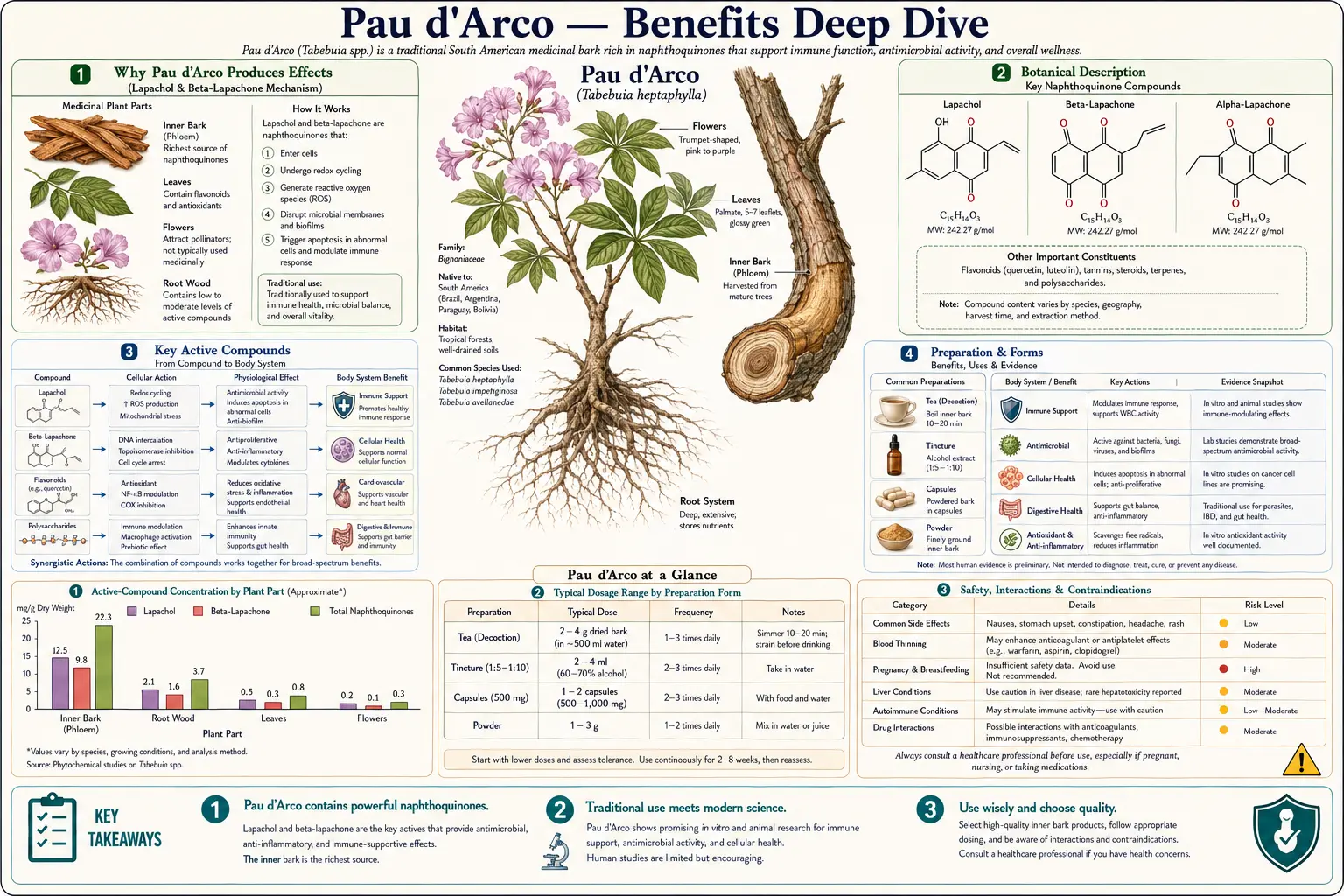
Pau d'Arco — the inner bark of Tabebuia impetiginosa (now reclassified as Handroanthus impetiginosus) — is the South American "lapacho" or "ipê-roxo," the famed "miracle tree" of Brazilian and Argentinian folk medicine. The Guaraní, Kallawaya, and other Amazonian peoples have used its inner-bark decoctions for centuries as a "blood purifier" and broad-spectrum remedy for fungal infection, fever, wounds, dysentery, and chronic inflammation. The principal medicinal compounds are two naphthoquinones — lapachol and the more potent beta-lapachone — which generate intracellular reactive oxygen species, inhibit DNA topoisomerase I and II, suppress NF-κB-driven inflammation, and exert direct activity against Candida albicans and other dermatophytes. Four deep-dive pages below cover the four areas where the modern literature is strongest: antifungal action, immune modulation, anti-inflammatory mechanisms, and the cautions / cancer-research story that explains why Pau d'Arco has been treated with both reverence and serious concern by the National Cancer Institute since the 1970s.
Deep-Dive Articles
Antifungal
Lapachol and beta-lapachone naphthoquinone activity against Candida albicans, Aspergillus, Trichophyton, and other dermatophytes. Traditional Brazilian Indigenous use for skin yeast and "white tongue," topical bark decoctions for ringworm and athlete's foot, and the modern role of standardized Pau d'Arco extracts in "candida diet" anti-fungal supplement protocols (alongside caprylic acid, undecylenic acid, and oregano oil). Mechanism: redox cycling generates intracellular superoxide that fungi cannot detoxify as efficiently as mammalian cells.
Immune Modulation
Quinone-driven immunomodulation, natural killer (NK) cell activation, macrophage stimulation, and the traditional South American rainforest indication of "blood purification" (depurative). How the same redox-cycling that kills fungi also activates innate immune cells at lower doses, the cytokine profile shift documented in murine and in-vitro studies, and the role of Pau d'Arco in traditional Kallawaya and Guaraní medicine for fevers, wound healing, and recurrent infection.
Anti-Inflammatory
Beta-lapachone inhibition of NF-κB nuclear translocation, suppression of pro-inflammatory cytokines (TNF-α, IL-6, IL-1β), COX inhibition, and the traditional Brazilian use of Pau d'Arco tea for joint pain and arthritis. Mechanistic overlap with curcumin and boswellia at the NF-κB node, with discussion of why the anti-inflammatory dose is generally lower than the antimicrobial dose.
Cautions & Cancer Research
The full story of the National Cancer Institute Phase I lapachol trials in the 1970s — terminated due to dose-limiting prothrombin prolongation and gastrointestinal toxicity at the doses needed for antitumor effect. Modern synthetic beta-lapachone derivatives (ARQ-501, ARQ-761) in oncology Phase I/II trials. Critical safety warnings: the anticoagulant interaction (beta-lapachone is a vitamin K antagonist functional analog), high-dose hepatotoxicity, hemolytic anemia in G6PD deficiency, and the absolute contraindication in pregnancy due to teratogenic potential.
Table of Contents
- Deep-Dive Articles
- Why Pau d'Arco Produces Effects (Lapachol & Beta-Lapachone Mechanism)
- Research Papers
- External Authoritative Resources
- Connections
- Featured Videos
Why Pau d'Arco Produces Effects (Lapachol & Beta-Lapachone Mechanism)
The diverse clinical profile of Pau d'Arco — antifungal, immune-stimulating, anti-inflammatory, and historically antitumor — can be traced to a single molecular feature shared by its two principal naphthoquinones, lapachol (2-hydroxy-3-(3-methyl-2-butenyl)-1,4-naphthoquinone) and beta-lapachone (the cyclized ortho-naphthoquinone). Both molecules are redox-active quinones that undergo one-electron reduction inside cells to form unstable semiquinone radicals, which then react with molecular oxygen to regenerate the parent quinone and release a superoxide anion. This catalytic cycle, called redox cycling, deposits reactive oxygen species (ROS) inside the cell at a rate that often overwhelms the antioxidant defenses of fungi, parasites, and rapidly dividing tumor cells — while mammalian cells with intact glutathione, superoxide dismutase, and catalase systems tolerate the stress at lower doses.
- Redox cycling & reactive oxygen species (ROS) — the unifying mechanism. The semiquinone-quinone-superoxide loop is catalyzed in fungal cells by NAD(P)H:quinone oxidoreductase 1 (NQO1) and similar flavin reductases, producing intracellular oxidative stress that fungi and parasites are unusually sensitive to. This drives the antifungal activity against Candida albicans, Aspergillus, and dermatophytes.
- DNA topoisomerase I and II inhibition — beta-lapachone in particular is a topoisomerase poison, stabilizing the cleavable DNA-enzyme intermediate and producing DNA double-strand breaks. This mechanism overlaps with the camptothecin (topo I) and etoposide (topo II) drug classes and is the rationale for the synthetic derivative ARQ-501 (beta-lapachone) entering NCI-sponsored oncology Phase I trials — covered in detail on the Cautions & Cancer Research page.
- NF-κB nuclear translocation inhibition — at sub-cytotoxic concentrations, beta-lapachone blocks the IκB-kinase complex and prevents NF-κB p65 from translocating to the nucleus, suppressing transcription of TNF-α, IL-6, IL-1β, COX-2, and iNOS. This is the molecular basis for the anti-inflammatory effect and overlaps with the mechanism of curcumin, boswellic acids, and resveratrol.
- Innate immune activation — at intermediate doses, the same redox stress in macrophages and dendritic cells stimulates a measurable activation phenotype (upregulated MHC-II, increased phagocytic activity, NK cell cytotoxicity) without producing cell death. This biphasic dose-response is the molecular basis for the traditional "blood purifier" indication and the modern immune-modulating dosing range.
The therapeutic complication is that the same redox-cycling mechanism that drives all of these benefits also drives toxicity at higher doses. Lapachol at the doses required for measurable antitumor activity in the NCI Phase I trials (1.5-3.5 g/day orally) produced clinically significant prothrombin prolongation — beta-lapachone and lapachol are functional vitamin K antagonists, structurally similar to warfarin's 4-hydroxycoumarin pharmacophore. This is the basis for the absolute contraindication with warfarin, heparin, apixaban, rivaroxaban, and other anticoagulants, and the strong recommendation to discontinue Pau d'Arco at least 2 weeks before any planned surgery. The fourth deep-dive page covers the full caution profile and the NCI cancer-trial history — essential reading before any practical use of standardized Pau d'Arco extracts.
Research Papers
- de Almeida ER et al. (1990). Antiinflammatory action of lapachol. Journal of Ethnopharmacology. — PubMed
- Hartwell JL (1982). Plants Used Against Cancer (compilation including Tabebuia ethnobotany). — PubMed
- Block JB, Serpick AA, Miller W, Wiernik PH (1974). Early clinical studies with lapachol (NSC-11905). Cancer Chemotherapy Reports. — PubMed
- Pardee AB et al. (2002). Cancer therapy with beta-lapachone. Current Cancer Drug Targets. — PubMed
- Park HJ et al. (2005). beta-Lapachone inhibits NF-kappaB activation. Journal of Pharmacology. — PubMed
External Authoritative Resources
- NCI — Complementary & Alternative Medicine (background on the NCI lapachol Phase I program)
- NCCIH — Herbs at a Glance (NIH National Center for Complementary and Integrative Health)
- MedlinePlus — Pau d'Arco (interactions, dosing cautions)
- Memorial Sloan Kettering — About Herbs: Pau d'Arco (oncology-focused clinical summary)
- PubMed — All research on Tabebuia impetiginosa / lapachol / beta-lapachone
Connections
- All Herbs
- Pau d'Arco (Main Page)
- Pau d'Arco — Antifungal
- Pau d'Arco — Immune Modulation
- Pau d'Arco — Anti-Inflammatory
- Pau d'Arco — Cautions & Cancer Research
- Oregano
- Neem
- Goldenseal
- Cat's Claw
- Olive Leaf
- Echinacea
- Fungal Infections
- Cancer
- Immune Boosting
- Oxidative Stress