Pau d'Arco: History and Traditional Use
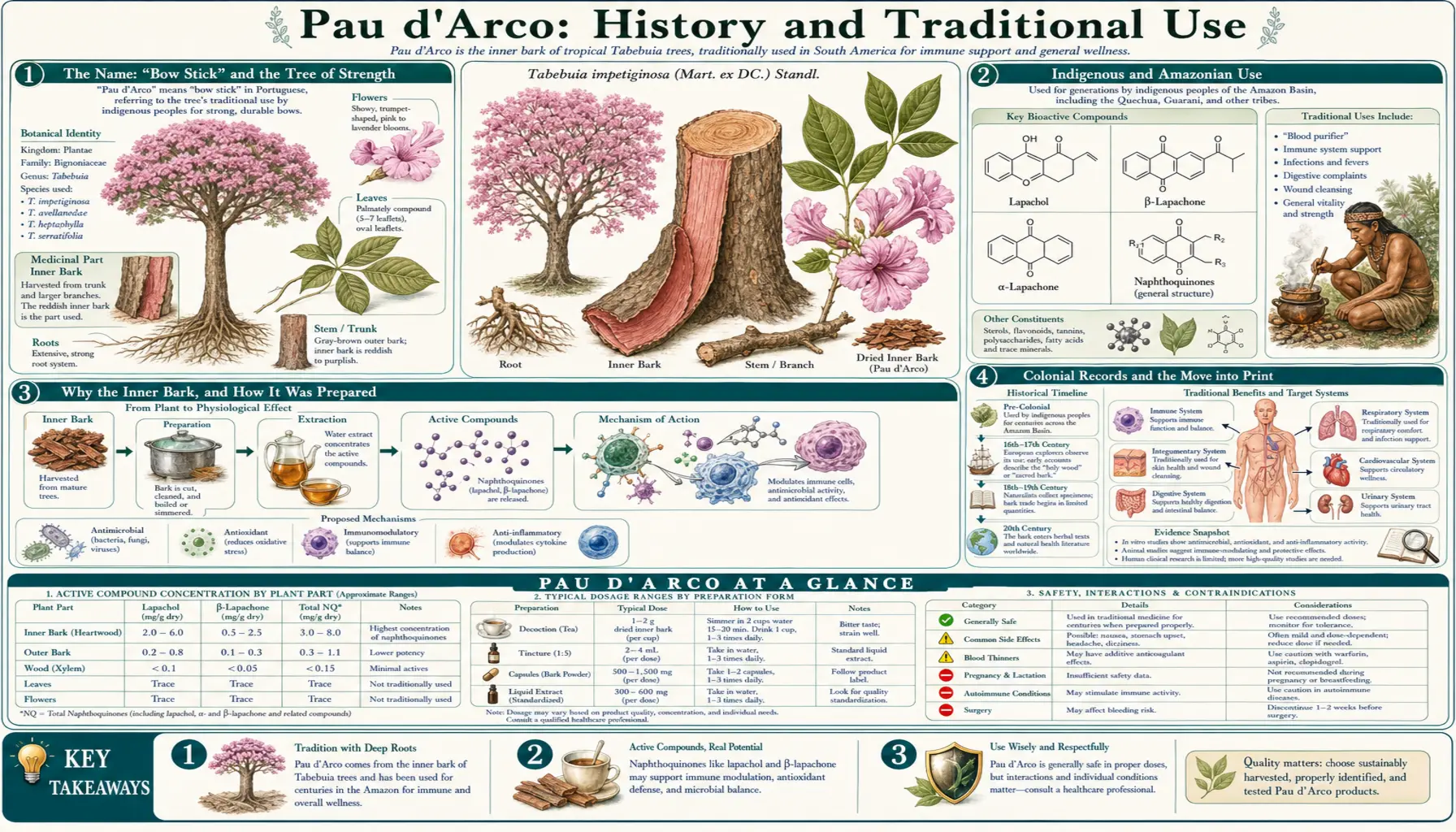
Pau d'Arco is the inner bark of large flowering hardwood trees of the genus Handroanthus (long classified as Tabebuia), native to the tropical forests of Central and South America. Its story is mostly an indigenous and folk-medicine story: for centuries Amazonian peoples brewed the reddish inner bark into a decoction, and the Portuguese name itself — "bow stick" — records the tree's older use as bow wood. Much of what is said about Pau d'Arco is tradition rather than proven fact, and this page is careful to mark which is which. The one firmly documented scientific thread is the bark's main compound, lapachol, first isolated in 1882 and later studied (and ultimately set aside) as a cancer drug. Everything below is presented as history and folklore, not as medical advice.
Table of Contents
- The Name: "Bow Stick" and the Tree of Strength
- Indigenous and Amazonian Use
- Why the Inner Bark, and How It Was Prepared
- Colonial Records and the Move into Print
- The 1960s Brazilian Revival
- Lapachol: A Documented Scientific Milestone
- The National Cancer Institute Trials
- Many Names, Modern Folklore, and Honest Limits
- References
- Connections
- Featured Videos
The Name: "Bow Stick" and the Tree of Strength
The most reliable thing we can say about Pau d'Arco begins with its name. Pau d'arco is Portuguese and translates literally as "bow stick" or "bow wood." The tree is one of the densest, hardest, most rot-resistant timbers in the Americas, and several South American peoples are documented to have used its wood to make hunting bows — the use that gave the tree its enduring common name. So before it was ever a famous "medicinal tea," Pau d'Arco was, quite simply, the wood you reached for when you needed a bow that would not break.
Among the Guaraní and Tupí peoples of what is now Brazil and Paraguay, the tree carried a name commonly rendered as tajy, traditionally translated as something close to "to have strength and vigor." Folk tradition links that name both to the unbreakable wood and to the tree itself, which is a striking sight: a tall canopy hardwood that erupts into masses of pink-to-purple trumpet flowers. It is easy to see why a tree that strong and that beautiful accumulated a reputation that went well beyond carpentry.
It is worth being clear that "strength and vigor" is a traditional association, not a medical claim. What the name reliably tells us is historical, not pharmacological: this was a prized, tough, useful tree that the people living alongside it knew intimately. That intimate, everyday familiarity — the same pattern seen with many of the world's great folk medicines — is the soil out of which the herbal tradition grew.
Indigenous and Amazonian Use
The heart of Pau d'Arco's history is its use as a folk remedy across tropical South and Central America. Drawing on the ethnopharmacological literature — most usefully the 2009 review by Gómez Castellanos, Prieto, and Heinrich in the Journal of Ethnopharmacology — the traditional picture is reasonably well documented: the inner bark was prepared as a decoction and taken for a long list of complaints, including bacterial and fungal infections, fever, syphilis, malaria, trypanosomiasis (the parasitic disease later named Chagas disease), and stomach and bladder disorders. Rainforest peoples across a wide area used it for malaria, anemia, colds, cough, flu, fungal infections, arthritic pain, snakebite, and skin problems.
One of the most historically interesting features is convergence: communities living far apart, in different language groups, are recorded using the same bark for a broadly similar set of problems. Ethnobotanists treat that kind of independent agreement as a meaningful signal that a plant was genuinely valued, even when the underlying biology was unknown to the people using it. The Guaraní and Tupí are the most frequently named peoples in the documented record, using the bark "for many different conditions and as a tonic."
A note of honest caution is needed here, because pages like this are read by real people. You will often see Pau d'Arco described as an ancient "Inca" medicine or the sacred remedy of named Andean healers. Some sources suggest its use may even predate the Inca, but specific, firmly dated attributions to particular pre-Columbian empires or individual named healers are hard to verify and are best treated as tradition and reasonable inference rather than established fact. What is well supported is the broad pattern: a long-standing, widespread indigenous use of the inner-bark decoction across tropical South America.
Why the Inner Bark, and How It Was Prepared
Traditional practice is unusually specific about which part of the tree to use, and that specificity has held up well. The medicine is the inner bark — the reddish-brown layer between the rough outer bark and the wood, called entrecasca in Portuguese. Folk knowledge held that this layer was where the strength of the remedy lay, and modern chemistry agrees: the inner bark is far richer in the active naphthoquinone compounds than the outer bark or the wood. It is a small but telling example of traditional users arriving, by observation alone, at the part of the plant a chemist would later choose.
The traditional preparation is a decoction — the bark is simmered in water rather than merely steeped — and that detail also turns out to be sound. The bark's key compounds are not very water-soluble, so a quick steep like an ordinary tea bag extracts comparatively little of them; prolonged simmering pulls more of the active material into the brew. Whether or not early users understood the chemistry, the method they settled on (long boiling of the inner bark) is the method that actually works to release the compounds. The finished decoction is reddish-brown, woody, and faintly bitter.
This is also a good place for a standing caution that belongs in any honest history. The traditional uses described on this page are historical and cultural records, not treatment recommendations, and Pau d'Arco is not a benign "drink as much as you like" herb — it has real interactions and contraindications. For the practical side — modern preparation, dosing, forms, and especially safety — see the companion Pau d'Arco hub and the Benefits articles, which cover cautions in detail.
Colonial Records and the Move into Print
As European colonists, missionaries, and naturalists moved through Brazil and the surrounding regions, indigenous plant medicines began to be written down, and Pau d'Arco entered the documentary record. The herb became a familiar part of Brazilian folk medicine, used widely for fevers, infections, digestive complaints, and skin conditions, and the bark was traded under the local names that still follow it today.
The transition from oral tradition to written, "biomedical" mention can be dated with some confidence. The Gómez Castellanos review notes that biomedical uses of red lapacho were reported as early as 1873 — an important marker, because it shows the bark was being discussed in a recognizably medical (not merely folkloric) context in the nineteenth century, decades before its mid-twentieth-century fame. From there the herb settled into the background of South American popular medicine: well known, widely used, but not yet an international phenomenon.
It is worth resisting the temptation to over-dramatize this period. There is no single discoverer, no founding physician, and no dramatic "rediscovery" to point to in the 1800s — just the slow, ordinary process by which a regional folk remedy gets catalogued. The drama, such as it is, came later, in the 1960s.
The 1960s Brazilian Revival
Pau d'Arco's leap from regional folk remedy to internationally sought-after "miracle bark" can be traced to a specific, well-documented moment. As the 2009 review puts it plainly, "in 1967, after reports in the Brazilian press, it came back to the light of clinicians and the public in general." A regional medicine suddenly became national news.
The figure most associated with this revival is Dr. Walter Accorsi, connected with the Municipal Hospital of Santo André in São Paulo, whose observations about Pau d'Arco (often under the name ipê roxo) were reported in the Brazilian magazine O Cruzeiro in 1967. According to the accounts that circulated, he reported that the bark preparation eased pain in seriously ill patients and seemed to raise their red-blood-cell counts. The story spread quickly, and demand for the bark surged across Brazil and, soon after, abroad.
Here honesty matters more than at any other point in this history. The 1967 reports were uncontrolled clinical observations relayed through a popular magazine, not a controlled clinical trial, and they fueled extravagant claims — especially around cancer and leukemia — that the evidence has never borne out. The historically accurate statement is narrow and important: a 1967 press account turned Pau d'Arco into a celebrated remedy and launched a global market for the bark. That is a fact about publicity and popular demand. It is not, and should not be read as, evidence that the bark cures cancer; it does not, and anyone facing a serious illness should rely on their medical team.
Lapachol: A Documented Scientific Milestone
Running alongside the folk history is a parallel, and much more firmly documented, scientific history — the story of the bark's signature compound, lapachol. This is where it is appropriate to name real people, because these are genuine, verifiable laboratory milestones rather than folklore.
Lapachol was first isolated in 1882 by the Italian chemist Emanuele Paternò, working with bark of a Tabebuia species (Bignoniaceae family). Its chemical structure was worked out in 1896 by Samuel Cox Hooker, who identified it as a 1,4-naphthoquinone — specifically 2-hydroxy-3-(3-methyl-2-butenyl)-1,4-naphthoquinone. With those two steps, a folk remedy gained a named, characterized active molecule, and Pau d'Arco crossed from pure tradition into chemistry. Related compounds, including alpha-lapachone and beta-lapachone, were identified in the same family of naphthoquinones.
This matters for the history because it changed the questions people could ask. Once you can name and purify a compound, you can test it, measure it, and ask whether the old traditional uses have any chemical basis. The naphthoquinones in the inner bark are also, tellingly, part of why the wood resists fungal rot so well — a structural-defense chemistry that traditional users intuited as "strength" long before anyone could draw the molecule.
The National Cancer Institute Trials
The single most consequential chapter in Pau d'Arco's scientific history is the rise and fall of lapachol as a candidate anticancer drug — a cautionary tale that the herb's enthusiasts often leave out.
Interest accelerated after a 1968 paper in the journal Cancer Research by K. V. Rao, T. J. McBride, and J. J. Oleson, titled "Recognition and Evaluation of Lapachol as an Antitumor Agent," which reported that lapachol showed significant activity against the Walker 256 tumor in rodent models, with the best results from oral dosing. On the strength of such findings, the United States National Cancer Institute (NCI) advanced lapachol into human clinical trials in the 1970s.
The trials did not succeed. By 1974 the program was discontinued: the blood levels of lapachol needed for a reliable anticancer effect could not be reached without serious toxicity, and a particular problem was that lapachol acts as a vitamin K antagonist — that is, it interferes with normal blood clotting, raising the risk of bleeding. The therapeutic window was simply too narrow. This is the documented origin of the well-known warning that Pau d'Arco can thin the blood and must be kept away from anticoagulant medications and from surgery.
The honest summary of this episode is twofold. First, it is genuinely interesting science: a folk remedy yielded a compound serious enough for national-level cancer trials. Second, and more importantly, those trials ended in failure on safety grounds. Modern laboratory work continues on lapachol and especially beta-lapachone and their synthetic derivatives, but that is early research, not a treatment — and the doses in any cup of Pau d'Arco tea are far below what was studied. Pau d'Arco is not a proven cancer therapy, and this part of its history is best read as a warning to respect the bark, not as a reason to trust folk cancer claims.
Many Names, Modern Folklore, and Honest Limits
Like most widely traded folk medicines, Pau d'Arco collected a thicket of names as it moved between languages and markets. The same bark is sold as lapacho (Spanish, from much of South America), ipê roxo or pau d'arco roxo ("purple ipê," Brazilian Portuguese, after the flower color), and taheebo, a name that became especially common in the North American and Japanese health-food markets that took off after the 1960s publicity. The botanical name has shifted too: the medicinal trees were long catalogued under Tabebuia (you will still see Tabebuia impetiginosa and Tabebuia avellanedae in older and many newer sources), and have more recently been reclassified into the genus Handroanthus. The older names persist in the literature, which is why this site lists them side by side.
The modern "folklore" of Pau d'Arco is largely a twentieth-century commercial creation built on the back of the 1967 story: the marketing language of a "miracle tea," a cure-all "tree of life," and a sweeping anti-cancer remedy. A responsible history has to separate that recent sales mythology from the genuine, older tradition. The genuine tradition is real and worth respecting — an inner-bark decoction used across tropical South America for infections, fevers, and skin and digestive complaints. The cure-all mythology is not supported by evidence and has, at times, drawn people away from effective care.
So the through-line of Pau d'Arco's history is a balance. On one side: a tough, beautiful tree; an inner-bark remedy with deep and genuinely cross-cultural roots; and a real chemical compound, lapachol, with a documented place in the history of cancer-drug research. On the other side: a wave of mid-century publicity and marketing that promised far more than the bark can deliver. Knowing both halves — the honest tradition and the honest limits — is the most useful thing the history of Pau d'Arco has to offer.
References
The references below are the verifiable sources behind the historical and scientific claims on this page. Author names, titles, and journals are given as plain text; only stable identifiers (DOI, PMID, or a permanent publisher URL) are linked, and each opens in a new tab. Two curated PubMed topic-search links are included for readers who wish to explore the wider literature. Several attributions in the article — the etymology of the name, the bow-wood use, and the broad pattern of indigenous use — are documented in ethnobotanical reviews and tropical-plant databases and are marked in the text as tradition where they cannot be precisely dated.
- Gómez Castellanos JR, Prieto JM, Heinrich M. Red Lapacho (Tabebuia impetiginosa) — a global ethnopharmacological commodity? Journal of Ethnopharmacology. 2009;121(1):1-13. — doi:10.1016/j.jep.2008.10.004 (PMID: 18992801)
- Rao KV, McBride TJ, Oleson JJ. Recognition and Evaluation of Lapachol as an Antitumor Agent. Cancer Research. 1968;28(10):1952-1954. — AACR — Cancer Research 28(10):1952
- Hussain H, Krohn K, Ahmad VU, Miana GA, Green IR. Lapachol: an overview. Arkivoc. 2007;2007(2):145-171. — doi:10.3998/ark.5550190.0008.204 (history of the 1882 isolation by Paternò and 1896 structure determination by Hooker)
- Portillo A, Vila R, Freixa B, Adzet T, Cañigueral S. Antifungal activity of Paraguayan plants used in traditional medicine. Journal of Ethnopharmacology. 2001;76(1):93-98. — doi:10.1016/s0378-8741(01)00214-8 (PMID: 11378288) — documents the traditional antifungal use that frames the bark's folk reputation
- PubMed topic search — Tabebuia / Handroanthus impetiginosus ethnobotany and traditional use: PubMed: Tabebuia ethnopharmacology traditional use
- PubMed topic search — lapachol history, pharmacology, and antitumor research: PubMed: lapachol pharmacology antitumor
External Authoritative Resources
Connections
- All Herbs
- Pau d'Arco Hub
- Pau d'Arco Benefits Deep Dive
- Cat's Claw
- Chanca Piedra
- Oregano
- Goldenseal
- Neem