Maca — Benefits Deep Dive
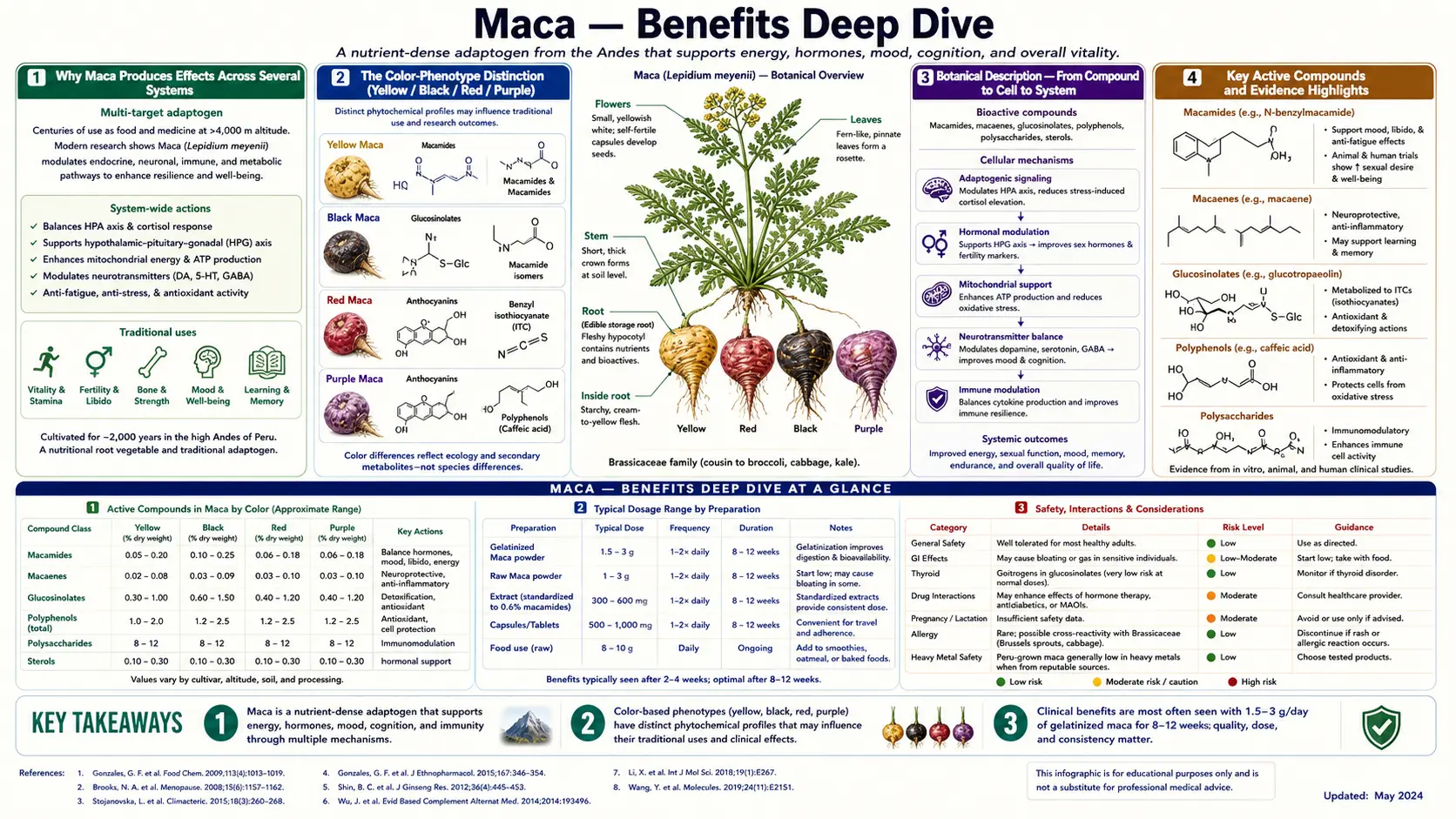
Maca (Lepidium meyenii) is a Peruvian Andean cruciferous root cultivated for at least two thousand years on the harsh Junin Plateau at altitudes above 13,000 feet — one of the very few food crops that thrives in that extreme UV, freezing nights, and thin-oxygen environment. Botanically a relative of radish and turnip, Maca produces a unique class of polar lipid amides (macamides and macaenes) found in no other known plant, plus glucosinolates, sterols, and unusually high mineral density. Crucially, Maca appears in four distinct color phenotypes — yellow, black, red, and purple — that share the species name but differ measurably in alkaloid and macamide profile, so the color is a treatment-relevant variable: black is the phenotype most consistently associated with libido and sperm parameters in trials, red with prostate and bone effects, yellow is the general-purpose tonic. Four benefit pages below explore the conditions where Maca produces the largest documented clinical effect — libido and sexual function, peri- and postmenopausal hormonal balance, energy and physical endurance, and mood and cognition.
Deep-Dive Articles
Libido & Sexual Function
The Gonzales 2002 men's trial (1.5–3 g/day raised subjective libido by week 8 without changing testosterone), the Gonzales 2010 women's trial, the Shin 2010 BMC Complementary Medicine systematic review, the macamides + macaenes hypothesis as putative active class, the contrast with conventional hormonal supplements (Maca is a sexual modulator that does NOT bind androgen or estrogen receptors), and practical dosing of 1.5–3 g/day of the black phenotype.
Hormonal Balance & Menopause
The Meissner 2006 and 2008 trials on postmenopausal symptom relief, the critical safety distinction that Maca has no direct estrogenic activity (unlike soy isoflavones or black cohosh) — making it appropriate for women with hormone-sensitive cancers where phytoestrogens are contraindicated, secondary thyroid effects in some trials, and the HPA / HPO axis modulation hypothesis as the working mechanism.
Energy & Endurance
Traditional Peruvian use as an altitude-tolerance staple at 13,000+ ft, the Stone 2009 cycling time-trial study, the iron and B-vitamin nutritional contribution to baseline energy, mitochondrial-mechanism speculation, and the practical distinction between dose-range for endurance (typically 1.5–3 g/day chronic) versus strength / acute performance contexts.
Mood & Cognitive Function
The Brooks 2008 postmenopausal anxiety and depression trial, the BDNF and serotonin working hypotheses, the memory data in rodent models (Rubio scopolamine reversal), and the appropriate clinical framing as an adjunct to SSRIs and other first-line antidepressants — not a replacement for them. Maca's mood effect is real but modest in magnitude.
Table of Contents
- Deep-Dive Articles
- Why Maca Produces Effects Across Several Systems
- The Color-Phenotype Distinction (Yellow / Black / Red / Purple)
- Key Research Papers
- External Authoritative Resources
- Connections
- Featured Videos
Why Maca Produces Effects Across Several Systems
Most herbal "adaptogens" with broad system effects act through a single dominant mechanism — ginseng through ginsenoside steroid analogs, ashwagandha through withanolide cortisol modulation, rhodiola through the rosavin / salidroside catecholamine pathway. Maca is unusual because its dominant mechanism is almost certainly not hormonal mimicry. Multiple high-quality in vitro receptor-binding studies have specifically tested Maca extracts at concentrations far above physiologic and found no measurable binding to androgen, estrogen, or progesterone receptors, and no aromatase or 5-alpha-reductase inhibition. Yet clinical trials reproducibly show libido, energy, mood, and menopausal-symptom benefit.
The working mechanistic hypothesis — and it remains a hypothesis — is that Maca acts upstream of the endocrine axes, at the level of the hypothalamus and pituitary, modulating the regulatory tone of the HPA (hypothalamic-pituitary-adrenal) and HPG (hypothalamic-pituitary-gonadal) axes without directly mimicking any downstream hormone. The proposed mediators are:
- Macamides — a class of polar lipid amides (N-benzylpalmitamide, N-benzyloleamide, N-benzyllinoleamide, and related structures) found in no other known plant. Macamides are structural cousins of the endocannabinoid anandamide, and several macamides have been shown in vitro to inhibit fatty acid amide hydrolase (FAAH), the enzyme that degrades anandamide. The implication is that Maca may potentiate endogenous endocannabinoid tone, which in turn modulates HPA stress response, mood, and sexual function.
- Macaenes — a closely related class of unsaturated fatty acids unique to Maca, often discussed alongside macamides as the "M+M" markers in commercial extract standardization.
- Glucosinolates — the cruciferous-family sulfur-containing compounds (Maca is a member of Brassicaceae, related to broccoli and radish) hydrolyzed to isothiocyanates by myrosinase. Maca's glucosinolate profile (benzyl glucosinolate is dominant) is distinctive among cruciferae but shares the broad anti-inflammatory and detoxification-supporting properties of the class.
- Sterols — beta-sitosterol, campesterol, ergosterol, and ergostadienol are present, and although these do not bind human sex hormone receptors with meaningful affinity, they may modulate cholesterol metabolism upstream of endogenous steroid synthesis.
- Mineral and B-vitamin density — Maca root contains unusually high concentrations of iron, calcium, magnesium, zinc, copper, and B vitamins for a tuberous food. Part of the chronic "energy" benefit may be straightforward micronutrient repletion in deficient individuals, separate from any pharmacologic effect.
This is fundamentally different from soy, black cohosh, DHEA, or pregnenolone — all of which contain compounds that bind sex hormone receptors directly. The distinction matters clinically: Maca is appropriate to discuss with patients who are contraindicated for phytoestrogens — for example, women with hormone-receptor-positive breast cancer, endometriosis, or estrogen-sensitive fibroids — because there is no plausible mechanism by which Maca would feed a receptor-driven tumor or condition. See the Hormonal Balance and Menopause deep-dive for the detailed safety reasoning.
The complication is that this mechanistic flexibility means Maca's effect size in any individual is hard to predict from biomarkers. Unlike testosterone replacement, where you can measure serum testosterone, dose to target, and observe the symptom response, Maca's endpoints are entirely symptomatic. The clinical trial literature reflects this — most positive trials use self-report scales (sexual function, menopausal symptom scores, mood inventories), and a smaller body of trials measuring actual hormone levels typically finds no change in testosterone, estrogen, or progesterone.
The Color-Phenotype Distinction (Yellow / Black / Red / Purple)
Maca root color is a treatment-relevant variable that most Western marketing has obscured. Traditional Andean farmers have always distinguished the phenotypes, planting and selling them separately for different indications. Modern phytochemical analysis confirms that the colors differ measurably in macamide concentration, glucosinolate profile, and sterol content — even when grown side by side in the same field, meaning the differences are heritable (genetic) rather than environmental.
- Yellow Maca — the most common phenotype, ~60–70% of any unsorted harvest. The "general purpose" tonic. Used for routine energy and endurance support. Most commercial Maca powder sold as unspecified is predominantly yellow. Yellow is the phenotype to start with for general fatigue, low motivation, or any non-specific tonic indication.
- Black Maca — the phenotype most consistently associated with libido and sperm parameters in the controlled trials. The 2001 Gonzales men's sperm trial used black Maca and found increased sperm count and motility. The 2006 Gonzales et al. sperm trial again used black and reproduced the effect. Black contains the highest measured macamide concentration of the four colors. If the indication is libido, fertility, or male sexual function specifically, black is the phenotype to use.
- Red Maca — the phenotype associated with prostate and bone effects. The 2005 Gonzales rat study comparing yellow, red, and black for benign prostatic hyperplasia found that only red reduced testosterone-enanthate-induced prostate weight. A 2006 follow-up extended this finding. Red Maca has also been studied (less robustly) for bone density in ovariectomized rodents. If the indication is BPH, prostate health, or postmenopausal bone support, red is the rational choice.
- Purple Maca — the rarest phenotype, often overlapping in chemistry with red. Less studied. Sometimes marketed as a separate fourth color but in practice frequently sold mixed with red.
The practical implication: when choosing a Maca product for a specific indication, the color matters at least as much as the dose. Buying "Maca powder" without color specification means buying predominantly yellow, which is fine for general tonic use but may underperform for libido (where black is the evidence base) or BPH (where red is the evidence base). High-quality suppliers will specify the color, the origin (Junin Plateau vs. lowland cultivation, which dramatically affects active compound concentration), and ideally the macamide content.
One additional preparation variable: gelatinized Maca has been gently heated to break down starches, which improves digestibility and tolerance for people who experience bloating with raw Maca. Gelatinization does not destroy macamides or glucosinolates at the temperatures used. Most clinical trials have used either raw or gelatinized preparations interchangeably without clear differences in outcome, but tolerance is typically better with gelatinized.
Key Research Papers
- Gonzales GF et al. (2002). Effect of Lepidium meyenii (MACA) on sexual desire and its absent relationship with serum testosterone levels in adult healthy men. Andrologia, 34(6):367-372. — PubMed
- Shin BC, Lee MS, Yang EJ, Lim HS, Ernst E (2010). Maca (L. meyenii) for improving sexual function: a systematic review. BMC Complementary and Alternative Medicine, 10:44. — PubMed
- Meissner HO et al. (2006). Hormone-balancing effect of pre-gelatinized organic Maca: (I) Biochemical and pharmacodynamic study on Maca using clinical laboratory model on ovariectomized rats. International Journal of Biomedical Science, 2(3):260-272. — PubMed
- Brooks NA et al. (2008). Beneficial effects of Lepidium meyenii (Maca) on psychological symptoms and measures of sexual dysfunction in postmenopausal women are not related to estrogen or androgen content. Menopause, 15(6):1157-1162. — PubMed
- Stone M et al. (2009). A pilot investigation into the effect of maca supplementation on physical activity and sexual desire in sportsmen. Journal of Ethnopharmacology, 126(3):574-576. — PubMed
External Authoritative Resources
- PMC — Maca: An Andean Crop with Multi-Pharmacological Functions (Wang 2007 review) — the most-cited Western-literature overview of Maca phytochemistry and pharmacology
- PMC — Ethnobiology and Ethnopharmacology of Lepidium meyenii (Gonzales 2012) — comprehensive review of the traditional use, color-phenotype distinctions, and clinical evidence
- MedlinePlus — Maca (Natural Medicines monograph)
- PubMed — All Maca / Lepidium meyenii research (~600+ papers)
- USDA FoodData Central — Maca root nutritional composition (search "maca")
Connections
- All Herbs
- Maca (Main Page)
- Maca for Libido and Sexual Function
- Maca for Hormonal Balance & Menopause
- Maca for Energy and Endurance
- Maca for Mood and Cognitive Function
- Ashwagandha
- Ginseng
- Rhodiola Rosea
- Holy Basil
- Black Cohosh
- Hormone Panel
- Testosterone Test
- Fatigue
- Stress Management
- Iron
- Zinc
- Calcium